X-ray imaging and finite element analysis of the L6-S1 intervertebral disc in rats under abnormal forward-flexed posture
Authors: HE Miao, WU Gang, ZHANG Xuxing
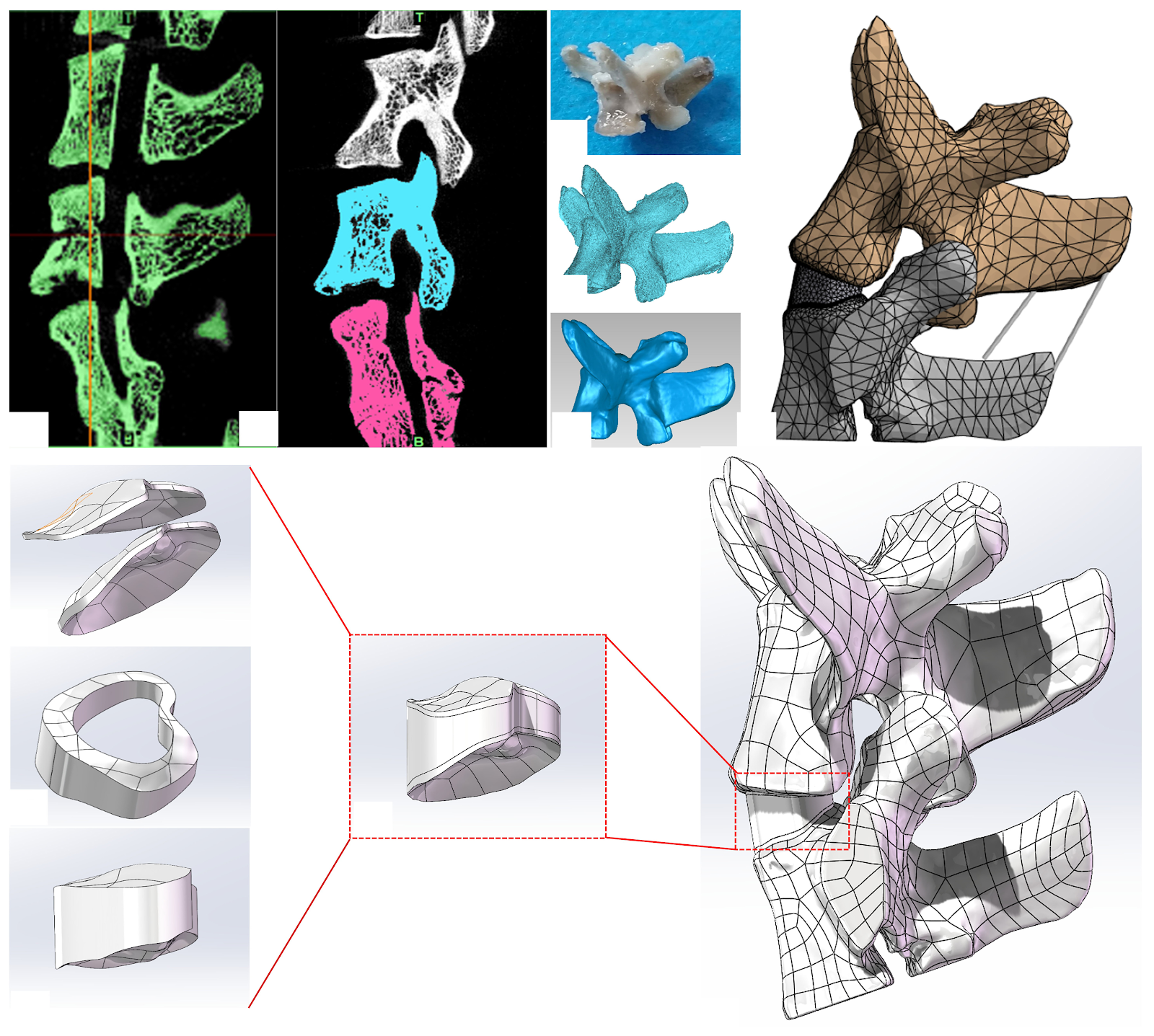
BACKGROUND: Our group developed a rat lumbar spine model inducing L6-S1 segmental degeneration by prolonged fixation in an abnormal forward-bending posture through a specific device. However, biomechanical evaluation of this model remains lacking. OBJECTIVE: To evaluate the biomechanical properties of L6-S1 motion segment in rats with abnormal forward bending posture through X-ray verification and finite element analysis. METHODS: This study utilized a previously established SD rat model of abnormal forward-flexed posture. Lateral X-ray images of three healthy female SD rats were taken in both restrained (unanesthetized) and relaxed (anesthetized) states to measure the L6-S1 disc angle and analyze its changes under different postures. Micro-CT data from one healthy female SD rat were used to reconstruct a 3D L6-S1 model with Mimics, Geomagic Wrap, and SolidWorks. The model was then meshed, assigned material properties, and subjected to forward flexion loading simulation in ANSYS Workbench to calculate stress distribution in L6-S1 disc structures. RESULTS AND CONCLUSION: (1) The mean L6-S1 intervertebral disc angle was (12.16±0.57)° in relaxed posture and (1.26±0.26)° in restrained posture. (2) Under 10° forward flexion, the maximum von Mises stresses in the upper endplate, lower endplate, annulus fibrosus, and nucleus pulposus were 10.398, 19.928, 6.819, and 0.104 MPa, respectively, with endplates showing significantly higher stresses. (3) The forward-flexed posture reduced the L6-S1 disc angle, altering disc morphology and load distribution. The finite element model simulated the biomechanical environment under abnormal posture, indicating that endplates may be the earliest structures to undergo degenerative changes.