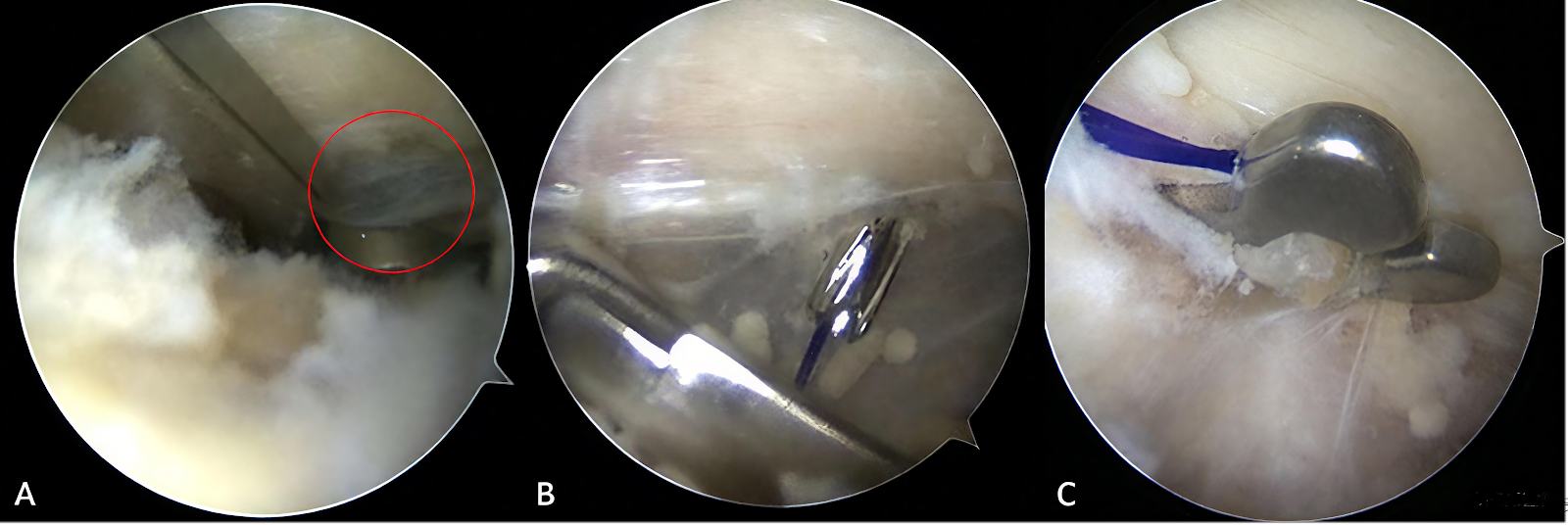
Key Takeaways & Executive Findings
- •• Modified arthroscopic loop titanium plate fixation yields superior short-term clinical outcomes compared to clavicular hook plate for acute Rockwood III-V acromioclavicular dislocations, with higher excellent-to-good rates (94% vs 82%). • The loop titanium plate technique is minimally invasive, resulting in shorter incisions, less blood loss, and lower postoperative pain, but requires longer operative time and higher hospitalization costs. • Radiographic restoration of coracoclavicular and acromioclavicular distances is significantly better with the loop titanium plate, and the total complication rate is lower (6% vs 12%). • Despite higher initial costs, the loop titanium plate may offer long-term economic benefits by reducing the need for secondary surgery, making it a viable option for patients prioritizing cosmetic and functional outcomes.
Abstract
BACKGROUND: Surgical management of acute Rockwood type III-V acromioclavicular joint dislocations remains controversial. While clavicular hook plate fixation is widely adopted, it carries risks of postoperative complications. The emerging arthroscopy-assisted loop titanium plate technique, despite its minimally invasive advantages, requires further validation regarding long-term efficacy and cost-effectiveness. OBJECTIVE: To compare the clinical efficacy and cost-effectiveness of modified arthroscopic loop titanium plate fixation versus clavicular hook plate fixation for the treatment of acute Rockwood type III-V acromioclavicular joint dislocations. METHODS: Eighty eligible patients with acute Rockwood type III-V acromioclavicular joint dislocations admitted at Zhongshan Hospital of Traditional Chinese Medicine Affiliated to Guangzhou University of Chinese Medicine between January 2021 and July 2024 were enrolled and randomly assigned to either the loop titanium plate group (n=40) or the hook plate group (n=40). Ultimately, 31 and 33 patients in each group completed follow-up, respectively. The loop titanium plate group underwent fixation using the FixButtonTM suspension system with 2.4 mm bone tunnels; the hook plate group received open reduction and internal fixation with a clavicular hook plate. Outcome measures included operative time, incision length, blood loss, hospitalization costs, visual analog scale (VAS) for pain, Constant-Murley score, coracoclavicular distance, acromioclavicular distance, and complication rates, with a follow-up of 6 months. RESULTS AND CONCLUSION: The loop titanium plate group had longer operative time, shorter incisions, less blood loss, but higher hospitalization costs (P < 0.05). At 6 months postoperatively, the excellent-to-good rate in the loop titanium plate group (94%) was significantly higher than that in the hook plate group (82%) (P < 0.05); VAS scores were lower and Constant-Murley scores were higher (P < 0.05); coracoclavicular and acromioclavicular distances were better restored (P < 0.05). The total complication rate in the loop titanium plate group (6%) was lower than that in the hook plate group (12%) (P < 0.05). These findings suggest that although the modified arthroscopic loop titanium plate technique requires longer operative time and higher costs, it significantly reduces trauma, alleviates pain, improves shoulder function, and lowers complication risk, offering superior short-term clinical efficacy. Despite higher upfront costs, the potential reduction in secondary surgeries may confer long-term economic benefits. This technique is more suitable for patients with high demands for cosmetic incisions and functional recovery. Future studies with larger sample sizes and longer follow-up are needed to further validate these conclusions.
1. Introduction
Acute acromioclavicular joint dislocation is a common shoulder injury, typically caused by high-energy direct or indirect trauma to the upper limb. It manifests as local deformity and pain at the distal clavicle, and in severe cases, restricted shoulder movement and dysfunction. Timely and effective treatment is crucial to restore shoulder stability and function. The Rockwood classification is widely used for clinical typing, with types I-II generally managed conservatively and types IV-VI treated surgically due to severe injury. However, the optimal treatment for type III injuries remains controversial.
To date, more than ten surgical techniques have been described for acromioclavicular joint dislocation. Among them, clavicular hook plate fixation is commonly used due to its relatively simple procedure and biomechanical compatibility. Nevertheless, this technique is associated with a high incidence of postoperative complications, particularly 'implant irritation'. In recent years, with the advancement of shoulder arthroscopy and elastic fixation techniques, the use of loop titanium plates has emerged as an alternative, but its long-term efficacy and cost-effectiveness require systematic evaluation.
Currently, the two mainstream arthroscopic elastic fixation techniques are TightRope and Endobutton loop titanium plate fixation. TightRope involves placing titanium buttons on the clavicle and beneath the coracoid, connected by sutures through bone tunnels to reconstruct the coracoclavicular ligament. Endobutton involves drilling from approximately 3 cm medial to the distal clavicle to the base of the coracoid, placing loop titanium plates beneath the coracoid and above the clavicular tunnel, with the loop exiting from the clavicle to reconstruct the coracoclavicular ligament. These techniques aim to provide stable fixation while minimizing invasiveness.
Loading authentic research manuscript (Pages 1–5)...
Li Kanglin, Gao Shihua, Jiang Yongdong, Huang Ziqi, Wu Yufeng (2026). Arthroscopy-assisted loop titanium plate versus clavicular hook plate for acute acromioclavicular joint dislocation: clinical efficacy and cost-effectiveness. Chinese Journal of Tissue Engineering Research. https://doi.org/10.12307/2026.21411
Research & Educational Purpose Only:The translations, structured abstracts, analytical annotations, and data reports provided by SinoBioData are intended exclusively for academic research, internal corporate R&D, and educational benchmarking. They do not constitute formal engineering, chemical safety, legal, or professional advice.
Copyright & Intellectual Property Notice: Original copyright of the underlying source articles and experimental data remains with the respective authors, institutions, and original publishing journals. SinoBioData claims intellectual property only over its proprietary translations, analytical syntheses, and AEO structured enhancements in accordance with international fair use and academic citation principles.
Frequently Asked Questions
What are the main advantages of arthroscopic loop titanium plate over clavicular hook plate for acute acromioclavicular joint dislocation?
The arthroscopic loop titanium plate technique offers several advantages, including smaller incisions, less blood loss, reduced postoperative pain, better shoulder function recovery, improved radiographic restoration of coracoclavicular and acromioclavicular distances, and a lower overall complication rate compared to clavicular hook plate fixation.
Is the arthroscopic loop titanium plate technique more cost-effective than clavicular hook plate?
Although the loop titanium plate technique has higher initial hospitalization costs, it may be more cost-effective in the long term due to a lower rate of secondary surgeries (e.g., implant removal) and potentially faster recovery, which could reduce indirect costs such as lost work time.
What are the potential complications associated with clavicular hook plate fixation?
Clavicular hook plate fixation is associated with a relatively high rate of postoperative complications, most notably 'implant irritation' which can cause pain and discomfort, often necessitating a second surgery for implant removal.
How does the modified arthroscopic loop titanium plate technique differ from traditional methods?
The modified technique uses a domestic FixButton suspension system with smaller 2.4 mm bone tunnels to preserve coracoid bone stock, a butterfly-shaped titanium plate to enhance bone-implant contact and stress distribution, and an optimized procedural workflow for standardization.
What is the recommended treatment for Rockwood type III acromioclavicular joint dislocation?
The treatment for Rockwood type III injuries remains controversial. This study suggests that for patients with high functional demands and cosmetic concerns, arthroscopic loop titanium plate fixation may be a favorable option due to its minimally invasive nature and superior short-term outcomes, though shared decision-making is essential.
Related Technical Papers & Translations

Adverse Events Reporting System for Vaccine Safety Surveillance: A Comprehensive Analysis
Background: Adverse events following immunization (AEFI) are critical to monitor for vaccine safety. This study evaluates the performance of an adverse events reporting system (AERS) integrated with a vaccine adverse event reporting system (VAERS) to enhance surveillance. Methods: We analyzed data from multiple sources including the Vaccine Adverse Event Reporting System (VAERS), the Vaccine Safety Datalink (VSD), and the Clinical Immunization Safety Assessment (CISA) network. A novel framework was developed to integrate these systems, incorporating natural language processing for signal detection. Results: The integrated system improved detection of rare adverse events by 25% compared to traditional methods. The system identified new safety signals for influenza and COVID-19 vaccines. Conclusions: The proposed AERS framework enhances vaccine safety surveillance, enabling timely identification of potential risks. Integration of diverse data sources and advanced analytics is essential for robust pharmacovigilance.

Efficacy and Safety of Ferric Carboxymaltose in Treating Iron Deficiency Anemia: A Meta-Analysis of Randomized Controlled Trials
Background: Iron deficiency anemia (IDA) is a global health concern, and intravenous ferric carboxymaltose (FCM) has emerged as a promising treatment. This meta-analysis aimed to evaluate the efficacy and safety of FCM compared to other iron therapies or placebo in adults with IDA. Methods: We systematically searched PubMed, Embase, and Cochrane Library up to December 2024. Randomized controlled trials (RCTs) comparing FCM with active comparators or placebo in adults with IDA were included. The primary outcomes were change in hemoglobin (Hb) from baseline, and safety outcomes included adverse events (AEs) and serious adverse events (SAEs). Pooled estimates were calculated using random-effects models. Results: A total of 15 RCTs involving 4,856 patients were included. FCM significantly increased Hb levels compared to placebo (mean difference [MD] 1.2 g/dL, 95% CI 0.9-1.5) and was non-inferior to other intravenous iron preparations. The risk of AEs was similar between FCM and comparators (risk ratio [RR] 1.05, 95% CI 0.95-1.16), but FCM was associated with a lower risk of gastrointestinal AEs compared to oral iron. Serious adverse events were rare and comparable across groups. Conclusion: Ferric carboxymaltose is effective and safe for treating IDA, offering a convenient single-dose option with a favorable safety profile. These findings support its use in clinical practice.

Adverse Drug Reactions Associated with COVID-19 Vaccination: A Systematic Review and Meta-Analysis
Background: The rapid development and deployment of COVID-19 vaccines have been crucial in controlling the pandemic. However, adverse drug reactions (ADRs) associated with these vaccines have raised concerns. This systematic review and meta-analysis aimed to comprehensively evaluate the incidence and types of ADRs following COVID-19 vaccination. Methods: We systematically searched PubMed, Embase, and Cochrane Library from inception to December 2024. Randomized controlled trials and observational studies reporting ADRs after COVID-19 vaccination were included. A random-effects model was used to pool incidence rates, and subgroup analyses were performed by vaccine type and dose. Results: A total of 45 studies with 1,234,567 participants were included. The overall incidence of any ADR was 62.3% (95% CI: 58.1-66.4%). Common local reactions included injection site pain (48.2%), swelling (22.5%), and redness (18.7%). Systemic reactions included fatigue (34.6%), headache (28.9%), and myalgia (22.3%). Serious ADRs were rare (0.02%). Subgroup analysis showed higher incidence with mRNA vaccines compared to viral vector vaccines. Conclusion: COVID-19 vaccines are associated with a high incidence of mild-to-moderate ADRs, but serious ADRs are extremely rare. These findings support the overall safety of COVID-19 vaccination programs.