Acta Biochimica et Biophysica Sinica
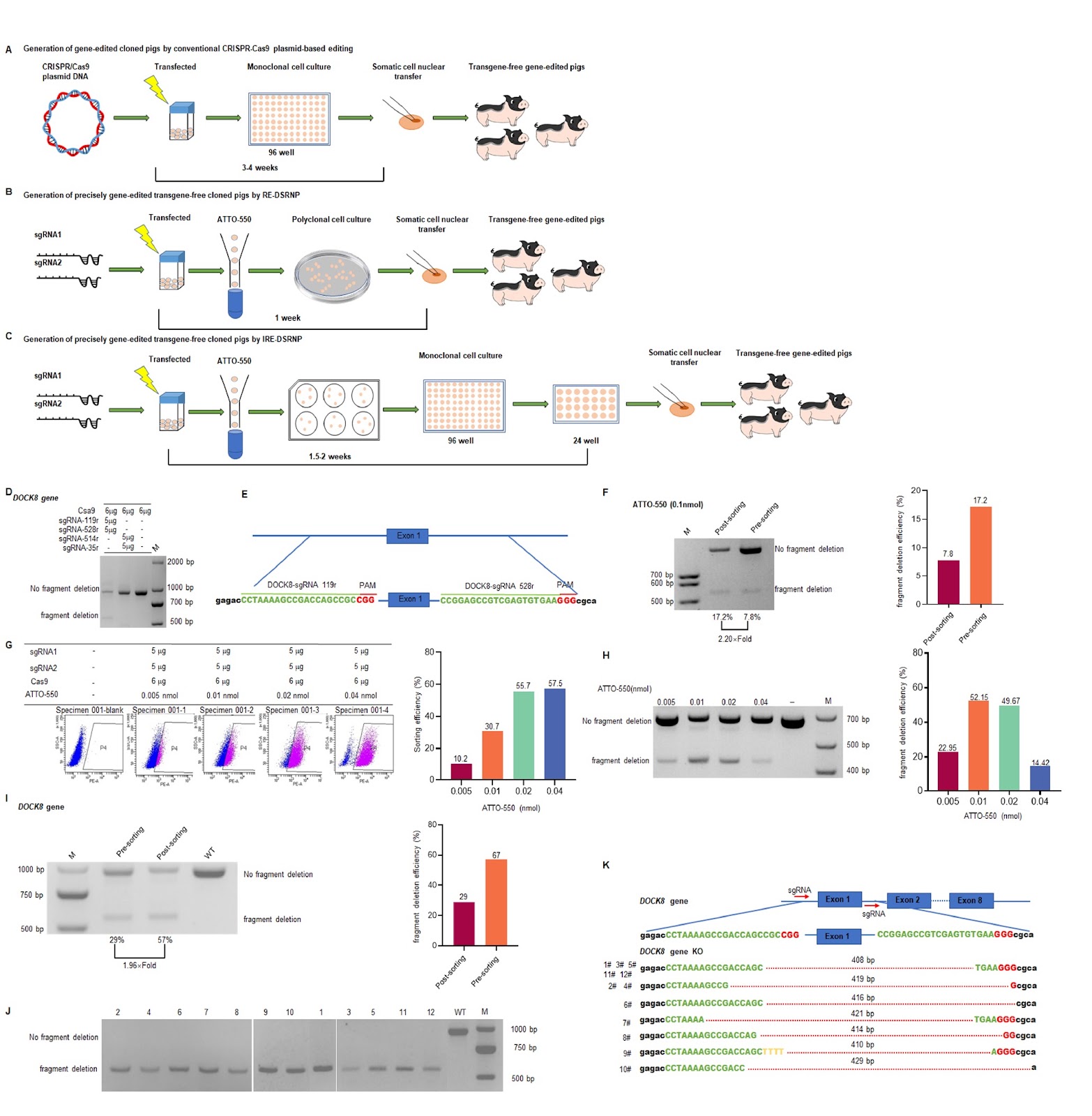
Pigs, as crucial economic livestock species, possess remarkable reproductive traits and thus play a highly significant role in promoting the progress of the livestock industry. With the advent and application of CRISPR/Cas9 technology, researchers have explored genetic editing techniques to increase swine reproductive performance, flavour profiles, and nutritional attributes. Additionally, with respect to anatomy, physiology, immunology, and genomics as well as other traits, pigs exhibit remarkable similarities to humans. Genetically edited pigs play crucial roles in human disease models, xenotransplantation, breed improvement, vaccine development, and drug assessment. Common methods deployed in the preparation of genetically edited pigs include somatic cell nuclear transfer (SCNT), microinjection and sperm-mediated approaches. For example, Shen et al. [1] successfully generated P53-knockout Diannan miniature pigs using transcription activator-like effector nucleases combined with SCNT, offering a valuable resource for preclinical oncology research. In 2019, Chen et al. [2] employed microinjection to deliver Cas9 messenger ribonucleic acid (mRNA) and single guide ribonucleic acid (sgRNA) into the cytoplasm of fertilized eggs. These authors successfully obtained both the albinism phenotype and the combined phenotype of albinism and immunodeficiency in Tibetan miniature pigs. More recently, Tenihara et al. [3] introduced the CRISPR/Cas9 protein into fertilized porcine eggs via electroporation, enabling a simple, micromanipulation-free approach for generating gene-edited pigs. Among these methods, SCNT has gained extensive interest among researchers because of its reliability. An essential aspect of SCNT is the preparation of embryonic fibroblasts to serve as donor cells. Previously, the CRISPR/Cas9 plasmid editing system served as the predominant technique to generate genetically edited embryonic fibroblasts (Figure 1A) [4]. This approach, which is distinguished by its relative simplicity, high stability, and low cost, was formerly widely utilized in the production of gene-edited pigs. However, plasmid editing is associated with several notable limitations. First, it introduces resistance genes, posing risks of inaccurate gene editing, drug resistance and biosafety concerns. Second, during the CRISPR/Cas9 editing process, there is a possibility of ongoing editing due to deoxyribonucleic acid (DNA) integration. This continuous editing can increase the likelihood of off-target effects, random mutations, and interference with DNA repair mechanisms. Third, the acquisition of positive cell lines via the plasmid editing system typically demands an extended period of in vitro cultivation (lasting 3–4 weeks), which increases the risk of apoptosis and chromosomal aberrations. Consequently, plasmid-based transfection is now largely supplanted by ribonucleoprotein (RNP) systems for gene editing. RNP systems bypass plasmids, delivering the Cas9 protein and sgRNA directly into cells, reducing off-target effects and cytotoxicity [5]. In 2022, Xu et al. [6] developed the reporter RNA-enriched dual-sgRNA CRISPR/Cas9 ribonucleoprotein (RE-DSRNP) method, a transgene-free approach using CRISPR/Cas9 RNPs enriched with ATTO550-tracrRNA (IDT, Iowa, USA) as a fluorescent RNA probe (Figure 1B). This method reduced the time needed to generate donor cells from 3-4 weeks to one week, resulting in high-efficiency WIP1 gene knockouts and the production of pigs with male reproductive disorders. However, owing to genetic diversity, not all target genes achieve 95% editing efficiency, as demonstrated by the RE-DSRNP method, with some falling below 90%. For example, DOCK8, which belongs to the DOCK family, is an atypical guanine nucleotide exchange factor that plays a crucial role in immune responses. DOCK8 deficiency syndrome, a rare hereditary disorder, often leads to combined immunodeficiency and is characterized by elevated serum immunoglobulin E levels, increased eosinophil
 Graphical AbstractOpen Access