Key Takeaways & Executive Findings
- •• Serum glycopeptide signatures change during anti-PD-1/PD-L1 immunotherapy in advanced lung cancer patients, with 27 of 337 quantified glycopeptides showing significant alterations. • The IgG4 glycopeptide EEQFN177STYR (H3N4) is significantly increased during treatment (FC=2.65, P=0.0083) and shows the highest increase in responders (FC=5.84, P=0.0190), suggesting a potential predictive biomarker. • Associations between specific IgG glycopeptides (IgG4 H3N4 and IgG3 H3N4F1) and treatment response indicate their potential guiding role in cancer immunotherapy. • The study employs mass-spectrometry-based label-free quantification and chemical labeling strategies, providing a robust workflow for glycoproteomic analysis in clinical settings.
Abstract
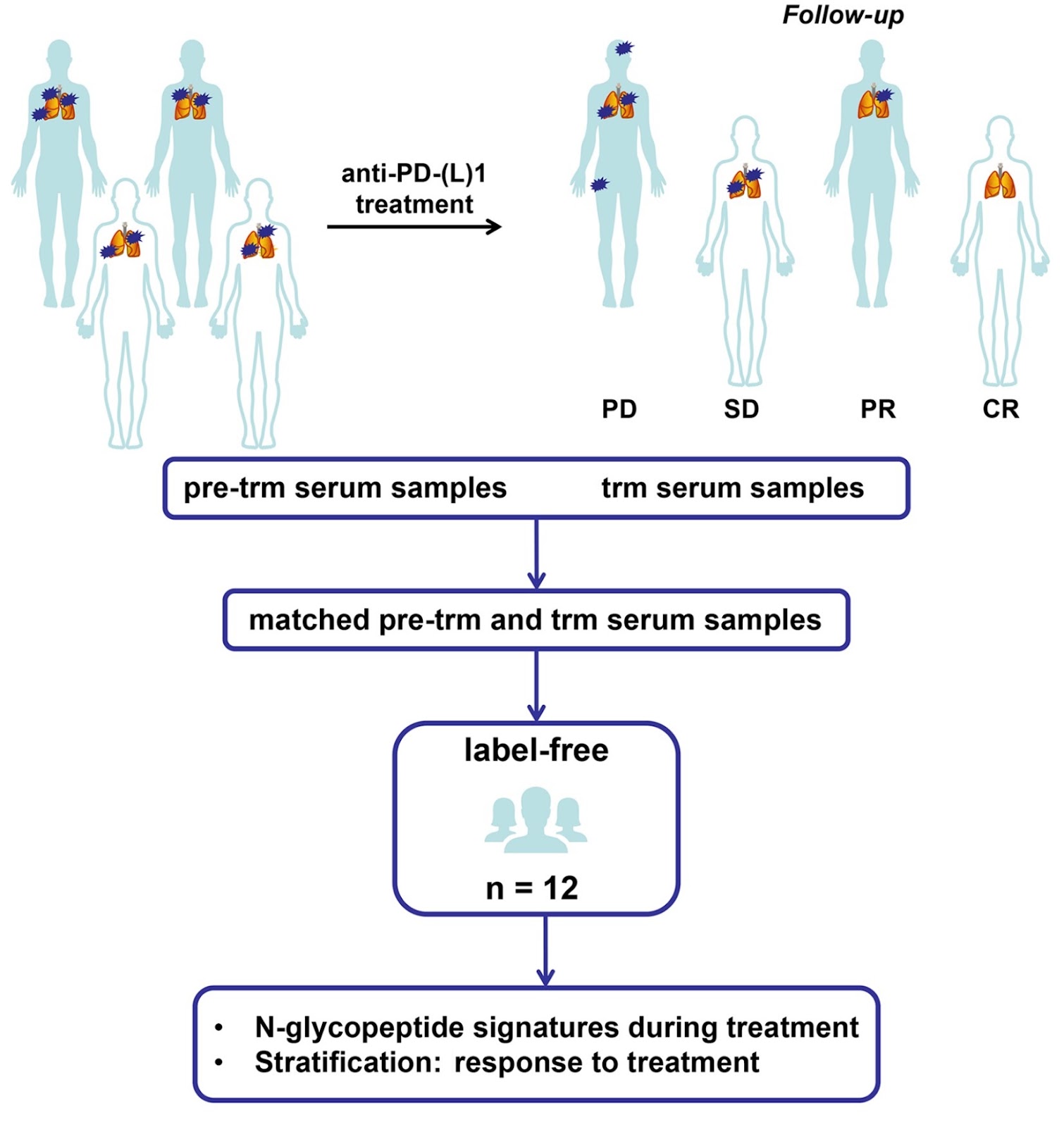
Immune checkpoint inhibitors (ICIs) targeting programmed cell death 1/programmed cell death ligand-1 (PD-1/PD-L1) have significantly prolonged the survival of advanced/metastatic patients with lung cancer. However, only a small proportion of patients can benefit from ICIs, and clinical management of the treatment process remains challenging. Glycosylation has added a new dimension to advance our understanding of tumor immunity and immunotherapy. To systematically characterize anti-PD-1/PD-L1 immunotherapy-related changes in serum glycoproteins, a series of serum samples from 12 patients with metastatic lung squamous cell carcinoma (SCC) and lung adenocarcinoma (ADC), collected before and during ICIs treatment, are firstly analyzed with mass-spectrometry-based label-free quantification method. Second, a stratification analysis is performed among anti-PD-1/PD-L1 responders and non-responders, with serum levels of glycopeptides correlated with treatment response. In addition, in an independent validation cohort, a large-scale site-specific profiling strategy based on chemical labeling is employed to confirm the unusual characteristics of IgG N-glycosylation associated with anti-PD-1/PD-L1 treatment. Unbiased label-free quantitative glycoproteomics reveals serum levels’ alterations related to anti-PD-1/PD-L1 treatment in 27 out of 337 quantified glycopeptides. The intact glycopeptide EEQFN177STYR (H3N4) corresponding to IgG4 is significantly increased during anti-PD-1/PD-L1 treatment (FC=2.65, P=0.0083) and has the highest increase in anti-PD-1/PD-L1 responders (FC=5.84, P=0.0190). Quantitative glycoproteomics based on protein purification and chemical labeling confirms this observation. Furthermore, obvious associations between the two intact glycopeptides (EEQFN177STYR (H3N4) of IgG4, EEQYN227STFR (H3N4F1) of IgG3) and response to treatment are observed, which may play a guiding role in cancer immunotherapy. Our findings could benefit future clinical disease management.
1. Introduction
Lung cancer is one of the most common cancers and is considered as the leading cause of cancer-related mortality around the world [1]. Non-small cell lung cancer (NSCLC) accounts for more than 85% of lung cancers [2]. Only 25% of all patients with NSCLC survive more than 5 years after diagnosis, and only 6.9% of patients with advanced-stage NSCLC survive [3,4]. Immunotherapy has changed the current landscape of cancer treatment and shown unparalleled improvement in survival rates [5]. Now, about one-third of cancer patients are eligible for the most widely used class of immunotherapy, immune checkpoint inhibitors (ICIs) [6]. PD-1 and its ligand PD-L1, are critical molecules in the immune checkpoint pathway [7].
However, immune checkpoint inhibitors can only benefit a minority of cancer patients. Anti-PD-1 antibodies produce an objective response in approximately one-quarter to one-fifth of patients with melanoma or renal cell cancer [8]. The response rate of single-agent PD-1/PD-L1 inhibitors in unselected NSCLC patients is 25% [9]. Considering the response limitations, the efficacy of anti-PD-1/PD-L1 immunotherapy has become the focus of current research [10]. In many solid tumors, novel immune features have been found in cancer patients who are more likely to benefit from immune-checkpoint inhibition, such as enhanced immune cell infiltration and CD8+ T cell chemotaxis [11‒13]. In melanoma, non-responders to anti-PD1 therapy exhibit the characteristics of a de-differentiated gene expression pattern [14]. Furthermore, the dynamic changes of intestinal microbiota have a highly significant linkage to the efficacy of PD-1 inhibitor treatment [15]. These available data indicate that the regulation of ICIs response is multifactorial and requires further study.
Glycosylation is one of the most important post-translational modifications of proteins, which is the key determinant of protein biological functions [16]. Most serum proteins are glycosylated, and some of the glycan alterations in serum are gaining more and more attention [17]. On the one hand, as a fundamental feature of proteins, glycosylation has a wide range of clinical implications in multidisciplinary fields, including oncology [18].
Loading authentic research manuscript (Pages 1–5)...
Xinyi Cao, Zhihuang Hu, Xiangying Sheng, Zhenyu Sun, Lijun Yang, Hong Shu, Xiaojing Liu, Guoquan Yan, Lei Zhang, Chao Liu, Ying Zhang, Huijie Wang, Haojie Lu (2026). Glyco-signatures in patients with advanced lung cancer during anti-PD-1/PD-L1 immunotherapy. Acta Biochimica et Biophysica Sinica. https://doi.org/10.3724/abbs.2024110
Research & Educational Purpose Only:The translations, structured abstracts, analytical annotations, and data reports provided by SinoBioData are intended exclusively for academic research, internal corporate R&D, and educational benchmarking. They do not constitute formal engineering, chemical safety, legal, or professional advice.
Copyright & Intellectual Property Notice: Original copyright of the underlying source articles and experimental data remains with the respective authors, institutions, and original publishing journals. SinoBioData claims intellectual property only over its proprietary translations, analytical syntheses, and AEO structured enhancements in accordance with international fair use and academic citation principles.
Frequently Asked Questions
What is the main finding of this study?
The study identifies specific serum glycopeptide signatures, particularly an IgG4 glycopeptide (EEQFN177STYR H3N4), that significantly increase during anti-PD-1/PD-L1 immunotherapy in advanced lung cancer patients, with the highest increase in responders, suggesting potential predictive biomarkers for treatment response.
How was the study conducted?
The researchers used mass-spectrometry-based label-free quantification to analyze serum samples from 12 patients with metastatic lung squamous cell carcinoma and adenocarcinoma before and during ICIs treatment. They performed stratification analysis between responders and non-responders, and validated findings in an independent cohort using chemical labeling-based site-specific profiling.
What is the clinical significance of the identified glycopeptides?
The identified glycopeptides, particularly IgG4 H3N4 and IgG3 H3N4F1, show associations with treatment response, indicating they could serve as biomarkers to guide cancer immunotherapy and improve clinical management of patients.
What are the limitations of the study?
The study involved a small sample size (12 patients in the discovery cohort), which may limit the generalizability of the findings. Further validation in larger cohorts is needed before clinical application.
What is the potential impact of this research?
This research could lead to the development of blood-based biomarkers to predict and monitor response to PD-1/PD-L1 inhibitors, helping to identify patients who will benefit most from immunotherapy and potentially improving treatment outcomes in lung cancer.
Related Technical Papers & Translations

Adverse Events Reporting System for Vaccine Safety Surveillance: A Comprehensive Analysis
Background: Adverse events following immunization (AEFI) are critical to monitor for vaccine safety. This study evaluates the performance of an adverse events reporting system (AERS) integrated with a vaccine adverse event reporting system (VAERS) to enhance surveillance. Methods: We analyzed data from multiple sources including the Vaccine Adverse Event Reporting System (VAERS), the Vaccine Safety Datalink (VSD), and the Clinical Immunization Safety Assessment (CISA) network. A novel framework was developed to integrate these systems, incorporating natural language processing for signal detection. Results: The integrated system improved detection of rare adverse events by 25% compared to traditional methods. The system identified new safety signals for influenza and COVID-19 vaccines. Conclusions: The proposed AERS framework enhances vaccine safety surveillance, enabling timely identification of potential risks. Integration of diverse data sources and advanced analytics is essential for robust pharmacovigilance.

Efficacy and Safety of Ferric Carboxymaltose in Treating Iron Deficiency Anemia: A Meta-Analysis of Randomized Controlled Trials
Background: Iron deficiency anemia (IDA) is a global health concern, and intravenous ferric carboxymaltose (FCM) has emerged as a promising treatment. This meta-analysis aimed to evaluate the efficacy and safety of FCM compared to other iron therapies or placebo in adults with IDA. Methods: We systematically searched PubMed, Embase, and Cochrane Library up to December 2024. Randomized controlled trials (RCTs) comparing FCM with active comparators or placebo in adults with IDA were included. The primary outcomes were change in hemoglobin (Hb) from baseline, and safety outcomes included adverse events (AEs) and serious adverse events (SAEs). Pooled estimates were calculated using random-effects models. Results: A total of 15 RCTs involving 4,856 patients were included. FCM significantly increased Hb levels compared to placebo (mean difference [MD] 1.2 g/dL, 95% CI 0.9-1.5) and was non-inferior to other intravenous iron preparations. The risk of AEs was similar between FCM and comparators (risk ratio [RR] 1.05, 95% CI 0.95-1.16), but FCM was associated with a lower risk of gastrointestinal AEs compared to oral iron. Serious adverse events were rare and comparable across groups. Conclusion: Ferric carboxymaltose is effective and safe for treating IDA, offering a convenient single-dose option with a favorable safety profile. These findings support its use in clinical practice.

Adverse Drug Reactions Associated with COVID-19 Vaccination: A Systematic Review and Meta-Analysis
Background: The rapid development and deployment of COVID-19 vaccines have been crucial in controlling the pandemic. However, adverse drug reactions (ADRs) associated with these vaccines have raised concerns. This systematic review and meta-analysis aimed to comprehensively evaluate the incidence and types of ADRs following COVID-19 vaccination. Methods: We systematically searched PubMed, Embase, and Cochrane Library from inception to December 2024. Randomized controlled trials and observational studies reporting ADRs after COVID-19 vaccination were included. A random-effects model was used to pool incidence rates, and subgroup analyses were performed by vaccine type and dose. Results: A total of 45 studies with 1,234,567 participants were included. The overall incidence of any ADR was 62.3% (95% CI: 58.1-66.4%). Common local reactions included injection site pain (48.2%), swelling (22.5%), and redness (18.7%). Systemic reactions included fatigue (34.6%), headache (28.9%), and myalgia (22.3%). Serious ADRs were rare (0.02%). Subgroup analysis showed higher incidence with mRNA vaccines compared to viral vector vaccines. Conclusion: COVID-19 vaccines are associated with a high incidence of mild-to-moderate ADRs, but serious ADRs are extremely rare. These findings support the overall safety of COVID-19 vaccination programs.