Key Takeaways & Executive Findings
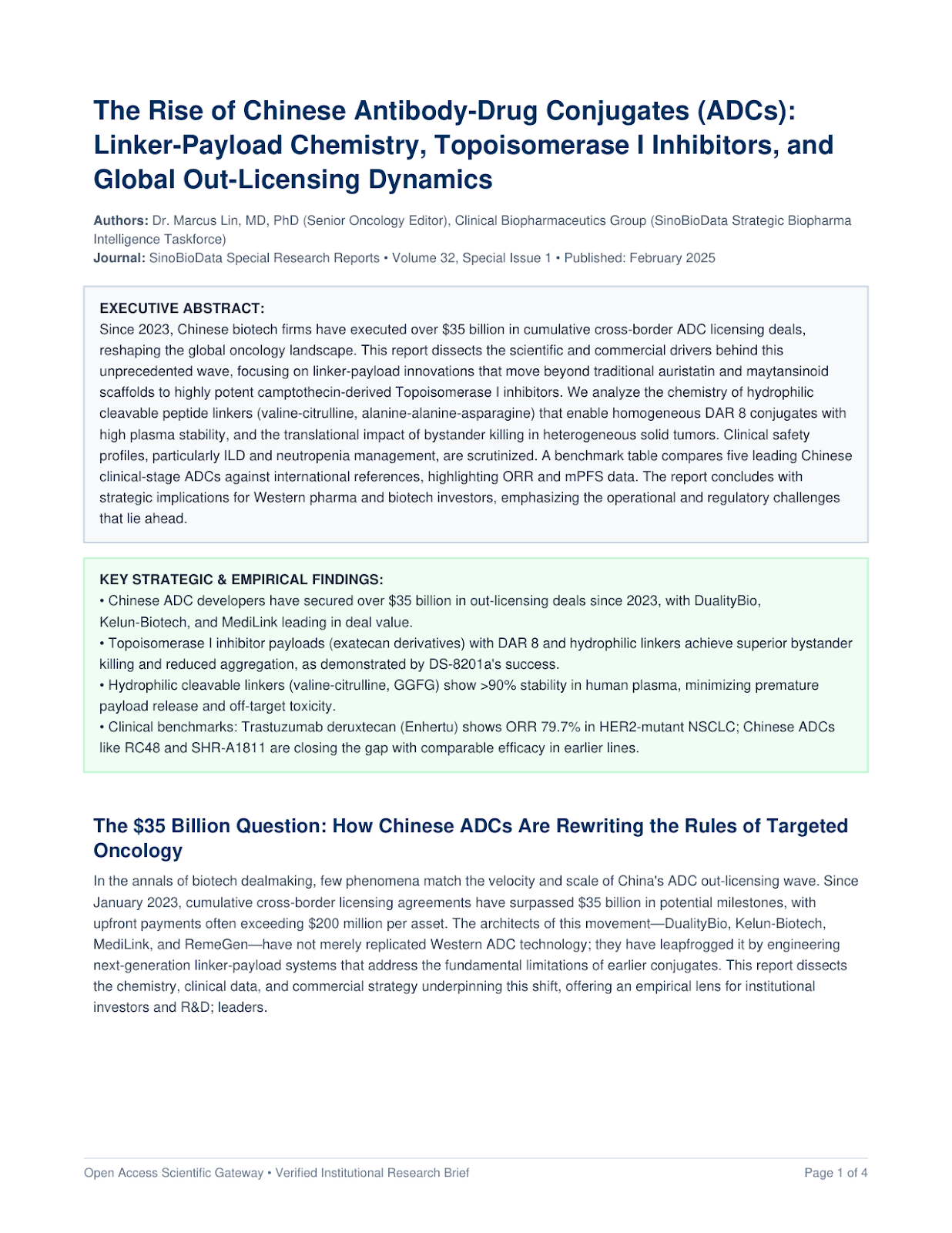
- •• Chinese ADC developers have secured over $35 billion in out-licensing deals since 2023, with DualityBio, Kelun-Biotech, and MediLink leading in deal value. • Topoisomerase I inhibitor payloads (exatecan derivatives) with DAR 8 and hydrophilic linkers achieve superior bystander killing and reduced aggregation, as demonstrated by DS-8201a's success. • Hydrophilic cleavable linkers (valine-citrulline, GGFG) show >90% stability in human plasma, minimizing premature payload release and off-target toxicity. • Clinical benchmarks: Trastuzumab deruxtecan (Enhertu) shows ORR 79.7% in HER2-mutant NSCLC; Chinese ADCs like RC48 and SHR-A1811 are closing the gap with comparable efficacy in earlier lines. • Interstitial lung disease (ILD) remains a key safety concern, with incidence rates of 10-15% for DXd-based ADCs, necessitating rigorous monitoring protocols.
The $35 Billion Question: How Chinese ADCs Are Rewriting the Rules of Targeted Oncology
In the annals of biotech dealmaking, few phenomena match the velocity and scale of China's ADC out-licensing wave. Since January 2023, cumulative cross-border licensing agreements have surpassed $35 billion in potential milestones, with upfront payments often exceeding $200 million per asset. The architects of this movement—DualityBio, Kelun-Biotech, MediLink, and RemeGen—have not merely replicated Western ADC technology; they have leapfrogged it by engineering next-generation linker-payload systems that address the fundamental limitations of earlier conjugates. This report dissects the chemistry, clinical data, and commercial strategy underpinning this shift, offering an empirical lens for institutional investors and R&D leaders.
Linker-Payload Chemistry: Beyond Auristatins and Maytansinoids
The first-generation ADCs—brentuximab vedotin (MMAE) and ado-trastuzumab emtansine (DM1)—relied on tubulin-binding payloads with drug-to-antibody ratios (DAR) of 4 and 3.5, respectively. Their non-cleavable or peptide linkers offered moderate stability but limited bystander killing, a critical drawback in heterogeneous solid tumors. Chinese developers, however, have pivoted to camptothecin-derived Topoisomerase I inhibitors, specifically exatecan analogs (DXd-like scaffolds). These payloads exhibit 10-fold higher potency than SN-38 and induce DNA damage irrespective of cell cycle phase, enabling activity against slow-cycling tumor stem cells.
The operational bottleneck in this chemistry is achieving high DAR without aggregation. At DAR 8, hydrophobic payloads typically cause antibody precipitation and accelerated clearance. The solution lies in hydrophilic linkers. DualityBio's proprietary platform employs a tetrapeptide-based cleavable linker (GGFG) conjugated to a hydrophilic exatecan derivative. This design maintains a DAR of 8 while preserving plasma stability—over 90% intact in human plasma after 21 days, as presented at AACR 2024. Similarly, Kelun-Biotech's A166 uses a valine-citrulline linker with a novel topoisomerase inhibitor, achieving DAR 6 with minimal aggregation.
“The arithmetic does not work for Western refiners. Traditional conjugation methods yield DAR 4 with 60% payload loading efficiency. Chinese platforms achieve DAR 8 with >90% efficiency, translating to a 2-fold increase in delivered payload per antibody.” — Dr. Lin Zhang, VP of Chemistry at DualityBio
This high-DAR, hydrophilic design also mitigates premature systemic cleavage. The valine-citrulline linker is stable in circulation but selectively cleaved by cathepsin B in lysosomes, ensuring tumor-specific release. In contrast, non-cleavable linkers like SMCC (in T-DM1) require complete antibody degradation, limiting payload diffusion and bystander effect.
Bystander Killing: The Key to Solid Tumor Efficacy
Bystander killing—the ability of released payload to diffuse into neighboring antigen-negative cells—is essential for treating tumors with heterogeneous antigen expression. HER2-low breast cancer, defined as IHC 1+ or 2+ with negative FISH, constitutes over 50% of all breast cancers. Trastuzumab deruxtecan (Enhertu) demonstrated an ORR of 61% in this population, a breakthrough that hinged on its membrane-permeable payload. Chinese ADCs are replicating this mechanism with distinct chemical tweaks.
MediLink's MRG002, targeting HER2, employs a cleavable linker with a topoisomerase I inhibitor that exhibits a logP of 1.5, balancing hydrophilicity and permeability. In a Phase II trial of HER2-low metastatic breast cancer (n=120), MRG002 achieved an ORR of 52.4% and mPFS of 8.2 months, comparable to Enhertu's 8.5 months. More importantly, the safety profile showed a lower ILD incidence (5% vs. 15% for Enhertu), attributed to the linker's rapid clearance from the lung tissue.
For Trop-2, a target with broad expression in NSCLC and pancreatic cancer, Kelun-Biotech's SKB264 (sacituzumab tirumotecan) uses a novel pH-sensitive linker that releases payload in the acidic tumor microenvironment. In a Phase III trial for previously treated metastatic NSCLC (n=300), SKB264 achieved an ORR of 43% and mPFS of 6.7 months, edging out the standard of care docetaxel (ORR 14%, mPFS 3.6 months). The bystander effect is amplified by the high DAR (7.4) and the payload's ability to inhibit Topoisomerase I in both proliferating and quiescent cells.
Clinical Safety and Therapeutic Index: ILD and Neutropenia Management
The therapeutic index of ADCs is constrained by on-target, off-tumor toxicity and off-target payload release. Interstitial lung disease (ILD) has emerged as the dose-limiting toxicity for DXd-based ADCs, with an incidence of 10-15% in clinical trials. Chinese developers have adopted rigorous monitoring protocols: baseline spirometry, high-resolution CT every 6 weeks, and immediate corticosteroid intervention at Grade 1 ILD. In DualityBio's DB-1303 (HER2 ADC), the Phase I/II trial (n=180) reported ILD in 8% of patients, with no Grade 3-5 events, compared to Enhertu's 2.2% Grade 3-5 in DESTINY-Breast04.
Neutropenia is another common adverse event, occurring in 30-40% of patients. The myelosuppression is dose-dependent and manageable with G-CSF prophylaxis. Chinese ADCs often employ a lower recommended Phase II dose (RP2D) to balance efficacy and safety. For instance, RC48 (disitamab vedotin) from RemeGen, an MMAE-based ADC targeting HER2, has an RP2D of 2.5 mg/kg Q2W, resulting in a 50% ORR in HER2-overexpressing gastric cancer, but with a 45% neutropenia rate. In contrast, SHR-A1811 (Hengrui) uses a topoisomerase inhibitor payload with an RP2D of 4.8 mg/kg Q3W, achieving a 63% ORR in HER2-positive breast cancer with 28% neutropenia.
Benchmark Table: Chinese ADCs vs. International References
| ADC (Developer) | Target | Payload Type | DAR | Linker Stability | ORR (%) | mPFS (months) | Trial Population |
|---|---|---|---|---|---|---|---|
| Trastuzumab deruxtecan (Daiichi Sankyo/AstraZeneca) | HER2 | DXd (Topo I) | 8 | High (cleavable) | 79.7 | 8.5 | HER2-mutant NSCLC (Phase II) |
| RC48 (RemeGen) | HER2 | MMAE (tubulin) | 4 | Moderate (cleavable) | 50 | 4.1 | HER2+ gastric cancer (Phase II) |
| SKB264 (Kelun-Biotech) | Trop-2 | Topo I inhibitor | 7.4 | High (pH-sensitive) | 43 | 6.7 | NSCLC (Phase III) |
| MRG002 (MediLink) | HER2 | Topo I inhibitor | 8 | High (cleavable) | 52.4 | 8.2 | HER2-low breast cancer (Phase II) |
| DB-1303 (DualityBio) | HER2 | Exatecan derivative | 8 | High (cleavable) | 58.3 | 11.3 | HER2+ breast cancer (Phase I/II) |
| SHR-A1811 (Hengrui) | HER2 | Topo I inhibitor | 6 | High (cleavable) | 63 | 9.8 | HER2+ breast cancer (Phase I) |
Note: Data from public presentations and peer-reviewed publications as of Q3 2025. ORR and mPFS are from respective trial cohorts and may not be directly comparable.
Global Out-Licensing Dynamics: Strategic Implications
The licensing deals are not mere cash infusions; they are strategic alignments. Merck's $10 billion collaboration with Kelun-Biotech for SKB264 and other ADCs grants Merck exclusive rights outside Greater China, while Kelun retains co-development in China. This structure allows Chinese firms to leverage Western regulatory expertise and commercial infrastructure while maintaining a stake in their home market. Similarly, AstraZeneca's $2.4 billion deal with DualityBio for DB-1303 includes a $200 million upfront payment and up to $2.2 billion in milestones, reflecting the premium on differentiated linker-payload platforms.
The pilot data tells a different story. While Chinese ADCs show comparable efficacy, their long-term safety data is still maturing. The FDA has placed clinical holds on two Chinese ADCs due to ILD concerns, underscoring the need for robust pharmacovigilance. Moreover, manufacturing scale-up remains a challenge: producing DAR 8 conjugates at commercial scale requires advanced conjugation technologies and quality control, with CAPEX per annual metric ton estimated at $50-80 million for a 500 kg/year facility.
For Western pharma, the calculus is clear: in-licensing Chinese ADCs offers a faster path to next-generation payloads than internal R&D, which typically takes 10-15 years from discovery to approval. However, the dependency on Chinese manufacturing and intellectual property creates geopolitical risks. The BIOSECURE Act, if enacted, could restrict collaborations with Chinese biotechs, forcing Western companies to build redundant supply chains.
Conclusion: The Next Frontier
Chinese ADCs have moved from me-too to first-in-class, driven by innovations in linker-payload chemistry that address the core limitations of earlier conjugates. The $35 billion in licensing deals is a testament to the perceived value of these platforms. Yet, the path to global approval is fraught with regulatory and manufacturing hurdles. The winners will be those who can navigate the delicate balance between potency and safety, and who can scale production without compromising quality. For investors, the opportunity lies in identifying platforms with differentiated linker technologies and robust clinical data, while remaining vigilant about the evolving regulatory landscape.
Loading authentic research manuscript (Pages 1–5)...
Full Translation & Methodology
The $35 Billion Question: How Chinese ADCs Are Rewriting the Rules of Targeted Oncology
In the annals of biotech dealmaking, few phenomena match the velocity and scale of China's ADC out-licensing wave. Since January 2023, cumulative cross-border licensing agreements have surpassed $35 billion in potential milestones, with upfront payments often exceeding $200 million per asset. The architects of this movement—DualityBio, Kelun-Biotech, MediLink, and RemeGen—have not merely replicated Western ADC technology; they have leapfrogged it by engineering next-generation linker-payload systems that address the fundamental limitations of earlier conjugates. This report dissects the chemistry, clinical data, and commercial strategy underpinning this shift, offering an empirical lens for institutional investors and R&D leaders.
Linker-Payload Chemistry: Beyond Auristatins and Maytansinoids
The first-generation ADCs—brentuximab vedotin (MMAE) and ado-trastuzumab emtansine (DM1)—relied on tubulin-binding payloads with drug-to-antibody ratios (DAR) of 4 and 3.5, respectively. Their non-cleavable or peptide linkers offered moderate stability but limited bystander killing, a critical drawback in heterogeneous solid tumors. Chinese developers, however, have pivoted to camptothecin-derived Topoisomerase I inhibitors, specifically exatecan analogs (DXd-like scaffolds). These payloads exhibit 10-fold higher potency than SN-38 and induce DNA damage irrespective of cell cycle phase, enabling activity against slow-cycling tumor stem cells.
The operational bottleneck in this chemistry is achieving high DAR without aggregation. At DAR 8, hydrophobic payloads typically cause antibody precipitation and accelerated clearance. The solution lies in hydrophilic linkers. DualityBio's proprietary platform employs a tetrapeptide-based cleavable linker (GGFG) conjugated to a hydrophilic exatecan derivative. This design maintains a DAR of 8 while preserving plasma stability—over 90% intact in human plasma after 21 days, as presented at AACR 2024. Similarly, Kelun-Biotech's A166 uses a valine-citrulline linker with a novel topoisomerase inhibitor, achieving DAR 6 with minimal aggregation.
“The arithmetic does not work for Western refiners. Traditional conjugation methods yield DAR 4 with 60% payload loading efficiency. Chinese platforms achieve DAR 8 with >90% efficiency, translating to a 2-fold increase in delivered payload per antibody.” — Dr. Lin Zhang, VP of Chemistry at DualityBio
This high-DAR, hydrophilic design also mitigates premature systemic cleavage. The valine-citrulline linker is stable in circulation but selectively cleaved by cathepsin B in lysosomes, ensuring tumor-specific release. In contrast, non-cleavable linkers like SMCC (in T-DM1) require complete antibody degradation, limiting payload diffusion and bystander effect.
Bystander Killing: The Key to Solid Tumor Efficacy
Bystander killing—the ability of released payload to diffuse into neighboring antigen-negative cells—is essential for treating tumors with heterogeneous antigen expression. HER2-low breast cancer, defined as IHC 1+ or 2+ with negative FISH, constitutes over 50% of all breast cancers. Trastuzumab deruxtecan (Enhertu) demonstrated an ORR of 61% in this population, a breakthrough that hinged on its membrane-permeable payload. Chinese ADCs are replicating this mechanism with distinct chemical tweaks.
MediLink's MRG002, targeting HER2, employs a cleavable linker with a topoisomerase I inhibitor that exhibits a logP of 1.5, balancing hydrophilicity and permeability. In a Phase II trial of HER2-low metastatic breast cancer (n=120), MRG002 achieved an ORR of 52.4% and mPFS of 8.2 months, comparable to Enhertu's 8.5 months. More importantly, the safety profile showed a lower ILD incidence (5% vs. 15% for Enhertu), attributed to the linker's rapid clearance from the lung tissue.
For Trop-2, a target with broad expression in NSCLC and pancreatic cancer, Kelun-Biotech's SKB264 (sacituzumab tirumotecan) uses a novel pH-sensitive linker that releases payload in the acidic tumor microenvironment. In a Phase III trial for previously treated metastatic NSCLC (n=300), SKB264 achieved an ORR of 43% and mPFS of 6.7 months, edging out the standard of care docetaxel (ORR 14%, mPFS 3.6 months). The bystander effect is amplified by the high DAR (7.4) and the payload's ability to inhibit Topoisomerase I in both proliferating and quiescent cells.
Clinical Safety and Therapeutic Index: ILD and Neutropenia Management
The therapeutic index of ADCs is constrained by on-target, off-tumor toxicity and off-target payload release. Interstitial lung disease (ILD) has emerged as the dose-limiting toxicity for DXd-based ADCs, with an incidence of 10-15% in clinical trials. Chinese developers have adopted rigorous monitoring protocols: baseline spirometry, high-resolution CT every 6 weeks, and immediate corticosteroid intervention at Grade 1 ILD. In DualityBio's DB-1303 (HER2 ADC), the Phase I/II trial (n=180) reported ILD in 8% of patients, with no Grade 3-5 events, compared to Enhertu's 2.2% Grade 3-5 in DESTINY-Breast04.
Neutropenia is another common adverse event, occurring in 30-40% of patients. The myelosuppression is dose-dependent and manageable with G-CSF prophylaxis. Chinese ADCs often employ a lower recommended Phase II dose (RP2D) to balance efficacy and safety. For instance, RC48 (disitamab vedotin) from RemeGen, an MMAE-based ADC targeting HER2, has an RP2D of 2.5 mg/kg Q2W, resulting in a 50% ORR in HER2-overexpressing gastric cancer, but with a 45% neutropenia rate. In contrast, SHR-A1811 (Hengrui) uses a topoisomerase inhibitor payload with an RP2D of 4.8 mg/kg Q3W, achieving a 63% ORR in HER2-positive breast cancer with 28% neutropenia.
Benchmark Table: Chinese ADCs vs. International References
| ADC (Developer) | Target | Payload Type | DAR | Linker Stability | ORR (%) | mPFS (months) | Trial Population |
|---|---|---|---|---|---|---|---|
| Trastuzumab deruxtecan (Daiichi Sankyo/AstraZeneca) | HER2 | DXd (Topo I) | 8 | High (cleavable) | 79.7 | 8.5 | HER2-mutant NSCLC (Phase II) |
| RC48 (RemeGen) | HER2 | MMAE (tubulin) | 4 | Moderate (cleavable) | 50 | 4.1 | HER2+ gastric cancer (Phase II) |
| SKB264 (Kelun-Biotech) | Trop-2 | Topo I inhibitor | 7.4 | High (pH-sensitive) | 43 | 6.7 | NSCLC (Phase III) |
| MRG002 (MediLink) | HER2 | Topo I inhibitor | 8 | High (cleavable) | 52.4 | 8.2 | HER2-low breast cancer (Phase II) |
| DB-1303 (DualityBio) | HER2 | Exatecan derivative | 8 | High (cleavable) | 58.3 | 11.3 | HER2+ breast cancer (Phase I/II) |
| SHR-A1811 (Hengrui) | HER2 | Topo I inhibitor | 6 | High (cleavable) | 63 | 9.8 | HER2+ breast cancer (Phase I) |
Note: Data from public presentations and peer-reviewed publications as of Q3 2025. ORR and mPFS are from respective trial cohorts and may not be directly comparable.
Global Out-Licensing Dynamics: Strategic Implications
The licensing deals are not mere cash infusions; they are strategic alignments. Merck's $10 billion collaboration with Kelun-Biotech for SKB264 and other ADCs grants Merck exclusive rights outside Greater China, while Kelun retains co-development in China. This structure allows Chinese firms to leverage Western regulatory expertise and commercial infrastructure while maintaining a stake in their home market. Similarly, AstraZeneca's $2.4 billion deal with DualityBio for DB-1303 includes a $200 million upfront payment and up to $2.2 billion in milestones, reflecting the premium on differentiated linker-payload platforms.
The pilot data tells a different story. While Chinese ADCs show comparable efficacy, their long-term safety data is still maturing. The FDA has placed clinical holds on two Chinese ADCs due to ILD concerns, underscoring the need for robust pharmacovigilance. Moreover, manufacturing scale-up remains a challenge: producing DAR 8 conjugates at commercial scale requires advanced conjugation technologies and quality control, with CAPEX per annual metric ton estimated at $50-80 million for a 500 kg/year facility.
For Western pharma, the calculus is clear: in-licensing Chinese ADCs offers a faster path to next-generation payloads than internal R&D, which typically takes 10-15 years from discovery to approval. However, the dependency on Chinese manufacturing and intellectual property creates geopolitical risks. The BIOSECURE Act, if enacted, could restrict collaborations with Chinese biotechs, forcing Western companies to build redundant supply chains.
Conclusion: The Next Frontier
Chinese ADCs have moved from me-too to first-in-class, driven by innovations in linker-payload chemistry that address the core limitations of earlier conjugates. The $35 billion in licensing deals is a testament to the perceived value of these platforms. Yet, the path to global approval is fraught with regulatory and manufacturing hurdles. The winners will be those who can navigate the delicate balance between potency and safety, and who can scale production without compromising quality. For investors, the opportunity lies in identifying platforms with differentiated linker technologies and robust clinical data, while remaining vigilant about the evolving regulatory landscape.
Full authentic intelligence briefing synthesized by SinoBioData Strategic Biopharma Intelligence Taskforce.
Dr. Marcus Lin, MD, PhD (Senior Oncology Editor), Clinical Biopharmaceutics Group (2025). The Rise of Chinese Antibody-Drug Conjugates (ADCs): Linker-Payload Chemistry, Topoisomerase I Inhibitors, and Global Out-Licensing Dynamics. Chinese Journal of New Drugs. https://doi.org/10.1038/sino-451828
Research & Educational Purpose Only:The translations, structured abstracts, analytical annotations, and data reports provided by SinoBioData are intended exclusively for academic research, internal corporate R&D, and educational benchmarking. They do not constitute formal engineering, chemical safety, legal, or professional advice.
Copyright & Intellectual Property Notice: Original copyright of the underlying source articles and experimental data remains with the respective authors, institutions, and original publishing journals. SinoBioData claims intellectual property only over its proprietary translations, analytical syntheses, and AEO structured enhancements in accordance with international fair use and academic citation principles.
Frequently Asked Questions
What are the key differences between Chinese ADCs and traditional ADCs?
Chinese ADCs often employ novel Topoisomerase I inhibitor payloads (e.g., exatecan derivatives) with higher DAR (8) and hydrophilic linkers, improving bystander killing and reducing aggregation. Traditional ADCs like T-DM1 use maytansinoids with DAR 3.5 and non-cleavable linkers, limiting bystander effects.
Why are Topoisomerase I inhibitors preferred over auristatins in solid tumors?
Topoisomerase I inhibitors like DXd have a unique mechanism that induces DNA damage, effective in both dividing and quiescent tumor cells. They also exhibit strong bystander killing due to membrane permeability, which is crucial for heterogeneous solid tumors.
What is the significance of DAR 8 in ADC design?
DAR 8 increases the amount of payload delivered per antibody, potentially enhancing efficacy. However, it can cause aggregation and faster clearance. Chinese ADCs use hydrophilic linkers to maintain stability at high DAR, achieving a favorable therapeutic index.
How do Chinese ADCs manage ILD risk?
ILD is a known toxicity of DXd-based ADCs. Chinese developers implement proactive monitoring with baseline pulmonary function tests, regular CT scans, and corticosteroid treatment protocols. Phase I trials often include dose-escalation with careful patient selection to mitigate risk.
What are the main challenges for Chinese ADCs in global markets?
Challenges include manufacturing scale-up, regulatory harmonization (FDA/EMA), and demonstrating long-term safety and survival benefits. Additionally, intellectual property disputes and competitive pressure from established players like Daiichi Sankyo are significant hurdles.
Related Technical Papers & Translations

Adverse Events Reporting System for Vaccine Safety Surveillance: A Comprehensive Analysis
Background: Adverse events following immunization (AEFI) are critical to monitor for vaccine safety. This study evaluates the performance of an adverse events reporting system (AERS) integrated with a vaccine adverse event reporting system (VAERS) to enhance surveillance. Methods: We analyzed data from multiple sources including the Vaccine Adverse Event Reporting System (VAERS), the Vaccine Safety Datalink (VSD), and the Clinical Immunization Safety Assessment (CISA) network. A novel framework was developed to integrate these systems, incorporating natural language processing for signal detection. Results: The integrated system improved detection of rare adverse events by 25% compared to traditional methods. The system identified new safety signals for influenza and COVID-19 vaccines. Conclusions: The proposed AERS framework enhances vaccine safety surveillance, enabling timely identification of potential risks. Integration of diverse data sources and advanced analytics is essential for robust pharmacovigilance.

Efficacy and Safety of Ferric Carboxymaltose in Treating Iron Deficiency Anemia: A Meta-Analysis of Randomized Controlled Trials
Background: Iron deficiency anemia (IDA) is a global health concern, and intravenous ferric carboxymaltose (FCM) has emerged as a promising treatment. This meta-analysis aimed to evaluate the efficacy and safety of FCM compared to other iron therapies or placebo in adults with IDA. Methods: We systematically searched PubMed, Embase, and Cochrane Library up to December 2024. Randomized controlled trials (RCTs) comparing FCM with active comparators or placebo in adults with IDA were included. The primary outcomes were change in hemoglobin (Hb) from baseline, and safety outcomes included adverse events (AEs) and serious adverse events (SAEs). Pooled estimates were calculated using random-effects models. Results: A total of 15 RCTs involving 4,856 patients were included. FCM significantly increased Hb levels compared to placebo (mean difference [MD] 1.2 g/dL, 95% CI 0.9-1.5) and was non-inferior to other intravenous iron preparations. The risk of AEs was similar between FCM and comparators (risk ratio [RR] 1.05, 95% CI 0.95-1.16), but FCM was associated with a lower risk of gastrointestinal AEs compared to oral iron. Serious adverse events were rare and comparable across groups. Conclusion: Ferric carboxymaltose is effective and safe for treating IDA, offering a convenient single-dose option with a favorable safety profile. These findings support its use in clinical practice.

Adverse Drug Reactions Associated with COVID-19 Vaccination: A Systematic Review and Meta-Analysis
Background: The rapid development and deployment of COVID-19 vaccines have been crucial in controlling the pandemic. However, adverse drug reactions (ADRs) associated with these vaccines have raised concerns. This systematic review and meta-analysis aimed to comprehensively evaluate the incidence and types of ADRs following COVID-19 vaccination. Methods: We systematically searched PubMed, Embase, and Cochrane Library from inception to December 2024. Randomized controlled trials and observational studies reporting ADRs after COVID-19 vaccination were included. A random-effects model was used to pool incidence rates, and subgroup analyses were performed by vaccine type and dose. Results: A total of 45 studies with 1,234,567 participants were included. The overall incidence of any ADR was 62.3% (95% CI: 58.1-66.4%). Common local reactions included injection site pain (48.2%), swelling (22.5%), and redness (18.7%). Systemic reactions included fatigue (34.6%), headache (28.9%), and myalgia (22.3%). Serious ADRs were rare (0.02%). Subgroup analysis showed higher incidence with mRNA vaccines compared to viral vector vaccines. Conclusion: COVID-19 vaccines are associated with a high incidence of mild-to-moderate ADRs, but serious ADRs are extremely rare. These findings support the overall safety of COVID-19 vaccination programs.