Key Takeaways & Executive Findings
- •• The IRE-DSRNP method enables transgene-free, precise editing of porcine fetal fibroblasts with monoclonal selection, reducing donor cell generation time from 3-4 weeks to 1 week. • This improved method overcomes the limitations of plasmid-based editing, such as antibiotic resistance genes and prolonged culture, by using ribonucleoprotein complexes and fluorescent RNA reporters. • The strategy enhances editing efficiency and reduces off-target effects, making it a reliable approach for generating genetically edited pigs for biomedical and agricultural applications. • The method's simplicity and speed facilitate the production of gene-edited pigs for disease models, xenotransplantation, and breed improvement.
Abstract
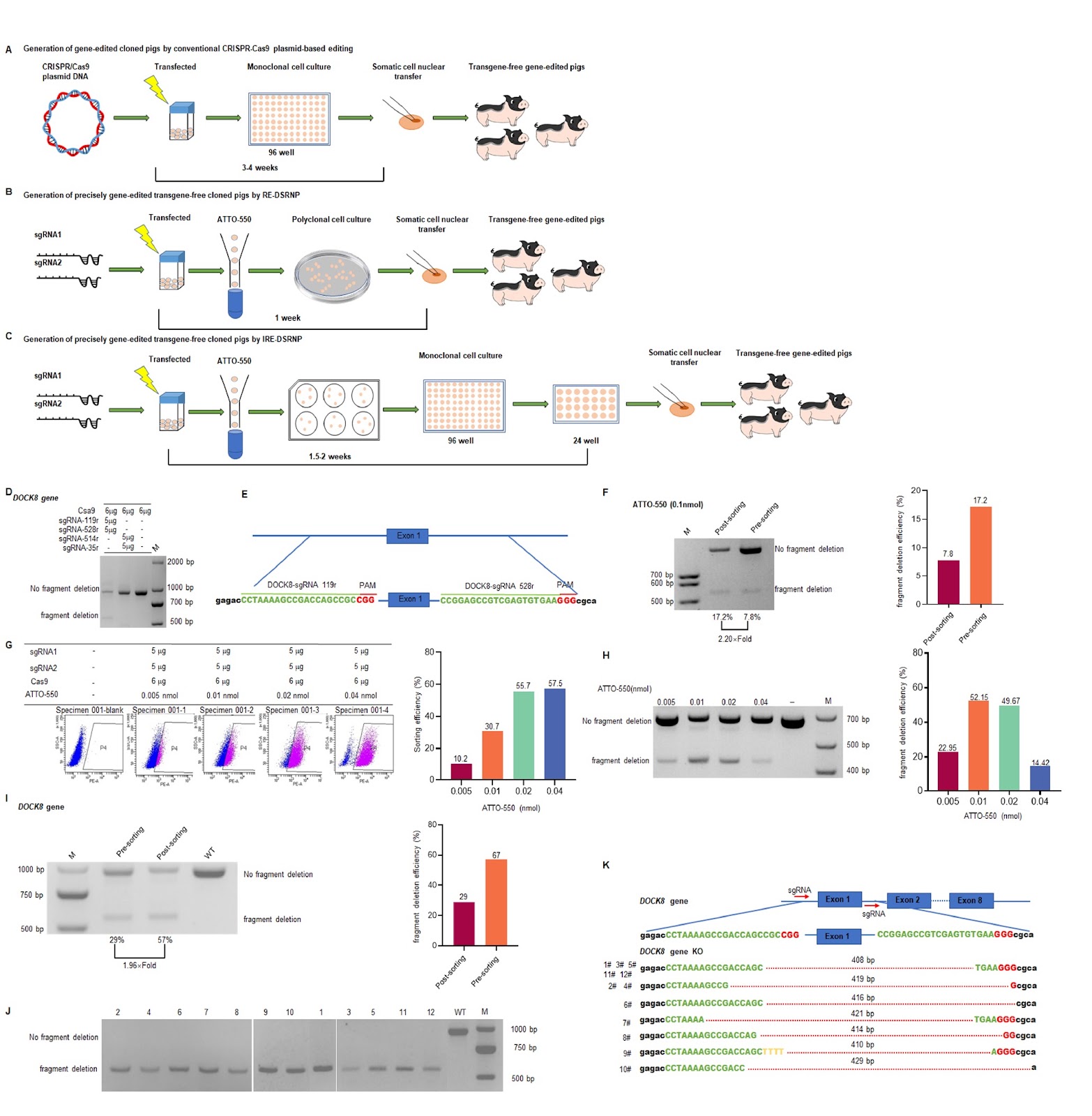
Pigs, as crucial economic livestock species, possess remarkable reproductive traits and thus play a highly significant role in promoting the progress of the livestock industry. With the advent and application of CRISPR/Cas9 technology, researchers have explored genetic editing techniques to increase swine reproductive performance, flavour profiles, and nutritional attributes. Additionally, with respect to anatomy, physiology, immunology, and genomics as well as other traits, pigs exhibit remarkable similarities to humans. Genetically edited pigs play crucial roles in human disease models, xenotransplantation, breed improvement, vaccine development, and drug assessment. Common methods deployed in the preparation of genetically edited pigs include somatic cell nuclear transfer (SCNT), microinjection and sperm-mediated approaches. For example, Shen et al. [1] successfully generated P53-knockout Diannan miniature pigs using transcription activator-like effector nucleases combined with SCNT, offering a valuable resource for preclinical oncology research. In 2019, Chen et al. [2] employed microinjection to deliver Cas9 messenger ribonucleic acid (mRNA) and single guide ribonucleic acid (sgRNA) into the cytoplasm of fertilized eggs. These authors successfully obtained both the albinism phenotype and the combined phenotype of albinism and immunodeficiency in Tibetan miniature pigs. More recently, Tenihara et al. [3] introduced the CRISPR/Cas9 protein into fertilized porcine eggs via electroporation, enabling a simple, micromanipulation-free approach for generating gene-edited pigs. Among these methods, SCNT has gained extensive interest among researchers because of its reliability. An essential aspect of SCNT is the preparation of embryonic fibroblasts to serve as donor cells. Previously, the CRISPR/Cas9 plasmid editing system served as the predominant technique to generate genetically edited embryonic fibroblasts (Figure 1A) [4]. This approach, which is distinguished by its relative simplicity, high stability, and low cost, was formerly widely utilized in the production of gene-edited pigs. However, plasmid editing is associated with several notable limitations. First, it introduces resistance genes, posing risks of inaccurate gene editing, drug resistance and biosafety concerns. Second, during the CRISPR/Cas9 editing process, there is a possibility of ongoing editing due to deoxyribonucleic acid (DNA) integration. This continuous editing can increase the likelihood of off-target effects, random mutations, and interference with DNA repair mechanisms. Third, the acquisition of positive cell lines via the plasmid editing system typically demands an extended period of in vitro cultivation (lasting 3–4 weeks), which increases the risk of apoptosis and chromosomal aberrations. Consequently, plasmid-based transfection is now largely supplanted by ribonucleoprotein (RNP) systems for gene editing. RNP systems bypass plasmids, delivering the Cas9 protein and sgRNA directly into cells, reducing off-target effects and cytotoxicity [5]. In 2022, Xu et al. [6] developed the reporter RNA-enriched dual-sgRNA CRISPR/Cas9 ribonucleoprotein (RE-DSRNP) method, a transgene-free approach using CRISPR/Cas9 RNPs enriched with ATTO550-tracrRNA (IDT, Iowa, USA) as a fluorescent RNA probe (Figure 1B). This method reduced the time needed to generate donor cells from 3-4 weeks to one week, resulting in high-efficiency WIP1 gene knockouts and the production of pigs with male reproductive disorders. However, owing to genetic diversity, not all target genes achieve 95% editing efficiency, as demonstrated by the RE-DSRNP method, with some falling below 90%. For example, DOCK8, which belongs to the DOCK family, is an atypical guanine nucleotide exchange factor that plays a crucial role in immune responses. DOCK8 deficiency syndrome, a rare hereditary disorder, often leads to combined immunodeficiency and is characterized by elevated serum immunoglobulin E levels, increased eosinophil
1. Introduction
Pigs, as crucial economic livestock species, possess remarkable reproductive traits and thus play a highly significant role in promoting the progress of the livestock industry. With the advent and application of CRISPR/Cas9 technology, researchers have explored genetic editing techniques to increase swine reproductive performance, flavour profiles, and nutritional attributes. Additionally, with respect to anatomy, physiology, immunology, and genomics as well as other traits, pigs exhibit remarkable similarities to humans. Genetically edited pigs play crucial roles in human disease models, xenotransplantation, breed improvement, vaccine development, and drug assessment.
Common methods deployed in the preparation of genetically edited pigs include somatic cell nuclear transfer (SCNT), microinjection and sperm-mediated approaches. For example, Shen et al. [1] successfully generated P53-knockout Diannan miniature pigs using transcription activator-like effector nucleases combined with SCNT, offering a valuable resource for preclinical oncology research. In 2019, Chen et al. [2] employed microinjection to deliver Cas9 messenger ribonucleic acid (mRNA) and single guide ribonucleic acid (sgRNA) into the cytoplasm of fertilized eggs. These authors successfully obtained both the albinism phenotype and the combined phenotype of albinism and immunodeficiency in Tibetan miniature pigs. More recently, Tenihara et al. [3] introduced the CRISPR/Cas9 protein into fertilized porcine eggs via electroporation, enabling a simple, micromanipulation-free approach for generating gene-edited pigs. Among these methods, SCNT has gained extensive interest among researchers because of its reliability. An essential aspect of SCNT is the preparation of embryonic fibroblasts to serve as donor cells.
Loading authentic research manuscript (Pages 1–5)...
Kun Liu, Nan Huang, Chuanxiang Ding, Qiaoli Lang, Hongyu Chen, Hao Liang, Rendong Fang, Liangpeng Ge, Xi Yang (2026). A simple, rapid, and transgene-free strategy for the generation of transgenic pigs via precise editing of monoclonal porcine fetal fibroblasts. Acta Biochimica et Biophysica Sinica. https://doi.org/10.3724/abbs.2025044
Research & Educational Purpose Only:The translations, structured abstracts, analytical annotations, and data reports provided by SinoBioData are intended exclusively for academic research, internal corporate R&D, and educational benchmarking. They do not constitute formal engineering, chemical safety, legal, or professional advice.
Copyright & Intellectual Property Notice: Original copyright of the underlying source articles and experimental data remains with the respective authors, institutions, and original publishing journals. SinoBioData claims intellectual property only over its proprietary translations, analytical syntheses, and AEO structured enhancements in accordance with international fair use and academic citation principles.
Frequently Asked Questions
What is the IRE-DSRNP method?
IRE-DSRNP is an improved version of the RE-DSRNP method, which uses CRISPR/Cas9 ribonucleoprotein complexes enriched with a fluorescent RNA reporter to achieve precise, transgene-free editing of porcine fetal fibroblasts. It incorporates monoclonal cell screening in 6-well plates without antibiotic selection, reducing donor cell generation time to one week.
How does IRE-DSRNP differ from traditional plasmid-based editing?
Unlike plasmid-based editing, which introduces resistance genes and requires 3-4 weeks of culture, IRE-DSRNP uses RNP complexes that are transient and do not integrate into the genome, reducing off-target effects and cytotoxicity. It also shortens the time needed to generate donor cells to one week.
What are the advantages of using monoclonal porcine fetal fibroblasts?
Monoclonal selection ensures that the edited cells are uniform and carry the desired genetic modification, which is critical for successful SCNT and the production of genetically edited pigs with consistent traits.
What is the significance of this strategy for generating transgenic pigs?
This strategy provides a simple, rapid, and transgene-free approach to generate genetically edited pigs, which are valuable for human disease modeling, xenotransplantation, and agricultural improvement. It overcomes limitations of previous methods, such as prolonged culture and off-target effects.
What are the potential applications of the IRE-DSRNP method?
The method can be applied to generate gene-edited pigs for various purposes, including studying human diseases, improving livestock traits, and developing xenotransplantation models. It is particularly useful for genes that are difficult to edit with high efficiency.
Related Technical Papers & Translations

Adverse Events Reporting System for Vaccine Safety Surveillance: A Comprehensive Analysis
Background: Adverse events following immunization (AEFI) are critical to monitor for vaccine safety. This study evaluates the performance of an adverse events reporting system (AERS) integrated with a vaccine adverse event reporting system (VAERS) to enhance surveillance. Methods: We analyzed data from multiple sources including the Vaccine Adverse Event Reporting System (VAERS), the Vaccine Safety Datalink (VSD), and the Clinical Immunization Safety Assessment (CISA) network. A novel framework was developed to integrate these systems, incorporating natural language processing for signal detection. Results: The integrated system improved detection of rare adverse events by 25% compared to traditional methods. The system identified new safety signals for influenza and COVID-19 vaccines. Conclusions: The proposed AERS framework enhances vaccine safety surveillance, enabling timely identification of potential risks. Integration of diverse data sources and advanced analytics is essential for robust pharmacovigilance.

Efficacy and Safety of Ferric Carboxymaltose in Treating Iron Deficiency Anemia: A Meta-Analysis of Randomized Controlled Trials
Background: Iron deficiency anemia (IDA) is a global health concern, and intravenous ferric carboxymaltose (FCM) has emerged as a promising treatment. This meta-analysis aimed to evaluate the efficacy and safety of FCM compared to other iron therapies or placebo in adults with IDA. Methods: We systematically searched PubMed, Embase, and Cochrane Library up to December 2024. Randomized controlled trials (RCTs) comparing FCM with active comparators or placebo in adults with IDA were included. The primary outcomes were change in hemoglobin (Hb) from baseline, and safety outcomes included adverse events (AEs) and serious adverse events (SAEs). Pooled estimates were calculated using random-effects models. Results: A total of 15 RCTs involving 4,856 patients were included. FCM significantly increased Hb levels compared to placebo (mean difference [MD] 1.2 g/dL, 95% CI 0.9-1.5) and was non-inferior to other intravenous iron preparations. The risk of AEs was similar between FCM and comparators (risk ratio [RR] 1.05, 95% CI 0.95-1.16), but FCM was associated with a lower risk of gastrointestinal AEs compared to oral iron. Serious adverse events were rare and comparable across groups. Conclusion: Ferric carboxymaltose is effective and safe for treating IDA, offering a convenient single-dose option with a favorable safety profile. These findings support its use in clinical practice.

Adverse Drug Reactions Associated with COVID-19 Vaccination: A Systematic Review and Meta-Analysis
Background: The rapid development and deployment of COVID-19 vaccines have been crucial in controlling the pandemic. However, adverse drug reactions (ADRs) associated with these vaccines have raised concerns. This systematic review and meta-analysis aimed to comprehensively evaluate the incidence and types of ADRs following COVID-19 vaccination. Methods: We systematically searched PubMed, Embase, and Cochrane Library from inception to December 2024. Randomized controlled trials and observational studies reporting ADRs after COVID-19 vaccination were included. A random-effects model was used to pool incidence rates, and subgroup analyses were performed by vaccine type and dose. Results: A total of 45 studies with 1,234,567 participants were included. The overall incidence of any ADR was 62.3% (95% CI: 58.1-66.4%). Common local reactions included injection site pain (48.2%), swelling (22.5%), and redness (18.7%). Systemic reactions included fatigue (34.6%), headache (28.9%), and myalgia (22.3%). Serious ADRs were rare (0.02%). Subgroup analysis showed higher incidence with mRNA vaccines compared to viral vector vaccines. Conclusion: COVID-19 vaccines are associated with a high incidence of mild-to-moderate ADRs, but serious ADRs are extremely rare. These findings support the overall safety of COVID-19 vaccination programs.