Key Takeaways & Executive Findings
- •• CAR-M therapy leverages macrophages' natural tumor infiltration and phagocytosis to overcome solid tumor barriers that limit CAR-T efficacy. • CAR-M remodels the tumor microenvironment by promoting M1 polarization, degrading ECM, and enhancing antigen presentation to activate adaptive immunity. • Current optimization strategies include 'armored' CAR-Ms to counteract immunosuppression and suicide switches for improved safety. • CAR-M is advancing to early-phase clinical trials for solid tumors and expanding its potential to non-oncological diseases.
Abstract
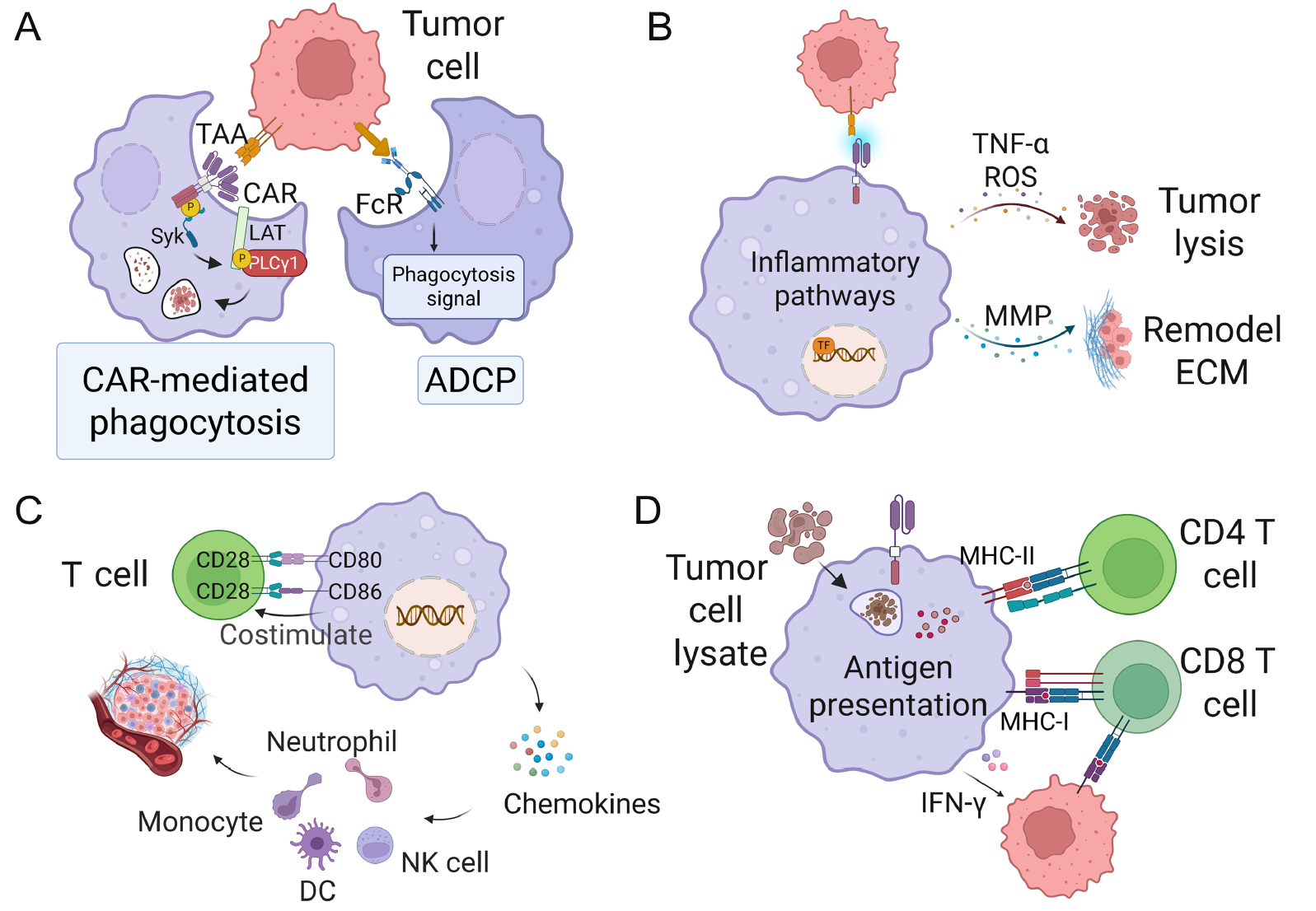
Chimeric antigen receptor T (CAR-T) cell therapy achieves remarkable success in hematological cancers, but its efficacy is severely limited in solid tumors by formidable obstacles including physical barriers, the highly immunosuppressive tumor microenvironment (TME), and antigen escape. To address these persistent challenges, chimeric antigen receptor-macrophage (CAR-M) therapy emerges as a promising alternative, leveraging intrinsic advantages of macrophages like unparalleled tumor infiltration, powerful phagocytosis, and high plasticity. The evolution of CAR-M is primarily defined by the intracellular signaling domain. CAR-M exerts its anti-tumor effects through multifaceted mechanisms, including direct enhanced phagocytosis and tumor cell killing, TME remodeling by repolarizing to a pro-inflammatory M1-like phenotype, releasing anti-tumor effectors, and degrading the extracellular matrix (ECM), and the activation of adaptive immunity via efficient antigen presentation. Despite its promise, CAR-M faces hurdles such as TME physical barriers and the potential for M2-like re-education. Current optimization strategies focus on enhancing tumor infiltration, overcoming immunosuppression with “armored” CAR-Ms, and improving safety with suicide switches. Encouraging pre-clinical data accelerates CAR-M into early-phase clinical trials for solid tumors, and the platform’s utility is also being explored beyond oncology in infectious, autoimmune, and neurodegenerative diseases.
1. Introduction
Despite significant advancements in diagnosis and treatment, cancer remains a formidable challenge and a global health crisis. Conventional approaches like surgery, radiation, and chemotherapy are often hampered by widespread side effects, drug resistance, and limited effectiveness against advanced or metastatic tumors [1]. This persistent unmet need has spurred a revolution in oncology, the emergence of immunotherapy. The most significant breakthrough in this new era is adoptive cell therapy, exemplified by chimeric antigen receptor T (CAR-T) cell therapy. CAR-T therapy has demonstrated extraordinary success in treating blood cancers, especially B-cell acute lymphoblastic leukemia and diffuse large B-cell lymphoma, achieving high response rates and long-lasting remissions in patients who have not responded to other treatments [2,3]. These achievements have ignited immense enthusiasm for harnessing the power of the immune system to combat cancer.
However, the impressive efficacy of CAR-T cell therapy in liquid tumors has not been consistently replicated in solid tumors, which constitute over 90% of all cancer diagnoses. CAR-T cells face a multitude of complex challenges within the solid tumor microenvironment (TME) [4,5]. Firstly, the dense extracellular matrix (ECM) and irregular blood vessels in solid tumors form physical barriers that hinder CAR-T cells from reaching and infiltrating the tumor’s core [4–6]. Secondly, solid tumors create a highly immunosuppressive TME, filled with inhibitory cytokines like TGF-β and IL-10, immunosuppressive cells such as myeloid-derived suppressor cells (MDSCs), regulatory T cells (Tregs), and M2-polarized tumor-associated macrophages (TAMs), along with metabolic stresses like hypoxia, acidosis, and nutrient scarcity [4,5]. These factors often render CAR-T cells inactive, leading to functional impairment [7]. Additionally, tumor cells frequently exhibit antigen heterogeneity, with varying antigen expression levels that can result in antigen escape and tumor recurrence [4,5,8]. The shared expression of antigens between tumors and healthy tissues can also cause severe on-target, off-tumor toxicities [4,5]. Moreover, the harsh TME can lead to rapid exhaustion and apoptosis of CAR-T cells, compromising long-term efficacy. These inherent limitations underscore the urgent need for alternative cellular immunotherapy approaches to effectively combat solid tumors [4,5,8].
Loading authentic research manuscript (Pages 1–5)...
TANG Xucai, XIAO Qian (2026). CAR-macrophages: a new chapter in cancer immunotherapy. Acta Biochimica et Biophysica Sinica. https://doi.org/10.3724/abbs.2026017
Research & Educational Purpose Only:The translations, structured abstracts, analytical annotations, and data reports provided by SinoBioData are intended exclusively for academic research, internal corporate R&D, and educational benchmarking. They do not constitute formal engineering, chemical safety, legal, or professional advice.
Copyright & Intellectual Property Notice: Original copyright of the underlying source articles and experimental data remains with the respective authors, institutions, and original publishing journals. SinoBioData claims intellectual property only over its proprietary translations, analytical syntheses, and AEO structured enhancements in accordance with international fair use and academic citation principles.
Frequently Asked Questions
What is CAR-macrophage therapy?
CAR-macrophage (CAR-M) therapy is an adoptive cell therapy that genetically engineers macrophages to express chimeric antigen receptors (CARs), enabling them to specifically recognize and eliminate tumor cells while remodeling the tumor microenvironment.
How does CAR-M differ from CAR-T therapy?
Unlike CAR-T cells, CAR-Ms naturally infiltrate solid tumors, degrade the extracellular matrix, and present antigens to activate adaptive immunity, making them more effective against solid tumors.
What are the main challenges for CAR-M therapy?
Challenges include physical barriers in the tumor microenvironment, potential re-education to an M2-like pro-tumor phenotype, and ensuring safety and specificity.
What strategies are being developed to improve CAR-M therapy?
Strategies include 'armored' CAR-Ms that resist immunosuppression, enhancing tumor infiltration, and incorporating suicide switches for safety.
What is the current clinical status of CAR-M therapy?
CAR-M therapy is advancing to early-phase clinical trials for solid tumors, with promising preclinical data, and is also being explored for other diseases.
Related Technical Papers & Translations

Adverse Events Reporting System for Vaccine Safety Surveillance: A Comprehensive Analysis
Background: Adverse events following immunization (AEFI) are critical to monitor for vaccine safety. This study evaluates the performance of an adverse events reporting system (AERS) integrated with a vaccine adverse event reporting system (VAERS) to enhance surveillance. Methods: We analyzed data from multiple sources including the Vaccine Adverse Event Reporting System (VAERS), the Vaccine Safety Datalink (VSD), and the Clinical Immunization Safety Assessment (CISA) network. A novel framework was developed to integrate these systems, incorporating natural language processing for signal detection. Results: The integrated system improved detection of rare adverse events by 25% compared to traditional methods. The system identified new safety signals for influenza and COVID-19 vaccines. Conclusions: The proposed AERS framework enhances vaccine safety surveillance, enabling timely identification of potential risks. Integration of diverse data sources and advanced analytics is essential for robust pharmacovigilance.

Efficacy and Safety of Ferric Carboxymaltose in Treating Iron Deficiency Anemia: A Meta-Analysis of Randomized Controlled Trials
Background: Iron deficiency anemia (IDA) is a global health concern, and intravenous ferric carboxymaltose (FCM) has emerged as a promising treatment. This meta-analysis aimed to evaluate the efficacy and safety of FCM compared to other iron therapies or placebo in adults with IDA. Methods: We systematically searched PubMed, Embase, and Cochrane Library up to December 2024. Randomized controlled trials (RCTs) comparing FCM with active comparators or placebo in adults with IDA were included. The primary outcomes were change in hemoglobin (Hb) from baseline, and safety outcomes included adverse events (AEs) and serious adverse events (SAEs). Pooled estimates were calculated using random-effects models. Results: A total of 15 RCTs involving 4,856 patients were included. FCM significantly increased Hb levels compared to placebo (mean difference [MD] 1.2 g/dL, 95% CI 0.9-1.5) and was non-inferior to other intravenous iron preparations. The risk of AEs was similar between FCM and comparators (risk ratio [RR] 1.05, 95% CI 0.95-1.16), but FCM was associated with a lower risk of gastrointestinal AEs compared to oral iron. Serious adverse events were rare and comparable across groups. Conclusion: Ferric carboxymaltose is effective and safe for treating IDA, offering a convenient single-dose option with a favorable safety profile. These findings support its use in clinical practice.

Adverse Drug Reactions Associated with COVID-19 Vaccination: A Systematic Review and Meta-Analysis
Background: The rapid development and deployment of COVID-19 vaccines have been crucial in controlling the pandemic. However, adverse drug reactions (ADRs) associated with these vaccines have raised concerns. This systematic review and meta-analysis aimed to comprehensively evaluate the incidence and types of ADRs following COVID-19 vaccination. Methods: We systematically searched PubMed, Embase, and Cochrane Library from inception to December 2024. Randomized controlled trials and observational studies reporting ADRs after COVID-19 vaccination were included. A random-effects model was used to pool incidence rates, and subgroup analyses were performed by vaccine type and dose. Results: A total of 45 studies with 1,234,567 participants were included. The overall incidence of any ADR was 62.3% (95% CI: 58.1-66.4%). Common local reactions included injection site pain (48.2%), swelling (22.5%), and redness (18.7%). Systemic reactions included fatigue (34.6%), headache (28.9%), and myalgia (22.3%). Serious ADRs were rare (0.02%). Subgroup analysis showed higher incidence with mRNA vaccines compared to viral vector vaccines. Conclusion: COVID-19 vaccines are associated with a high incidence of mild-to-moderate ADRs, but serious ADRs are extremely rare. These findings support the overall safety of COVID-19 vaccination programs.