Key Takeaways & Executive Findings
- •• Combination therapy of En-PSCs and HSYA significantly improves uterine repair in rats with full-thickness injury, reducing fibrosis and enhancing regeneration. • The treatment promotes angiogenesis and restores fertility, leading to increased live births in the rat model. • Mechanistically, En-PSCs/HSYA activates the NRG1/ErbB4 signaling pathway, which is crucial for the therapeutic effects. • This study provides a promising cell-based therapeutic strategy for intrauterine adhesions, potentially applicable to clinical settings.
Abstract
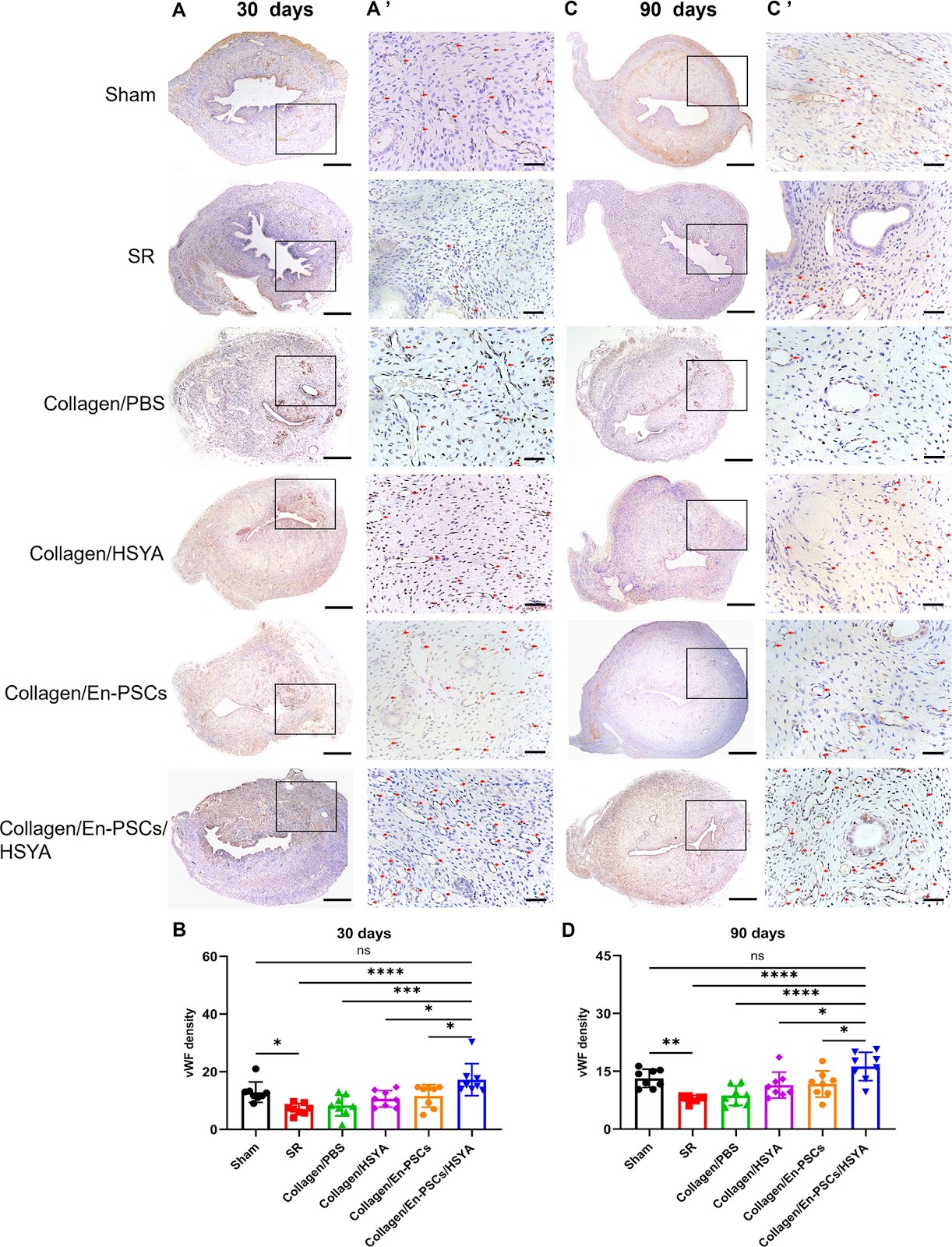
Background Intrauterine adhesions (IUAs) jeopardise uterine function in women, which is a great challenge in the clinic. Previous studies have shown that endometrial perivascular cells (En-PSCs) can improve the healing of scarred uteri and that hydroxysafflor yellow A (HSYA) promotes angiogenesis. The purpose of this study was to observe whether the combination of En-PSCs with HSYA could improve the blood supply and fertility in the rat uterus after full-thickness injury. Methods En-PSCs were sorted by flow cytometry, and the effect of HSYA on the proliferation and angiogenesis of the En-PSCs was detected using CCK-8 and tube formation assays. Based on a previously reported rat IUA model, the rat uteri were sham-operated, spontaneously regenerated, or treated with collagen-loaded PBS, collagen-loaded HSYA, collagen-loaded En-PSCs, or collagen-loaded En-PSCs with HSYA, and then collected at both 30 and 90 days postsurgery. HE staining and Masson staining were used to evaluate uterine structure and collagen fibre deposition, and immunohistochemical staining for α-SMA and vWF was used to evaluate myometrial regeneration and neovascularization in each group. A fertility assay was performed to detect the recovery of pregnancy function in each group. RNA-seq was performed to determine the potential mechanism underlying En-PSCs/HSYA treatment. Immunofluorescence, tube formation assays, and Western blot were used to validate the molecular mechanism involved. Results The transplantation of Collagen/En-PSCs/HSYA markedly promoted uterine repair in rats with full-thickness injury by reducing fibrosis, increasing endometrial thickness, regenerating myometrium, promoting angiogenesis, and facilitated live births. RNA sequencing results suggested that En-PSCs/HSYA activated the NRG1/ErbB4 signaling pathway. In vitro tube formation experiments revealed that the addition of an ErbB inhibitor diminished the tube formation ability of cocultured En-PSCs and HUVECs. Western blot results further showed that elevated levels of NRG1 and ErbB4 proteins were detected in the Collagen/En-PSCs/HSYA group compared to the Collagen/En-PSCs group. These collective results suggested that the beneficial effects of the transplantation of Collagen/En-PSCs/HSYA might be attributed to the modulation of the NRG1/ErbB4 signaling pathway. Conclusions The combination of En-PSCs/HSYA facilitated morphological and functional repair in rats with full-thickness uterine injury and may promote endometrial angiogenesis by regulating the NRG1/ErbB4 signaling pathway.
1. Introduction
Intrauterine adhesions (IUAs) are characterised by symptoms such as endometrial fibrosis, menstrual abnormalities, and recurrent miscarriages [1, 2]. The functional layer of the endometrium in normal women undergoes cyclic shedding in response to hormonal changes, and the basal layer plays an important role in promoting functional regeneration [3]. However, intrauterine surgery can cause irreversible damage to the basal layer, leading to impaired regeneration of the functional layer and damaged uterine function. Hysteroscopic adhesion disintegration is the mainstay of clinical treatment for IUA, but the risks of high postoperative recurrence rates and increased likelihood of miscarriage and placental abnormalities remain to be urgently addressed [4, 5]. Alternative therapies such as intrauterine devices, oestrogen supplementation, and amniotic membrane transplantation also have associated drawbacks, such as the occurrence of menstrual abnormalities and decreased pregnancy rates [6–8].
The endometrium, as a unique circulating regenerative tissue in the human body, is intricately tied to vascular growth for functional maintenance [9]. In patients with IUAs, angiogenesis is typically impaired due to the constriction or closure of capillary lumens caused by extensive fibroblast deposits in the stroma [10, 11]. Stem cells have emerged as a promising treatment for IUA, and notable progress has been made in clinical trials [12–14]. Perivascular cells, particularly endometrial perivascular cells (En-PSCs), have shown potential in promoting uterine repair. Additionally, hydroxysafflor yellow A (HSYA), a natural compound, is known to promote angiogenesis. This study investigates the combined effect of En-PSCs and HSYA on uterine repair in a rat model of full-thickness injury, aiming to improve blood supply and fertility outcomes.
Loading authentic research manuscript (Pages 1–5)...
Ning Li, Jialian Mao, Miaomiao Wang, Jiahui Qi, Zhiwei Jiang, Yifan Li, Guijun Yan, Yali Hu, Shiyuan Li, Haixiang Sun, Lijun Ding (2026). Transplantation of human endometrial perivascular stem cells with hydroxy saffron yellow A promotes uterine repair in rats. Stem Cell Research & Therapy. https://doi.org/10.1186/s13287-024-03821-1
Research & Educational Purpose Only:The translations, structured abstracts, analytical annotations, and data reports provided by SinoBioData are intended exclusively for academic research, internal corporate R&D, and educational benchmarking. They do not constitute formal engineering, chemical safety, legal, or professional advice.
Copyright & Intellectual Property Notice: Original copyright of the underlying source articles and experimental data remains with the respective authors, institutions, and original publishing journals. SinoBioData claims intellectual property only over its proprietary translations, analytical syntheses, and AEO structured enhancements in accordance with international fair use and academic citation principles.
Frequently Asked Questions
What is the main finding of this study?
The combination of endometrial perivascular cells (En-PSCs) and hydroxysafflor yellow A (HSYA) significantly promotes uterine repair in rats with full-thickness injury, reducing fibrosis, enhancing angiogenesis, and improving fertility outcomes.
How does the En-PSCs/HSYA treatment work?
The treatment activates the NRG1/ErbB4 signaling pathway, which is crucial for promoting endometrial angiogenesis and tissue regeneration.
What are intrauterine adhesions (IUAs)?
Intrauterine adhesions are characterized by endometrial fibrosis, menstrual abnormalities, and recurrent miscarriages, often resulting from damage to the basal layer of the endometrium due to intrauterine surgery.
What is the significance of this research?
This study provides a promising cell-based therapeutic strategy for intrauterine adhesions, potentially offering a more effective treatment to restore uterine function and fertility in affected women.
What methods were used in this study?
The study used flow cytometry to sort En-PSCs, CCK-8 and tube formation assays for proliferation and angiogenesis, a rat IUA model, histological staining, fertility assays, RNA-seq, immunofluorescence, and Western blot to validate mechanisms.
Related Technical Papers & Translations

Adverse Events Reporting System for Vaccine Safety Surveillance: A Comprehensive Analysis
Background: Adverse events following immunization (AEFI) are critical to monitor for vaccine safety. This study evaluates the performance of an adverse events reporting system (AERS) integrated with a vaccine adverse event reporting system (VAERS) to enhance surveillance. Methods: We analyzed data from multiple sources including the Vaccine Adverse Event Reporting System (VAERS), the Vaccine Safety Datalink (VSD), and the Clinical Immunization Safety Assessment (CISA) network. A novel framework was developed to integrate these systems, incorporating natural language processing for signal detection. Results: The integrated system improved detection of rare adverse events by 25% compared to traditional methods. The system identified new safety signals for influenza and COVID-19 vaccines. Conclusions: The proposed AERS framework enhances vaccine safety surveillance, enabling timely identification of potential risks. Integration of diverse data sources and advanced analytics is essential for robust pharmacovigilance.

Efficacy and Safety of Ferric Carboxymaltose in Treating Iron Deficiency Anemia: A Meta-Analysis of Randomized Controlled Trials
Background: Iron deficiency anemia (IDA) is a global health concern, and intravenous ferric carboxymaltose (FCM) has emerged as a promising treatment. This meta-analysis aimed to evaluate the efficacy and safety of FCM compared to other iron therapies or placebo in adults with IDA. Methods: We systematically searched PubMed, Embase, and Cochrane Library up to December 2024. Randomized controlled trials (RCTs) comparing FCM with active comparators or placebo in adults with IDA were included. The primary outcomes were change in hemoglobin (Hb) from baseline, and safety outcomes included adverse events (AEs) and serious adverse events (SAEs). Pooled estimates were calculated using random-effects models. Results: A total of 15 RCTs involving 4,856 patients were included. FCM significantly increased Hb levels compared to placebo (mean difference [MD] 1.2 g/dL, 95% CI 0.9-1.5) and was non-inferior to other intravenous iron preparations. The risk of AEs was similar between FCM and comparators (risk ratio [RR] 1.05, 95% CI 0.95-1.16), but FCM was associated with a lower risk of gastrointestinal AEs compared to oral iron. Serious adverse events were rare and comparable across groups. Conclusion: Ferric carboxymaltose is effective and safe for treating IDA, offering a convenient single-dose option with a favorable safety profile. These findings support its use in clinical practice.

Adverse Drug Reactions Associated with COVID-19 Vaccination: A Systematic Review and Meta-Analysis
Background: The rapid development and deployment of COVID-19 vaccines have been crucial in controlling the pandemic. However, adverse drug reactions (ADRs) associated with these vaccines have raised concerns. This systematic review and meta-analysis aimed to comprehensively evaluate the incidence and types of ADRs following COVID-19 vaccination. Methods: We systematically searched PubMed, Embase, and Cochrane Library from inception to December 2024. Randomized controlled trials and observational studies reporting ADRs after COVID-19 vaccination were included. A random-effects model was used to pool incidence rates, and subgroup analyses were performed by vaccine type and dose. Results: A total of 45 studies with 1,234,567 participants were included. The overall incidence of any ADR was 62.3% (95% CI: 58.1-66.4%). Common local reactions included injection site pain (48.2%), swelling (22.5%), and redness (18.7%). Systemic reactions included fatigue (34.6%), headache (28.9%), and myalgia (22.3%). Serious ADRs were rare (0.02%). Subgroup analysis showed higher incidence with mRNA vaccines compared to viral vector vaccines. Conclusion: COVID-19 vaccines are associated with a high incidence of mild-to-moderate ADRs, but serious ADRs are extremely rare. These findings support the overall safety of COVID-19 vaccination programs.