Key Takeaways & Executive Findings
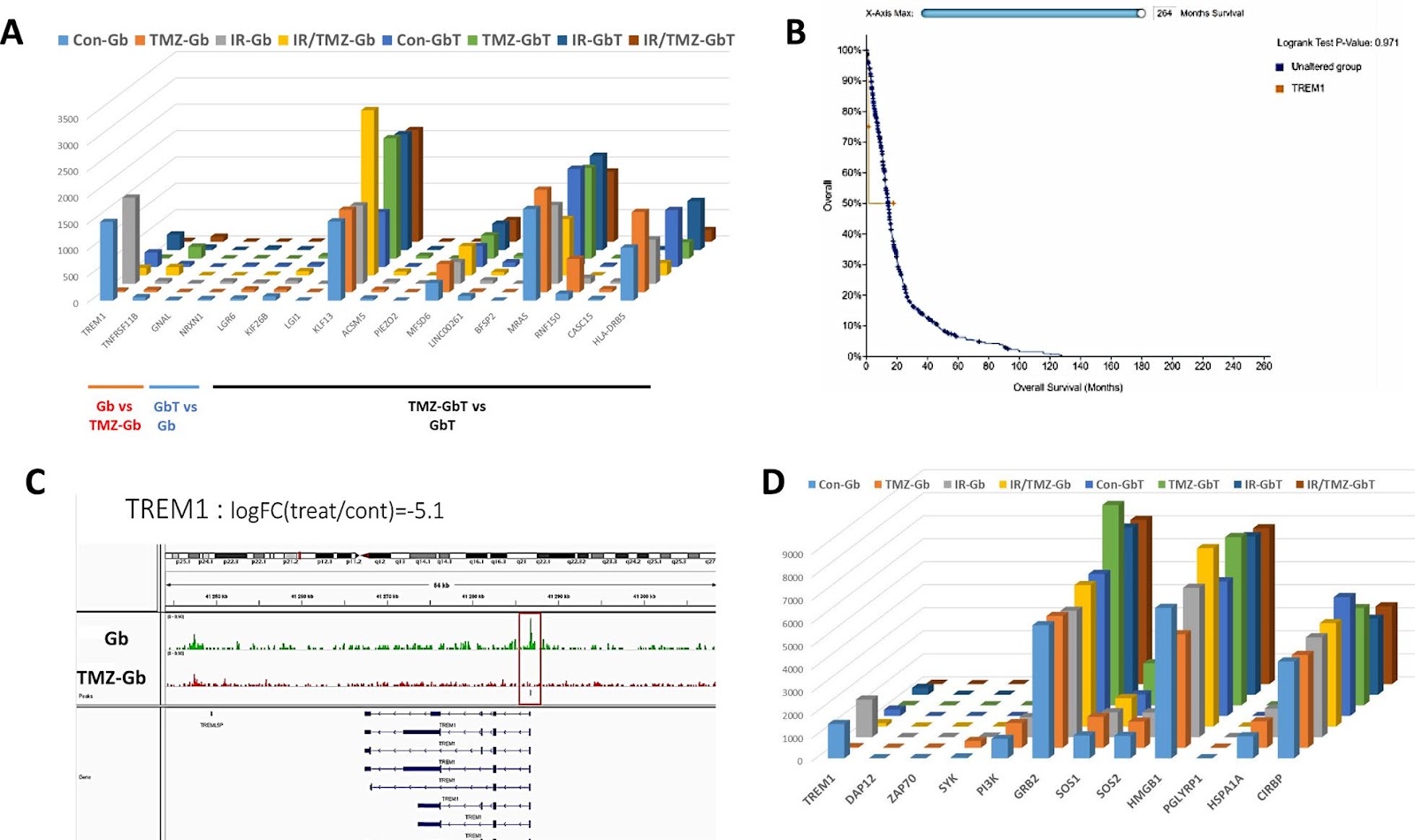
- •• Bioprinted 3D co-cultures of MSC and GBM recapitulate key tumor microenvironment interactions, providing a more physiologically relevant model than 2D cultures. • Standard GBM therapy (Temozolomide ± radiation) induces overexpression of mitochondrial OXPHOS genes, which are further modulated by MSC co-culture. • TREM-1 is identified as an epigenetically regulated marker of MSC/GBM interaction associated with improved overall survival in GBM patients. • The long non-coding RNA miR3681HG is implicated in post-transcriptional regulation and correlates with reduced overall survival, offering potential prognostic and therapeutic targets.
Abstract
Background The interaction between mesenchymal stem cells (MSC) and Glioblastoma (GBM), although potentially of the highest importance, is ill-understood. This is due, in part, to the lack of relevant experimental models. The similarity between the in vitro situations and the in vivo situation can be improved by 3D co-culture as it reproduces key cell–cell interactions between the tumor microenvironment (TME) and cancer cells. Methods MSC Can acquired characteristics of cancer associated fibroblasts (CAF) by being cultured with conditioned medium from GBM cultures and thus are called MSCCAF. We co Cultured MSCCAF with patient derived GBM in a scaffold 3D bioprinted model. We studied the response to current GBM therapy (e.g. Temozolomide +/Radiation) on the co cultures by bulk transcriptomic (RNA Seq) and epigenetic (ATAC Seq) analyses Results The transcriptomic modifications induced by standard GBM treatment in bioprinted scaffolds of mono- or co-cultures of GBM ± MSC can be analyzed. We found that mitochondrial encoded OXPHOS genes are overexpressed under these conditions and are modified by both co-culture and treatment (chemotherapy ± radiation). We have identified two new markers of MSC/GBM interactions, one epigenetically regulated (i.e. TREM-1) associated with an increased overall survival in GBM patients and another implicated in post-transcriptional regulation (i.e. the long non-coding RNA, miR3681HG), which is associated with a reduced overall survival in GBM patients.
1. Introduction
Glioblastoma (GBM) is the predominant primary cancer in human adults with a median survival following diagnosis of 12 to 15 months, with less than 10% of people surviving longer than five years [1]. The most current common treatment for GBM is a combination of complete (when possible) surgical resection, followed by radiotherapy and concomitant chemotherapy with the alkylating agent Temozolomide (TMZ) [2]. GBM are extremely heterogeneous and exhibit a very complex tumor microenvironment (TME), which render these tumors difficult to treat [3]. Today the main axis of research emphasizes on new therapies that are more “patient-specific” and which take into account a prediction on the mechanisms of resistance [4]. One way to achieve this goal is to use accurate in vitro tests that allow drug or innovative treatment screening on a personalized basis [5].
Among the cells present in the GBM microenvironment are the mesenchymal stem cells (MSC), the origins of which are ill-defined [6, 7]. Of note, the presence of MSC has been correlated with the survival of the patients [8]. However, so far, no clear mechanisms have been established to explain both the tropism and the mechanism(s) of action of MSC in GBM [9]. We have recently shown, in three-dimensional (3D) co-cultures, that the influences of MSC on GBM are multiple and involve both molecule and organelle transfers through connecting structures such as tunneling nanotubes (TNT) [10] and extracellular vesicles (EV) [11]. Strikingly, the co-culture of MSC and GBM affect both cellular types as, for example, it allows MSC to acquire a cancer-associated fibroblast (CAF) phenotype and properties that are specific for each GBM [12].
The current paradigm of in vitro studies is currently shifting from the classical two-dimensional (2D) to 3D-cultures. 3D-cultures can be developed with or without a scaffold. Scaffold-based 3D-cultures can use solid scaffold or hydrogels derived from extracellular matrix, proteins, polymer and many other materials. It is expected that 3D-cultures could influence the
Loading authentic research manuscript (Pages 1–5)...
Lisa Oliver, Yuna Landais, Catherine Gratas, Pierre-François Cartron, François Paris, Dominique Heymann, François M. Vallette, Aurelien Serandour (2026). Transcriptional landscape of the interaction of human Mesenchymal Stem Cells with Glioblastoma in bioprinted co-cultures. Stem Cell Research & Therapy. https://doi.org/10.1186/s13287-024-04022-6
Research & Educational Purpose Only:The translations, structured abstracts, analytical annotations, and data reports provided by SinoBioData are intended exclusively for academic research, internal corporate R&D, and educational benchmarking. They do not constitute formal engineering, chemical safety, legal, or professional advice.
Copyright & Intellectual Property Notice: Original copyright of the underlying source articles and experimental data remains with the respective authors, institutions, and original publishing journals. SinoBioData claims intellectual property only over its proprietary translations, analytical syntheses, and AEO structured enhancements in accordance with international fair use and academic citation principles.
Frequently Asked Questions
What is the significance of using 3D bioprinted co-cultures in this study?
3D bioprinted co-cultures better mimic the in vivo tumor microenvironment, allowing for more accurate studies of cell-cell interactions between mesenchymal stem cells and glioblastoma cells, which is crucial for understanding tumor biology and treatment response.
What are the key findings regarding mitochondrial OXPHOS genes?
The study found that mitochondrial-encoded OXPHOS genes are overexpressed under standard GBM treatment conditions and are further modified by co-culture with MSC, suggesting a role in therapy resistance and metabolic adaptation.
How does TREM-1 relate to patient survival in GBM?
TREM-1 was identified as an epigenetically regulated marker of MSC/GBM interaction and is associated with increased overall survival in GBM patients, indicating a potential protective role.
What is the role of miR3681HG in GBM?
miR3681HG is a long non-coding RNA implicated in post-transcriptional regulation and is associated with reduced overall survival in GBM patients, suggesting it may serve as a prognostic biomarker or therapeutic target.
How were the transcriptomic and epigenetic analyses performed?
The study used bulk RNA sequencing (RNA-Seq) for transcriptomic analysis and ATAC-Seq for epigenetic analysis to investigate the effects of co-culture and treatment on gene expression and chromatin accessibility.
Related Technical Papers & Translations

Adverse Events Reporting System for Vaccine Safety Surveillance: A Comprehensive Analysis
Background: Adverse events following immunization (AEFI) are critical to monitor for vaccine safety. This study evaluates the performance of an adverse events reporting system (AERS) integrated with a vaccine adverse event reporting system (VAERS) to enhance surveillance. Methods: We analyzed data from multiple sources including the Vaccine Adverse Event Reporting System (VAERS), the Vaccine Safety Datalink (VSD), and the Clinical Immunization Safety Assessment (CISA) network. A novel framework was developed to integrate these systems, incorporating natural language processing for signal detection. Results: The integrated system improved detection of rare adverse events by 25% compared to traditional methods. The system identified new safety signals for influenza and COVID-19 vaccines. Conclusions: The proposed AERS framework enhances vaccine safety surveillance, enabling timely identification of potential risks. Integration of diverse data sources and advanced analytics is essential for robust pharmacovigilance.

Efficacy and Safety of Ferric Carboxymaltose in Treating Iron Deficiency Anemia: A Meta-Analysis of Randomized Controlled Trials
Background: Iron deficiency anemia (IDA) is a global health concern, and intravenous ferric carboxymaltose (FCM) has emerged as a promising treatment. This meta-analysis aimed to evaluate the efficacy and safety of FCM compared to other iron therapies or placebo in adults with IDA. Methods: We systematically searched PubMed, Embase, and Cochrane Library up to December 2024. Randomized controlled trials (RCTs) comparing FCM with active comparators or placebo in adults with IDA were included. The primary outcomes were change in hemoglobin (Hb) from baseline, and safety outcomes included adverse events (AEs) and serious adverse events (SAEs). Pooled estimates were calculated using random-effects models. Results: A total of 15 RCTs involving 4,856 patients were included. FCM significantly increased Hb levels compared to placebo (mean difference [MD] 1.2 g/dL, 95% CI 0.9-1.5) and was non-inferior to other intravenous iron preparations. The risk of AEs was similar between FCM and comparators (risk ratio [RR] 1.05, 95% CI 0.95-1.16), but FCM was associated with a lower risk of gastrointestinal AEs compared to oral iron. Serious adverse events were rare and comparable across groups. Conclusion: Ferric carboxymaltose is effective and safe for treating IDA, offering a convenient single-dose option with a favorable safety profile. These findings support its use in clinical practice.

Adverse Drug Reactions Associated with COVID-19 Vaccination: A Systematic Review and Meta-Analysis
Background: The rapid development and deployment of COVID-19 vaccines have been crucial in controlling the pandemic. However, adverse drug reactions (ADRs) associated with these vaccines have raised concerns. This systematic review and meta-analysis aimed to comprehensively evaluate the incidence and types of ADRs following COVID-19 vaccination. Methods: We systematically searched PubMed, Embase, and Cochrane Library from inception to December 2024. Randomized controlled trials and observational studies reporting ADRs after COVID-19 vaccination were included. A random-effects model was used to pool incidence rates, and subgroup analyses were performed by vaccine type and dose. Results: A total of 45 studies with 1,234,567 participants were included. The overall incidence of any ADR was 62.3% (95% CI: 58.1-66.4%). Common local reactions included injection site pain (48.2%), swelling (22.5%), and redness (18.7%). Systemic reactions included fatigue (34.6%), headache (28.9%), and myalgia (22.3%). Serious ADRs were rare (0.02%). Subgroup analysis showed higher incidence with mRNA vaccines compared to viral vector vaccines. Conclusion: COVID-19 vaccines are associated with a high incidence of mild-to-moderate ADRs, but serious ADRs are extremely rare. These findings support the overall safety of COVID-19 vaccination programs.