Key Takeaways & Executive Findings
- •• Midbrain organoids (MOs) recapitulate key PD pathological hallmarks, enabling mechanistic studies and drug screening. • MOs support genetic modelling of PD-linked mutations (LRRK2, GBA1, DNAJC6) and optogenetics-assisted α-synuclein aggregation. • MOs show promise for cell replacement therapy, with successful integration and functional recovery in animal PD models. • Challenges like batch variability, limited vascularization, and high costs must be overcome to enhance reproducibility and scalability.
Abstract
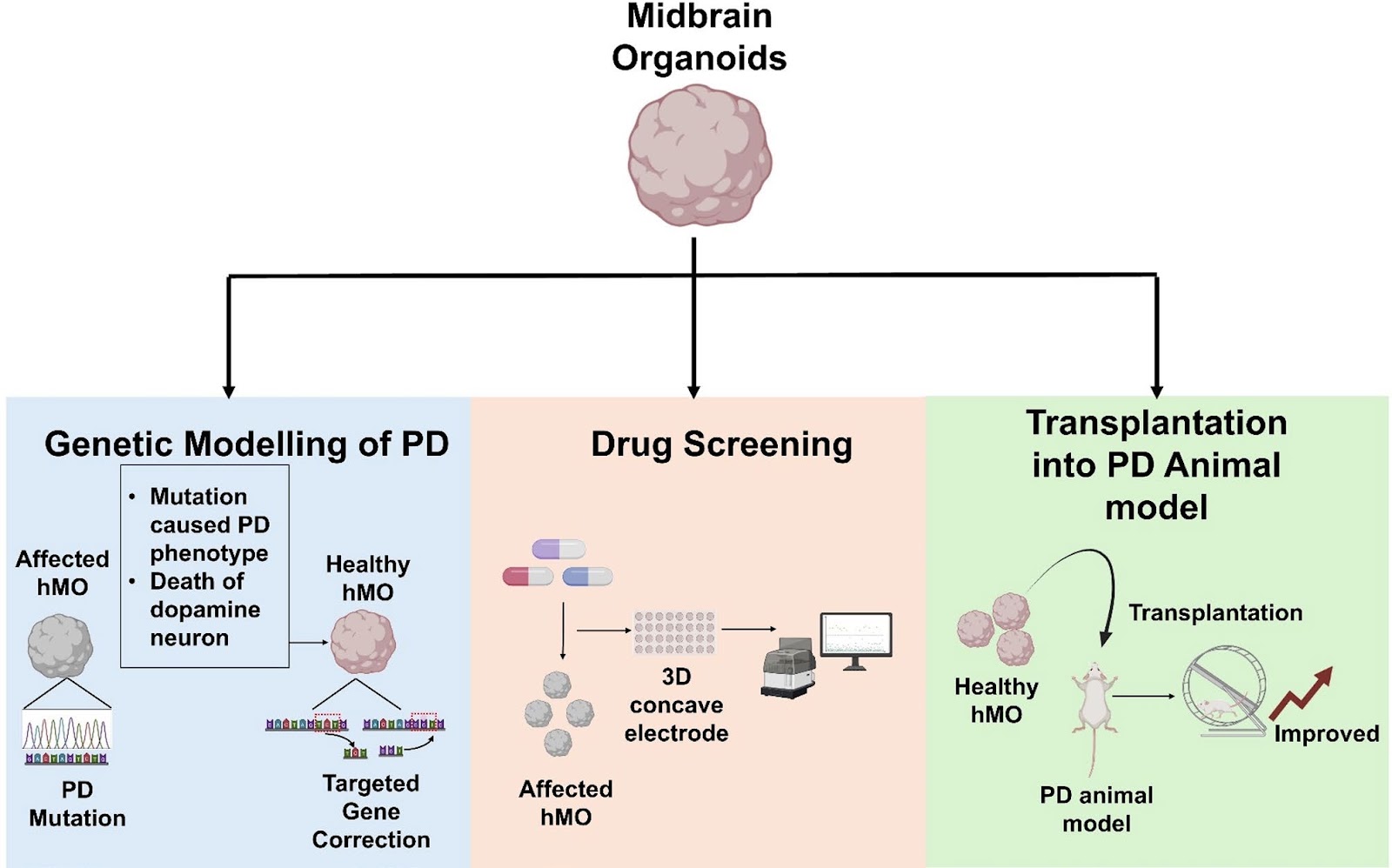
Parkinson's disease (PD), a progressive neurodegenerative disorder marked by dopaminergic (DA) neuron loss and Lewy body formation, lacks therapies to halt neurodegeneration. Current models, including 2D cultures and animal studies, fail to fully recapitulate human midbrain complexity, underscoring the need for advanced human-relevant disease modelling systems. Midbrain organoids (MOs), three-dimensional (3D) stem cell-derived neuronal structures mimicking midbrain architecture, have emerged as transformative tools for modelling PD. These organoids replicate key pathological hallmarks and enable disease mechanistic studies and drug screening for PD. Recent advances of research in MOs include genetic modelling of PD-linked mutations (e.g., LRRK2, GBA1, DNAJC6), optogenetics-assisted α-synuclein (α-syn) protein aggregation systems, and high-throughput drug testing platforms. MOs also show promise for cell replacement therapy, with successful integration and functional recovery in animal PD models. However, challenges such as batch variability, limited vascularization, incomplete neuronal maturation, and high costs hinder reproducibility and scalability. Future directions focus on integrating vascular networks, microglia co-cultures, automated workflows, and assembloid technologies to enhance pathophysiological relevance and translational potential in PD. By addressing these limitations, research in MOs could revolutionize PD research, offering critical insights into disease mechanisms and accelerating therapeutic discovery for PD patients.
1. Introduction
Parkinson's disease (PD) affected an estimated 11.9 million individuals worldwide in 2021, with projections suggesting a rise to 15.6 million in 2030, 20.4 million in 2040, and 25.2 million by 2050, driven primarily by global population aging and growth [1]. PD imposes a substantial dual burden in aging societies, with annual U.S. costs exceeding $50 billion from both direct healthcare expenses and indirect losses like reduced productivity and caregiver strain. Beyond economics, patients face social isolation and stigma, while families and healthcare systems grapple with caregiver burnout, rising hospitalizations, and disparities in specialized care access [2, 3]. Its pathological hallmark includes Lewy bodies formation and the gradual loss of dopamine (DA)-producing neurons in the substantia nigra pars compacta (SNpc) of the midbrain [4, 5]. As DA levels fall, patients develop characteristic PD motor symptoms, including resting tremor, rigidity, bradykinesia (slowness of movement) and postural instability, as well as a variety of non-motor features such as sleep disturbances, mood changes, and autonomic dysfunction [5].
Despite intensive research, there are currently no therapies that can halt or reverse the underlying neurodegeneration; available treatments (for example, levodopa and dopamine agonists) primarily aim to replenish DA or mimic its action and thus relieve patient symptoms [6, 7]. Deep brain stimulation (DBS), a surgical therapy used to manage motor symptoms and medication-induced complications, has also been applied in selected patients with early-stage PD [8]. However, while DBS can significantly improve motor function and quality of life, there is no conclusive evidence that it can alter the course of neurodegeneration or slow disease progression. Moreover, individual responses to these medications vary widely, and long-term use can lead to complications such as motor fluctuations and dyskinesias [9]. This clinical variability, together with PD's complex and multifactorial nature, continues to challenge the development of truly disease-modifying treatments. To address these challenges, researchers are leveraging advanced model systems, including cell-based assays, animal models, and patient-derived neuronal cultures.
Loading authentic research manuscript (Pages 1–5)...
Rosalie Elvira, Eng King Tan, Zhi Dong Zhou (2026). Three-dimensional midbrain organoids: a next-generation tool for Parkinson's disease modelling and drug discovery. Stem Cell Research & Therapy. https://doi.org/10.1186/s13287-025-04660-4
Research & Educational Purpose Only:The translations, structured abstracts, analytical annotations, and data reports provided by SinoBioData are intended exclusively for academic research, internal corporate R&D, and educational benchmarking. They do not constitute formal engineering, chemical safety, legal, or professional advice.
Copyright & Intellectual Property Notice: Original copyright of the underlying source articles and experimental data remains with the respective authors, institutions, and original publishing journals. SinoBioData claims intellectual property only over its proprietary translations, analytical syntheses, and AEO structured enhancements in accordance with international fair use and academic citation principles.
Frequently Asked Questions
What are midbrain organoids?
Midbrain organoids are three-dimensional, stem cell-derived neuronal structures that mimic the architecture and function of the human midbrain, including dopaminergic neurons and other cell types. They are used to model Parkinson's disease and test potential therapies.
How are midbrain organoids used in Parkinson's disease research?
Midbrain organoids are used to study disease mechanisms, screen drugs, and test cell replacement therapies. They can be genetically modified to carry PD-linked mutations and can replicate key pathological features like Lewy body formation and dopaminergic neuron loss.
What are the limitations of current midbrain organoid models?
Current limitations include batch-to-batch variability, lack of vascularization, incomplete neuronal maturation, and high production costs, which hinder reproducibility and scalability for widespread use.
What future directions are proposed for midbrain organoid research?
Future directions include integrating vascular networks, co-culturing with microglia, automating workflows, and using assembloid technologies to better mimic the brain environment and enhance translational potential.
Can midbrain organoids be used for cell replacement therapy in Parkinson's disease?
Yes, midbrain organoids show promise for cell replacement therapy. Studies have demonstrated successful integration and functional recovery in animal models of Parkinson's disease, suggesting potential for future clinical applications.
Related Technical Papers & Translations

Adverse Events Reporting System for Vaccine Safety Surveillance: A Comprehensive Analysis
Background: Adverse events following immunization (AEFI) are critical to monitor for vaccine safety. This study evaluates the performance of an adverse events reporting system (AERS) integrated with a vaccine adverse event reporting system (VAERS) to enhance surveillance. Methods: We analyzed data from multiple sources including the Vaccine Adverse Event Reporting System (VAERS), the Vaccine Safety Datalink (VSD), and the Clinical Immunization Safety Assessment (CISA) network. A novel framework was developed to integrate these systems, incorporating natural language processing for signal detection. Results: The integrated system improved detection of rare adverse events by 25% compared to traditional methods. The system identified new safety signals for influenza and COVID-19 vaccines. Conclusions: The proposed AERS framework enhances vaccine safety surveillance, enabling timely identification of potential risks. Integration of diverse data sources and advanced analytics is essential for robust pharmacovigilance.

Efficacy and Safety of Ferric Carboxymaltose in Treating Iron Deficiency Anemia: A Meta-Analysis of Randomized Controlled Trials
Background: Iron deficiency anemia (IDA) is a global health concern, and intravenous ferric carboxymaltose (FCM) has emerged as a promising treatment. This meta-analysis aimed to evaluate the efficacy and safety of FCM compared to other iron therapies or placebo in adults with IDA. Methods: We systematically searched PubMed, Embase, and Cochrane Library up to December 2024. Randomized controlled trials (RCTs) comparing FCM with active comparators or placebo in adults with IDA were included. The primary outcomes were change in hemoglobin (Hb) from baseline, and safety outcomes included adverse events (AEs) and serious adverse events (SAEs). Pooled estimates were calculated using random-effects models. Results: A total of 15 RCTs involving 4,856 patients were included. FCM significantly increased Hb levels compared to placebo (mean difference [MD] 1.2 g/dL, 95% CI 0.9-1.5) and was non-inferior to other intravenous iron preparations. The risk of AEs was similar between FCM and comparators (risk ratio [RR] 1.05, 95% CI 0.95-1.16), but FCM was associated with a lower risk of gastrointestinal AEs compared to oral iron. Serious adverse events were rare and comparable across groups. Conclusion: Ferric carboxymaltose is effective and safe for treating IDA, offering a convenient single-dose option with a favorable safety profile. These findings support its use in clinical practice.

Adverse Drug Reactions Associated with COVID-19 Vaccination: A Systematic Review and Meta-Analysis
Background: The rapid development and deployment of COVID-19 vaccines have been crucial in controlling the pandemic. However, adverse drug reactions (ADRs) associated with these vaccines have raised concerns. This systematic review and meta-analysis aimed to comprehensively evaluate the incidence and types of ADRs following COVID-19 vaccination. Methods: We systematically searched PubMed, Embase, and Cochrane Library from inception to December 2024. Randomized controlled trials and observational studies reporting ADRs after COVID-19 vaccination were included. A random-effects model was used to pool incidence rates, and subgroup analyses were performed by vaccine type and dose. Results: A total of 45 studies with 1,234,567 participants were included. The overall incidence of any ADR was 62.3% (95% CI: 58.1-66.4%). Common local reactions included injection site pain (48.2%), swelling (22.5%), and redness (18.7%). Systemic reactions included fatigue (34.6%), headache (28.9%), and myalgia (22.3%). Serious ADRs were rare (0.02%). Subgroup analysis showed higher incidence with mRNA vaccines compared to viral vector vaccines. Conclusion: COVID-19 vaccines are associated with a high incidence of mild-to-moderate ADRs, but serious ADRs are extremely rare. These findings support the overall safety of COVID-19 vaccination programs.