Key Takeaways & Executive Findings
- •• A local pulsatile PTH delivery system enhances osteogenic differentiation of DPSCs, promoting mandibular bone regeneration. • The system shows excellent biocompatibility with DPSCs, supporting cell adhesion and viability. • In vivo studies confirm effective repair of critical-sized mandibular defects in a rabbit model. • This approach offers a promising strategy for reconstructing large mandibular defects, addressing limitations of current grafting methods.
Abstract
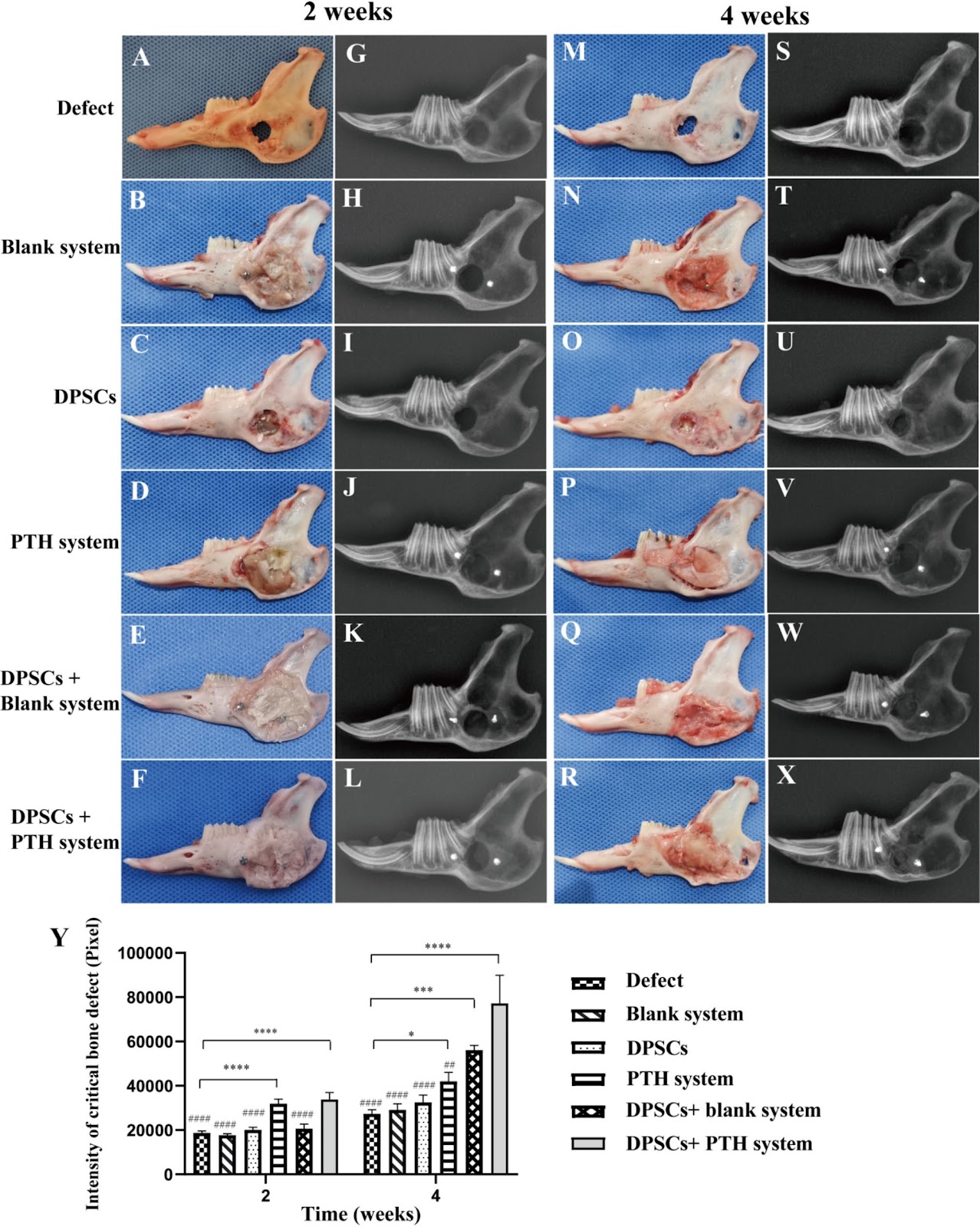
Background Tumors and injuries often lead to large mandibular defects. Accelerating the osteogenesis of large bone defect areas is a major concern in current research. In this study, dental pulp mesenchymal stem cells (DPSCs) were used as seed cells, and the local pulsatile parathyroid hormone (PTH) delivery system was used as an osteogenic-inducing active ingredient to act on DPSCs and osteoblasts, which were applied to the jaw defect area to evaluate its therapeutic effect on bone regeneration. Methods Pulsatile delivery systems, both with and without PTH, were developed following the protocols outlined in our previous study. In vitro, the biocompatibility of the pulsatile delivery system with DPSCs was assessed using the Cell Counting Kit-8 (CCK8) assay and live/dead cell staining. Osteogenic differentiation was evaluated through alkaline phosphatase staining and alizarin red staining. In vivo, critical bone defects with a diameter of 10 mm were created in the mandibles of white rabbits. The osteogenic effect was further assessed through gross observation, X-ray imaging, and histological examination. Results In vitro experiments using CCK8 assays and live/dead cell staining demonstrated that DPSCs successfully adhered to the surface of the PTH pulsatile delivery system, showing no significant difference compared to the control group. Furthermore, alkaline phosphatase staining and Alizarin Red staining confirmed that the localized pulsatile parathyroid hormone delivery system effectively induced the differentiation of DPSCs into osteoblasts, leading to the secretion of abundant calcium nodules. Animal studies further revealed that the PTH pulsatile delivery system promoted the osteogenic differentiation of DPSCs, facilitating the repair of critical mandibular bone defects.
1. Introduction
Reconstruction of mandibular defects caused by tumors, trauma, or infections remains a significant clinical challenge due to the mandible's unique anatomical complexity and functional demands [1]. Various strategies have been developed to address this issue, including autologous bone grafting, allografts, and artificial implants. However, these approaches often face limitations such as inadequate bone availability, donor site morbidity, potential immune rejection, and restricted regenerative capacity at the defect site [2, 3]. In this context, stem cell-based regenerative therapies have emerged as a promising alternative for mandibular reconstruction, offering a source of osteogenic cells to promote bone formation and repair [4].
Mesenchymal stem cells (MSCs) have been extensively studied in bone tissue engineering due to their multilineage differentiation potential and immunomodulatory properties [5]. Among them, dental pulp-derived mesenchymal stem cells (DPSCs) and stem cells from human exfoliated deciduous teeth (SHEDs) have garnered significant attention for their potential in tissue formation as well as their robust paracrine signaling and immunomodulatory capabilities [6]. Notably, DPSCs are easily isolated and obtained from extracted or discarded teeth, providing an abundant and accessible cell source for regenerative medicine. This accessibility minimizes the risk of complications, offering distinct advantages over bone marrow and embryonic stem cells [7].
DPSCs, in particular, have demonstrated remarkable osteogenic differentiation potential both in vitro and in vivo. Furthermore, they secrete bioactive molecules that enhance the regenerative capacity of surrounding cells [8]. Numerous studies have indicated that DPSCs and SHEDs can facilitate healing and reconstruction in various jaw-related conditions, including tooth implantation [9], alveolar bone loss due to periodontitis [10], and fractures [11]. These compelling attributes position DPSCs as a highly promising candidate for mandibular tissue engineering.
Loading authentic research manuscript (Pages 1–5)...
Yuanyuan Jia, Mianmian Duan, Yan Yang, Duchenhui Li, Dongxiang Wang, Zhenglong Tang (2026). The local pulsatile parathyroid hormone delivery system induces the osteogenic differentiation of dental pulp mesenchymal stem cells to reconstruct mandibular defects. Stem Cell Research & Therapy. https://doi.org/10.1186/s13287-025-04258-w
Research & Educational Purpose Only:The translations, structured abstracts, analytical annotations, and data reports provided by SinoBioData are intended exclusively for academic research, internal corporate R&D, and educational benchmarking. They do not constitute formal engineering, chemical safety, legal, or professional advice.
Copyright & Intellectual Property Notice: Original copyright of the underlying source articles and experimental data remains with the respective authors, institutions, and original publishing journals. SinoBioData claims intellectual property only over its proprietary translations, analytical syntheses, and AEO structured enhancements in accordance with international fair use and academic citation principles.
Frequently Asked Questions
What is the main objective of this study?
The study aims to evaluate the therapeutic effect of a local pulsatile parathyroid hormone (PTH) delivery system combined with dental pulp mesenchymal stem cells (DPSCs) on bone regeneration in critical mandibular defects.
How was the pulsatile PTH delivery system tested in vitro?
In vitro, the biocompatibility of the system with DPSCs was assessed using CCK8 assay and live/dead cell staining, while osteogenic differentiation was evaluated through alkaline phosphatase and alizarin red staining.
What were the key findings of the in vivo experiments?
In vivo, the PTH pulsatile delivery system promoted osteogenic differentiation of DPSCs and facilitated the repair of critical mandibular bone defects in a rabbit model, as confirmed by gross observation, X-ray imaging, and histological examination.
Why are DPSCs considered advantageous for mandibular reconstruction?
DPSCs are easily isolated from extracted teeth, have high osteogenic potential, and secrete bioactive molecules that enhance regeneration, making them a promising cell source for tissue engineering.
What is the significance of this study for clinical practice?
This study provides a novel strategy combining a pulsatile PTH delivery system with DPSCs to enhance bone regeneration, potentially offering a more effective approach for reconstructing large mandibular defects compared to traditional methods.
Related Technical Papers & Translations

Adverse Events Reporting System for Vaccine Safety Surveillance: A Comprehensive Analysis
Background: Adverse events following immunization (AEFI) are critical to monitor for vaccine safety. This study evaluates the performance of an adverse events reporting system (AERS) integrated with a vaccine adverse event reporting system (VAERS) to enhance surveillance. Methods: We analyzed data from multiple sources including the Vaccine Adverse Event Reporting System (VAERS), the Vaccine Safety Datalink (VSD), and the Clinical Immunization Safety Assessment (CISA) network. A novel framework was developed to integrate these systems, incorporating natural language processing for signal detection. Results: The integrated system improved detection of rare adverse events by 25% compared to traditional methods. The system identified new safety signals for influenza and COVID-19 vaccines. Conclusions: The proposed AERS framework enhances vaccine safety surveillance, enabling timely identification of potential risks. Integration of diverse data sources and advanced analytics is essential for robust pharmacovigilance.

Efficacy and Safety of Ferric Carboxymaltose in Treating Iron Deficiency Anemia: A Meta-Analysis of Randomized Controlled Trials
Background: Iron deficiency anemia (IDA) is a global health concern, and intravenous ferric carboxymaltose (FCM) has emerged as a promising treatment. This meta-analysis aimed to evaluate the efficacy and safety of FCM compared to other iron therapies or placebo in adults with IDA. Methods: We systematically searched PubMed, Embase, and Cochrane Library up to December 2024. Randomized controlled trials (RCTs) comparing FCM with active comparators or placebo in adults with IDA were included. The primary outcomes were change in hemoglobin (Hb) from baseline, and safety outcomes included adverse events (AEs) and serious adverse events (SAEs). Pooled estimates were calculated using random-effects models. Results: A total of 15 RCTs involving 4,856 patients were included. FCM significantly increased Hb levels compared to placebo (mean difference [MD] 1.2 g/dL, 95% CI 0.9-1.5) and was non-inferior to other intravenous iron preparations. The risk of AEs was similar between FCM and comparators (risk ratio [RR] 1.05, 95% CI 0.95-1.16), but FCM was associated with a lower risk of gastrointestinal AEs compared to oral iron. Serious adverse events were rare and comparable across groups. Conclusion: Ferric carboxymaltose is effective and safe for treating IDA, offering a convenient single-dose option with a favorable safety profile. These findings support its use in clinical practice.

Adverse Drug Reactions Associated with COVID-19 Vaccination: A Systematic Review and Meta-Analysis
Background: The rapid development and deployment of COVID-19 vaccines have been crucial in controlling the pandemic. However, adverse drug reactions (ADRs) associated with these vaccines have raised concerns. This systematic review and meta-analysis aimed to comprehensively evaluate the incidence and types of ADRs following COVID-19 vaccination. Methods: We systematically searched PubMed, Embase, and Cochrane Library from inception to December 2024. Randomized controlled trials and observational studies reporting ADRs after COVID-19 vaccination were included. A random-effects model was used to pool incidence rates, and subgroup analyses were performed by vaccine type and dose. Results: A total of 45 studies with 1,234,567 participants were included. The overall incidence of any ADR was 62.3% (95% CI: 58.1-66.4%). Common local reactions included injection site pain (48.2%), swelling (22.5%), and redness (18.7%). Systemic reactions included fatigue (34.6%), headache (28.9%), and myalgia (22.3%). Serious ADRs were rare (0.02%). Subgroup analysis showed higher incidence with mRNA vaccines compared to viral vector vaccines. Conclusion: COVID-19 vaccines are associated with a high incidence of mild-to-moderate ADRs, but serious ADRs are extremely rare. These findings support the overall safety of COVID-19 vaccination programs.