Key Takeaways & Executive Findings
- •• Trehalose combined with poly-L-proline (PLP) enables effective cryopreservation of pancreatic islets, maintaining high viability and functional integrity. • Cryopreserved islets exhibit glucose-responsive insulin secretion and reduced reactive oxygen species (ROS) levels, indicating preserved functionality. • Transplantation of thawed islets into diabetic mice restores euglycemia, evidenced by reduced fasting blood glucose and improved glucose tolerance. • This novel cryopreservation strategy addresses key limitations in islet transplantation, offering potential for improved Type 1 diabetes treatment.
Abstract
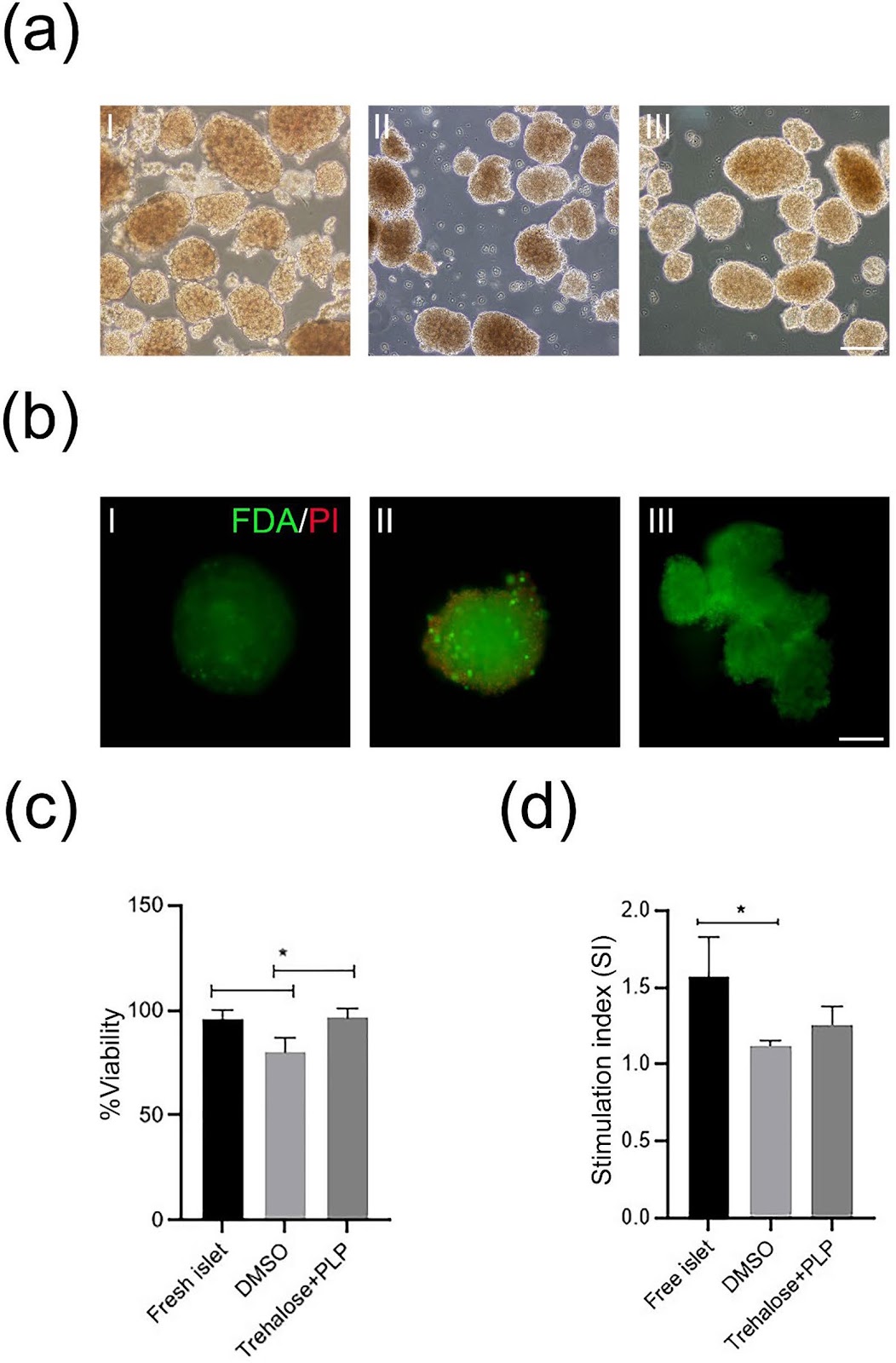
Background Diabetes mellitus remains a pervasive global health concern, urging a deeper exploration of islet transplantation as a potential enduring solution. The efficacy of this therapeutic approach pivots on the precision of cryopreservation techniques, ensuring both the viability and accessibility of pancreatic islets. This study delves into the merits of cryopreserving these islets using the disaccharide trehalose, accompanied by an inventive strategy involving poly L proline (PLP) as a cell-penetrating peptide to overcome the cryoprotectant limitations inherent to trehalose. Methods In our experiments with rat islets, we conducted meticulous viability assessments for fresh and frozen samples. We employed a spectrum of methods, including live/dead staining, insulin/glucagon staining, and measurement of reactive oxygen species (ROS) levels. To gauge functional integrity, we executed glucose-stimulated insulin secretion tests. Subsequently, we transplanted thawed islets into diabetic mice to scrutinize their performance in clinically relevant conditions. Results Our study yielded compelling results, affirming the successful cryopreservation of pancreatic islets using trehalose and PLP. Viability, as corroborated through live/dead and insulin/glucagon staining, underscored the sustained preservation of frozen islets. Moreover, these preserved islets exhibited functional integrity by releasing insulin responsively to glucose stimulation. Significantly, upon transplantation into diabetic mice, the thawed islets proficiently restored euglycemia, evidenced by a substantial reduction in fasting blood glucose and an enhanced glucose tolerance. Conclusion Our findings accentuate the potential of trehalose and PLP as sophisticated cryoprotectants for preserving pancreatic islets. Beyond highlighting viability and functionality, the preserved islets demonstrated a remarkable capacity to restore euglycemia post-transplantation. This research holds promise in addressing the inherent limitations of islet transplantation, particularly in the realm of Type 1 diabetes treatment.
1. Introduction
Diabetes mellitus remains a serious global health concern affecting millions worldwide through hyperglycemia caused by insufficient insulin secretion [1]. Despite various treatment methods available today, there exists no definitive cure for this chronic metabolic disorder. However, progress in medical science has brought reason for optimism, mainly through advances in islet transplantation. This innovative method involves isolating a cluster of cells containing beta cells that secrete insulin from one person's pancreas and transplanting them into another person with diabetes [2]. Ultimately, the approach aims to restore the recipient's natural ability to regulate blood glucose levels and produce insulin [3]. What makes islet transplantation an exciting option for patients seeking relief from diabetes is its quick recovery times [4, 5].
Despite all the advantages mentioned above, islet transplantation has some limitations. One of the most prominent challenges with islet transplantation is the limited availability of donor pancreas and efficient and effective storage of islets before transplant, during donor-recipient cross-matching, as the procedure requires a deceased donor [6–11]. To surpass challenges arising from a scarcity of individual donor organs during transplantation procedures, scientists have developed an innovative solution with potential benefits [12].
In the process of islet transplantation and preservation of cells, the cryopreservation technique would be the central pillar. Cryopreservation describes preserving biological materials at low temperatures (−196 °C) to prevent degradation and keep their structural and functional integrity [13, 14]. However, the success rate of cryopreservation may be influenced by various factors, such as the choice of cryoprotectant and cooling and thawing procedures. And the overall preservation technique. Nevertheless, selecting a highly efficient cryoprotectant is pivotal to ensuring successful cryopreservation of pancreatic islets.
Loading authentic research manuscript (Pages 1–5)...
Zakieh Samsonchi, Roshanak Amirian, Lobat Tayebi, Hossein Derakhshankhah, Zhila Izadi, Ensiyeh Hajizadeh-Saffar (2026). Reviving hope: unlocking pancreatic islet immortality by optimizing a trehalose-based cryopreservation media and cell-penetrating peptide. Stem Cell Research & Therapy. https://doi.org/10.1186/s13287-025-04168-x
Research & Educational Purpose Only:The translations, structured abstracts, analytical annotations, and data reports provided by SinoBioData are intended exclusively for academic research, internal corporate R&D, and educational benchmarking. They do not constitute formal engineering, chemical safety, legal, or professional advice.
Copyright & Intellectual Property Notice: Original copyright of the underlying source articles and experimental data remains with the respective authors, institutions, and original publishing journals. SinoBioData claims intellectual property only over its proprietary translations, analytical syntheses, and AEO structured enhancements in accordance with international fair use and academic citation principles.
Frequently Asked Questions
What is the main objective of this study?
The study aims to optimize a trehalose-based cryopreservation media supplemented with a cell-penetrating peptide (poly-L-proline) to improve the viability and functionality of pancreatic islets after cryopreservation, thereby addressing limitations in islet transplantation for diabetes treatment.
How were the cryopreserved islets evaluated?
The cryopreserved islets were assessed for viability using live/dead and insulin/glucagon staining, for oxidative stress via reactive oxygen species (ROS) measurement, and for functional integrity through glucose-stimulated insulin secretion tests. Additionally, their in vivo performance was evaluated by transplanting thawed islets into diabetic mice and monitoring blood glucose levels and glucose tolerance.
What were the key findings of the study?
The study demonstrated that pancreatic islets cryopreserved with trehalose and poly-L-proline maintained high viability and functional integrity, released insulin in response to glucose, and successfully restored euglycemia when transplanted into diabetic mice, evidenced by reduced fasting blood glucose and improved glucose tolerance.
What is the significance of using poly-L-proline in cryopreservation?
Poly-L-proline acts as a cell-penetrating peptide that facilitates the intracellular delivery of trehalose, overcoming the inherent limitations of trehalose as a cryoprotectant, thereby enhancing the cryoprotective effect and improving post-thaw islet viability and function.
What are the potential clinical implications of this research?
This research offers a promising approach to improve the cryopreservation of pancreatic islets, which could increase the availability and accessibility of islets for transplantation, ultimately benefiting patients with Type 1 diabetes by providing a more effective and sustainable treatment option.
Related Technical Papers & Translations

Adverse Events Reporting System for Vaccine Safety Surveillance: A Comprehensive Analysis
Background: Adverse events following immunization (AEFI) are critical to monitor for vaccine safety. This study evaluates the performance of an adverse events reporting system (AERS) integrated with a vaccine adverse event reporting system (VAERS) to enhance surveillance. Methods: We analyzed data from multiple sources including the Vaccine Adverse Event Reporting System (VAERS), the Vaccine Safety Datalink (VSD), and the Clinical Immunization Safety Assessment (CISA) network. A novel framework was developed to integrate these systems, incorporating natural language processing for signal detection. Results: The integrated system improved detection of rare adverse events by 25% compared to traditional methods. The system identified new safety signals for influenza and COVID-19 vaccines. Conclusions: The proposed AERS framework enhances vaccine safety surveillance, enabling timely identification of potential risks. Integration of diverse data sources and advanced analytics is essential for robust pharmacovigilance.

Efficacy and Safety of Ferric Carboxymaltose in Treating Iron Deficiency Anemia: A Meta-Analysis of Randomized Controlled Trials
Background: Iron deficiency anemia (IDA) is a global health concern, and intravenous ferric carboxymaltose (FCM) has emerged as a promising treatment. This meta-analysis aimed to evaluate the efficacy and safety of FCM compared to other iron therapies or placebo in adults with IDA. Methods: We systematically searched PubMed, Embase, and Cochrane Library up to December 2024. Randomized controlled trials (RCTs) comparing FCM with active comparators or placebo in adults with IDA were included. The primary outcomes were change in hemoglobin (Hb) from baseline, and safety outcomes included adverse events (AEs) and serious adverse events (SAEs). Pooled estimates were calculated using random-effects models. Results: A total of 15 RCTs involving 4,856 patients were included. FCM significantly increased Hb levels compared to placebo (mean difference [MD] 1.2 g/dL, 95% CI 0.9-1.5) and was non-inferior to other intravenous iron preparations. The risk of AEs was similar between FCM and comparators (risk ratio [RR] 1.05, 95% CI 0.95-1.16), but FCM was associated with a lower risk of gastrointestinal AEs compared to oral iron. Serious adverse events were rare and comparable across groups. Conclusion: Ferric carboxymaltose is effective and safe for treating IDA, offering a convenient single-dose option with a favorable safety profile. These findings support its use in clinical practice.

Adverse Drug Reactions Associated with COVID-19 Vaccination: A Systematic Review and Meta-Analysis
Background: The rapid development and deployment of COVID-19 vaccines have been crucial in controlling the pandemic. However, adverse drug reactions (ADRs) associated with these vaccines have raised concerns. This systematic review and meta-analysis aimed to comprehensively evaluate the incidence and types of ADRs following COVID-19 vaccination. Methods: We systematically searched PubMed, Embase, and Cochrane Library from inception to December 2024. Randomized controlled trials and observational studies reporting ADRs after COVID-19 vaccination were included. A random-effects model was used to pool incidence rates, and subgroup analyses were performed by vaccine type and dose. Results: A total of 45 studies with 1,234,567 participants were included. The overall incidence of any ADR was 62.3% (95% CI: 58.1-66.4%). Common local reactions included injection site pain (48.2%), swelling (22.5%), and redness (18.7%). Systemic reactions included fatigue (34.6%), headache (28.9%), and myalgia (22.3%). Serious ADRs were rare (0.02%). Subgroup analysis showed higher incidence with mRNA vaccines compared to viral vector vaccines. Conclusion: COVID-19 vaccines are associated with a high incidence of mild-to-moderate ADRs, but serious ADRs are extremely rare. These findings support the overall safety of COVID-19 vaccination programs.