Key Takeaways & Executive Findings
- •• MSCs alleviate IMQ-induced psoriasis in mice by upregulating serine metabolism and enhancing PSPH expression. • MSCs activate the PINK1-Parkin mitophagy pathway in psoriatic HaCaT cells, leading to reduced NLRP3 inflammasome activation and decreased inflammatory cytokines. • Knockdown of PSPH reverses the therapeutic effects of MSCs, confirming its critical role in mediating the anti-inflammatory action. • MSCs restore skin barrier function by increasing claudin-1 expression and normalizing keratinocyte differentiation markers KRT1 and KRT6.
Abstract
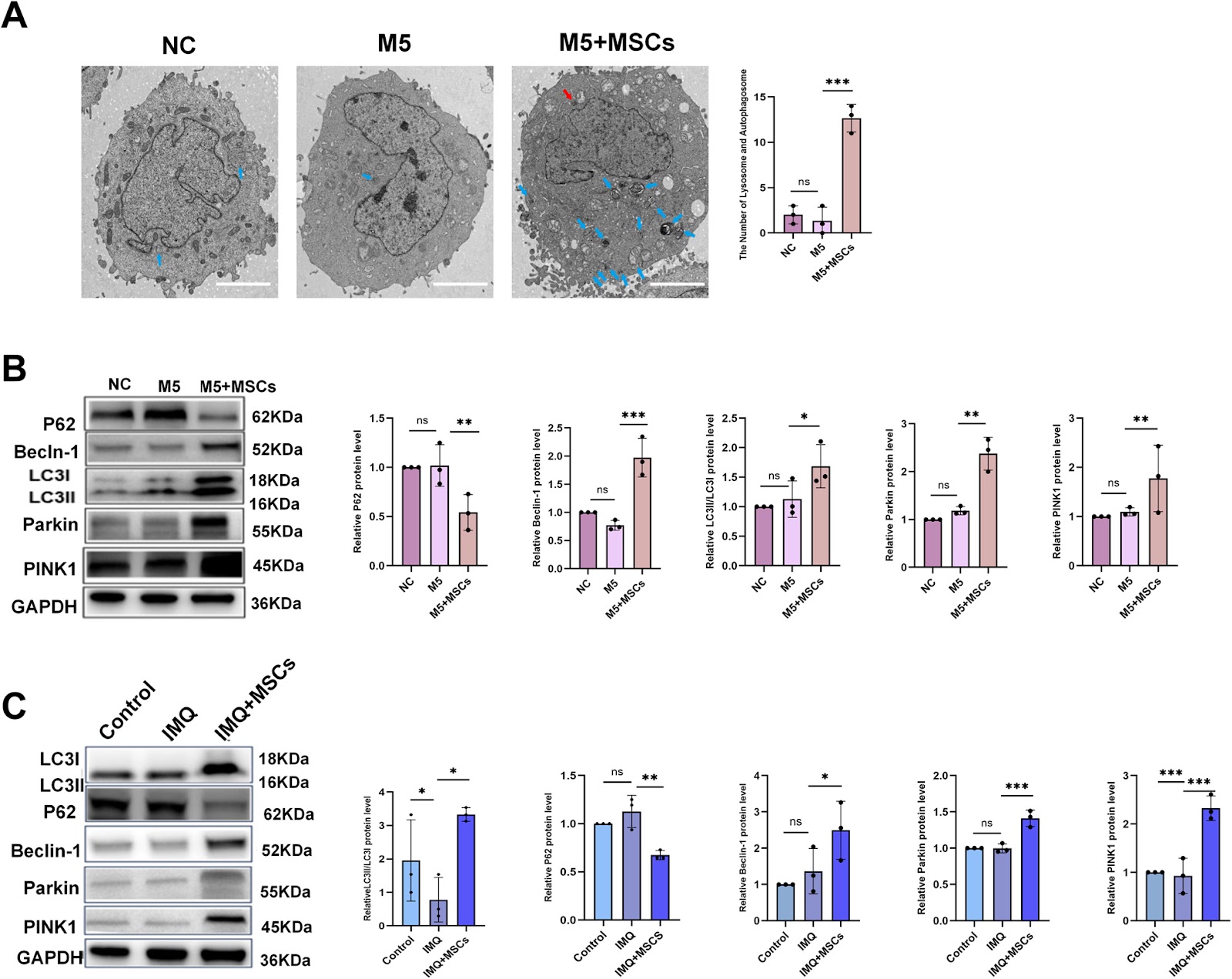
Background: Psoriasis is a refractory immune-related disease. In recent years, it has been discovered that mesenchymal stem cells (MSCs) can be used as a new therapeutic approach for psoriasis, but their potential therapeutic mechanism remains unclear. This study aims to explore the role of MSCs in the treatment of psoriasis. Methods: We employed a mouse psoriasis model induced by imiquimod (IMQ) in vivo and a co-culture system of MSCs and HaCaT keratinocytes (KCs) cell line in vitro. These approaches allowed us to investigate the effect of MSCs on the levels of inflammatory factors and the activation of inflammasomes in both contexts. Mouse-targeted amino acid sequencing, transmission electron microscopy for in vitro observation, immunofluorescence for both in vivo and in vitro analyses, and siRNA transfection in vitro were employed in this study. Results: Our results showed that MSCs significantly improved the skin lesion of mice with psoriasis, and reduced the levels of inflammatory factors and chemokines including IL-1β, IL-6, IL-8, TNF-α, MCP-1, CCL7, CCL20 and CCL27 in the mouse skin lesion areas and M5-induced psoriatic KCs models in vitro. Likewise, MSCs repaired the skin barrier by enhancing claudin-1 expression in vivo. In addition, MSCs increased KRT1 and decreased KRT6 levels in vivo and in vitro. Amino acid metabolism analysis showed that MSCs could improve the serine metabolism level in the mouse skins and upregulated the key enzyme phosphoserine phosphatase (PSPH) in serine metabolism. In vitro experiments demonstrated that knockdown of PSPH could reverse the therapeutic effects of MSCs on psoriasis. Furthermore, studies in vitro and in vivo revealed that MSCs can activate the PINK1-Parkin pathway. It was specifically manifested by elevated levels of PINK1, Parkin, p-Parkin, Beclin-1, and LC3B-II/I, coupled with a reduction in P62 protein. Subsequently, the activation of PINK1-Parkin led to decreased expressions of IL-1β, IL-6, IL-8, TNF-α, CCL7, CCL20, CCL27, and MCP-1. In vitro and in vivo experiments indicated that MSCs can reduce the levels of these inflammatory factors by inhibiting the activation of NLRP3 inflammasomes. Meanwhile, PSPH knockdown in vitro can reverse the activating effects of MSCs on the PINK1-Parkin, as shown by decreased levels of PINK, Parkin, p-Parkin, Beclin-1, and LC3B-II/I, concurrently with an elevation in P62. Conclusions: The results of this study indicated that MSCs can alleviate IMQ-induced psoriasiform dermatitis in mice by upregulating serine metabolism. The key serine metabolism enzyme PSPH may enhance PINK1/Parkin-mediated mitochondrial autophagy in psoriatic HaCaT and inhibit NLRP3 inflammasome activation in HaCaT cells, thereby alleviating skin inflammatory responses and suppressing skin proliferation in psoriatic mice.
1. Introduction
Psoriasis is a chronic inflammatory skin disease that affects approximately 2–3% of the global population [1]. It is characterized by recurrent autoimmune responses, which result in excessive hyperproliferation and aberrant differentiation of KCs [2, 3]. The prevailing hypothesis suggests that the stimulation of inflammatory factors leads to the hyperproliferation of KCs, which subsequently promotes the secretion of pro-inflammatory cytokines, exacerbating the inflammatory response [4–6]. Consequently, psoriatic KCs play a central role in the inflammatory pathogenic loop of psoriasis, functioning both as triggers of immune responses and as pro-inflammatory effectors [7]. Immunomodulatory drugs have shown some success in treating psoriasis [8]. Biologic therapies directed against TNF-α, IL-17, and IL-23 have been introduced, demonstrating considerable clinical efficacy. Nevertheless, treatment with these agents is associated with a susceptibility to disease recurrence and potential adverse effects, including nasopharyngitis, upper respiratory tract infections, and tuberculosis [9]. These limitations underscore the pressing need to develop safer alternative therapeutic strategies for psoriasis management.
MSCs are multipotent progenitor cells capable of modulating immune responses [10, 11]. Interestingly, their immunomodulatory properties can be enhanced by inflammatory cytokines [12, 13]. Thus, MSCs exhibit significant anti-inflammatory abilities in inflammatory microenvironments and are commonly used to treat psoriasis. Several case reports have documented the therapeutic effects of MSC treatment for psoriasis [14, 15]. For example, adipose-derived MSCs were utilized for one patient with psoriasis vulgaris and another with psoriatic arthritis. The patients' Psoriasis Area Severity Index (PASI) scores of the patients decreased (from 21.6 to 9.0 and 24.0 to 8.3, respectively) after multiple MSCs infusions, with no serious adverse events reported [16]. Given their easy accessibility, multipotency, and active paracrine activity, adipose-derived MSCs have emerged as the preferred MSC type for immunotherapy [17]. Therefore, adipose-derived MSCs were adopted in our current study. Nevertheless, the anti-inflammatory mechanisms of MSCs in psoriatic KCs remain poorly understood.
Loading authentic research manuscript (Pages 1–5)...
Qing Lin, Yunfei Ji, Bin Yang, Rongjia Zhu, Ping Song, Robert Chunhua Zhao (2026). Research based on serine metabolism indicates mesenchymal stem cells alleviate psoriasis by regulating the PSPH-PINK1-Parkin-NLRP3 pathway in HaCaT. Stem Cell Research & Therapy. https://doi.org/10.1186/s13287-026-04964-z
Research & Educational Purpose Only:The translations, structured abstracts, analytical annotations, and data reports provided by SinoBioData are intended exclusively for academic research, internal corporate R&D, and educational benchmarking. They do not constitute formal engineering, chemical safety, legal, or professional advice.
Copyright & Intellectual Property Notice: Original copyright of the underlying source articles and experimental data remains with the respective authors, institutions, and original publishing journals. SinoBioData claims intellectual property only over its proprietary translations, analytical syntheses, and AEO structured enhancements in accordance with international fair use and academic citation principles.
Frequently Asked Questions
What is the role of mesenchymal stem cells (MSCs) in treating psoriasis?
MSCs alleviate psoriasis by upregulating serine metabolism, activating the PINK1-Parkin mitophagy pathway, and inhibiting NLRP3 inflammasome activation in keratinocytes, thereby reducing inflammation and skin proliferation.
How does PSPH contribute to the therapeutic effect of MSCs on psoriasis?
PSPH is a key enzyme in serine metabolism that is upregulated by MSCs. Knockdown of PSPH reverses the beneficial effects of MSCs, indicating that PSPH is essential for mediating the anti-inflammatory and anti-proliferative actions.
What is the significance of the PINK1-Parkin pathway in MSC therapy for psoriasis?
MSCs activate the PINK1-Parkin pathway, which promotes mitophagy. This leads to reduced NLRP3 inflammasome activation and decreased secretion of pro-inflammatory cytokines, contributing to the therapeutic effect.
Which inflammatory markers are reduced by MSC treatment in psoriasis?
MSC treatment reduces levels of IL-1β, IL-6, IL-8, TNF-α, MCP-1, CCL7, CCL20, and CCL27 in both in vivo and in vitro models of psoriasis.
What are the potential clinical implications of this study?
This study provides mechanistic insights into how MSCs treat psoriasis, suggesting that targeting serine metabolism and the PSPH-PINK1-Parkin-NLRP3 axis could be a novel therapeutic strategy for psoriasis management.
Related Technical Papers & Translations

Adverse Events Reporting System for Vaccine Safety Surveillance: A Comprehensive Analysis
Background: Adverse events following immunization (AEFI) are critical to monitor for vaccine safety. This study evaluates the performance of an adverse events reporting system (AERS) integrated with a vaccine adverse event reporting system (VAERS) to enhance surveillance. Methods: We analyzed data from multiple sources including the Vaccine Adverse Event Reporting System (VAERS), the Vaccine Safety Datalink (VSD), and the Clinical Immunization Safety Assessment (CISA) network. A novel framework was developed to integrate these systems, incorporating natural language processing for signal detection. Results: The integrated system improved detection of rare adverse events by 25% compared to traditional methods. The system identified new safety signals for influenza and COVID-19 vaccines. Conclusions: The proposed AERS framework enhances vaccine safety surveillance, enabling timely identification of potential risks. Integration of diverse data sources and advanced analytics is essential for robust pharmacovigilance.

Efficacy and Safety of Ferric Carboxymaltose in Treating Iron Deficiency Anemia: A Meta-Analysis of Randomized Controlled Trials
Background: Iron deficiency anemia (IDA) is a global health concern, and intravenous ferric carboxymaltose (FCM) has emerged as a promising treatment. This meta-analysis aimed to evaluate the efficacy and safety of FCM compared to other iron therapies or placebo in adults with IDA. Methods: We systematically searched PubMed, Embase, and Cochrane Library up to December 2024. Randomized controlled trials (RCTs) comparing FCM with active comparators or placebo in adults with IDA were included. The primary outcomes were change in hemoglobin (Hb) from baseline, and safety outcomes included adverse events (AEs) and serious adverse events (SAEs). Pooled estimates were calculated using random-effects models. Results: A total of 15 RCTs involving 4,856 patients were included. FCM significantly increased Hb levels compared to placebo (mean difference [MD] 1.2 g/dL, 95% CI 0.9-1.5) and was non-inferior to other intravenous iron preparations. The risk of AEs was similar between FCM and comparators (risk ratio [RR] 1.05, 95% CI 0.95-1.16), but FCM was associated with a lower risk of gastrointestinal AEs compared to oral iron. Serious adverse events were rare and comparable across groups. Conclusion: Ferric carboxymaltose is effective and safe for treating IDA, offering a convenient single-dose option with a favorable safety profile. These findings support its use in clinical practice.

Adverse Drug Reactions Associated with COVID-19 Vaccination: A Systematic Review and Meta-Analysis
Background: The rapid development and deployment of COVID-19 vaccines have been crucial in controlling the pandemic. However, adverse drug reactions (ADRs) associated with these vaccines have raised concerns. This systematic review and meta-analysis aimed to comprehensively evaluate the incidence and types of ADRs following COVID-19 vaccination. Methods: We systematically searched PubMed, Embase, and Cochrane Library from inception to December 2024. Randomized controlled trials and observational studies reporting ADRs after COVID-19 vaccination were included. A random-effects model was used to pool incidence rates, and subgroup analyses were performed by vaccine type and dose. Results: A total of 45 studies with 1,234,567 participants were included. The overall incidence of any ADR was 62.3% (95% CI: 58.1-66.4%). Common local reactions included injection site pain (48.2%), swelling (22.5%), and redness (18.7%). Systemic reactions included fatigue (34.6%), headache (28.9%), and myalgia (22.3%). Serious ADRs were rare (0.02%). Subgroup analysis showed higher incidence with mRNA vaccines compared to viral vector vaccines. Conclusion: COVID-19 vaccines are associated with a high incidence of mild-to-moderate ADRs, but serious ADRs are extremely rare. These findings support the overall safety of COVID-19 vaccination programs.