Key Takeaways & Executive Findings
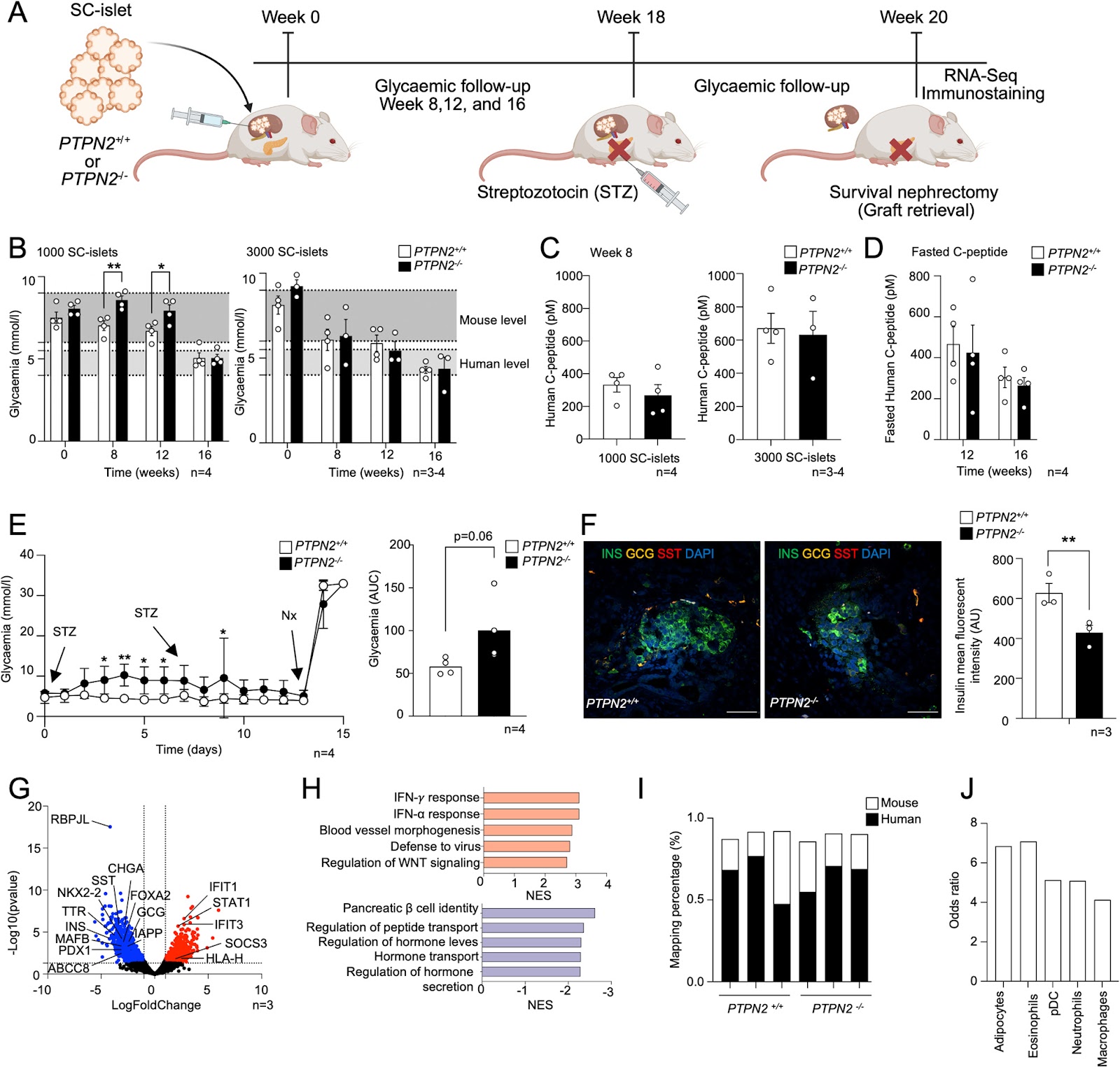
- •• PTPN2 expression is dynamically regulated during SC-islet differentiation and altered in T1D β cells, with increased expression in recent-onset and decreased in long-standing T1D. • PTPN2 deficiency exacerbates interferon-induced inflammatory signalling in stem cells and differentiated somatic metabolic cells. • PTPN2 knockout impairs SC-islet differentiation efficiency in vitro, partly via increased hedgehog signalling. • PTPN2-deficient SC-islets show reduced glycaemic control after implantation in vivo, associated with diminished endocrine identity and enhanced interferon signalling.
Abstract
Background: Protein tyrosine phosphatases (PTPs) play key roles in β-cell function and diabetes development. PTPN2 is a candidate gene for type 1 diabetes (T1D) that negatively regulates JAK/STAT signalling. However, the impact of PTPN2 deficiency on the differentiation and functionality of human stem cell-derived somatic metabolic cells remains unclear. Methods: PTPN2 expression in β cells from T1D organ donors and during the differentiation of human stem cell-derived islets (SC-islets) was evaluated using single-cell RNA-Sequencing (scRNA-Seq) datasets. We differentiated CRISPR-Cas12a genome-edited PTPN2-deficient H1 human embryonic stem cells (H1-hESCs) into SC-islets, and scRNA-Seq was performed. The maturation and functionality of PTPN2-deficient SC-islets were assessed by implantation under the kidney capsule of NOD-SCID mice. Results: scRNA-Seq analysis showed that PTPN2 expression was increased in β cells from recently diagnosed T1D and decreased in long-standing T1D organ donors compared with controls. Conversely, we found that PTPN2 expression was decreased at the early stages of SC-islet differentiation and reconstituted at the later stages, suggesting a developmental dynamic. PTPN2 deficiency exacerbated interferon-induced inflammatory signalling in stem cells and differentiated somatic metabolic cells. Interestingly, PTPN2 deficiency increased hedgehog signalling and reduced SC-islet differentiation efficiency in vitro. In addition, PTPN2-knockout SC-islets exhibited reduced glycaemic control after implantation in vivo, mediated by reduced endocrine cell identity and enhanced interferon signalling. Conclusions: Our study postulates a key role of PTPN2 in preserving β-cell function during inflammatory and metabolic stress in SC-islets.
1. Introduction
Inflammation-mediated pancreatic β-cell destruction is a hallmark of type 1 diabetes (T1D), resulting in diminished β-cell mass and insulin production [1–3]. During insulitis, type I and type II interferons activate the JAK/STAT signalling pathway in β cells via a cascade of tyrosine phosphorylation, exacerbating cytokine production, immune cell infiltration in the pancreas, and β-cell dysfunction [4]. Baricitinib is a pharmacological inhibitor of JAK proteins 1 and 2 used to treat rheumatoid arthritis. Repurposing the drug in a phase 2 clinical trial with recently diagnosed T1D patients showed that baricitinib improved human C-peptide levels during mixed meal insulin secretion [5]. This indicates that the pharmacological inhibition of JAK/STAT signalling preserves β-cell function in patients with T1D.
The superfamily of protein tyrosine phosphatases (PTPs) regulates tyrosine phosphorylation implicated in several pathways, including JAK/STAT signalling. Classical PTPs share highly similar catalytic mechanisms conserved in receptor- and non-receptor-types [6]. PTPN2 and PTPN22 are non-receptor PTPs and known risk genes for T1D [7, 8]. Lack of PTPN2 function caused by single-nucleotide polymorphisms (SNPs) rs2542151 and rs1893217 results in a higher risk of developing T1D and earlier disease development [9]. Complete depletion of PTPN2 in mice results in severe autoimmunity and premature lethality [10]. Furthermore, specific PTPN2 deletion in T cells of non-obese diabetic (NOD) mice causes earlier insulitis and increased diabetes incidence [11], suggesting the importance of PTPN2 in autoimmune diabetes.
Loading authentic research manuscript (Pages 1–5)...
Valerie Vandenbempt, Javier Negueruela, Francisco Ribeiro-Costa, Mariana Nunes, Leonardo Traini, Sema Elif Eski, Wadsen St-Pierre-Wijckmans, Stéphane Demine, Nicolas Baeyens, Hazem Ibrahim, Luciano G. Martelotto, Sumeet Pal Singh, Alessandra K. Cardozo, Mayank Bansal, Esteban N. Gurzov (2026). PTPN2 Deficiency Amplifies Inflammatory Signalling and Impairs Functional Maturation of Human Stem Cell-Derived Islets. Stem Cell Research & Therapy. https://doi.org/10.1186/s13287-025-04892-4
Research & Educational Purpose Only:The translations, structured abstracts, analytical annotations, and data reports provided by SinoBioData are intended exclusively for academic research, internal corporate R&D, and educational benchmarking. They do not constitute formal engineering, chemical safety, legal, or professional advice.
Copyright & Intellectual Property Notice: Original copyright of the underlying source articles and experimental data remains with the respective authors, institutions, and original publishing journals. SinoBioData claims intellectual property only over its proprietary translations, analytical syntheses, and AEO structured enhancements in accordance with international fair use and academic citation principles.
Frequently Asked Questions
What is the role of PTPN2 in type 1 diabetes?
PTPN2 is a protein tyrosine phosphatase that negatively regulates JAK/STAT signalling. It is a candidate gene for type 1 diabetes, and its deficiency exacerbates inflammatory signalling and impairs the functional maturation of stem cell-derived islets, leading to reduced glycaemic control.
How was PTPN2 deficiency studied in this research?
The researchers used CRISPR-Cas12a to generate PTPN2-deficient H1 human embryonic stem cells, differentiated them into SC-islets, and assessed their maturation and functionality in vitro and after implantation in NOD-SCID mice.
What were the main findings regarding PTPN2 expression in T1D?
PTPN2 expression was increased in β cells from recently diagnosed T1D donors but decreased in long-standing T1D donors compared with controls, suggesting a dynamic role during disease progression.
How does PTPN2 deficiency affect SC-islet differentiation?
PTPN2 deficiency increased hedgehog signalling and reduced SC-islet differentiation efficiency in vitro, and resulted in reduced endocrine cell identity and enhanced interferon signalling after implantation in vivo.
What is the potential therapeutic implication of this study?
The study suggests that preserving PTPN2 function could be a strategy to protect β-cell function during inflammatory and metabolic stress, potentially informing therapies for type 1 diabetes.
Related Technical Papers & Translations

Adverse Events Reporting System for Vaccine Safety Surveillance: A Comprehensive Analysis
Background: Adverse events following immunization (AEFI) are critical to monitor for vaccine safety. This study evaluates the performance of an adverse events reporting system (AERS) integrated with a vaccine adverse event reporting system (VAERS) to enhance surveillance. Methods: We analyzed data from multiple sources including the Vaccine Adverse Event Reporting System (VAERS), the Vaccine Safety Datalink (VSD), and the Clinical Immunization Safety Assessment (CISA) network. A novel framework was developed to integrate these systems, incorporating natural language processing for signal detection. Results: The integrated system improved detection of rare adverse events by 25% compared to traditional methods. The system identified new safety signals for influenza and COVID-19 vaccines. Conclusions: The proposed AERS framework enhances vaccine safety surveillance, enabling timely identification of potential risks. Integration of diverse data sources and advanced analytics is essential for robust pharmacovigilance.

Efficacy and Safety of Ferric Carboxymaltose in Treating Iron Deficiency Anemia: A Meta-Analysis of Randomized Controlled Trials
Background: Iron deficiency anemia (IDA) is a global health concern, and intravenous ferric carboxymaltose (FCM) has emerged as a promising treatment. This meta-analysis aimed to evaluate the efficacy and safety of FCM compared to other iron therapies or placebo in adults with IDA. Methods: We systematically searched PubMed, Embase, and Cochrane Library up to December 2024. Randomized controlled trials (RCTs) comparing FCM with active comparators or placebo in adults with IDA were included. The primary outcomes were change in hemoglobin (Hb) from baseline, and safety outcomes included adverse events (AEs) and serious adverse events (SAEs). Pooled estimates were calculated using random-effects models. Results: A total of 15 RCTs involving 4,856 patients were included. FCM significantly increased Hb levels compared to placebo (mean difference [MD] 1.2 g/dL, 95% CI 0.9-1.5) and was non-inferior to other intravenous iron preparations. The risk of AEs was similar between FCM and comparators (risk ratio [RR] 1.05, 95% CI 0.95-1.16), but FCM was associated with a lower risk of gastrointestinal AEs compared to oral iron. Serious adverse events were rare and comparable across groups. Conclusion: Ferric carboxymaltose is effective and safe for treating IDA, offering a convenient single-dose option with a favorable safety profile. These findings support its use in clinical practice.

Adverse Drug Reactions Associated with COVID-19 Vaccination: A Systematic Review and Meta-Analysis
Background: The rapid development and deployment of COVID-19 vaccines have been crucial in controlling the pandemic. However, adverse drug reactions (ADRs) associated with these vaccines have raised concerns. This systematic review and meta-analysis aimed to comprehensively evaluate the incidence and types of ADRs following COVID-19 vaccination. Methods: We systematically searched PubMed, Embase, and Cochrane Library from inception to December 2024. Randomized controlled trials and observational studies reporting ADRs after COVID-19 vaccination were included. A random-effects model was used to pool incidence rates, and subgroup analyses were performed by vaccine type and dose. Results: A total of 45 studies with 1,234,567 participants were included. The overall incidence of any ADR was 62.3% (95% CI: 58.1-66.4%). Common local reactions included injection site pain (48.2%), swelling (22.5%), and redness (18.7%). Systemic reactions included fatigue (34.6%), headache (28.9%), and myalgia (22.3%). Serious ADRs were rare (0.02%). Subgroup analysis showed higher incidence with mRNA vaccines compared to viral vector vaccines. Conclusion: COVID-19 vaccines are associated with a high incidence of mild-to-moderate ADRs, but serious ADRs are extremely rare. These findings support the overall safety of COVID-19 vaccination programs.