Key Takeaways & Executive Findings
- •• Established a stepwise protocol to differentiate human embryonic stem cells into prostate-like organoids in vitro. • Demonstrated that NKX3-1 is essential for prostatic lineage commitment, as its inducible expression enabled generation of AR/FOXA1/NKX3-1 triple-positive cells. • Provided a novel NKX3-1-inducible cell line and a 3D culture system that recapitulates key aspects of prostate development. • Offers a human-derived model to study prostate development and disease, reducing reliance on rodent models.
Abstract
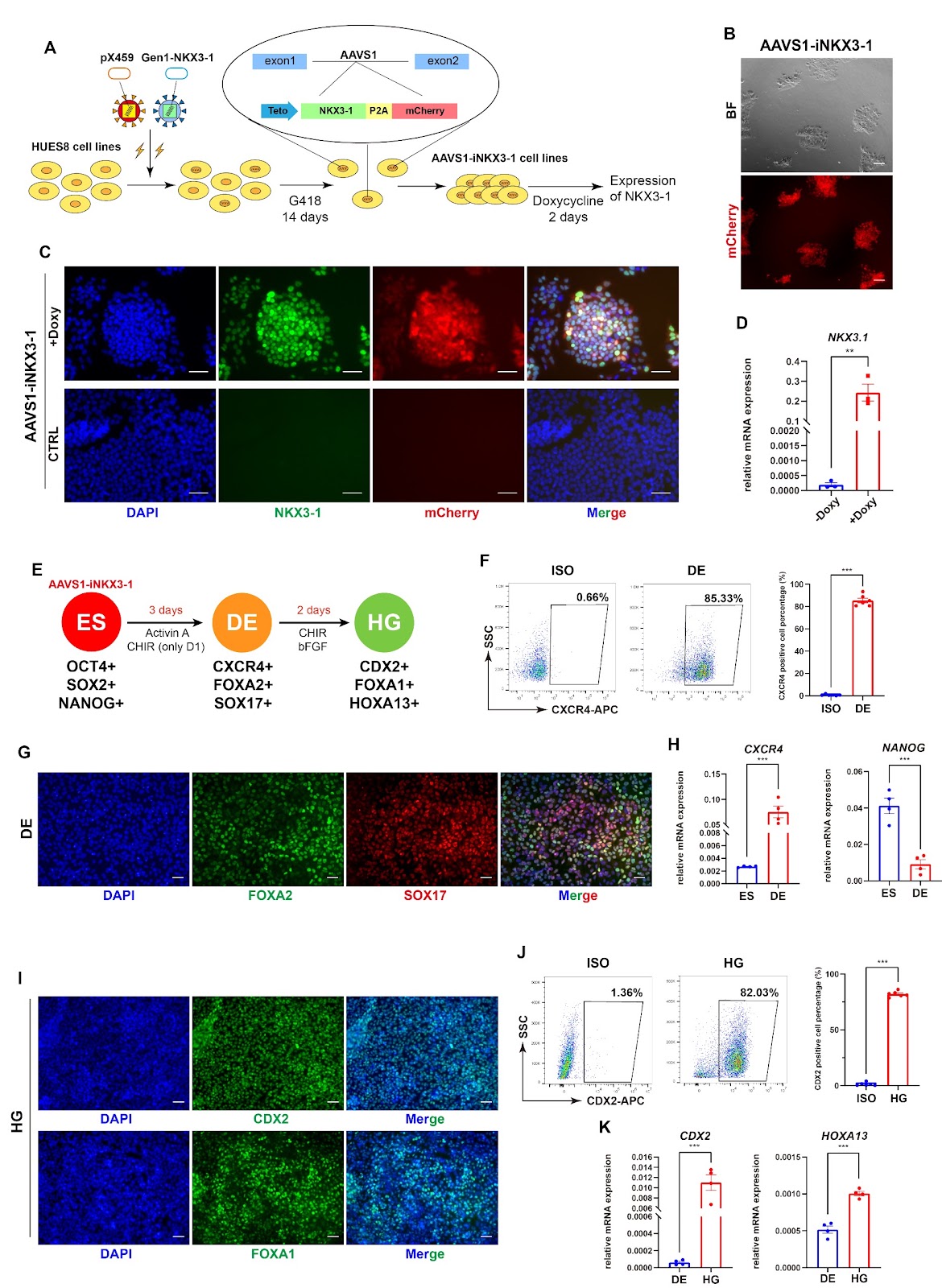
Background Understanding the lineage differentiation of human prostate not only is crucial for basic research on human developmental biology but also significantly contributes to the management of prostate-related disorders. Current knowledge mainly relies on studies on rodent models, lacking human-derived alternatives despite clinical samples may provide a snapshot at certain stage. Human embryonic stem cells can generate all the embryonic lineages including the prostate, and indeed a few studies demonstrate such possibility based on co-culture or co-transplantation with urogenital mesenchyme into mouse renal capsule. Methods To establish a stepwise protocol to obtain prostatic organoids in vitro from human embryonic stem cells, we apply chemicals and growth factors by mimicking the regulation network of transcription factors and signal transduction pathways, and construct cell lines carrying an inducible NKX3-1 expressing cassette, together with three-dimensional culture system. Unpaired t test was applied for statistical analyses. Results We first successfully generate the definitive endoderm, hindgut, and urogenital sinus cells. The embryonic stem cell-derived urogenital sinus cells express prostatic key transcription factors AR and FOXA1, but fail to express NKX3-1. Therefore, we construct NKX3-1-inducible cell line by homologous recombination, which is eventually able to yield AR, FOXA1, and NKX3-1 triple-positive urogenital prostatic lineage cells through stepwise differentiation. Finally, combined with 3D culture we successfully derive prostate-like organoids with certain structures and prostatic cell populations. Conclusions This study reveals the crucial role of NKX3-1 in prostatic differentiation and offers the inducible NKX3-1 cell line, as well as provides a stepwise differentiation protocol to generate human prostate-like organoids, which should facilitate the studies on prostate development and disease pathogenesis.
1. Introduction
The prostate is a crucial organ unique to males, positioned inferior to the bladder, approximately the size of a walnut, composed of ducts with an inner layer of epithelium surrounded by stroma. Its primary functions include controlling urination and secreting prostatic fluid, which are of paramount importance to reproductive health [1]. The prostate is derived from the urogenital sinus (UGS) through a series of events including pre-budding, budding, bud elongation and branching, canalization of the solid epithelial cords, and luminal and basal epithelial cell differentiation [1]. The UGS comprises the urogenital sinus epithelium (UGE) and the urogenital sinus mesenchyme (UGM). The nascent prostate is composed of solid epithelial cords in the initial phase of branching morphogenesis. Subsequently, these epithelial cords undergo canalicular differentiation to form glandular structures, with epithelial cells differentiating into basal, luminal, and neuroendocrine lineages, ultimately leading to the formation of a complete prostatic structure [2]. Through the analysis of cellular lineage, it is evident that the entire length of the primitive urogenital sinus from which the prostate originates, is derived from the endoderm [3].
The prostate forms through epithelial budding from the UGS which is initiated by the action of androgens: during the 9–10 weeks of human embryonic development, Leydig cell-secreted dihydrotestosterone (DHT) binds to androgen receptors (AR) and then enters the nucleus to bind to androgen response elements (ARE) in chromatin, thereby activating AR downstream signals in the UGM [4]. Subsequently, mesenchymal AR activates a paracrine signal that acts on UGE to stimulate the formation of buds [5]. As a pivotal transcription factor in endodermal cells, FOXA1 functions as a pioneer factor and enhances the interaction with chromatin, thereby facilitating the binding of AR to the corresponding androgen receptor response elements and promoting transcription efficiency [6]. The high expression level
Loading authentic research manuscript (Pages 1–5)...
Songwei Wang, Yangyang Yu, Yinglei Li, Tianzhe Zhang, Wei Jiang, Xinghuan Wang, Ran Liu (2026). Prostatic lineage differentiation from human embryonic stem cells through inducible expression of NKX3-1. Stem Cell Research & Therapy. https://doi.org/10.1186/s13287-024-03886-y
Research & Educational Purpose Only:The translations, structured abstracts, analytical annotations, and data reports provided by SinoBioData are intended exclusively for academic research, internal corporate R&D, and educational benchmarking. They do not constitute formal engineering, chemical safety, legal, or professional advice.
Copyright & Intellectual Property Notice: Original copyright of the underlying source articles and experimental data remains with the respective authors, institutions, and original publishing journals. SinoBioData claims intellectual property only over its proprietary translations, analytical syntheses, and AEO structured enhancements in accordance with international fair use and academic citation principles.
Frequently Asked Questions
What is the main achievement of this study?
The study established a stepwise protocol to differentiate human embryonic stem cells into prostate-like organoids in vitro, demonstrating the crucial role of NKX3-1 in prostatic lineage differentiation.
How was NKX3-1 expression induced in the cells?
The researchers constructed an NKX3-1-inducible cell line using homologous recombination, allowing controlled expression of NKX3-1 during differentiation.
What are the key transcription factors involved in prostatic differentiation?
Key transcription factors include AR (androgen receptor), FOXA1, and NKX3-1, which are essential for proper prostatic lineage commitment.
Why is this research significant?
It provides a human-derived model for studying prostate development and disease, reducing reliance on rodent models and offering potential for drug testing and regenerative medicine.
What is the role of NKX3-1 in prostate development?
NKX3-1 is a prostate-specific transcription factor that is critical for prostatic differentiation; its absence prevents the formation of AR/FOXA1/NKX3-1 triple-positive cells, and its induction enables the generation of prostate-like organoids.
Related Technical Papers & Translations

Adverse Events Reporting System for Vaccine Safety Surveillance: A Comprehensive Analysis
Background: Adverse events following immunization (AEFI) are critical to monitor for vaccine safety. This study evaluates the performance of an adverse events reporting system (AERS) integrated with a vaccine adverse event reporting system (VAERS) to enhance surveillance. Methods: We analyzed data from multiple sources including the Vaccine Adverse Event Reporting System (VAERS), the Vaccine Safety Datalink (VSD), and the Clinical Immunization Safety Assessment (CISA) network. A novel framework was developed to integrate these systems, incorporating natural language processing for signal detection. Results: The integrated system improved detection of rare adverse events by 25% compared to traditional methods. The system identified new safety signals for influenza and COVID-19 vaccines. Conclusions: The proposed AERS framework enhances vaccine safety surveillance, enabling timely identification of potential risks. Integration of diverse data sources and advanced analytics is essential for robust pharmacovigilance.

Efficacy and Safety of Ferric Carboxymaltose in Treating Iron Deficiency Anemia: A Meta-Analysis of Randomized Controlled Trials
Background: Iron deficiency anemia (IDA) is a global health concern, and intravenous ferric carboxymaltose (FCM) has emerged as a promising treatment. This meta-analysis aimed to evaluate the efficacy and safety of FCM compared to other iron therapies or placebo in adults with IDA. Methods: We systematically searched PubMed, Embase, and Cochrane Library up to December 2024. Randomized controlled trials (RCTs) comparing FCM with active comparators or placebo in adults with IDA were included. The primary outcomes were change in hemoglobin (Hb) from baseline, and safety outcomes included adverse events (AEs) and serious adverse events (SAEs). Pooled estimates were calculated using random-effects models. Results: A total of 15 RCTs involving 4,856 patients were included. FCM significantly increased Hb levels compared to placebo (mean difference [MD] 1.2 g/dL, 95% CI 0.9-1.5) and was non-inferior to other intravenous iron preparations. The risk of AEs was similar between FCM and comparators (risk ratio [RR] 1.05, 95% CI 0.95-1.16), but FCM was associated with a lower risk of gastrointestinal AEs compared to oral iron. Serious adverse events were rare and comparable across groups. Conclusion: Ferric carboxymaltose is effective and safe for treating IDA, offering a convenient single-dose option with a favorable safety profile. These findings support its use in clinical practice.

Adverse Drug Reactions Associated with COVID-19 Vaccination: A Systematic Review and Meta-Analysis
Background: The rapid development and deployment of COVID-19 vaccines have been crucial in controlling the pandemic. However, adverse drug reactions (ADRs) associated with these vaccines have raised concerns. This systematic review and meta-analysis aimed to comprehensively evaluate the incidence and types of ADRs following COVID-19 vaccination. Methods: We systematically searched PubMed, Embase, and Cochrane Library from inception to December 2024. Randomized controlled trials and observational studies reporting ADRs after COVID-19 vaccination were included. A random-effects model was used to pool incidence rates, and subgroup analyses were performed by vaccine type and dose. Results: A total of 45 studies with 1,234,567 participants were included. The overall incidence of any ADR was 62.3% (95% CI: 58.1-66.4%). Common local reactions included injection site pain (48.2%), swelling (22.5%), and redness (18.7%). Systemic reactions included fatigue (34.6%), headache (28.9%), and myalgia (22.3%). Serious ADRs were rare (0.02%). Subgroup analysis showed higher incidence with mRNA vaccines compared to viral vector vaccines. Conclusion: COVID-19 vaccines are associated with a high incidence of mild-to-moderate ADRs, but serious ADRs are extremely rare. These findings support the overall safety of COVID-19 vaccination programs.