Key Takeaways & Executive Findings
- •• Phase separation is a novel intracellular regulatory mechanism that forms membrane-less organelles and is implicated in the functional regulation of hematopoietic stem cells (HSCs). • The review highlights the interplay between phase separation and genetic, epigenetic, and microenvironmental regulation of HSCs, offering potential therapeutic targets for diseases like leukemia. • Understanding phase separation mechanisms may lead to novel targeted therapies for HSC-related disorders, addressing a gap in current clinical approaches. • The paper emphasizes the need for deeper exploration of phase separation's role in HSC genetic regulation to translate findings into clinical applications.
Abstract
Hematopoietic stem cells (HSCs) are the primitive cells that give rise to common precursors for all blood cell lineages. Abnormalities in their number and/or function are important factors leading to the decline of immune function and the occurrence of various systemic diseases. Phase separation refers to a physicochemical mechanism in which intracellular liquid-liquid phase separation (LLPS) forms membrane-less organelles. It participates in various physiological activities and is related to the occurrence of diseases. Studies have shown that the functional activity of HSCs is regulated by complex mechanisms, and phase separation is closely related to these complex mechanisms such as genetic regulation, epigenetic regulation, microenvironment regulation, gene expression, autophagy degradation, and cell proliferation. With the deepening of research, the importance of phase separation in the pathogenesis and treatment of diseases such as leukemia and tumors has gradually emerged, but the deep mechanism of its regulation of HSCs genetic regulation still lacks exploration, and the direction of clinical targeted therapy is not yet clear. Here, we will summarize and elaborate the genetic regulation mechanism of HSCs, discuss the relationship between phase separation and the functional regulation of HSCs, and analyze the possibility of phase separation participating in the genetic regulation of HSCs to treat diseases, in order to provide help for the clinical implementation of targeted therapy for HSCs regulation.
1. Introduction
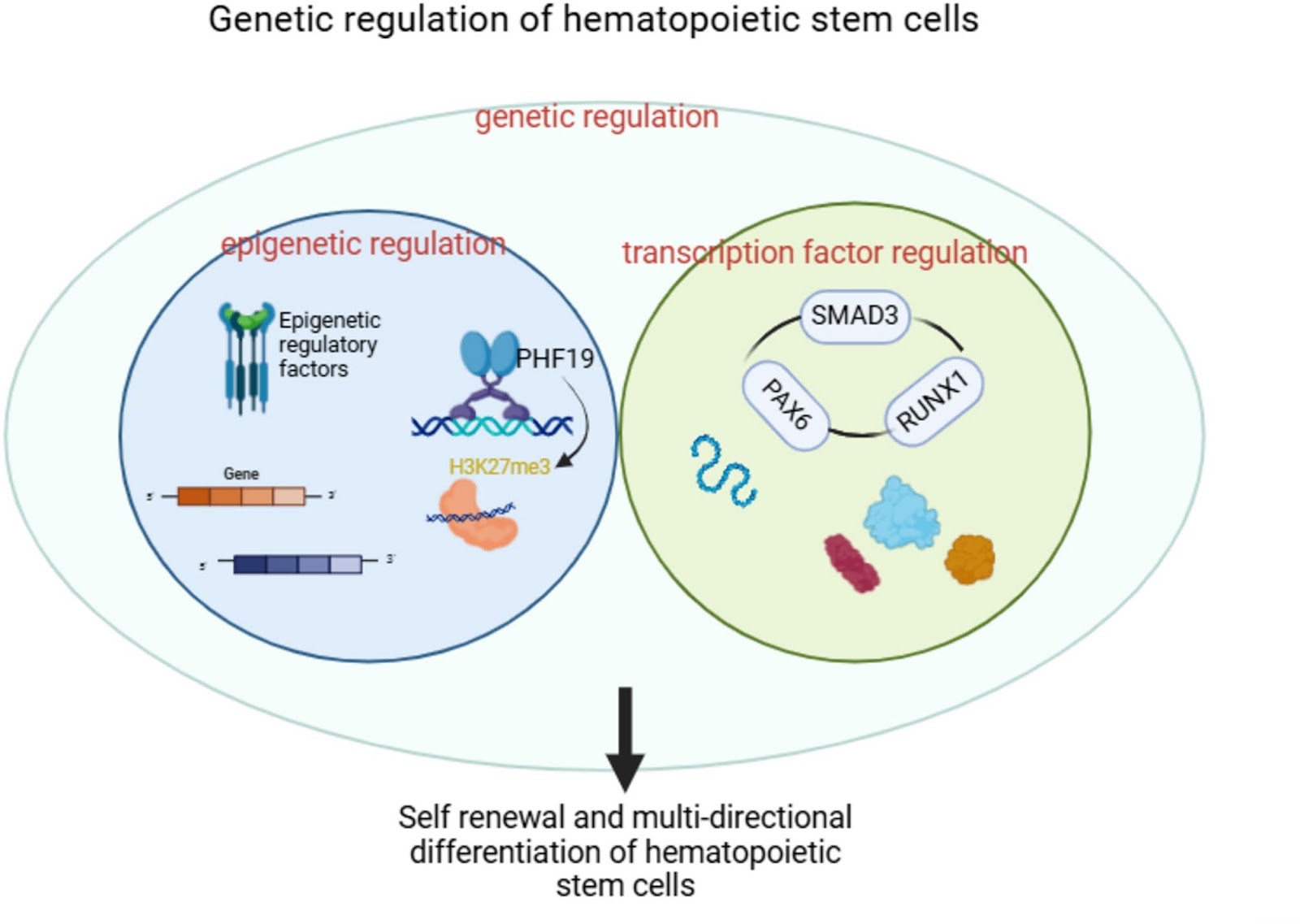
Hematopoietic stem cells (HSCs) are a type of stem cell with long-term self-renewal ability and multi-directional differentiation ability [1]. They are at the top of the hematopoietic hierarchy and play a crucial role in development, tissue repair and regeneration. The functional activity of HSCs is regulated by multiple complex mechanisms, including genetic regulation, epigenetic regulation, and microenvironment regulation. These heterogeneous and diverse HSCs abnormalities are related to the occurrence and development of multiple diseases [2].
As a new intracellular regulatory mechanism, phase separation has received extensive attention in recent years. Studies have shown that the liquid-liquid phase separation (LLPS) of biological macromolecules can form multiple membrane-less compartments in cells. The biomolecular condensates generated by phase separation in cells can participate in various biological activities and functional processes, such as gene expression, stem cell regulation, transcriptional dysregulation, signal transduction and stress response, providing a method to regulate cell function. There are many factors that affect phase separation, including molecular concentration, temperature, ionic strength (salt concentration), pH value, crowding effect, and the impact of nucleic acid molecules on protein phase separation. These factors, acting alone or in combination, affect the fusion and infiltration of biomolecules [3]. Abnormal phase separation is closely related to various diseases such as neurodegenerative diseases and cancer, and may play a role in disease treatment [4]. Phase separation also plays a key role in the regulation of stem cells. Existing studies have found that biomolecular condensates represented by phase separation will affect the epigenetic regulation of cancer stem cells. Understanding its principles and characteristics will help accurately curb the occurrence and development of diseases and find potential therapeutic targets, bringing new possibilities for tumor treatment [5].
Loading authentic research manuscript (Pages 1–5)...
XinYu Tang, Yan Wang, RuiRong Xu (2026). Phase separation participates in the genetic regulation mechanism of hematopoietic stem cells: potential therapeutic methods. Stem Cell Research & Therapy. https://doi.org/10.1186/s13287-025-04350-1
Research & Educational Purpose Only:The translations, structured abstracts, analytical annotations, and data reports provided by SinoBioData are intended exclusively for academic research, internal corporate R&D, and educational benchmarking. They do not constitute formal engineering, chemical safety, legal, or professional advice.
Copyright & Intellectual Property Notice: Original copyright of the underlying source articles and experimental data remains with the respective authors, institutions, and original publishing journals. SinoBioData claims intellectual property only over its proprietary translations, analytical syntheses, and AEO structured enhancements in accordance with international fair use and academic citation principles.
Frequently Asked Questions
What is phase separation and how does it relate to hematopoietic stem cells?
Phase separation is a physicochemical process where intracellular liquid-liquid phase separation forms membrane-less organelles. It participates in various physiological activities and is closely related to the complex regulatory mechanisms of hematopoietic stem cells (HSCs), including genetic, epigenetic, and microenvironmental regulation.
What are the potential therapeutic implications of phase separation in HSC regulation?
Understanding phase separation mechanisms in HSCs may reveal novel therapeutic targets for diseases like leukemia and other blood disorders. By modulating phase separation, it may be possible to correct abnormal HSC function and improve clinical outcomes.
What factors influence phase separation in cells?
Factors such as molecular concentration, temperature, ionic strength, pH, crowding effects, and nucleic acid molecules can influence phase separation. These factors can act alone or in combination to affect the formation and behavior of biomolecular condensates.
What is the current state of research on phase separation and HSC genetic regulation?
Research is still in early stages. While phase separation is known to be involved in stem cell regulation and disease, the deep mechanisms of its role in HSC genetic regulation remain unexplored, and clinical targeted therapies are not yet established.
How might phase separation be targeted for therapeutic purposes in HSC-related diseases?
By identifying specific phase separation processes that are dysregulated in diseases, researchers could develop drugs or interventions to modulate these processes, potentially restoring normal HSC function and treating conditions like leukemia.
Related Technical Papers & Translations

Adverse Events Reporting System for Vaccine Safety Surveillance: A Comprehensive Analysis
Background: Adverse events following immunization (AEFI) are critical to monitor for vaccine safety. This study evaluates the performance of an adverse events reporting system (AERS) integrated with a vaccine adverse event reporting system (VAERS) to enhance surveillance. Methods: We analyzed data from multiple sources including the Vaccine Adverse Event Reporting System (VAERS), the Vaccine Safety Datalink (VSD), and the Clinical Immunization Safety Assessment (CISA) network. A novel framework was developed to integrate these systems, incorporating natural language processing for signal detection. Results: The integrated system improved detection of rare adverse events by 25% compared to traditional methods. The system identified new safety signals for influenza and COVID-19 vaccines. Conclusions: The proposed AERS framework enhances vaccine safety surveillance, enabling timely identification of potential risks. Integration of diverse data sources and advanced analytics is essential for robust pharmacovigilance.

Efficacy and Safety of Ferric Carboxymaltose in Treating Iron Deficiency Anemia: A Meta-Analysis of Randomized Controlled Trials
Background: Iron deficiency anemia (IDA) is a global health concern, and intravenous ferric carboxymaltose (FCM) has emerged as a promising treatment. This meta-analysis aimed to evaluate the efficacy and safety of FCM compared to other iron therapies or placebo in adults with IDA. Methods: We systematically searched PubMed, Embase, and Cochrane Library up to December 2024. Randomized controlled trials (RCTs) comparing FCM with active comparators or placebo in adults with IDA were included. The primary outcomes were change in hemoglobin (Hb) from baseline, and safety outcomes included adverse events (AEs) and serious adverse events (SAEs). Pooled estimates were calculated using random-effects models. Results: A total of 15 RCTs involving 4,856 patients were included. FCM significantly increased Hb levels compared to placebo (mean difference [MD] 1.2 g/dL, 95% CI 0.9-1.5) and was non-inferior to other intravenous iron preparations. The risk of AEs was similar between FCM and comparators (risk ratio [RR] 1.05, 95% CI 0.95-1.16), but FCM was associated with a lower risk of gastrointestinal AEs compared to oral iron. Serious adverse events were rare and comparable across groups. Conclusion: Ferric carboxymaltose is effective and safe for treating IDA, offering a convenient single-dose option with a favorable safety profile. These findings support its use in clinical practice.

Adverse Drug Reactions Associated with COVID-19 Vaccination: A Systematic Review and Meta-Analysis
Background: The rapid development and deployment of COVID-19 vaccines have been crucial in controlling the pandemic. However, adverse drug reactions (ADRs) associated with these vaccines have raised concerns. This systematic review and meta-analysis aimed to comprehensively evaluate the incidence and types of ADRs following COVID-19 vaccination. Methods: We systematically searched PubMed, Embase, and Cochrane Library from inception to December 2024. Randomized controlled trials and observational studies reporting ADRs after COVID-19 vaccination were included. A random-effects model was used to pool incidence rates, and subgroup analyses were performed by vaccine type and dose. Results: A total of 45 studies with 1,234,567 participants were included. The overall incidence of any ADR was 62.3% (95% CI: 58.1-66.4%). Common local reactions included injection site pain (48.2%), swelling (22.5%), and redness (18.7%). Systemic reactions included fatigue (34.6%), headache (28.9%), and myalgia (22.3%). Serious ADRs were rare (0.02%). Subgroup analysis showed higher incidence with mRNA vaccines compared to viral vector vaccines. Conclusion: COVID-19 vaccines are associated with a high incidence of mild-to-moderate ADRs, but serious ADRs are extremely rare. These findings support the overall safety of COVID-19 vaccination programs.