Key Takeaways & Executive Findings
- •• The mZIF-8/PLA membrane, fabricated via electrospinning and biomimetic mineralization, exhibits enhanced hydrophilicity and cell compatibility, promoting osteogenesis and angiogenesis in BMSCs. • The membrane induces M2 macrophage polarization, modulating the local immune microenvironment to support bone regeneration. • In vivo, the membrane bridges critical-sized bone defects within 4 weeks and achieves near-complete repair by 12 weeks, with improved bone strength and vascularization. • This dual-functional membrane offers a promising strategy for guided bone regeneration, addressing limitations of current barrier membranes in osteoinduction and immunomodulation.
Abstract
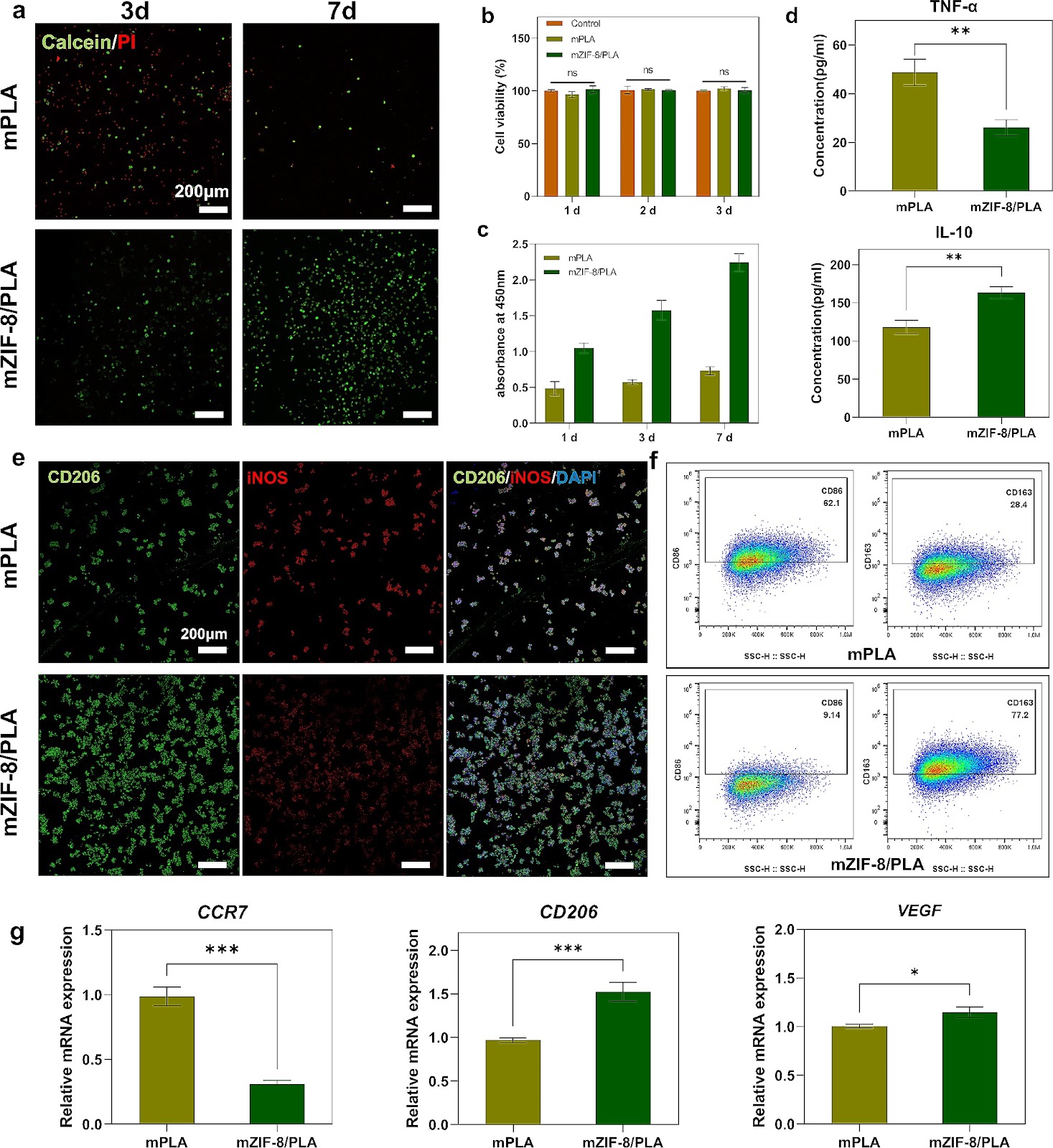
Background Biomaterials used in bone tissue engineering must fulfill the requirements of osteoconduction, osteoinduction, and osseointegration. However, biomaterials with good osteoconductive properties face several challenges, including inadequate vascularization, limited osteoinduction and barrier ability, as well as the potential to trigger immune and inflammatory responses. Therefore, there is an urgent need to develop guided bone regeneration membranes as a crucial component of tissue engineering strategies for repairing bone defects. Methods The mZIF-8/PLA membrane was prepared using electrospinning technology and simulated body fluid external mineralization method. Its ability to induce biomimetic mineralization was evaluated through TEM, EDS, XRD, FT-IR, zeta potential, and wettability techniques. The biocompatibility, osteoinduction properties, and osteo-immunomodulatory effects of the mZIF-8/PLA membrane were comprehensively evaluated by examining cell behaviors of surface-seeded BMSCs and macrophages, as well as the regulation of cellular genes and protein levels using PCR and WB. In vivo, the mZIF-8/PLA membrane's potential to promote bone regeneration and angiogenesis was assessed through Micro-CT and immunohistochemical staining. Results The mineralized deposition enhances hydrophilicity and cell compatibility of mZIF-8/PLA membrane. mZIF-8/PLA membrane promotes up-regulation of osteogenesis and angiogenesis related factors in BMSCs. Moreover, it induces the polarization of macrophages towards the M2 phenotype and modulates the local immune microenvironment. After 4-weeks of implantation, the mZIF-8/PLA membrane successfully bridges critical bone defects and almost completely repairs the defect area after 12-weeks, while significantly improving the strength and vascularization of new bone. Conclusions The mZIF-8/PLA membrane with dual osteoconductive and immunomodulatory abilities could pave new research paths for bone tissue engineering.
1. Introduction
Bone defects commonly arise from various causes such as trauma, infections, and tumors [1]. A significant challenge in the healing of large bone defects is the rapid growth of connective tissue that impedes new bone formation. Guided bone regeneration (GBR) technology has been developed to address this issue and is widely used in orthopedics and dentistry [2–3]. The success of GBR treatment hinges on the properties of the barrier membrane, which acts as a physical barrier separating soft tissue from the bone defect area to prevent interference by fibrous connective tissue. By allowing osteoblasts to proliferate within the bone defect area, the GBR membrane facilitates new bone formation. Therefore, the barrier membrane plays a crucial role in promoting the proliferation and regeneration of bone tissue [4].
Bone-guided membrane materials used in preclinical applications can be categorized into biodegradable and nonbiodegradable types [5, 6]. The nonbiodegradable bone guide membrane typically consist of materials such as polytetrafluoroethylene [7] and titanium [8, 9]. While these nondegradable membrane offer stable material properties and high mechanical strength, they often require a second surgical procedure of removal, potentially leading to complications like mucosal dehiscence, exposure, and postoperative infection [10]. In order to minimize patient discomfort, costs, tissue invasion, and the risk of new bone tissue loss, biodegradable materials are preferred over nonbiodegradable ones for clinical applications. Therefore, studies focused on absorbable membranes based on polymers (both natural and artificial), including collagen (for example, Bio-Gide™ from Wolhusen, Switzerland) [11], polyglycolic acid [12], polylactic acid (PLA) [13], and polycaprolacton [14]. PLA is a particularly suitable for electrospun membrane preparation due to its biocompatibility and non-bioaccumulative nature in vital organs [15]. However, the lack of osteoinductive properties in PLA presents a significant challenge when utilizing it in bone tissue engineering.
Loading authentic research manuscript (Pages 1–5)...
Bingqian Wang, Xinfang Xie, Wenbin Jiang, Yichen Zhan, Yifan Zhang, Yaqi Guo, Zhenxing Wang, Nengqiang Guo, Ke Guo, Jiaming Sun (2026). Osteoinductive micro-nano guided bone regeneration membrane for in situ bone defect repair. Stem Cell Research & Therapy. https://doi.org/10.1186/s13287-024-03745-w
Research & Educational Purpose Only:The translations, structured abstracts, analytical annotations, and data reports provided by SinoBioData are intended exclusively for academic research, internal corporate R&D, and educational benchmarking. They do not constitute formal engineering, chemical safety, legal, or professional advice.
Copyright & Intellectual Property Notice: Original copyright of the underlying source articles and experimental data remains with the respective authors, institutions, and original publishing journals. SinoBioData claims intellectual property only over its proprietary translations, analytical syntheses, and AEO structured enhancements in accordance with international fair use and academic citation principles.
Frequently Asked Questions
What is the mZIF-8/PLA membrane?
The mZIF-8/PLA membrane is a guided bone regeneration membrane fabricated by electrospinning polylactic acid (PLA) with zeolitic imidazolate framework-8 (ZIF-8) nanoparticles, followed by biomimetic mineralization in simulated body fluid. It combines osteoconductive and immunomodulatory properties for enhanced bone repair.
How does the mZIF-8/PLA membrane promote bone regeneration?
The membrane enhances hydrophilicity and cell compatibility, promotes upregulation of osteogenic and angiogenic factors in bone marrow mesenchymal stem cells (BMSCs), and induces macrophage polarization toward the M2 phenotype, creating a favorable immune microenvironment for bone regeneration.
What are the advantages of the mZIF-8/PLA membrane over traditional GBR membranes?
Unlike nondegradable membranes that require removal surgery, the mZIF-8/PLA membrane is biodegradable. It also addresses the lack of osteoinductive properties in pure PLA by incorporating ZIF-8, and its immunomodulatory effects help reduce inflammation and promote tissue integration.
What were the in vivo results of the mZIF-8/PLA membrane?
In a rat model, the membrane successfully bridged critical-sized bone defects within 4 weeks and achieved near-complete repair by 12 weeks, with significantly improved bone strength and vascularization compared to controls.
What is the significance of this study for clinical applications?
The study provides a novel dual-functional membrane that not only acts as a physical barrier but also actively stimulates bone formation and modulates the immune response, offering a promising strategy for improving outcomes in bone defect repair and potentially reducing the need for secondary surgeries.
Related Technical Papers & Translations

Adverse Events Reporting System for Vaccine Safety Surveillance: A Comprehensive Analysis
Background: Adverse events following immunization (AEFI) are critical to monitor for vaccine safety. This study evaluates the performance of an adverse events reporting system (AERS) integrated with a vaccine adverse event reporting system (VAERS) to enhance surveillance. Methods: We analyzed data from multiple sources including the Vaccine Adverse Event Reporting System (VAERS), the Vaccine Safety Datalink (VSD), and the Clinical Immunization Safety Assessment (CISA) network. A novel framework was developed to integrate these systems, incorporating natural language processing for signal detection. Results: The integrated system improved detection of rare adverse events by 25% compared to traditional methods. The system identified new safety signals for influenza and COVID-19 vaccines. Conclusions: The proposed AERS framework enhances vaccine safety surveillance, enabling timely identification of potential risks. Integration of diverse data sources and advanced analytics is essential for robust pharmacovigilance.

Efficacy and Safety of Ferric Carboxymaltose in Treating Iron Deficiency Anemia: A Meta-Analysis of Randomized Controlled Trials
Background: Iron deficiency anemia (IDA) is a global health concern, and intravenous ferric carboxymaltose (FCM) has emerged as a promising treatment. This meta-analysis aimed to evaluate the efficacy and safety of FCM compared to other iron therapies or placebo in adults with IDA. Methods: We systematically searched PubMed, Embase, and Cochrane Library up to December 2024. Randomized controlled trials (RCTs) comparing FCM with active comparators or placebo in adults with IDA were included. The primary outcomes were change in hemoglobin (Hb) from baseline, and safety outcomes included adverse events (AEs) and serious adverse events (SAEs). Pooled estimates were calculated using random-effects models. Results: A total of 15 RCTs involving 4,856 patients were included. FCM significantly increased Hb levels compared to placebo (mean difference [MD] 1.2 g/dL, 95% CI 0.9-1.5) and was non-inferior to other intravenous iron preparations. The risk of AEs was similar between FCM and comparators (risk ratio [RR] 1.05, 95% CI 0.95-1.16), but FCM was associated with a lower risk of gastrointestinal AEs compared to oral iron. Serious adverse events were rare and comparable across groups. Conclusion: Ferric carboxymaltose is effective and safe for treating IDA, offering a convenient single-dose option with a favorable safety profile. These findings support its use in clinical practice.

Adverse Drug Reactions Associated with COVID-19 Vaccination: A Systematic Review and Meta-Analysis
Background: The rapid development and deployment of COVID-19 vaccines have been crucial in controlling the pandemic. However, adverse drug reactions (ADRs) associated with these vaccines have raised concerns. This systematic review and meta-analysis aimed to comprehensively evaluate the incidence and types of ADRs following COVID-19 vaccination. Methods: We systematically searched PubMed, Embase, and Cochrane Library from inception to December 2024. Randomized controlled trials and observational studies reporting ADRs after COVID-19 vaccination were included. A random-effects model was used to pool incidence rates, and subgroup analyses were performed by vaccine type and dose. Results: A total of 45 studies with 1,234,567 participants were included. The overall incidence of any ADR was 62.3% (95% CI: 58.1-66.4%). Common local reactions included injection site pain (48.2%), swelling (22.5%), and redness (18.7%). Systemic reactions included fatigue (34.6%), headache (28.9%), and myalgia (22.3%). Serious ADRs were rare (0.02%). Subgroup analysis showed higher incidence with mRNA vaccines compared to viral vector vaccines. Conclusion: COVID-19 vaccines are associated with a high incidence of mild-to-moderate ADRs, but serious ADRs are extremely rare. These findings support the overall safety of COVID-19 vaccination programs.