Key Takeaways & Executive Findings
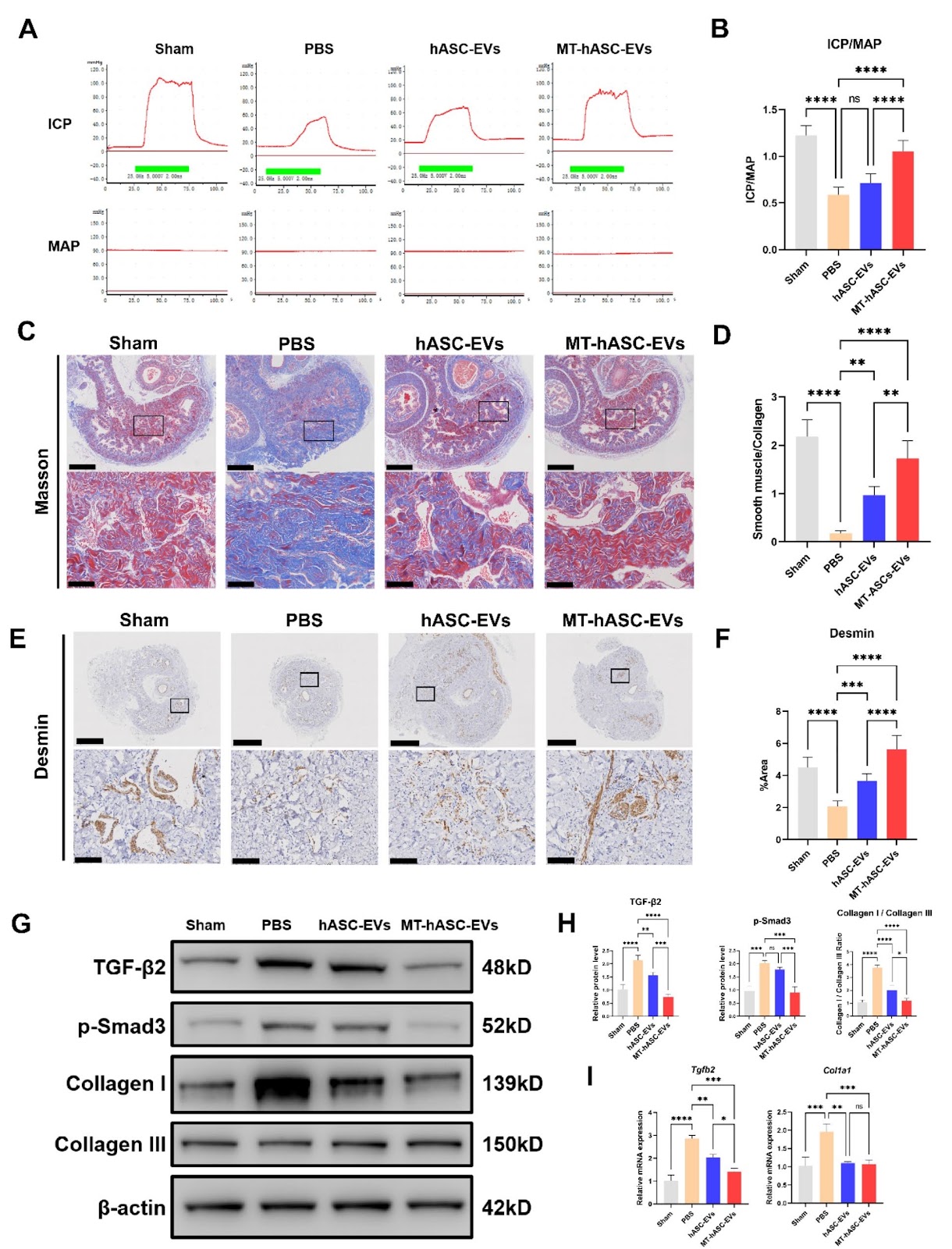
- •• MT-hASC-EVs significantly restore erectile function and reduce cavernous fibrosis in a rat model of CNI-ED. • Mechanistically, MT-hASC-EVs deliver miR-145-5p to target the TGF-β2/Smad3 axis, inhibiting fibrosis. • MT-hASC-EVs promote proliferation and anti-apoptosis of corpus cavernosum smooth muscle cells in vitro. • This study suggests a novel cell-free therapeutic strategy for CNI-ED using melatonin-pretreated stem cell exosomes.
Abstract
Background Cavernous nerve injury-induced erectile dysfunction (CNI-ED) is a common complication after radical prostatectomy. Conventional treatment approaches have had little success in treating the severe cavernous fibrosis which is a consequence of CNI-ED. Methods Pre-treatment of adipose-derived stem cells with melatonin allows for the extraction of active exosomes (MT-hASC-EVs) from the conditioned medium. The therapeutic effects of MT-hASC-EVs were assessed in a rat model of CNI-ED, and the anti-fibrotic properties were evaluated. MicroRNA sequencing was used to identify specific microRNAs highly expressed in MT-hASC-EVs, and differential microRNAs were screened for regulatory pathways through target gene enrichment analysis. Finally, the conclusions from bioinformatics analysis were validated through in vitro experiments. Results Intracavernous injection of MT-hASC-EVs significantly restored erectile function and reduced the extent of corpus cavernosum fibrosis in the CNI-ED rat model. MT-hASC-EVs promoted the proliferation and anti-apoptotic effects of corpus cavernosum smooth muscle cells (CCSMCs) in vitro. Mechanistically, MT-hASC-EVs inhibit fibrosis by delivering miR-145-5p, which targets TGF-β2/Smad3 axis. Conclusions MT-hASCs-EVs can inhibit cavernous fibrosis and improve erectile function in a rat model of CNI-ED by targeting the miR-145-5p/TGF-β/Smad axis.
1. Introduction
Erectile dysfunction (ED) refers to the persistent or recurrent inability to achieve and maintain sufficient penile erection for satisfactory sexual intercourse [1]. The etiology of ED is complex, and cavernous nerve injury (CNI) is a significant contributing factor, commonly associated with pelvic surgery, pelvic fractures, and post-urethral injury surgeries [2]. CNI-induced ED following radical prostatectomy has an incidence rate as high as 63-94%, despite the use of nerve-sparing techniques [3]. During radical prostatectomy, unavoidable traction, compression, and vascular damage to the cavernous nerves lead to impairment and neurotrophic loss which results in reduced penile blood flow perfusion, leading to sustained hypoxia in the corpus cavernosum [3]. Subsequent smooth muscle atrophy occurs along with activation of TGF-β/Smad and RhoA/Rock pathways which lead to cavernous fibrosis [2, 4]. Traditional phosphodiesterase 5 inhibitors (PDE5i, e.g., tadalafil and sildenafil) have limited efficacy in treating CNI-ED due to insensitivity of corpora cavernosa tissue to nitric oxide (NO) resulting from smooth muscle cell loss and cavernous fibrosis [5, 6]. It is worth noting that while regeneration of cavernous nerves could be observed 28 days after CNI in a rat model, subsequent loss of smooth muscle cells and cavernous fibrosis were irreversible [7]. Therefore, prevention, alleviation, or even reversal of cavernous fibrosis represents an important therapeutic direction for managing CNI-ED.
In recent years, stem cells and their derivatives have become new treatment options for ED [8–10], among which extracellular vesicles (EVs) have gained favor among researchers due to their simplicity, convenience, and suitability for industrial production [11]. EVs are sac-like structures that cells release into the extracellular space [12–14]. Based on diameter and source, they can be divided into exosomes (50–100 nm) and microvesicles (100–1000 nm). As a carrier, EVs transport signal proteins, lipids, and nucleic acids, which can be endocytosed by distant target cells, thereby changing the biological behavior of the target cells and serving as a key factor in cell-to-cell signal communication [15]. Many reports have suggested that mesenchymal stem cell-derived EVs have a certain therapeutic effect on CNI-ED [16–19].
Melatonin is a hormone secreted by the pineal gland, primarily responsible for regulating biological rhythms and sleep-wake cycles [20]. In addition, melatonin has been found to have therapeutic
Loading authentic research manuscript (Pages 1–5)...
Xiaolin Zhang, Mengbo Yang, Xinda Chen, Ming Zhang, Yiliang Peng, Mujun Lu (2026). Melatonin-pretreated mesenchymal stem cell-derived exosomes alleviate cavernous fibrosis in a rat model of nerve injury-induced erectile dysfunction via miR-145-5p/TGF-β/Smad axis. Stem Cell Research & Therapy. https://doi.org/10.1186/s13287-025-04173-0
Research & Educational Purpose Only:The translations, structured abstracts, analytical annotations, and data reports provided by SinoBioData are intended exclusively for academic research, internal corporate R&D, and educational benchmarking. They do not constitute formal engineering, chemical safety, legal, or professional advice.
Copyright & Intellectual Property Notice: Original copyright of the underlying source articles and experimental data remains with the respective authors, institutions, and original publishing journals. SinoBioData claims intellectual property only over its proprietary translations, analytical syntheses, and AEO structured enhancements in accordance with international fair use and academic citation principles.
Frequently Asked Questions
What is the main finding of this study?
The study demonstrates that melatonin-pretreated mesenchymal stem cell-derived exosomes (MT-hASC-EVs) significantly alleviate cavernous fibrosis and improve erectile function in a rat model of nerve injury-induced erectile dysfunction (CNI-ED) by delivering miR-145-5p to target the TGF-β2/Smad3 axis.
How do MT-hASC-EVs exert their anti-fibrotic effects?
MT-hASC-EVs inhibit fibrosis by delivering miR-145-5p, which targets the TGF-β2/Smad3 axis, thereby reducing corpus cavernosum fibrosis and promoting smooth muscle cell proliferation and anti-apoptosis.
What is the significance of this research for treating CNI-ED?
This research provides a novel cell-free therapeutic strategy using melatonin-pretreated stem cell exosomes, which could potentially overcome the limitations of conventional treatments for CNI-ED, such as PDE5 inhibitors, by directly addressing cavernous fibrosis.
What experimental models were used in this study?
The study used a rat model of CNI-ED to assess the therapeutic effects of MT-hASC-EVs, along with in vitro experiments on corpus cavernosum smooth muscle cells (CCSMCs) to validate the mechanistic findings.
What is the role of melatonin in this therapy?
Melatonin pretreatment of adipose-derived stem cells enhances the anti-fibrotic properties of the exosomes they secrete, likely by enriching specific microRNAs such as miR-145-5p, which are responsible for the therapeutic effects.
Related Technical Papers & Translations

Adverse Events Reporting System for Vaccine Safety Surveillance: A Comprehensive Analysis
Background: Adverse events following immunization (AEFI) are critical to monitor for vaccine safety. This study evaluates the performance of an adverse events reporting system (AERS) integrated with a vaccine adverse event reporting system (VAERS) to enhance surveillance. Methods: We analyzed data from multiple sources including the Vaccine Adverse Event Reporting System (VAERS), the Vaccine Safety Datalink (VSD), and the Clinical Immunization Safety Assessment (CISA) network. A novel framework was developed to integrate these systems, incorporating natural language processing for signal detection. Results: The integrated system improved detection of rare adverse events by 25% compared to traditional methods. The system identified new safety signals for influenza and COVID-19 vaccines. Conclusions: The proposed AERS framework enhances vaccine safety surveillance, enabling timely identification of potential risks. Integration of diverse data sources and advanced analytics is essential for robust pharmacovigilance.

Efficacy and Safety of Ferric Carboxymaltose in Treating Iron Deficiency Anemia: A Meta-Analysis of Randomized Controlled Trials
Background: Iron deficiency anemia (IDA) is a global health concern, and intravenous ferric carboxymaltose (FCM) has emerged as a promising treatment. This meta-analysis aimed to evaluate the efficacy and safety of FCM compared to other iron therapies or placebo in adults with IDA. Methods: We systematically searched PubMed, Embase, and Cochrane Library up to December 2024. Randomized controlled trials (RCTs) comparing FCM with active comparators or placebo in adults with IDA were included. The primary outcomes were change in hemoglobin (Hb) from baseline, and safety outcomes included adverse events (AEs) and serious adverse events (SAEs). Pooled estimates were calculated using random-effects models. Results: A total of 15 RCTs involving 4,856 patients were included. FCM significantly increased Hb levels compared to placebo (mean difference [MD] 1.2 g/dL, 95% CI 0.9-1.5) and was non-inferior to other intravenous iron preparations. The risk of AEs was similar between FCM and comparators (risk ratio [RR] 1.05, 95% CI 0.95-1.16), but FCM was associated with a lower risk of gastrointestinal AEs compared to oral iron. Serious adverse events were rare and comparable across groups. Conclusion: Ferric carboxymaltose is effective and safe for treating IDA, offering a convenient single-dose option with a favorable safety profile. These findings support its use in clinical practice.

Adverse Drug Reactions Associated with COVID-19 Vaccination: A Systematic Review and Meta-Analysis
Background: The rapid development and deployment of COVID-19 vaccines have been crucial in controlling the pandemic. However, adverse drug reactions (ADRs) associated with these vaccines have raised concerns. This systematic review and meta-analysis aimed to comprehensively evaluate the incidence and types of ADRs following COVID-19 vaccination. Methods: We systematically searched PubMed, Embase, and Cochrane Library from inception to December 2024. Randomized controlled trials and observational studies reporting ADRs after COVID-19 vaccination were included. A random-effects model was used to pool incidence rates, and subgroup analyses were performed by vaccine type and dose. Results: A total of 45 studies with 1,234,567 participants were included. The overall incidence of any ADR was 62.3% (95% CI: 58.1-66.4%). Common local reactions included injection site pain (48.2%), swelling (22.5%), and redness (18.7%). Systemic reactions included fatigue (34.6%), headache (28.9%), and myalgia (22.3%). Serious ADRs were rare (0.02%). Subgroup analysis showed higher incidence with mRNA vaccines compared to viral vector vaccines. Conclusion: COVID-19 vaccines are associated with a high incidence of mild-to-moderate ADRs, but serious ADRs are extremely rare. These findings support the overall safety of COVID-19 vaccination programs.