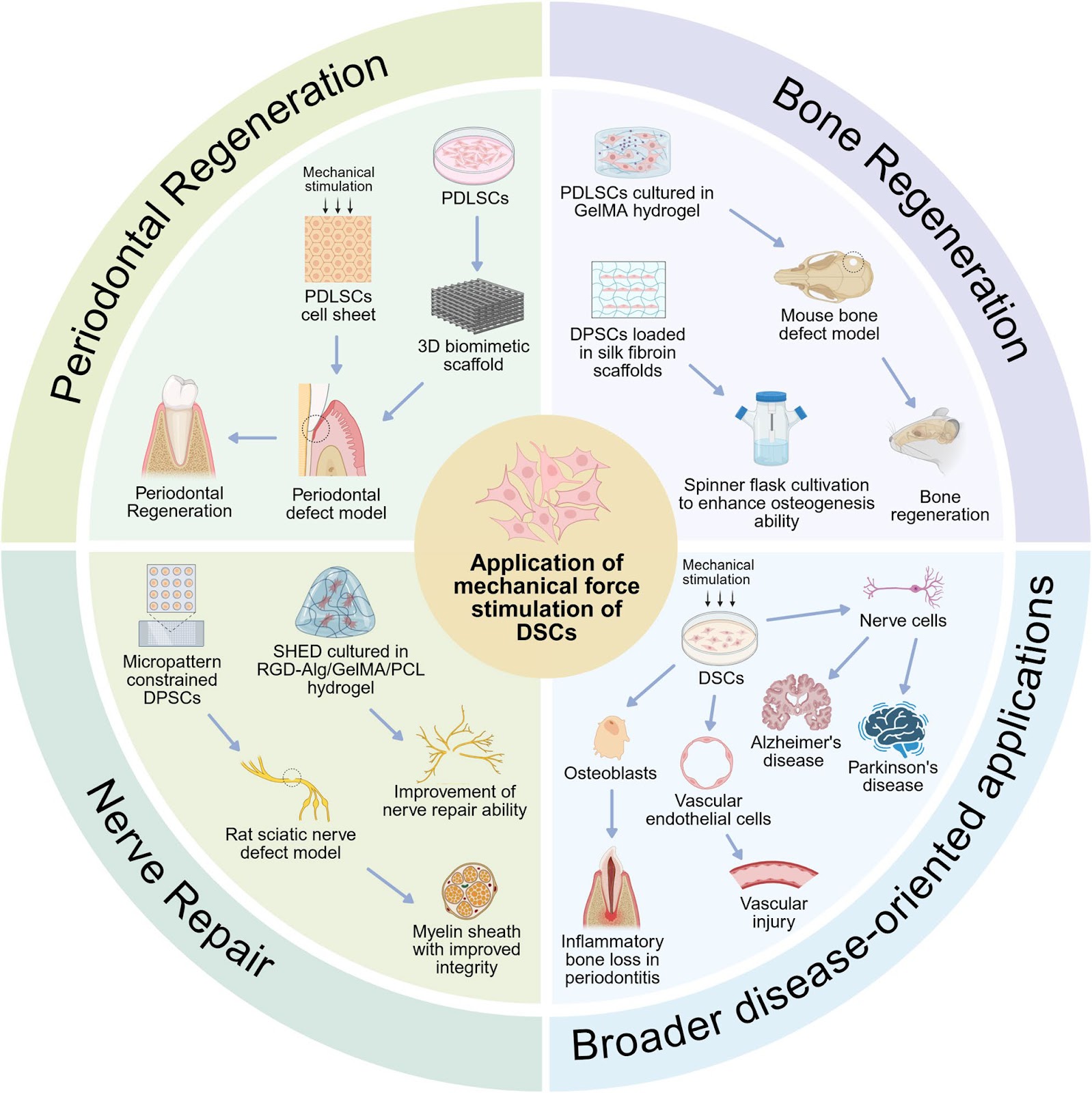
Key Takeaways & Executive Findings
- •• Mechanical preconditioning is a promising mechanomedicine-guided strategy to functionally prime dental-derived stromal cells (DSCs) for enhanced tissue regeneration. • DSCs respond to defined biophysical cues—including tensile/compressive forces, fluid shear stress, hydrostatic pressure, matrix stiffness, and topography—via mechanotransduction pathways that modulate lineage commitment and function. • Quantitative loading windows can be tailored to specific DSC subtypes and clinical indications, enabling more predictable therapeutic outcomes. • Translational success requires overcoming barriers such as stromal cell heterogeneity, donor variability, senescence, and the lack of standardized GMP-compatible manufacturing workflows.
Abstract
Dental-derived stromal cells (DSCs), including periodontal ligament stem cells, dental pulp stem cells, stem cells from the apical papilla, and stem cells from human exfoliated deciduous teeth, are promising candidates for oral and craniofacial regeneration because of their accessibility, expandability, and functional relevance to periodontal, dentin–pulp, bone, and neurovascular repair. However, the therapeutic performance of DSC-based products remains inconsistent, partly because conventionally expanded cells may be insufficiently adapted to the mechanical cues encountered in vivo. In this Review, we present mechanical preconditioning as a mechanomedicine-guided strategy for ex vivo functional priming of DSCs. We summarize how major DSC populations respond to defined biophysical cues such as tensile and compressive forces, fluid shear stress, hydrostatic pressure, matrix stiffness, and surface topography, and we discuss the principal mechanotransduction pathways involved. We further outline representative quantitative loading windows and consider how these may support subtype-specific and indication-specific preconditioning design. Finally, we highlight key translational barriers, including stromal cell heterogeneity, donor variability, senescence, uncertain persistence of mechanically induced states, safety concerns, and the lack of standardized manufacturing workflows. Overall, clinical translation will require a shift from descriptive mechanobiology toward parameter-defined, indication-specific, and good manufacturing practice-compatible preconditioning strategies for DSC-based regeneration.
1. Introduction
Mesenchymal stromal cells (MSCs) are heterogeneous adherent stromal cell populations in which bona fide stem cells constitute only a subset. Standard isolation and expansion procedures generally yield non-clonal mixtures that also include lineage-committed progenitors and more differentiated stromal cells [1, 2]. Among them, dental-derived stromal cells (DSCs) originate from oral tissues and include periodontal ligament stem cells (PDLSCs), dental pulp stem cells (DPSCs), stem cells from the apical papilla (SCAP), and stem cells from human exfoliated deciduous teeth (SHED) [3]. Although these populations are conventionally referred to as “stem cells” in the dental literature, they are more accurately regarded as heterogeneous, non-clonal stromal/progenitor mixtures rather than uniformly defined stem-cell entities [4, 5]. Nevertheless, DSCs remain highly attractive for regenerative applications because they are relatively accessible, can be obtained across multiple developmental stages, expand efficiently ex vivo, and are functionally relevant to periodontal, dentin–pulp, craniofacial, and neurovascular repair [6]. Their generally favorable immunological profile further supports their therapeutic potential [7, 8]. However, despite encouraging preclinical findings, the performance of DSC-based therapies remains inconsistent. One plausible explanation is that conventional expansion is typically performed under mechanically simplified culture conditions that do not recapitulate key biophysical features of the target tissue, potentially limiting subsequent adaptation after implantation [9, 10].
DSCs operate within microenvironments shaped by both biochemical and biophysical cues. A landmark study by Engler et al. established matrix elasticity as a determinant of lineage bias in MSCs, providing a conceptual foundation for mechanical regulation in regenerative biology [11]. This principle is directly relevant to DSCs, whose tissues of origin are embedded in mechanically dynamic oral environments. However, the biomechanical context of oral tissues should be distinguished from the actual biophysical inputs experienced by cells during ex vivo conditioning. Processes such as tooth eruption, occlusion, implantation, and orthodontic tooth movement underscore the mechanically active nature of oral tissues. However, isolated DSCs in experimental systems do not directly experience these macroscopic mechanical events. Rather, they respond to defined physical cues such as tensile and compressive forces, fluid shear stress (FSS), hydrostatic pressure, matrix stiffness, and surface topography [9, 10, 12, 13]. These inputs are sensed through mechanotransduction systems involving integrins, ion channels, focal adhesion complexes, and cytoskeletal–nuclear coupling, and can induce downstream changes in gene expression and cell state that regulate lineage bias and cellular function [14, 15]. Through these processes, mechanical regulation contributes to tissue homeostasis, adaptive remodeling, and regenerative behavior [16].
Loading authentic research manuscript (Pages 1–5)...
Xinyuan Pan, Lan Yang, Jinqi Zou, Gaixin Xu, Yixin Jiang, Guowen Liu, Yuying Wang, Xiaolin Wang, Hongxia Liu, Yanfang Ren, Qiusheng Shi (2026). Mechanomedicine-guided mechanical preconditioning of dental-derived stromal cells for tissue regeneration. Stem Cell Research & Therapy. https://doi.org/10.1186/s13287-026-05049-7
Research & Educational Purpose Only:The translations, structured abstracts, analytical annotations, and data reports provided by SinoBioData are intended exclusively for academic research, internal corporate R&D, and educational benchmarking. They do not constitute formal engineering, chemical safety, legal, or professional advice.
Copyright & Intellectual Property Notice: Original copyright of the underlying source articles and experimental data remains with the respective authors, institutions, and original publishing journals. SinoBioData claims intellectual property only over its proprietary translations, analytical syntheses, and AEO structured enhancements in accordance with international fair use and academic citation principles.
Frequently Asked Questions
What are dental-derived stromal cells (DSCs)?
Dental-derived stromal cells (DSCs) are heterogeneous, non-clonal stromal/progenitor populations isolated from oral tissues, including periodontal ligament stem cells (PDLSCs), dental pulp stem cells (DPSCs), stem cells from the apical papilla (SCAP), and stem cells from human exfoliated deciduous teeth (SHED). They are attractive for regenerative applications due to their accessibility, expandability, and relevance to oral and craniofacial repair.
What is mechanical preconditioning in the context of DSC-based therapies?
Mechanical preconditioning is a mechanomedicine-guided strategy that involves applying controlled biophysical cues—such as tensile/compressive forces, fluid shear stress, hydrostatic pressure, matrix stiffness, and surface topography—to DSCs during ex vivo expansion. This primes the cells to better adapt to the mechanical environment in vivo, potentially improving their therapeutic performance for tissue regeneration.
Which mechanotransduction pathways are involved in DSC responses to mechanical cues?
DSCs sense mechanical cues through mechanotransduction systems involving integrins, ion channels, focal adhesion complexes, and cytoskeletal–nuclear coupling. These pathways translate physical stimuli into downstream changes in gene expression and cell state, regulating lineage bias and cellular functions relevant to regeneration.
What are the main translational barriers for mechanical preconditioning of DSCs?
Key barriers include stromal cell heterogeneity, donor variability, cellular senescence, uncertain persistence of mechanically induced states, safety concerns, and the lack of standardized good manufacturing practice (GMP)-compatible workflows. Overcoming these challenges is essential for clinical translation.
How can mechanical preconditioning be tailored for specific DSC subtypes and indications?
By defining quantitative loading windows (e.g., magnitude, duration, frequency) for each biophysical cue, researchers can design preconditioning protocols that are subtype-specific and indication-specific. This approach aims to bias DSCs toward therapeutically relevant states, such as osteo-/odontogenic differentiation or immunomodulatory phenotypes, depending on the target tissue.
Related Technical Papers & Translations

Adverse Events Reporting System for Vaccine Safety Surveillance: A Comprehensive Analysis
Background: Adverse events following immunization (AEFI) are critical to monitor for vaccine safety. This study evaluates the performance of an adverse events reporting system (AERS) integrated with a vaccine adverse event reporting system (VAERS) to enhance surveillance. Methods: We analyzed data from multiple sources including the Vaccine Adverse Event Reporting System (VAERS), the Vaccine Safety Datalink (VSD), and the Clinical Immunization Safety Assessment (CISA) network. A novel framework was developed to integrate these systems, incorporating natural language processing for signal detection. Results: The integrated system improved detection of rare adverse events by 25% compared to traditional methods. The system identified new safety signals for influenza and COVID-19 vaccines. Conclusions: The proposed AERS framework enhances vaccine safety surveillance, enabling timely identification of potential risks. Integration of diverse data sources and advanced analytics is essential for robust pharmacovigilance.

Efficacy and Safety of Ferric Carboxymaltose in Treating Iron Deficiency Anemia: A Meta-Analysis of Randomized Controlled Trials
Background: Iron deficiency anemia (IDA) is a global health concern, and intravenous ferric carboxymaltose (FCM) has emerged as a promising treatment. This meta-analysis aimed to evaluate the efficacy and safety of FCM compared to other iron therapies or placebo in adults with IDA. Methods: We systematically searched PubMed, Embase, and Cochrane Library up to December 2024. Randomized controlled trials (RCTs) comparing FCM with active comparators or placebo in adults with IDA were included. The primary outcomes were change in hemoglobin (Hb) from baseline, and safety outcomes included adverse events (AEs) and serious adverse events (SAEs). Pooled estimates were calculated using random-effects models. Results: A total of 15 RCTs involving 4,856 patients were included. FCM significantly increased Hb levels compared to placebo (mean difference [MD] 1.2 g/dL, 95% CI 0.9-1.5) and was non-inferior to other intravenous iron preparations. The risk of AEs was similar between FCM and comparators (risk ratio [RR] 1.05, 95% CI 0.95-1.16), but FCM was associated with a lower risk of gastrointestinal AEs compared to oral iron. Serious adverse events were rare and comparable across groups. Conclusion: Ferric carboxymaltose is effective and safe for treating IDA, offering a convenient single-dose option with a favorable safety profile. These findings support its use in clinical practice.

Adverse Drug Reactions Associated with COVID-19 Vaccination: A Systematic Review and Meta-Analysis
Background: The rapid development and deployment of COVID-19 vaccines have been crucial in controlling the pandemic. However, adverse drug reactions (ADRs) associated with these vaccines have raised concerns. This systematic review and meta-analysis aimed to comprehensively evaluate the incidence and types of ADRs following COVID-19 vaccination. Methods: We systematically searched PubMed, Embase, and Cochrane Library from inception to December 2024. Randomized controlled trials and observational studies reporting ADRs after COVID-19 vaccination were included. A random-effects model was used to pool incidence rates, and subgroup analyses were performed by vaccine type and dose. Results: A total of 45 studies with 1,234,567 participants were included. The overall incidence of any ADR was 62.3% (95% CI: 58.1-66.4%). Common local reactions included injection site pain (48.2%), swelling (22.5%), and redness (18.7%). Systemic reactions included fatigue (34.6%), headache (28.9%), and myalgia (22.3%). Serious ADRs were rare (0.02%). Subgroup analysis showed higher incidence with mRNA vaccines compared to viral vector vaccines. Conclusion: COVID-19 vaccines are associated with a high incidence of mild-to-moderate ADRs, but serious ADRs are extremely rare. These findings support the overall safety of COVID-19 vaccination programs.