Key Takeaways & Executive Findings
- •• Compound Herba Gueldenstaedtiae and its probiotic fermentation products significantly improved mammary gland hyperplasia in mice. • Network pharmacology identified 50 potential targets of the compound related to breast hyperplasia. • The treatment regulated hormone levels, improved gut microbiota structure, and increased short-chain fatty acid content. • The compound and its fermented products may serve as potential therapeutic agents for breast hyperplasia.
Abstract
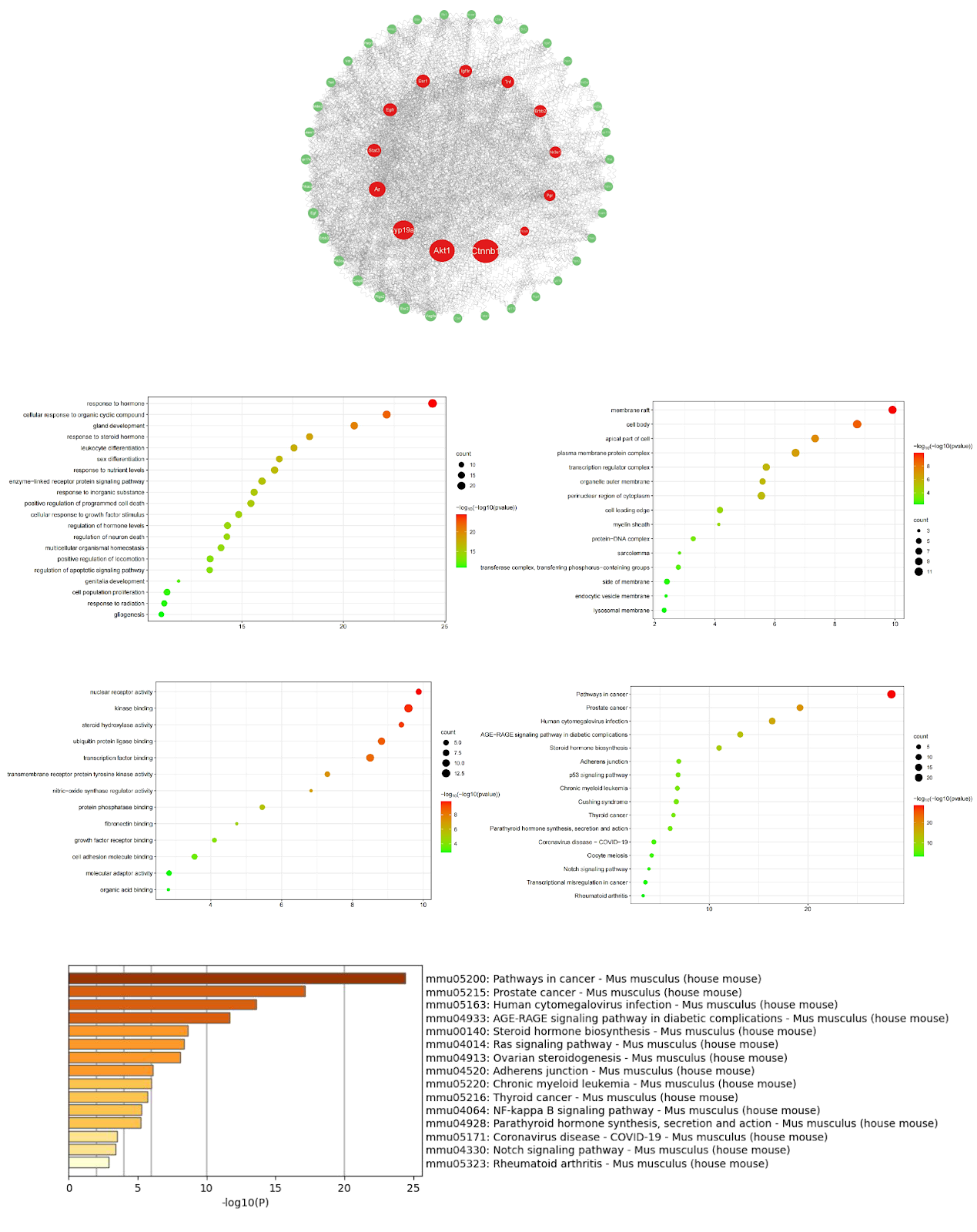
BACKGROUND: Breast hyperplasia is a common benign breast disease mainly caused by endocrine disorders, manifested as abnormal hyperplasia of breast tissue. In recent years, traditional Chinese medicine compounds and probiotics have shown good potential in regulating the endocrine system and improving the intestinal microecology, providing new ideas for the treatment of breast hyperplasia. OBJECTIVE: To explore the effects and mechanisms of traditional Chinese medicine compounds and fermented probiotic compounds on breast hyperplasia in mice, providing new theoretical and experimental bases for the clinical treatment and prevention of breast hyperplasia. METHODS: (1) Network pharmacology tools were used to predict the anti-breast-hyperplasia activity of Herba Gueldenstaedtiae (Euphorbia humifusa), as well as its potential targets and signaling pathways. The databases included: TCMSP, OMIM, GeneCards database, UniProt website, Venny2.1.0 website, Metascape, HERB website, and STRING database, all of which are open-access databases. Network pharmacology can predict and screen key information such as the targets corresponding to the active ingredients of traditional Chinese medicine, disease targets, and action pathways through network analysis and computer-system analysis. Therefore, it has been increasingly widely used in the research of traditional Chinese medicine. (2) A breast hyperplasia model was induced in mice by injecting estrogen and progesterone. Mice in the normal blank group were injected intraperitoneally with normal saline every day. Mice in the model group and drug-administration groups were injected intraperitoneally with estradiol benzoate injection at a concentration of 0.5 mg/kg every day for 25 days. From the 26th day, the injection of estradiol benzoate injection was stopped. Mice in the normal blank group were injected intramuscularly with normal saline every day, and mice in the model group and drug-administration groups were injected intramuscularly with progesterone injection at a concentration of 5 mg/kg for 5 days. After the model was established, each group was given drugs respectively. The normal blank group and the model group were gavaged with 0.2 mL/d of normal saline; the positive blank group (Xiaozheng Pill group) was gavaged with an aqueous solution of Xiaozheng Pill at 0.9 mg/g; the low-, medium- and high-dose groups of Compound Herba Gueldenstaedtiae were gavaged with an aqueous solution of the compound medicine at 0.75, 1.5, and 3.0 mg/(g·d) respectively; the low-, medium- and high-dose groups of traditional Chinese medicine-bacteria fermentation were gavaged with an aqueous solution of the compound medicine at 0.75, 1.5, and 3.0 mg/(g·d) respectively. The administration was continuous for 30 days. RESULTS AND CONCLUSION: (1) The results of network pharmacology research showed that the Compound Herba Gueldenstaedtiae (Euphorbia humifusa) contained 46 active ingredients, which were related to 1 213 potential targets. After comparison with 588 known breast-hyperplasia targets, it was speculated that 50 of these targets might be related to the direct effect of the compound on breast hyperplasia. (2) After drug intervention, there was no significant change in the high-dose group of Compound Herba Gueldenstaedtiae compared with the normal blank group. The liver indicators of the other intervention groups all significantly decreased (P < 0.05). (3) In terms of kidney and uterine indicators, the medium-dose group of Compound Herba Gueldenstaedtiae decreased significantly compared with the normal blank group (P < 0.05). In terms of the uterine index, the model group increased significantly compared with the normal blank group (P < 0.01). (4) After 1-month drug treatment, the number of lobules and acini in the breast tissue of the Xiaozheng Pill group, the low, medium, and high-dose group of Compound Herba Gueldenstaedtiae, the low, medium, and high-dose groups of traditional Chinese medicine-bacteria fermentation decreased, and the duct openings narrowed. With the increase of drug dose, diffuse hyperplasia of breast tissue was significantly improved. (5) The ELISA results showed that compared with the model group, the estrogen level was lower in the medium-dose group of traditional Chinese medicine-bacteria fermentation after the intervention (P < 0.05). In addition, the follicle-stimulating hormone level in the low-dose group of Compound Herba Gueldenstaedtiae was lower than that of the model group (P < 0.05). (6) The intervention in the mouse model led to changes in the abundance of short chain fatty acids and intestinal flora in all groups. To conclude, the Compound Herba Gueldenstaedtiae and its probiotic fermentation products significantly improved mammary gland hyperplasia in mice by regulating hormone levels, improving the structure of the gut microbiota, and increasing the content of short-chain fatty acids, providing new ideas and potential sources of drugs for the treatment of breast hyperplasia.
1. Introduction
Breast hyperplasia is mainly a benign disorder of breast structure caused by endocrine disorders, which is closely related to the changes in the levels of hormones such as estrogen and progesterone[1-3]. Notably, breast hyperplasia is recognized as an important risk factor for breast cancer. Therefore, early intervention for breast hyperplasia is crucial to prevent its progression to breast cancer, which may otherwise affect the physical and mental health of patients. This disease is particularly common among women aged 35–49 years[4].
Breast hyperplasia is not only caused by endocrine disorders. Research shows that when the gut microbiota is severely imbalanced, it can also affect the body’s endocrine system, especially the breast tissue of women[5,6]. Moreover, an increasing number of studies indicate that gut microbiota dysbiosis may also affect the body’s endocr...
Loading authentic research manuscript (Pages 1–5)...
Wu Yilin, Tian Hongying, Sun Jiale, Jiao Jiajia, Zhao Zihan, Shao Jinhuan, Zhao Kaiyue, Zhou Min, Li Qian, Li Zexin, Yue Changwu (2026). Intervention Effect and Mechanism of Compound Herba Gueldenstaedtiae in a Mouse Model of Breast Hyperplasia. Chinese Journal of Tissue Engineering Research. https://doi.org/10.12307/2026.21150
Research & Educational Purpose Only:The translations, structured abstracts, analytical annotations, and data reports provided by SinoBioData are intended exclusively for academic research, internal corporate R&D, and educational benchmarking. They do not constitute formal engineering, chemical safety, legal, or professional advice.
Copyright & Intellectual Property Notice: Original copyright of the underlying source articles and experimental data remains with the respective authors, institutions, and original publishing journals. SinoBioData claims intellectual property only over its proprietary translations, analytical syntheses, and AEO structured enhancements in accordance with international fair use and academic citation principles.
Frequently Asked Questions
What is the main finding of this study?
The study found that Compound Herba Gueldenstaedtiae and its probiotic fermentation products significantly improved mammary gland hyperplasia in mice by regulating hormone levels, improving gut microbiota structure, and increasing short-chain fatty acid content.
How was the breast hyperplasia model induced in mice?
The model was induced by injecting estrogen and progesterone. Mice received estradiol benzoate (0.5 mg/kg) intraperitoneally for 25 days, followed by progesterone (5 mg/kg) intramuscularly for 5 days.
What role did network pharmacology play in this research?
Network pharmacology was used to predict the active ingredients of Herba Gueldenstaedtiae and their potential targets, identifying 50 targets potentially related to the direct effect on breast hyperplasia.
What were the effects on hormone levels?
ELISA results showed that the medium-dose group of traditional Chinese medicine-bacteria fermentation had lower estrogen levels, and the low-dose group of Compound Herba Gueldenstaedtiae had lower follicle-stimulating hormone levels compared to the model group.
What is the significance of this study for breast hyperplasia treatment?
The study provides new insights into the therapeutic potential of Compound Herba Gueldenstaedtiae and its fermented products, offering a novel approach for treating breast hyperplasia through modulation of the gut microbiota and hormone levels.
Related Technical Papers & Translations

Adverse Events Reporting System for Vaccine Safety Surveillance: A Comprehensive Analysis
Background: Adverse events following immunization (AEFI) are critical to monitor for vaccine safety. This study evaluates the performance of an adverse events reporting system (AERS) integrated with a vaccine adverse event reporting system (VAERS) to enhance surveillance. Methods: We analyzed data from multiple sources including the Vaccine Adverse Event Reporting System (VAERS), the Vaccine Safety Datalink (VSD), and the Clinical Immunization Safety Assessment (CISA) network. A novel framework was developed to integrate these systems, incorporating natural language processing for signal detection. Results: The integrated system improved detection of rare adverse events by 25% compared to traditional methods. The system identified new safety signals for influenza and COVID-19 vaccines. Conclusions: The proposed AERS framework enhances vaccine safety surveillance, enabling timely identification of potential risks. Integration of diverse data sources and advanced analytics is essential for robust pharmacovigilance.

Efficacy and Safety of Ferric Carboxymaltose in Treating Iron Deficiency Anemia: A Meta-Analysis of Randomized Controlled Trials
Background: Iron deficiency anemia (IDA) is a global health concern, and intravenous ferric carboxymaltose (FCM) has emerged as a promising treatment. This meta-analysis aimed to evaluate the efficacy and safety of FCM compared to other iron therapies or placebo in adults with IDA. Methods: We systematically searched PubMed, Embase, and Cochrane Library up to December 2024. Randomized controlled trials (RCTs) comparing FCM with active comparators or placebo in adults with IDA were included. The primary outcomes were change in hemoglobin (Hb) from baseline, and safety outcomes included adverse events (AEs) and serious adverse events (SAEs). Pooled estimates were calculated using random-effects models. Results: A total of 15 RCTs involving 4,856 patients were included. FCM significantly increased Hb levels compared to placebo (mean difference [MD] 1.2 g/dL, 95% CI 0.9-1.5) and was non-inferior to other intravenous iron preparations. The risk of AEs was similar between FCM and comparators (risk ratio [RR] 1.05, 95% CI 0.95-1.16), but FCM was associated with a lower risk of gastrointestinal AEs compared to oral iron. Serious adverse events were rare and comparable across groups. Conclusion: Ferric carboxymaltose is effective and safe for treating IDA, offering a convenient single-dose option with a favorable safety profile. These findings support its use in clinical practice.

Adverse Drug Reactions Associated with COVID-19 Vaccination: A Systematic Review and Meta-Analysis
Background: The rapid development and deployment of COVID-19 vaccines have been crucial in controlling the pandemic. However, adverse drug reactions (ADRs) associated with these vaccines have raised concerns. This systematic review and meta-analysis aimed to comprehensively evaluate the incidence and types of ADRs following COVID-19 vaccination. Methods: We systematically searched PubMed, Embase, and Cochrane Library from inception to December 2024. Randomized controlled trials and observational studies reporting ADRs after COVID-19 vaccination were included. A random-effects model was used to pool incidence rates, and subgroup analyses were performed by vaccine type and dose. Results: A total of 45 studies with 1,234,567 participants were included. The overall incidence of any ADR was 62.3% (95% CI: 58.1-66.4%). Common local reactions included injection site pain (48.2%), swelling (22.5%), and redness (18.7%). Systemic reactions included fatigue (34.6%), headache (28.9%), and myalgia (22.3%). Serious ADRs were rare (0.02%). Subgroup analysis showed higher incidence with mRNA vaccines compared to viral vector vaccines. Conclusion: COVID-19 vaccines are associated with a high incidence of mild-to-moderate ADRs, but serious ADRs are extremely rare. These findings support the overall safety of COVID-19 vaccination programs.