Key Takeaways & Executive Findings
- •• Whole adipose tissue conditioned media inhibits TGF-β1-induced fibroblast-to-myofibroblast differentiation, whereas ADSC or lipid conditioned media do not. • Hepatocyte growth factor (HGF) is present in adipose tissue conditioned media but is not responsible for the observed inhibition. • Adipose tissue conditioned media can reverse myofibroblast phenotype in TGF-β1-treated fibroblasts but not in scar-derived cell populations. • The study underscores the importance of whole adipose tissue in autologous fat grafting for hypertrophic scar treatment, warranting further mechanistic investigation.
Abstract
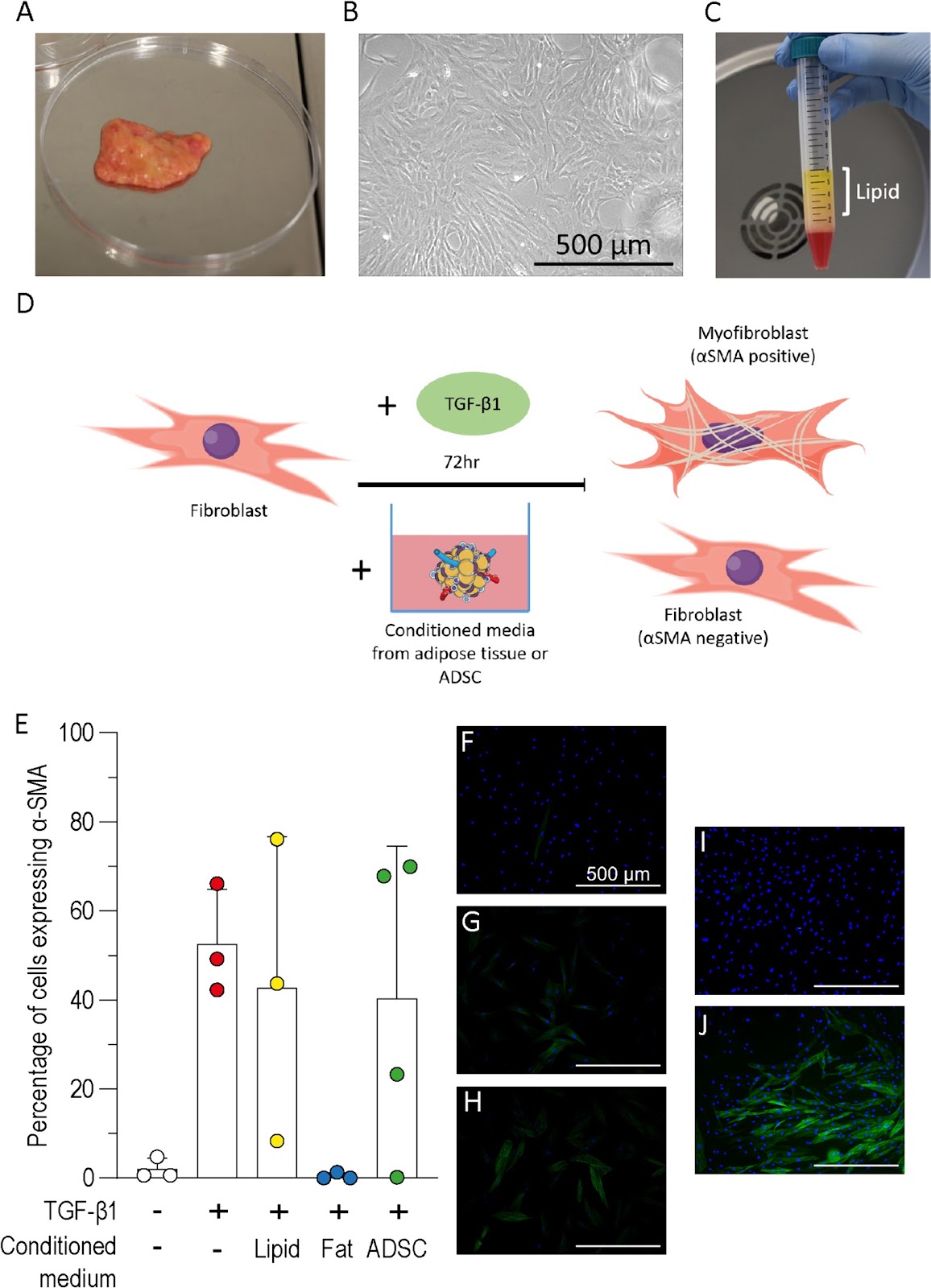
Background Hypertrophic scarring results from myofibroblast differentiation and persistence during wound healing. Currently no effective treatment for hypertrophic scarring exists however, autologous fat grafting has been shown to improve scar elasticity, appearance, and function. The aim of this study was to understand how paracrine factors from adipose tissues and adipose-derived stromal cells (ADSC) affect fibroblast to myofibroblast differentiation. Methods The transforming growth factor-β1 (TGF-β1) induced model of myofibroblast differentiation was used to test the effect of conditioned media from adipose tissue, ADSC or lipid on the proportion of fibroblasts and myofibroblasts. Results Adipose tissue conditioned media inhibited the differentiation of fibroblasts to myofibroblasts but this inhibition was not observed following treatment with ADSC or lipid conditioned media. Hepatocyte growth factor (HGF) was readily detected in the conditioned medium from adipose tissue but not ADSC. Cells treated with HGF, or fortinib to block HGF, demonstrated that HGF was not responsible for the inhibition of myofibroblast differentiation. Conditioned media from adipose tissue was shown to reduce the proportion of myofibroblasts when added to fibroblasts previously treated with TGF-β1, however, conditioned media treatment was unable to significantly reduce the proportion of myofibroblasts in cell populations isolated from scar tissue. Conclusions Cultured ADSC or adipocytes have been the focus of most studies, however, this work highlights the importance of considering whole adipose tissue to further our understanding of fat grafting. This study supports the use of autologous fat grafts for scar treatment and highlights the need for further investigation to determine the mechanism.
1. Introduction
Hypertrophic dermal scarring is a debilitating condition characterised by excessive collagen and extracellular matrix (ECM) deposition [1]. During healthy wound healing, regeneration and remodelling results in scars which closely resemble the surrounding skin. During hypertrophic scar formation this process is disrupted and the inflammatory phase is prolonged resulting in raised and rigid scars which remain within the confines of the originally injured area. Hypertrophic scars can be painful, itchy, tight, cosmetically undesirable and can limit movement but there is currently no effective cure. This can significantly affect a patient’s mental health and quality of life [2, 3]. Current treatment options for hypertrophic scarring including surgery, topical agents and physical therapy have shown limited success and result in minimal improvements in scar outcomes [1, 4, 5].
In recent years autologous fat grafting has generated significant clinical interest for the treatment of hypertrophic scarring. Subcutaneous injections of adipose tissue have been shown to regenerate dermal tissue and improve skin function and appearance [6, 7]. Adipose tissue is composed of adipocytes and a heterogeneous cell population called the stromal vascular fraction (SVF) [8], within which there is a stem cell-like population known as adipose-derived stromal cells (ADSC) [9]. ADSCs are thought to be partly responsible for the improvement in scarring seen from autologous fat grafting [7, 10, 11], however, there is growing interest into how the other components of adipose tissue contribute to its regenerative effects [12, 13].
A large number of ADSCs can be isolated and expanded from adipose tissue and factors secreted from ADSCs have been shown to reduce inflammation [14], increase angiogenesis [15], and inhibit the differentiation of fibroblasts into myofibroblasts [16]. Therapies delivering ADSC alone or in combination with lipoaspirate are currently in clinical trials but the regulatory, financial and logistical challenges associated with autologous cell therapy will limit its accessibility and adoption [17]. Autologous fat grafting is a more attractive option for hypertrophic scar therapy as adipose tissue is readily accessible through liposuction.
Loading authentic research manuscript (Pages 1–5)...
S. Higginbotham, V. L. Workman, A-V. Giblin, N. H. Green, D. W. Lambert, V. Hearnden (2026). Inhibition and reversal of a TGF‑β1 induced myofibroblast phenotype by adipose tissue‑derived paracrine factors. Stem Cell Research & Therapy. https://doi.org/10.1186/s13287-024-03776-3
Research & Educational Purpose Only:The translations, structured abstracts, analytical annotations, and data reports provided by SinoBioData are intended exclusively for academic research, internal corporate R&D, and educational benchmarking. They do not constitute formal engineering, chemical safety, legal, or professional advice.
Copyright & Intellectual Property Notice: Original copyright of the underlying source articles and experimental data remains with the respective authors, institutions, and original publishing journals. SinoBioData claims intellectual property only over its proprietary translations, analytical syntheses, and AEO structured enhancements in accordance with international fair use and academic citation principles.
Frequently Asked Questions
What is the main finding of this study?
The study found that conditioned media from whole adipose tissue inhibits and reverses TGF-β1-induced myofibroblast differentiation, whereas conditioned media from ADSC or lipid does not, highlighting the importance of whole adipose tissue in fat grafting for scar treatment.
How was the effect of adipose tissue conditioned media tested?
The researchers used a TGF-β1-induced model of myofibroblast differentiation and treated fibroblasts with conditioned media from adipose tissue, ADSC, or lipid, then measured the proportion of fibroblasts and myofibroblasts.
Is hepatocyte growth factor (HGF) responsible for the inhibition?
No, although HGF was detected in adipose tissue conditioned media, experiments with HGF and the HGF blocker fortinib showed that HGF is not responsible for the inhibition of myofibroblast differentiation.
Can adipose tissue conditioned media reverse existing myofibroblasts?
Yes, it reduced the proportion of myofibroblasts when added to fibroblasts previously treated with TGF-β1, but it was not effective on cell populations isolated from scar tissue.
What are the clinical implications of this study?
The study supports the use of autologous fat grafts for hypertrophic scar treatment and suggests that whole adipose tissue, rather than isolated ADSC, may be more effective, warranting further investigation into the underlying mechanisms.
Related Technical Papers & Translations

Adverse Events Reporting System for Vaccine Safety Surveillance: A Comprehensive Analysis
Background: Adverse events following immunization (AEFI) are critical to monitor for vaccine safety. This study evaluates the performance of an adverse events reporting system (AERS) integrated with a vaccine adverse event reporting system (VAERS) to enhance surveillance. Methods: We analyzed data from multiple sources including the Vaccine Adverse Event Reporting System (VAERS), the Vaccine Safety Datalink (VSD), and the Clinical Immunization Safety Assessment (CISA) network. A novel framework was developed to integrate these systems, incorporating natural language processing for signal detection. Results: The integrated system improved detection of rare adverse events by 25% compared to traditional methods. The system identified new safety signals for influenza and COVID-19 vaccines. Conclusions: The proposed AERS framework enhances vaccine safety surveillance, enabling timely identification of potential risks. Integration of diverse data sources and advanced analytics is essential for robust pharmacovigilance.

Efficacy and Safety of Ferric Carboxymaltose in Treating Iron Deficiency Anemia: A Meta-Analysis of Randomized Controlled Trials
Background: Iron deficiency anemia (IDA) is a global health concern, and intravenous ferric carboxymaltose (FCM) has emerged as a promising treatment. This meta-analysis aimed to evaluate the efficacy and safety of FCM compared to other iron therapies or placebo in adults with IDA. Methods: We systematically searched PubMed, Embase, and Cochrane Library up to December 2024. Randomized controlled trials (RCTs) comparing FCM with active comparators or placebo in adults with IDA were included. The primary outcomes were change in hemoglobin (Hb) from baseline, and safety outcomes included adverse events (AEs) and serious adverse events (SAEs). Pooled estimates were calculated using random-effects models. Results: A total of 15 RCTs involving 4,856 patients were included. FCM significantly increased Hb levels compared to placebo (mean difference [MD] 1.2 g/dL, 95% CI 0.9-1.5) and was non-inferior to other intravenous iron preparations. The risk of AEs was similar between FCM and comparators (risk ratio [RR] 1.05, 95% CI 0.95-1.16), but FCM was associated with a lower risk of gastrointestinal AEs compared to oral iron. Serious adverse events were rare and comparable across groups. Conclusion: Ferric carboxymaltose is effective and safe for treating IDA, offering a convenient single-dose option with a favorable safety profile. These findings support its use in clinical practice.

Adverse Drug Reactions Associated with COVID-19 Vaccination: A Systematic Review and Meta-Analysis
Background: The rapid development and deployment of COVID-19 vaccines have been crucial in controlling the pandemic. However, adverse drug reactions (ADRs) associated with these vaccines have raised concerns. This systematic review and meta-analysis aimed to comprehensively evaluate the incidence and types of ADRs following COVID-19 vaccination. Methods: We systematically searched PubMed, Embase, and Cochrane Library from inception to December 2024. Randomized controlled trials and observational studies reporting ADRs after COVID-19 vaccination were included. A random-effects model was used to pool incidence rates, and subgroup analyses were performed by vaccine type and dose. Results: A total of 45 studies with 1,234,567 participants were included. The overall incidence of any ADR was 62.3% (95% CI: 58.1-66.4%). Common local reactions included injection site pain (48.2%), swelling (22.5%), and redness (18.7%). Systemic reactions included fatigue (34.6%), headache (28.9%), and myalgia (22.3%). Serious ADRs were rare (0.02%). Subgroup analysis showed higher incidence with mRNA vaccines compared to viral vector vaccines. Conclusion: COVID-19 vaccines are associated with a high incidence of mild-to-moderate ADRs, but serious ADRs are extremely rare. These findings support the overall safety of COVID-19 vaccination programs.