Key Takeaways & Executive Findings
- •• N-methylflindersine, an alkaloid from Micromelum falcatum, inhibits U87 glioblastoma cell growth by inducing apoptosis and autophagy. • The compound downregulates Bcl-2 and upregulates Bax, shifting the balance toward apoptosis. • It elevates the LC3-II/LC3-I ratio, indicating enhanced autophagic flux. • The antitumor effect is associated with downregulation of the ERK signaling pathway, offering a potential therapeutic target.
Abstract
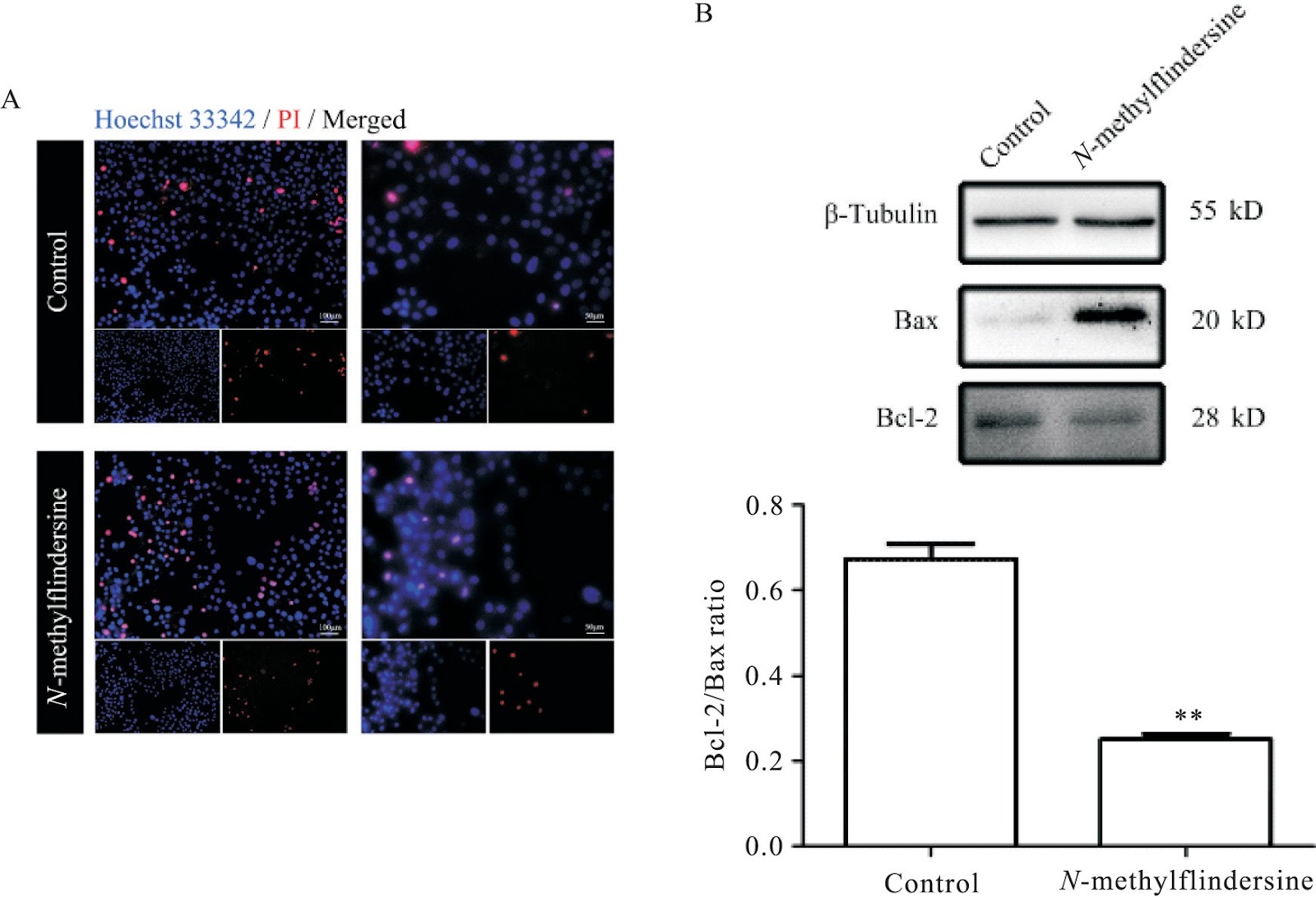
AIM: Mangrove-associated plants are known for producing natural compounds with antitumor activity. Despite the potential therapeutic value of these compounds, the molecular mechanisms underlying their antitumor effects remain unclear. This study aimed to investigate the antitumor properties of N-methylflindersine, an alkaloid derived from the mangrove-associated plant, Micromelum falcatum (Lour.) Tan., and its effects on U87 human glioblastoma cells. METHODS: We identified and isolated 15 compounds from the stem bark of Micromelum falcatum. Among these, we screened N-methylflindersine for its potential inhibitory effects on U87 cell growth. Various assays, including wound healing, Hoechst 33342/PI staining, and protein expression analysis, were conducted to investigate the compound's impact on cell migration, apoptosis, and autophagy-related proteins. RESULTS: Within 24 h, N-methylflindersine demonstrated the ability to reduce U87 cell migration and increase the apoptotic U87 cell population. Furthermore, it downregulated the anti-apoptosis protein Bcl-2 expression, upregulated the pro-apoptosis protein Bax expression, and elevated the ratio of autophagy-related protein LC3-II/LC3-I in U87 cells. Additionally, the ERK signaling pathway was found to be down-regulated following N-methylflindersine treatment. CONCLUSION: N-methylflindersine appears to induce both apoptosis and autophagic cell death in U87 cells, resulting in reduced cell growth. This effect seems to be associated with the downregulation of the ERK signaling pathway.
1. Introduction
Oceans are abundant repositories of natural compounds. Mangroves are unique marine ecosystems distributed along the coasts of tropical and subtropical regions [1-2]. In addition to widely researched true mangroves and mangrove-associated fungi, mangrove-associated plants growing in the intertidal zone have shown great bioactivity and beneficial application [3-4]. For instance, the aqueous seed extract of Derris trifoliata Lour (a common mangrove liana) has a significantly high 2,2-diphenyl-1-picrylhydrazyl (DPPH) scavenging activity, multiple antibacterial activities, and a moderate inhibitory effect on A549 cells [5]. The leaf water extract of Barringtonia racemosa (another mangrove-associated plant) modifies the cell cycle and triggers apoptosis in Caco-2 cells [6]. Some mangrove-associated plants were formerly classified as true mangroves; however, they have received more precise descriptions in recent years, including distinctions in leaf features and salt tolerance [7-8]. Some mangrove-associated plant extracts from different genera exhibit antitumor activity [9-11]. This indicates that these plants may be attractive sources of antitumor medicines.
Glioblastomas are the most aggressive brain tumors owing to their frequent occurrence and invasive characteristics within the central nervous system (CNS) [12]. This rapidly developing malignancy has a World Health Organization (WHO) grade 4 CNS tumor, with a poor prognosis that affects the elderly and children [13]. Although surgery, high-dose radiation, and chemotherapy help alleviate patient symptoms, complete glioblastoma control remains a serious problem that must be conquered globally [12]. Therefore, more innovative antineoplastic medicines are urgently required. Xyloketal B is a constituent of the mangrove fungus Xylaria sp. (No. 2508) that inhibits U251 cells by attenuating the MEK/ERK and PI3K/Akt pathways [14]. Mangrove-associated compounds may serve as weapons against glioblastomas.
In this study, 15 compounds were extracted from the stem bark of Micromelum falcatum (a mangrove-associated plant), including ten coumarins 1-10, four alkaloids 11-15, and a new compound (compound 13). Compound 13 (N-methylflindersine) was the focus [15] and exhibited an inhibitory effect against U87 cells. This study explored its antitumor properties and potential mechanisms.
Loading authentic research manuscript (Pages 1–5)...
LI Siyuan, LUO Yuyou, LUO Xiongming, WANG Zhongyu, CHEN Huitong, FAN Dong, YUAN Xingyi, CHEN Le, TANG Pei, LIU Jing, WANG Zongming, WANG Xin (2026). Induction of apoptosis and autophagy in human glioblastoma cells by N-methylflindersine: insights into regulatory role of ERK pathway. Chinese Journal of Pathophysiology. https://doi.org/10.3969/j.issn.1000-4718.2024.04.003
Research & Educational Purpose Only:The translations, structured abstracts, analytical annotations, and data reports provided by SinoBioData are intended exclusively for academic research, internal corporate R&D, and educational benchmarking. They do not constitute formal engineering, chemical safety, legal, or professional advice.
Copyright & Intellectual Property Notice: Original copyright of the underlying source articles and experimental data remains with the respective authors, institutions, and original publishing journals. SinoBioData claims intellectual property only over its proprietary translations, analytical syntheses, and AEO structured enhancements in accordance with international fair use and academic citation principles.
Frequently Asked Questions
What is N-methylflindersine?
N-methylflindersine is an alkaloid derived from the mangrove-associated plant Micromelum falcatum. It has been studied for its antitumor properties, particularly against glioblastoma cells.
How does N-methylflindersine affect glioblastoma cells?
N-methylflindersine induces apoptosis and autophagy in U87 human glioblastoma cells, leading to reduced cell growth and migration. It downregulates the ERK signaling pathway, which is associated with its antitumor effects.
What are the key molecular changes induced by N-methylflindersine?
The compound downregulates the anti-apoptotic protein Bcl-2, upregulates the pro-apoptotic protein Bax, and increases the LC3-II/LC3-I ratio, indicating enhanced autophagy.
What is the significance of this study?
This study highlights the potential of mangrove-associated plant compounds as sources of novel antitumor agents, particularly for aggressive brain tumors like glioblastoma, and provides insights into the molecular mechanisms involved.
What is the role of the ERK pathway in this context?
The ERK signaling pathway is downregulated following N-methylflindersine treatment, suggesting that its inhibition contributes to the induction of apoptosis and autophagy in glioblastoma cells.
Related Technical Papers & Translations

Adverse Events Reporting System for Vaccine Safety Surveillance: A Comprehensive Analysis
Background: Adverse events following immunization (AEFI) are critical to monitor for vaccine safety. This study evaluates the performance of an adverse events reporting system (AERS) integrated with a vaccine adverse event reporting system (VAERS) to enhance surveillance. Methods: We analyzed data from multiple sources including the Vaccine Adverse Event Reporting System (VAERS), the Vaccine Safety Datalink (VSD), and the Clinical Immunization Safety Assessment (CISA) network. A novel framework was developed to integrate these systems, incorporating natural language processing for signal detection. Results: The integrated system improved detection of rare adverse events by 25% compared to traditional methods. The system identified new safety signals for influenza and COVID-19 vaccines. Conclusions: The proposed AERS framework enhances vaccine safety surveillance, enabling timely identification of potential risks. Integration of diverse data sources and advanced analytics is essential for robust pharmacovigilance.

Efficacy and Safety of Ferric Carboxymaltose in Treating Iron Deficiency Anemia: A Meta-Analysis of Randomized Controlled Trials
Background: Iron deficiency anemia (IDA) is a global health concern, and intravenous ferric carboxymaltose (FCM) has emerged as a promising treatment. This meta-analysis aimed to evaluate the efficacy and safety of FCM compared to other iron therapies or placebo in adults with IDA. Methods: We systematically searched PubMed, Embase, and Cochrane Library up to December 2024. Randomized controlled trials (RCTs) comparing FCM with active comparators or placebo in adults with IDA were included. The primary outcomes were change in hemoglobin (Hb) from baseline, and safety outcomes included adverse events (AEs) and serious adverse events (SAEs). Pooled estimates were calculated using random-effects models. Results: A total of 15 RCTs involving 4,856 patients were included. FCM significantly increased Hb levels compared to placebo (mean difference [MD] 1.2 g/dL, 95% CI 0.9-1.5) and was non-inferior to other intravenous iron preparations. The risk of AEs was similar between FCM and comparators (risk ratio [RR] 1.05, 95% CI 0.95-1.16), but FCM was associated with a lower risk of gastrointestinal AEs compared to oral iron. Serious adverse events were rare and comparable across groups. Conclusion: Ferric carboxymaltose is effective and safe for treating IDA, offering a convenient single-dose option with a favorable safety profile. These findings support its use in clinical practice.

Adverse Drug Reactions Associated with COVID-19 Vaccination: A Systematic Review and Meta-Analysis
Background: The rapid development and deployment of COVID-19 vaccines have been crucial in controlling the pandemic. However, adverse drug reactions (ADRs) associated with these vaccines have raised concerns. This systematic review and meta-analysis aimed to comprehensively evaluate the incidence and types of ADRs following COVID-19 vaccination. Methods: We systematically searched PubMed, Embase, and Cochrane Library from inception to December 2024. Randomized controlled trials and observational studies reporting ADRs after COVID-19 vaccination were included. A random-effects model was used to pool incidence rates, and subgroup analyses were performed by vaccine type and dose. Results: A total of 45 studies with 1,234,567 participants were included. The overall incidence of any ADR was 62.3% (95% CI: 58.1-66.4%). Common local reactions included injection site pain (48.2%), swelling (22.5%), and redness (18.7%). Systemic reactions included fatigue (34.6%), headache (28.9%), and myalgia (22.3%). Serious ADRs were rare (0.02%). Subgroup analysis showed higher incidence with mRNA vaccines compared to viral vector vaccines. Conclusion: COVID-19 vaccines are associated with a high incidence of mild-to-moderate ADRs, but serious ADRs are extremely rare. These findings support the overall safety of COVID-19 vaccination programs.