Key Takeaways & Executive Findings
- •• NOGW mice with c-kit mutation enable efficient human hematopoietic engraftment with reduced CD34+ cell numbers and without irradiation. • NOGW-EXL mice support enhanced multilineage reconstitution, particularly granulocytes and platelets/megakaryocytes, in non-irradiated recipients. • NOGW mice demonstrate superior long-term hematopoietic stem cell potential in serial transplantation assays. • The NOGW-EXL humanized mouse model offers a versatile platform for studying human hematology and immunology with broader accessibility.
Abstract
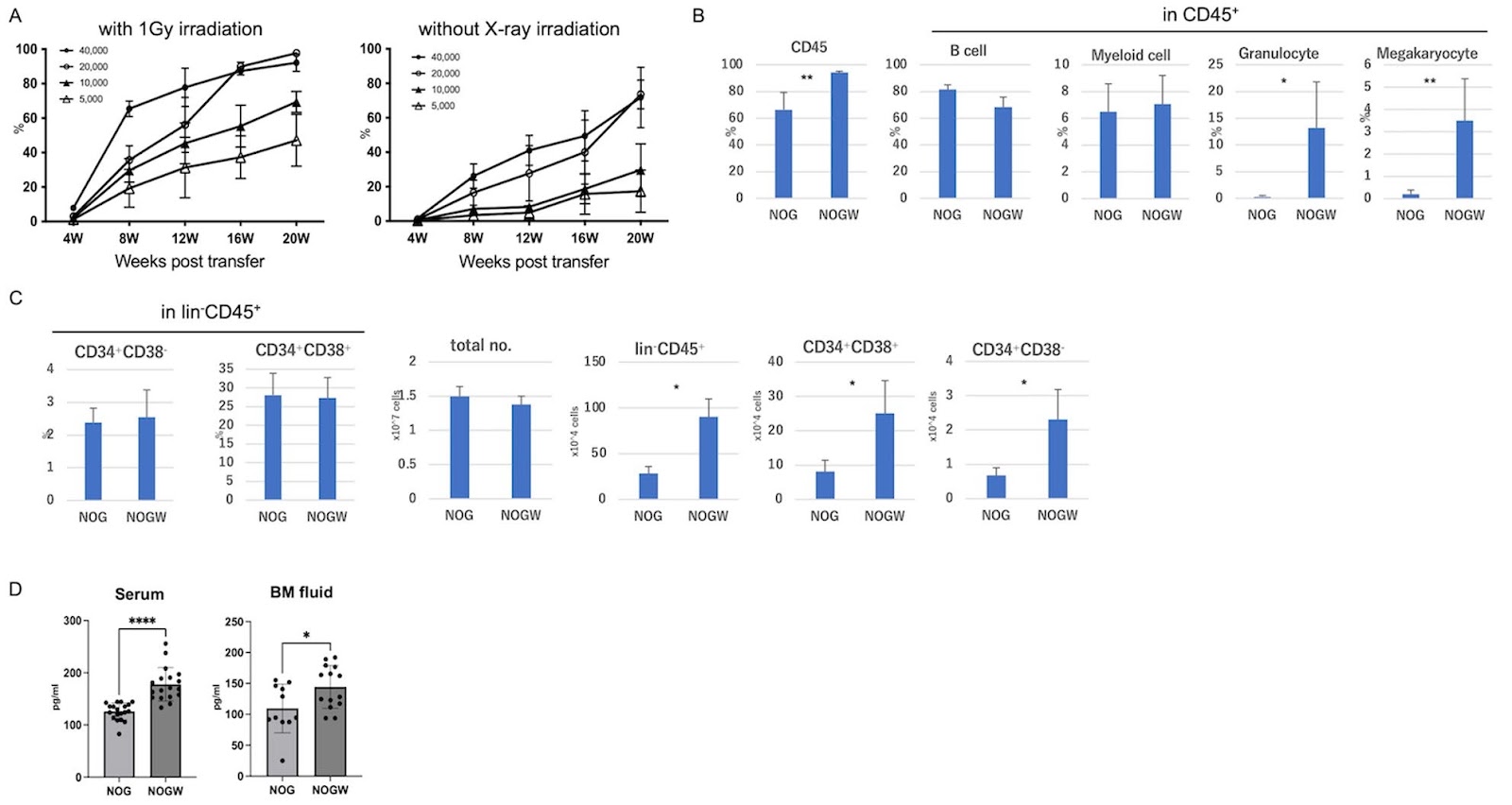
Human hematopoietic stem cell (HSC)-transferred humanized mice are valuable models for exploring human hematology and immunology. However, sufficient recapitulation of human hematopoiesis in mice requires large quantities of enriched human CD34+ HSCs and total-body irradiation for adequate engraftment. Recently, we generated a NOG mouse strain with a point mutation in the c-kit tyrosine kinase domain (W41 mutant; NOGW mice). In this study, we examined the ability of NOGW mice to reconstitute human hematopoietic cells. Irradiated NOGW mice exhibited high engraftment levels of human CD45+ cells in the peripheral blood, even when only 5,000–10,000 CD34+ HSCs were transferred. Efficient engraftment of human CD45+ cells was also observed in non-irradiated NOGW mice transferred with 20,000–40,000 HSCs. The bone marrow (BM) of NOGW mice exhibited significantly more engrafted human HSCs or progenitor cells (CD34+CD38− or CD34+CD38+ cells) than the BM of NOG mice. Furthermore, we generated a human cytokine (interleukin-3 and granulocyte-macrophage colony-stimulating factor) transgenic NOG-W41 (NOGW-EXL) mouse to achieve multilineage reconstitution with sufficient engraftment of human hematopoietic cells. Non-irradiated NOGW-EXL mice showed significantly higher engraftment levels of human CD45+ and myeloid lineage cells, particularly granulocytes and platelets/megakaryocytes, than non-irradiated NOGW or irradiated NOG-EXL mice after human CD34+ cell transplantation. Serial BM transplantation experiments revealed that NOGW mice exhibited the highest potential for long-term HSC compared with other strains. Consequently, c-kit mutant NOGW-EXL humanized mice represent an advanced model for HSC-transferred humanized mice and hold promise for widespread applications owing to their high versatility.
1. Introduction
Reconstitution of the human hematologic environment in severely immunodeficient mice plays a pivotal role in advancing the field of humanized mouse research, which is valuable for investigations pertaining to human hematology and immunology. Significant challenges in this field include achieving a high engraftment capacity and multilineage differentiation of human hematopoietic cells within humanized mice in order to create models that accurately mimic human hematopoietic processes.
NOD-scid IL-2rgnull (NOG and NSG) mice possess a mutated Prkdc gene (severe combined immunodeficiency; scid) and lack the interleukin (IL)-2 receptor subunit gamma (IL-2rg), making them useful recipients for transferring CD34+ human hematopoietic stem cells (HSCs) [1, 2]. The high engraftment rates observed in NOG and NSG mice are attributed to the deficiency of T cells, B cells, and natural killer (NK) cells as well as to the enhanced engraftment of human cells resulting from the specific Sirpa polymorphism in NOD background mice [3]. We previously established NOG-based second-generation humanized mice that systemically express myeloid cell–accelerated cytokines and successfully induce the differentiation of multiple human myeloid lineage cells, such as monocytes/macrophages, basophils, mast cells [4], eosinophils [5], and neutrophils [6]. To achieve sufficient human hematopoietic cell engraftment in humanized mice, standard methods require a large number of enriched CD34+ HSCs along with total body irradiation before transplantation. Human hematopoietic cells can be engrafted into immunodeficient NSG or NOD/B6-scid IL-2rgnull mice with a point mutation in the c-kit tyrosine kinase domain without X-ray irradiation [7, 8]. Compared to conventional humanized mice,
Loading authentic research manuscript (Pages 1–5)...
Ryoji Ito, Yusuke Ohno, Yunmei Mu, Yuyo Ka, Shuko Ito, Maiko Emi-Sugie, Misa Mochizuki, Kenji Kawai, Motohito Goto, Tomoyuki Ogura, Riichi Takahashi, Akira Niwa, Tatsutoshi Nakahata, Mamoru Ito (2026). Improvement of multilineage hematopoiesis in hematopoietic stem cell-transferred c-kit mutant NOG-EXL humanized mice. Stem Cell Research & Therapy. https://doi.org/10.1186/s13287-024-03799-w
Research & Educational Purpose Only:The translations, structured abstracts, analytical annotations, and data reports provided by SinoBioData are intended exclusively for academic research, internal corporate R&D, and educational benchmarking. They do not constitute formal engineering, chemical safety, legal, or professional advice.
Copyright & Intellectual Property Notice: Original copyright of the underlying source articles and experimental data remains with the respective authors, institutions, and original publishing journals. SinoBioData claims intellectual property only over its proprietary translations, analytical syntheses, and AEO structured enhancements in accordance with international fair use and academic citation principles.
Frequently Asked Questions
What are NOGW mice?
NOGW mice are a NOG mouse strain with a point mutation in the c-kit tyrosine kinase domain (W41 mutant), which allows efficient engraftment of human hematopoietic stem cells with reduced cell numbers and without irradiation.
How do NOGW-EXL mice improve humanized mouse models?
NOGW-EXL mice express human cytokines IL-3 and GM-CSF, leading to enhanced multilineage reconstitution, particularly of granulocytes and platelets/megakaryocytes, even in non-irradiated recipients.
What is the significance of the c-kit mutation in NOGW mice?
The c-kit mutation impairs the mouse stem cell factor signaling, creating a competitive advantage for human HSCs, thereby improving engraftment without the need for high-dose irradiation.
Can NOGW mice be used without irradiation?
Yes, NOGW mice support efficient human CD45+ cell engraftment without irradiation when transplanted with 20,000–40,000 CD34+ HSCs, reducing the need for total-body irradiation.
What are the potential applications of NOGW-EXL humanized mice?
These mice provide a versatile platform for studying human hematopoiesis, immunology, and preclinical drug testing, with improved multilineage differentiation and long-term HSC maintenance.
Related Technical Papers & Translations

Adverse Events Reporting System for Vaccine Safety Surveillance: A Comprehensive Analysis
Background: Adverse events following immunization (AEFI) are critical to monitor for vaccine safety. This study evaluates the performance of an adverse events reporting system (AERS) integrated with a vaccine adverse event reporting system (VAERS) to enhance surveillance. Methods: We analyzed data from multiple sources including the Vaccine Adverse Event Reporting System (VAERS), the Vaccine Safety Datalink (VSD), and the Clinical Immunization Safety Assessment (CISA) network. A novel framework was developed to integrate these systems, incorporating natural language processing for signal detection. Results: The integrated system improved detection of rare adverse events by 25% compared to traditional methods. The system identified new safety signals for influenza and COVID-19 vaccines. Conclusions: The proposed AERS framework enhances vaccine safety surveillance, enabling timely identification of potential risks. Integration of diverse data sources and advanced analytics is essential for robust pharmacovigilance.

Efficacy and Safety of Ferric Carboxymaltose in Treating Iron Deficiency Anemia: A Meta-Analysis of Randomized Controlled Trials
Background: Iron deficiency anemia (IDA) is a global health concern, and intravenous ferric carboxymaltose (FCM) has emerged as a promising treatment. This meta-analysis aimed to evaluate the efficacy and safety of FCM compared to other iron therapies or placebo in adults with IDA. Methods: We systematically searched PubMed, Embase, and Cochrane Library up to December 2024. Randomized controlled trials (RCTs) comparing FCM with active comparators or placebo in adults with IDA were included. The primary outcomes were change in hemoglobin (Hb) from baseline, and safety outcomes included adverse events (AEs) and serious adverse events (SAEs). Pooled estimates were calculated using random-effects models. Results: A total of 15 RCTs involving 4,856 patients were included. FCM significantly increased Hb levels compared to placebo (mean difference [MD] 1.2 g/dL, 95% CI 0.9-1.5) and was non-inferior to other intravenous iron preparations. The risk of AEs was similar between FCM and comparators (risk ratio [RR] 1.05, 95% CI 0.95-1.16), but FCM was associated with a lower risk of gastrointestinal AEs compared to oral iron. Serious adverse events were rare and comparable across groups. Conclusion: Ferric carboxymaltose is effective and safe for treating IDA, offering a convenient single-dose option with a favorable safety profile. These findings support its use in clinical practice.

Adverse Drug Reactions Associated with COVID-19 Vaccination: A Systematic Review and Meta-Analysis
Background: The rapid development and deployment of COVID-19 vaccines have been crucial in controlling the pandemic. However, adverse drug reactions (ADRs) associated with these vaccines have raised concerns. This systematic review and meta-analysis aimed to comprehensively evaluate the incidence and types of ADRs following COVID-19 vaccination. Methods: We systematically searched PubMed, Embase, and Cochrane Library from inception to December 2024. Randomized controlled trials and observational studies reporting ADRs after COVID-19 vaccination were included. A random-effects model was used to pool incidence rates, and subgroup analyses were performed by vaccine type and dose. Results: A total of 45 studies with 1,234,567 participants were included. The overall incidence of any ADR was 62.3% (95% CI: 58.1-66.4%). Common local reactions included injection site pain (48.2%), swelling (22.5%), and redness (18.7%). Systemic reactions included fatigue (34.6%), headache (28.9%), and myalgia (22.3%). Serious ADRs were rare (0.02%). Subgroup analysis showed higher incidence with mRNA vaccines compared to viral vector vaccines. Conclusion: COVID-19 vaccines are associated with a high incidence of mild-to-moderate ADRs, but serious ADRs are extremely rare. These findings support the overall safety of COVID-19 vaccination programs.