Key Takeaways & Executive Findings
- •• First in vivo evaluation of a hybrid hydrogel combining synthetic PuraMatrix® and endometrial extracellular matrix with human endometrial organoids for uterine regeneration. • The dual strategy significantly improved endometrial regeneration and fertility outcomes in an immunocompetent murine model of uterine damage. • Transcriptomic and histological analyses confirmed enhanced biocompatibility and tissue remodeling, supporting the translational potential of this approach. • This combined bioengineering strategy offers a promising new avenue for treating endometrial pathologies like Asherman syndrome and thin endometrium.
Abstract
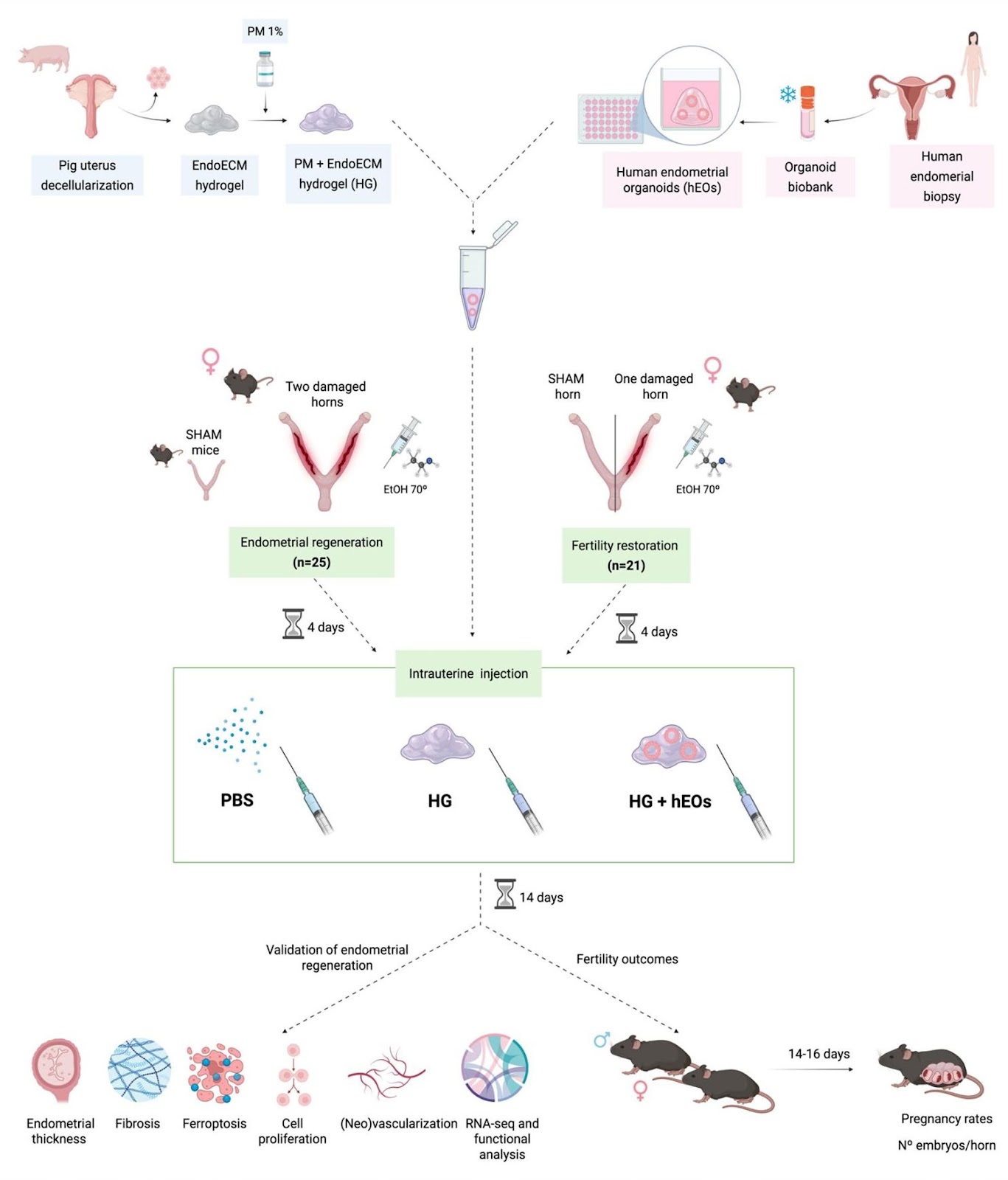
Background The human endometrium is a regenerative tissue essential for fertility, but pathological conditions like Asherman syndrome, endometrial atrophy, and thin endometrium can impair its function. Current therapies lack efficacy, driving demand for innovative regenerative therapies. In this context, endometrial-derived hydrogels and organoids have shown promise individually for tissue regeneration, but their combined therapeutic potential has not been previously evaluated in vivo. This study explores a dual regenerative strategy combining a hybrid hydrogel — composed of synthetic PuraMatrix® and endometrial extracellular matrix hydrogel — with human endometrial organoids in an immunocompetent murine model with uterine damage. Methods Endometrial damage model was established in female C57BL/6 mice (n = 46) via uterine injury using 70° ethanol. After 4 days of endometrial damage, human endometrial organoids were co-injected with the hybrid hydrogel into the uterine horns. Two weeks post-injection, a subset of mice (n = 25) was sacrificed for biocompatibility, histological, and transcriptomic analyses. Functional recovery of the endometrium was assessed in the remaining animals (n = 21) through fertility outcome evaluation. For endometrial regeneration analyses, normally distributed data were analyzed by one-way ANOVA and Tukey’s multiple comparisons, while non-normally distributed data were analyzed by the Kruskal–Wallis test with Dunn’s multiple comparisons. For fertility outcomes, t-test or Mann–Whitney U tests for 2-by-2 comparisons were performed.
1. Introduction
The human endometrium is the innermost layer of the uterus, undergoing tissue regeneration every menstrual cycle [1]. This dynamic tissue consists of luminal and glandular epithelia surrounded by stroma and blood vessels. Additionally, the endometrium is supported by a niche of epithelial and stromal stem cells that contribute to its regenerative capacity [2]. This remarkable ability to renew itself is essential for reproductive success, but pathological changes in the endometrial structure and function can lead to infertility. Endometrial diseases, such as Asherman syndrome (AS), endometrial atrophy (EA), and thin endometrium (TE) are characterized by fibrosis, glandular loss, and impaired vascularization, which significantly reduce the chances of a successful pregnancy [3]. The limited effectiveness of current treatments, including hormonal therapies and surgical interventions, highlights the need for innovative therapies to restore the endometrial structure and function [4].
In recent years, regenerative medicine has emerged as a promising strategy for endometrial repair [4]. Within this field, bioengineering approaches, particularly the use of hydrogels, have been explored for their potential to support tissue regeneration [5]. Natural hydrogels, such as those derived from the endometrial extracellular matrix (EndoECM), can be obtained by the decellularization of the endometrium to remove cellular components while preserving the native proteins and bioactive factors necessary for tissue remodelling [6]. On the other hand, synthetic hydrogels, such as PuraMatrix® (PM, Corning), offer excellent biocompatibility, high mechanical stability, and durability [5, 7]. Due to its simple composition, consisting exclusively of water and RADA16 peptide sequences, several PM-based formulations have been approved in Europe, the United States, and Japan to control intraoperative bleeding in surgical procedures [8]. RADA16 is a peptide-based biomaterial whose acidic aqueous solution spontaneously forms an extracellular matrix-like three-dimensional structure [9]. While ECM-derived hydrogels retain the biochemical cues of the native endometrium, they often lack mechanical stability, whereas synthetic hydrogels provide structural support but lack biological signals. Therefore, combining these two types of hydrogels into a hybrid system could synergistically enhance endometrial regeneration.
Loading authentic research manuscript (Pages 1–5)...
María Gómez-Álvarez, Clara Bueno-Fernandez, Emilio Francés-Herrero, Marcos Agustina-Hernández, Paula Alonso-Frías, Nadaya Corpas, Amparo Faus, Ana Díaz, Antonio Pellicer, Hortensia Ferrero, Irene Cervelló (2026). Hybrid endometrial-derived hydrogel and human endometrial organoids synergize for uterine regeneration in an immunocompetent murine model. Stem Cell Research & Therapy. https://doi.org/10.1186/s13287-026-04900-1
Research & Educational Purpose Only:The translations, structured abstracts, analytical annotations, and data reports provided by SinoBioData are intended exclusively for academic research, internal corporate R&D, and educational benchmarking. They do not constitute formal engineering, chemical safety, legal, or professional advice.
Copyright & Intellectual Property Notice: Original copyright of the underlying source articles and experimental data remains with the respective authors, institutions, and original publishing journals. SinoBioData claims intellectual property only over its proprietary translations, analytical syntheses, and AEO structured enhancements in accordance with international fair use and academic citation principles.
Frequently Asked Questions
What is the main objective of this study?
The study aims to evaluate the combined therapeutic potential of a hybrid hydrogel (PuraMatrix® and endometrial extracellular matrix) with human endometrial organoids for uterine regeneration in an immunocompetent murine model of endometrial damage.
How was the endometrial damage model established?
Endometrial damage was induced in female C57BL/6 mice by injecting 70% ethanol into the uterine horns, followed by a 4-day recovery period before treatment.
What were the key findings regarding fertility outcomes?
The combination of hybrid hydrogel and organoids significantly improved fertility outcomes compared to controls, as evidenced by increased embryo implantation and live birth rates in the treated group.
What analyses were performed to assess regeneration?
Biocompatibility, histological, and transcriptomic analyses were conducted on uterine tissues two weeks post-injection, along with fertility outcome evaluations in a separate cohort.
What is the significance of using an immunocompetent model?
Using an immunocompetent model allows for a more realistic assessment of the host immune response to the biomaterials and organoids, which is crucial for translational relevance.
Related Technical Papers & Translations

Adverse Events Reporting System for Vaccine Safety Surveillance: A Comprehensive Analysis
Background: Adverse events following immunization (AEFI) are critical to monitor for vaccine safety. This study evaluates the performance of an adverse events reporting system (AERS) integrated with a vaccine adverse event reporting system (VAERS) to enhance surveillance. Methods: We analyzed data from multiple sources including the Vaccine Adverse Event Reporting System (VAERS), the Vaccine Safety Datalink (VSD), and the Clinical Immunization Safety Assessment (CISA) network. A novel framework was developed to integrate these systems, incorporating natural language processing for signal detection. Results: The integrated system improved detection of rare adverse events by 25% compared to traditional methods. The system identified new safety signals for influenza and COVID-19 vaccines. Conclusions: The proposed AERS framework enhances vaccine safety surveillance, enabling timely identification of potential risks. Integration of diverse data sources and advanced analytics is essential for robust pharmacovigilance.

Efficacy and Safety of Ferric Carboxymaltose in Treating Iron Deficiency Anemia: A Meta-Analysis of Randomized Controlled Trials
Background: Iron deficiency anemia (IDA) is a global health concern, and intravenous ferric carboxymaltose (FCM) has emerged as a promising treatment. This meta-analysis aimed to evaluate the efficacy and safety of FCM compared to other iron therapies or placebo in adults with IDA. Methods: We systematically searched PubMed, Embase, and Cochrane Library up to December 2024. Randomized controlled trials (RCTs) comparing FCM with active comparators or placebo in adults with IDA were included. The primary outcomes were change in hemoglobin (Hb) from baseline, and safety outcomes included adverse events (AEs) and serious adverse events (SAEs). Pooled estimates were calculated using random-effects models. Results: A total of 15 RCTs involving 4,856 patients were included. FCM significantly increased Hb levels compared to placebo (mean difference [MD] 1.2 g/dL, 95% CI 0.9-1.5) and was non-inferior to other intravenous iron preparations. The risk of AEs was similar between FCM and comparators (risk ratio [RR] 1.05, 95% CI 0.95-1.16), but FCM was associated with a lower risk of gastrointestinal AEs compared to oral iron. Serious adverse events were rare and comparable across groups. Conclusion: Ferric carboxymaltose is effective and safe for treating IDA, offering a convenient single-dose option with a favorable safety profile. These findings support its use in clinical practice.

Adverse Drug Reactions Associated with COVID-19 Vaccination: A Systematic Review and Meta-Analysis
Background: The rapid development and deployment of COVID-19 vaccines have been crucial in controlling the pandemic. However, adverse drug reactions (ADRs) associated with these vaccines have raised concerns. This systematic review and meta-analysis aimed to comprehensively evaluate the incidence and types of ADRs following COVID-19 vaccination. Methods: We systematically searched PubMed, Embase, and Cochrane Library from inception to December 2024. Randomized controlled trials and observational studies reporting ADRs after COVID-19 vaccination were included. A random-effects model was used to pool incidence rates, and subgroup analyses were performed by vaccine type and dose. Results: A total of 45 studies with 1,234,567 participants were included. The overall incidence of any ADR was 62.3% (95% CI: 58.1-66.4%). Common local reactions included injection site pain (48.2%), swelling (22.5%), and redness (18.7%). Systemic reactions included fatigue (34.6%), headache (28.9%), and myalgia (22.3%). Serious ADRs were rare (0.02%). Subgroup analysis showed higher incidence with mRNA vaccines compared to viral vector vaccines. Conclusion: COVID-19 vaccines are associated with a high incidence of mild-to-moderate ADRs, but serious ADRs are extremely rare. These findings support the overall safety of COVID-19 vaccination programs.