Key Takeaways & Executive Findings
- •• hPD-MSCs exhibit classical MSC features including surface markers (CD90, CD73, CD105, CD44, CD106) and differentiation into adipogenic and osteogenic lineages. • Transcriptomic analysis reveals that hPD-MSCs share significant gene expression similarities with pancreatic stellate cells (PSCs), suggesting a potential lineage relationship. • Specific genes (ISL1, NPTX1, ZNF804A) distinguish hPD-MSCs from MSCs of other origins, implicating roles in pancreatic function and neural development. • A novel gene (ENSG00000286190) with unknown function was identified, offering a new avenue for research in pancreatic MSC biology.
Abstract
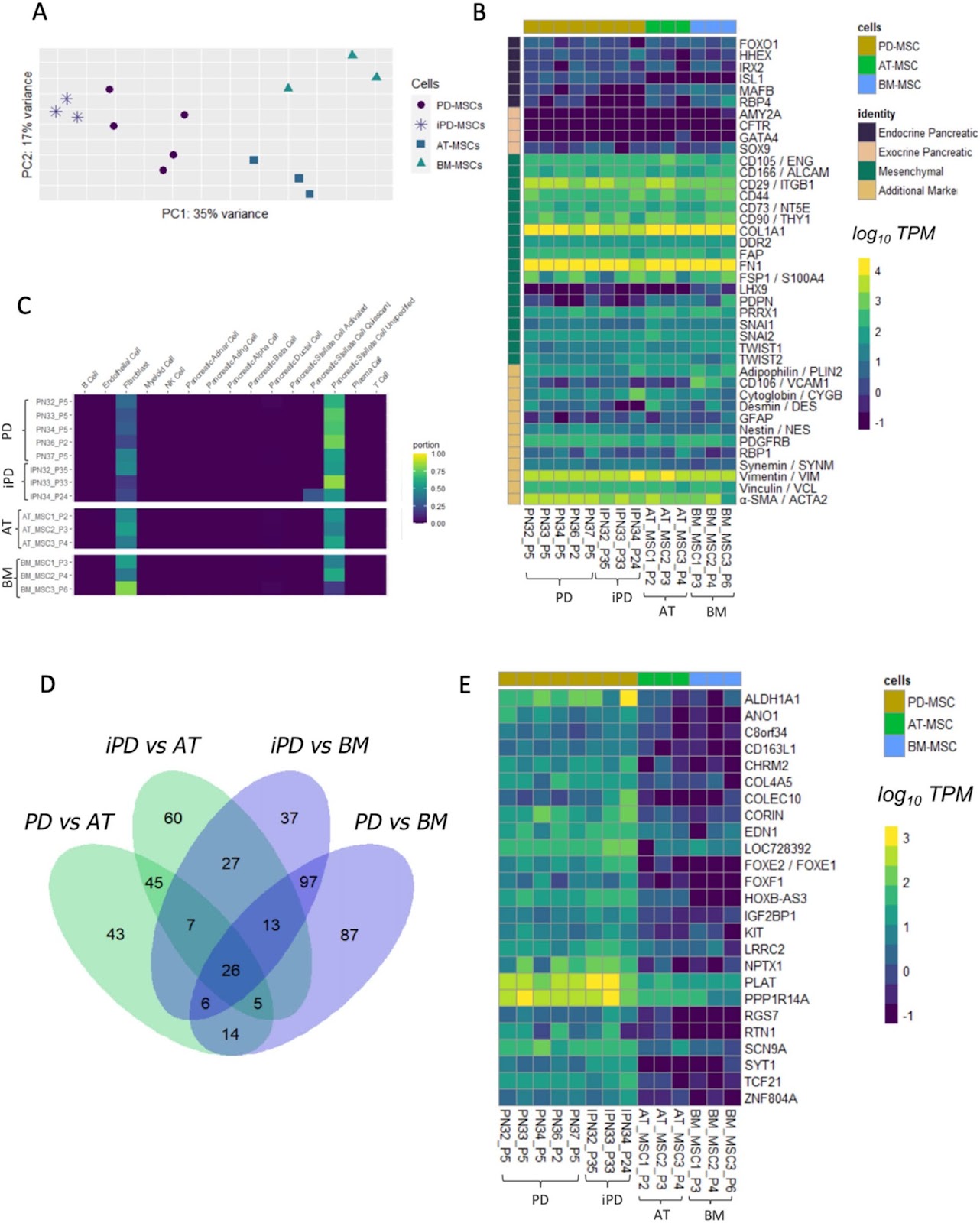
Background Mesenchymal stromal cells (MSCs) are recognized for their potential in regenerative medicine, attributed to their multipotent differentiation capabilities and immunomodulatory properties. Despite this potential, the classification and detailed characterization of MSCs, especially those derived from specific tissues like the pancreas, remains challenging leading to a proliferation of terminology in the literature. This study aims to address these challenges by providing a thorough characterization of human pancreatic islets-derived mesenchymal stromal cells (hPD-MSCs). Methods hPD-MSCs were isolated from donor islets using enzymatic digestion, immortalized through lentiviral transduction of human telomerase reverse transcriptase (hTERT). Cells were characterized by immunostaining, flow cytometry and multilineage differentiation potential into adipogenic and osteogenic lineages. Further a transcriptomic analysis was done to compare the gene expression profiles of hPD-MSCs with other mesenchymal cells. Results We show that hPD-MSCs express the classical MSC features, including morphological characteristics, surface markers expression (CD90, CD73, CD105, CD44, and CD106) and the ability to differentiate into both adipogenic and osteogenic lineages. Furthermore, transcriptomic analysis revealed distinct gene expression profiles, showing notable similarities between hPD-MSCs and pancreatic stellate cells (PSCs). The study also identified specific genes that distinguish hPD-MSCs from MSCs of other origins, including genes associated with pancreatic function (e.g., ISL1) and neural development (e.g., NPTX1, ZNF804A). A novel gene with an unknown function (ENSG00000286190) was also discovered. Conclusions This study enhances the understanding of hPD-MSCs, demonstrating their unique characteristics and potential applications in therapeutic strategies. The identification of specific gene expression profiles differentiates hPD-MSCs from other mesenchymal cells and opens new avenues for research into their role in pancreatic function and neural development.
1. Introduction
Recent progress in stem cell biology and regenerative medicine has given rise to translational research aimed at repairing damaged tissues and restoring their proper cellular functions. MSCs stand out as an important candidate in the field of cellular therapy, having undergone extensive investigation and clinical trials. The therapeutic benefits of MSCs lie in their ease of extraction, ability to differentiate into various cell types, minimal immune response, and, most significantly, the substances they release, which have been demonstrated to mitigate damaged tissues [1].
Despite the prospective advantages of MSCs, practical constraints arise due to the inherent challenges associated with the isolation process and heterogeneity arising from diverse donor characteristics [2]. While all MSCs share basic characteristics, studies have shown variances in genotype and phenotype expression profiles among MSCs of different sources including expression of certain surface markers, differentiation capacities, and immunomodulatory properties [3, 4]. These differences extend to the physiological functions of MSCs and their therapeutic potential in the treatment of diverse diseases.
This highlights the significance of a nuanced characterization of MSCs for effective utilization in clinical applications, considering logistical, practical, and in vivo attributes. MSCs were initially isolated from mononuclear cells derived from bone marrow (BM-MSCs); nevertheless, recent evidence suggests that MSCs are present in almost all human tissues [5]. Notably, the pancreas harbors distinct subpopulations of MSCs, with evidence indicating that these cells can be derived from exocrine tissue (acinar and ductal epithelial cells) [6–8], or islets [9, 10]. The precise etiology of these cells remains ambiguous, potentially arising from epithelial-mesenchymal tra
Loading authentic research manuscript (Pages 1–5)...
Nour Ebrahim, Nikolay Kondratyev, Alexander Artyuhov, Alexei Timofeev, Nadya Gurskaya, Alexey Andrianov, Roman Izrailov, Egor Volchkov, Tatyana Dyuzheva, Elena Kopantseva, Ekaterina Kiseleva, Vera Golimbet, Erdem Dashinimaev (2026). Human pancreatic islet-derived stromal cells reveal combined features of mesenchymal stromal cells and pancreatic stellate cells. Stem Cell Research & Therapy. https://doi.org/10.1186/s13287-024-03963-2
Research & Educational Purpose Only:The translations, structured abstracts, analytical annotations, and data reports provided by SinoBioData are intended exclusively for academic research, internal corporate R&D, and educational benchmarking. They do not constitute formal engineering, chemical safety, legal, or professional advice.
Copyright & Intellectual Property Notice: Original copyright of the underlying source articles and experimental data remains with the respective authors, institutions, and original publishing journals. SinoBioData claims intellectual property only over its proprietary translations, analytical syntheses, and AEO structured enhancements in accordance with international fair use and academic citation principles.
Frequently Asked Questions
What are human pancreatic islet-derived stromal cells (hPD-MSCs)?
hPD-MSCs are mesenchymal stromal cells isolated from human pancreatic islets. They exhibit classical MSC features such as surface marker expression and multilineage differentiation potential, but also show unique gene expression profiles similar to pancreatic stellate cells.
How were hPD-MSCs characterized in this study?
hPD-MSCs were characterized using immunostaining, flow cytometry, and differentiation assays into adipogenic and osteogenic lineages. Additionally, transcriptomic analysis compared their gene expression profiles with other mesenchymal cells.
What are the key findings of the transcriptomic analysis?
The transcriptomic analysis revealed that hPD-MSCs share notable similarities with pancreatic stellate cells (PSCs). Specific genes such as ISL1, NPTX1, and ZNF804A distinguish hPD-MSCs from MSCs of other origins, and a novel gene (ENSG00000286190) with unknown function was discovered.
Why is this research significant for regenerative medicine?
This research provides a thorough characterization of hPD-MSCs, highlighting their unique features and potential applications in therapeutic strategies. Understanding their gene expression profiles may open new avenues for treating pancreatic diseases and neural conditions.
What is the potential clinical relevance of hPD-MSCs?
hPD-MSCs may be used in cell-based therapies for pancreatic regeneration and possibly neural repair, given their expression of genes associated with pancreatic function and neural development. Their immunomodulatory properties and differentiation capacity make them attractive candidates for regenerative medicine.
Related Technical Papers & Translations

Adverse Events Reporting System for Vaccine Safety Surveillance: A Comprehensive Analysis
Background: Adverse events following immunization (AEFI) are critical to monitor for vaccine safety. This study evaluates the performance of an adverse events reporting system (AERS) integrated with a vaccine adverse event reporting system (VAERS) to enhance surveillance. Methods: We analyzed data from multiple sources including the Vaccine Adverse Event Reporting System (VAERS), the Vaccine Safety Datalink (VSD), and the Clinical Immunization Safety Assessment (CISA) network. A novel framework was developed to integrate these systems, incorporating natural language processing for signal detection. Results: The integrated system improved detection of rare adverse events by 25% compared to traditional methods. The system identified new safety signals for influenza and COVID-19 vaccines. Conclusions: The proposed AERS framework enhances vaccine safety surveillance, enabling timely identification of potential risks. Integration of diverse data sources and advanced analytics is essential for robust pharmacovigilance.

Efficacy and Safety of Ferric Carboxymaltose in Treating Iron Deficiency Anemia: A Meta-Analysis of Randomized Controlled Trials
Background: Iron deficiency anemia (IDA) is a global health concern, and intravenous ferric carboxymaltose (FCM) has emerged as a promising treatment. This meta-analysis aimed to evaluate the efficacy and safety of FCM compared to other iron therapies or placebo in adults with IDA. Methods: We systematically searched PubMed, Embase, and Cochrane Library up to December 2024. Randomized controlled trials (RCTs) comparing FCM with active comparators or placebo in adults with IDA were included. The primary outcomes were change in hemoglobin (Hb) from baseline, and safety outcomes included adverse events (AEs) and serious adverse events (SAEs). Pooled estimates were calculated using random-effects models. Results: A total of 15 RCTs involving 4,856 patients were included. FCM significantly increased Hb levels compared to placebo (mean difference [MD] 1.2 g/dL, 95% CI 0.9-1.5) and was non-inferior to other intravenous iron preparations. The risk of AEs was similar between FCM and comparators (risk ratio [RR] 1.05, 95% CI 0.95-1.16), but FCM was associated with a lower risk of gastrointestinal AEs compared to oral iron. Serious adverse events were rare and comparable across groups. Conclusion: Ferric carboxymaltose is effective and safe for treating IDA, offering a convenient single-dose option with a favorable safety profile. These findings support its use in clinical practice.

Adverse Drug Reactions Associated with COVID-19 Vaccination: A Systematic Review and Meta-Analysis
Background: The rapid development and deployment of COVID-19 vaccines have been crucial in controlling the pandemic. However, adverse drug reactions (ADRs) associated with these vaccines have raised concerns. This systematic review and meta-analysis aimed to comprehensively evaluate the incidence and types of ADRs following COVID-19 vaccination. Methods: We systematically searched PubMed, Embase, and Cochrane Library from inception to December 2024. Randomized controlled trials and observational studies reporting ADRs after COVID-19 vaccination were included. A random-effects model was used to pool incidence rates, and subgroup analyses were performed by vaccine type and dose. Results: A total of 45 studies with 1,234,567 participants were included. The overall incidence of any ADR was 62.3% (95% CI: 58.1-66.4%). Common local reactions included injection site pain (48.2%), swelling (22.5%), and redness (18.7%). Systemic reactions included fatigue (34.6%), headache (28.9%), and myalgia (22.3%). Serious ADRs were rare (0.02%). Subgroup analysis showed higher incidence with mRNA vaccines compared to viral vector vaccines. Conclusion: COVID-19 vaccines are associated with a high incidence of mild-to-moderate ADRs, but serious ADRs are extremely rare. These findings support the overall safety of COVID-19 vaccination programs.