Key Takeaways & Executive Findings
- •• Global research on hand tendon repair has grown fluctuantly over the past two decades, with the US, China, and Europe as major contributors. • Flexor tendon repair research emphasizes biomechanics and novel materials, while extensor tendon repair focuses on functional recovery and complex injuries. • Biomaterials and regenerative medicine are emerging as key research hotspots, driving precision medicine in tendon repair. • Future advancements will rely on interdisciplinary collaboration and advanced material integration to optimize repair outcomes.
Abstract
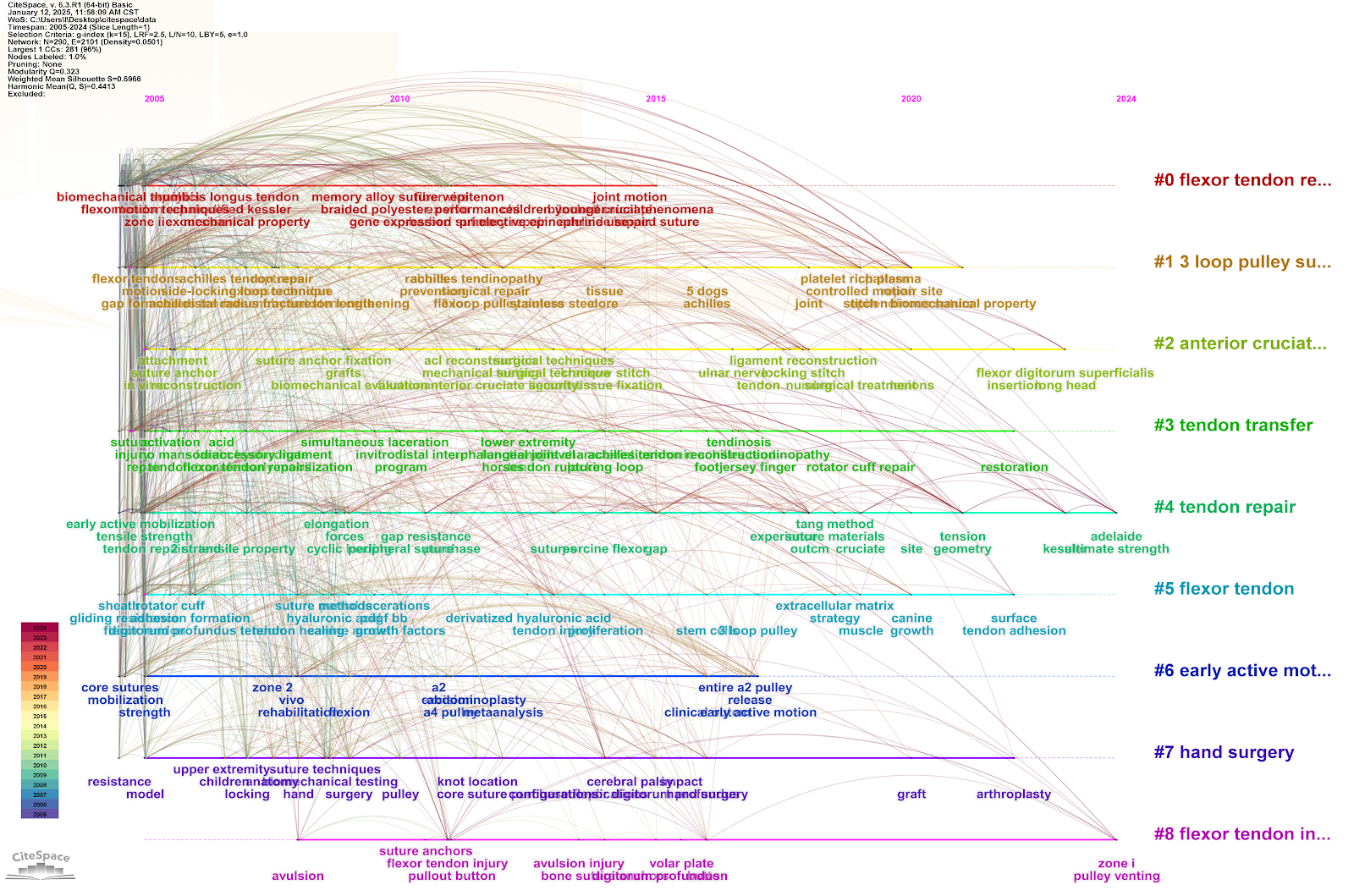
BACKGROUND: The tendon suturing technique for the hand has been continuously innovated with the development of biomechanics, minimally invasive techniques, and regenerative medicine. Over the past two decades, research has focused on optimizing traditional suturing techniques and the application of new repair materials, improving the effectiveness of tendon repair and the level of functional recovery in the hand. OBJECTIVE: To assess the global research status and development trends of hand tendon repair techniques over the past two decades through bibliometric analysis, identify research hotspots and their evolution. METHODS: Relevant literature was selected from the Web of Science database from 2005 to 2024, and bibliometric methods were employed for analysis. Data were organized using Microsoft Excel and analyzed for publication trends using the R language Bibliometrix package. VOSviewer was used to visualize keyword co-occurrence and collaboration networks, while CiteSpace was utilized to identify research hotspots and their temporal evolution. RESULTS AND CONCLUSION: Over the past two decades, research in the field of tendon suturing has shown a fluctuating growth trend. The United States, China, and Europe are the main contributing countries, with the United States occupying a central position in the global research network. Research on flexor tendon repair mainly focuses on biomechanics and the development of new repair materials, while extensor tendon research emphasizes postoperative functional recovery and complex injury repair. In recent years, biomaterials and regenerative medicine have gradually become research hotspots, promoting the application of precision medicine in tendon repair. In the future, interdisciplinary collaboration and the combination of advanced materials will further optimize hand tendon repair techniques.
1. Introduction
Hand tendon repair has always been a core challenge in hand surgery. Traditional repair techniques, such as the Kessler and modified Kessler suture methods, are widely used clinically, but complications such as tendon adhesion, repair site rupture, and insufficient functional recovery remain unresolved [1-5].
Over the past 20 years, with the deepening of biomechanical research, innovation in minimally invasive surgical techniques, and the rapid development of regenerative medicine [6-8], researchers have not only focused on optimizing the mechanical properties of traditional suture techniques [9-11], but also actively explored the application of novel repair materials [12-14], and promoted the shift from routine postoperative rehabilitation to individualized and precise approaches [15-17]. However, research in this field is highly fragmented and interdisciplinary, spanning basic biomechanics, materials science, cell biology, and clinical rehabilitation, making it difficult to systematically grasp global research dynamics, identify core research hotspots, and predict future trends.
Currently, there is a lack of systematic and quantitative analysis of the global research landscape in hand tendon repair over the past two decades. Bibliometrics, as a mature method for quantitatively analyzing literature systems to reveal disciplinary development patterns and research hotspot evolution, can effectively fill this gap. It transcends the subjective limitations of traditional reviews and, through objective data mining, accurately depicts the knowledge structure of the field, identifies key contributors and institutions, and tracks the dynamic shifts of research hotspots.
Loading authentic research manuscript (Pages 1–5)...
Zhou Ningyu, Zheng Yuxiang, Zhang Xiaoyang, Weng Yuxun, Yang Yinrui, Zhou Qijian, Zheng Jinchen, Liu Hongying, Sun Chenchen, Liu Zheng (2026). Hand tendon suturing: optimization of traditional suture techniques and application of novel repair materials. Chinese Journal of Tissue Engineering Research. https://doi.org/10.12307/2026.21474
Research & Educational Purpose Only:The translations, structured abstracts, analytical annotations, and data reports provided by SinoBioData are intended exclusively for academic research, internal corporate R&D, and educational benchmarking. They do not constitute formal engineering, chemical safety, legal, or professional advice.
Copyright & Intellectual Property Notice: Original copyright of the underlying source articles and experimental data remains with the respective authors, institutions, and original publishing journals. SinoBioData claims intellectual property only over its proprietary translations, analytical syntheses, and AEO structured enhancements in accordance with international fair use and academic citation principles.
Frequently Asked Questions
What are the main research hotspots in hand tendon repair over the past two decades?
The main research hotspots include optimization of traditional suture techniques, development of novel repair materials, and the application of biomaterials and regenerative medicine. Flexor tendon repair focuses on biomechanics and materials, while extensor tendon repair emphasizes functional recovery and complex injuries.
Which countries are leading in hand tendon repair research?
The United States, China, and European countries are the main contributors, with the United States holding a central position in the global research network.
What methods were used in this bibliometric analysis?
We used Web of Science core collection data from 2005-2024, analyzed publication trends with R's Bibliometrix package, visualized keyword co-occurrence and collaboration networks with VOSviewer, and used CiteSpace to identify research hotspots and their temporal evolution.
What are the future directions in hand tendon repair?
Future directions include interdisciplinary collaboration, integration of advanced materials, and the application of precision medicine to further optimize repair techniques and functional outcomes.
Related Technical Papers & Translations

Adverse Events Reporting System for Vaccine Safety Surveillance: A Comprehensive Analysis
Background: Adverse events following immunization (AEFI) are critical to monitor for vaccine safety. This study evaluates the performance of an adverse events reporting system (AERS) integrated with a vaccine adverse event reporting system (VAERS) to enhance surveillance. Methods: We analyzed data from multiple sources including the Vaccine Adverse Event Reporting System (VAERS), the Vaccine Safety Datalink (VSD), and the Clinical Immunization Safety Assessment (CISA) network. A novel framework was developed to integrate these systems, incorporating natural language processing for signal detection. Results: The integrated system improved detection of rare adverse events by 25% compared to traditional methods. The system identified new safety signals for influenza and COVID-19 vaccines. Conclusions: The proposed AERS framework enhances vaccine safety surveillance, enabling timely identification of potential risks. Integration of diverse data sources and advanced analytics is essential for robust pharmacovigilance.

Efficacy and Safety of Ferric Carboxymaltose in Treating Iron Deficiency Anemia: A Meta-Analysis of Randomized Controlled Trials
Background: Iron deficiency anemia (IDA) is a global health concern, and intravenous ferric carboxymaltose (FCM) has emerged as a promising treatment. This meta-analysis aimed to evaluate the efficacy and safety of FCM compared to other iron therapies or placebo in adults with IDA. Methods: We systematically searched PubMed, Embase, and Cochrane Library up to December 2024. Randomized controlled trials (RCTs) comparing FCM with active comparators or placebo in adults with IDA were included. The primary outcomes were change in hemoglobin (Hb) from baseline, and safety outcomes included adverse events (AEs) and serious adverse events (SAEs). Pooled estimates were calculated using random-effects models. Results: A total of 15 RCTs involving 4,856 patients were included. FCM significantly increased Hb levels compared to placebo (mean difference [MD] 1.2 g/dL, 95% CI 0.9-1.5) and was non-inferior to other intravenous iron preparations. The risk of AEs was similar between FCM and comparators (risk ratio [RR] 1.05, 95% CI 0.95-1.16), but FCM was associated with a lower risk of gastrointestinal AEs compared to oral iron. Serious adverse events were rare and comparable across groups. Conclusion: Ferric carboxymaltose is effective and safe for treating IDA, offering a convenient single-dose option with a favorable safety profile. These findings support its use in clinical practice.

Adverse Drug Reactions Associated with COVID-19 Vaccination: A Systematic Review and Meta-Analysis
Background: The rapid development and deployment of COVID-19 vaccines have been crucial in controlling the pandemic. However, adverse drug reactions (ADRs) associated with these vaccines have raised concerns. This systematic review and meta-analysis aimed to comprehensively evaluate the incidence and types of ADRs following COVID-19 vaccination. Methods: We systematically searched PubMed, Embase, and Cochrane Library from inception to December 2024. Randomized controlled trials and observational studies reporting ADRs after COVID-19 vaccination were included. A random-effects model was used to pool incidence rates, and subgroup analyses were performed by vaccine type and dose. Results: A total of 45 studies with 1,234,567 participants were included. The overall incidence of any ADR was 62.3% (95% CI: 58.1-66.4%). Common local reactions included injection site pain (48.2%), swelling (22.5%), and redness (18.7%). Systemic reactions included fatigue (34.6%), headache (28.9%), and myalgia (22.3%). Serious ADRs were rare (0.02%). Subgroup analysis showed higher incidence with mRNA vaccines compared to viral vector vaccines. Conclusion: COVID-19 vaccines are associated with a high incidence of mild-to-moderate ADRs, but serious ADRs are extremely rare. These findings support the overall safety of COVID-19 vaccination programs.