Key Takeaways & Executive Findings
- •• Developed a rapid 8-day serum-free co-differentiation platform from hiPSCs generating epithelial, mesenchymal, and endothelial intestinal lineages. • Derived cells exhibit intestinal identity with early colonic polarization, confirmed by bulk and single-cell RNA sequencing. • Colon-like intestinal patches (CL-IPs) formed organized tissue structures with human vasculature that anastomosed with host murine vessels after transplantation. • No residual pluripotency detected, supporting safety for potential regenerative therapy applications.
Abstract
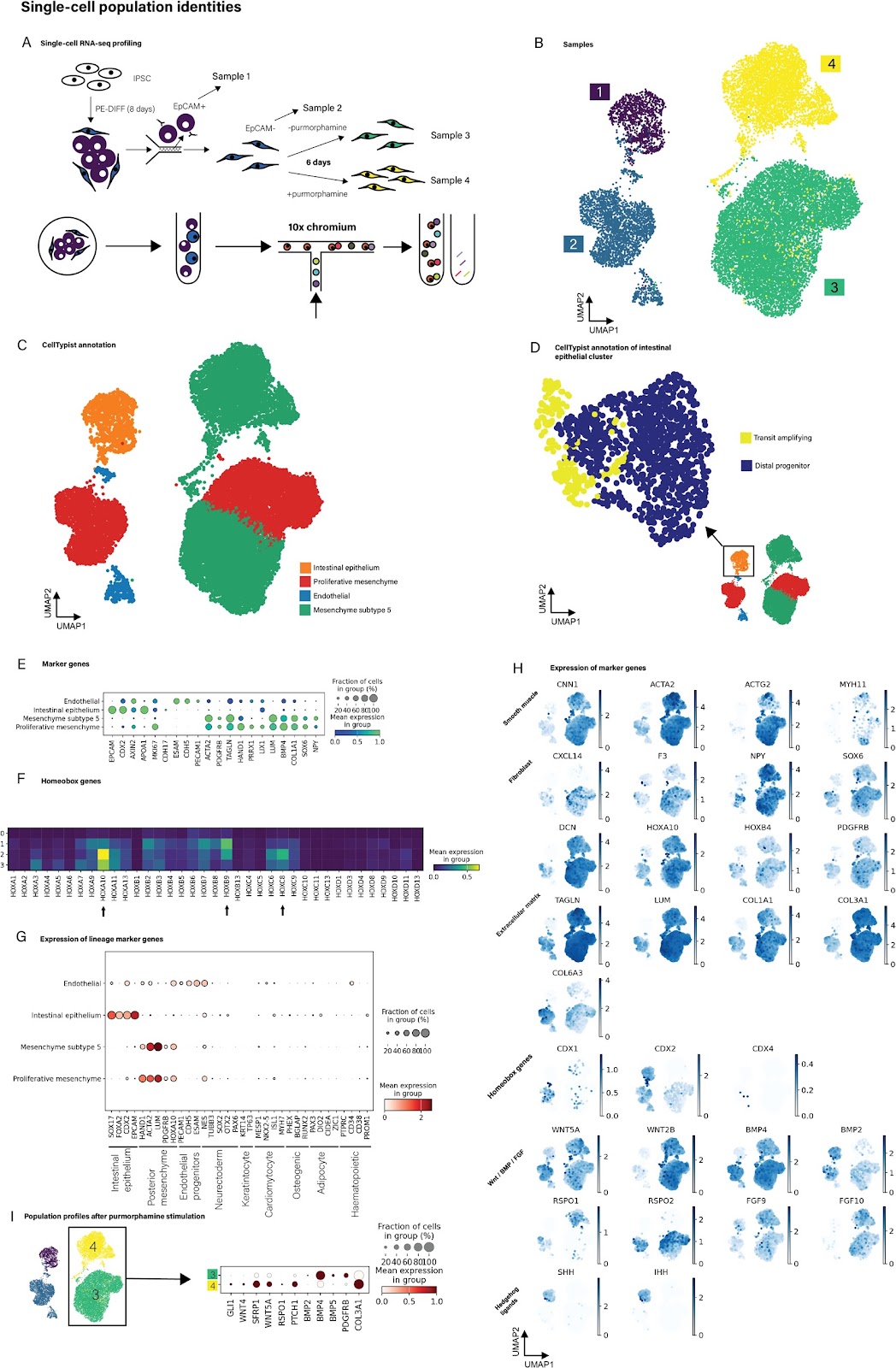
The intestinal mucosa is a complex functional layer which is formed from a diverse range of cell types that include epithelial cells (within crypts and villi) and an array of mesenchymal cells. Many intestinal diseases involve loss of the surface mucosa which can be difficult to restore, and which delays healing and return to normal function. We reason that development of a transplantable intestinal mucosal tissue graft may be a potential therapeutic strategy to aid healing. To be clinically useful, such a tissue graft would need to be capable of rapid production, avoid the risk of host rejection and be demonstrably safe. To create a potential intestinal graft, we developed a novel early-stage human induced pluripotent stem cell (hiPSC) co-differentiation platform capable of generating multiple intestinal cell lineages (epithelial, mesenchymal and endothelial) in 8 days. This protocol is simple to implement, serum-free and greatly reduces the use of animal products. We confirmed the identity of cells by demonstrating that these cells had RNA and protein expression profiles typical of intestinal cell lineages. In particular, we used bulk and single-cell RNA sequencing to characterise global cellular transcriptional profiles robustly and showed that the cells have intestinal identity with early polarisation towards colonic differentiation. The results were replicated across multiple hiPSC lines and in an independent centre. We further cultured the derived cells on collagen hydrogels to form colon-like intestinal patches (CL-IPs). When transplanted into mouse subcutis, CL-IPs formed into colon-like tissue structures, including crypts, stromal and muscle layers. They also developed human-origin vasculature which underwent anastomosis with the murine vasculature to transport murine blood into the graft. Teratoma assays and molecular analyses showed no evidence of residual pluripotency. While at an early stage, this platform shows great potential for further development as a potential source for novel intestinal mucosal regeneration therapy. In addition, the platform is physiologically relevant and thus shows promise as the basis for a new generation of in vitro models of intestinal pathobiology.
1. Introduction
Intestinal diseases are common and constitute a major health burden [1]. Many such diseases involve loss of the surface mucosa. As the mucosa is the main functional layer of the intestine – involved in absorption of nutrients and water – dysfunction results in many of the symptoms of bowel disease, such as diarrhoea, dehydration, nutrient deficiencies and haemorrhage. Loss of mucosal integrity is a prominent feature in inflammatory bowel disease (IBD) and thus restoring healthy mucosa may aid in breaking the cycle of chronic inflammation and microbial colonisation, to aid healing [2–4]. The mucosa is thus a focus for regeneration therapies [3, 5].
The intestinal mucosa is characterised by epithelial crypts supported by a range of mesenchymal cells including fibroblasts and endothelial cells and a deep band of smooth muscle, called muscularis mucosae [6–8]. These cell populations derive from endoderm and splanchnic mesoderm during embryogenesis and arise in tandem from the developing gut tube. Other cell populations, such as haemopoietic and neural cells migrate into the intestinal mucosa during embryonic life from other germ layers [8]. Interactions between epithelial and neighbouring stromal cells are particularly important in maintaining homeostasis and in disease pathogenesis.
Loading authentic research manuscript (Pages 1–5)...
William Dalleywater, Alexander V. Predeus, Batuhan Cakir, Pavel Mazin, Jayakumar Vadakekolathu, Sergio Rutella, Marian L. Meakin, Alison A. Ritchie, Shamir Montazid, Sara Cuevas Ocaña, Nadine Holmes, Victoria Wright, Fei Sang, Silvia Santoni, Adam Bills, Declan Sculthorpe, Rasa Elmentaite, Sarah A. Teichmann, Shazia Irshad, Ian Tomlinson, Andrew Silver, Ricky D. Wildman, Nicholas R. F. Hannan, Felicity R. A. J. Rose, Mohammad Ilyas (2026). Generation of biologically responsive colon-like intestinal tissue patches from human induced pluripotent stem cells using a rapid co-differentiation platform. Stem Cell Research & Therapy. https://doi.org/10.1186/s13287-026-05006-4
Research & Educational Purpose Only:The translations, structured abstracts, analytical annotations, and data reports provided by SinoBioData are intended exclusively for academic research, internal corporate R&D, and educational benchmarking. They do not constitute formal engineering, chemical safety, legal, or professional advice.
Copyright & Intellectual Property Notice: Original copyright of the underlying source articles and experimental data remains with the respective authors, institutions, and original publishing journals. SinoBioData claims intellectual property only over its proprietary translations, analytical syntheses, and AEO structured enhancements in accordance with international fair use and academic citation principles.
Frequently Asked Questions
What is the main achievement of this study?
The study developed a rapid 8-day co-differentiation platform from human induced pluripotent stem cells (hiPSCs) that generates multiple intestinal cell lineages (epithelial, mesenchymal, and endothelial) and forms colon-like intestinal patches (CL-IPs) with functional vasculature when transplanted into mice.
How does this platform differ from existing intestinal differentiation methods?
This platform is serum-free, simple to implement, and significantly reduces animal product use. It achieves co-differentiation of multiple lineages in just 8 days, which is faster than many conventional protocols, and produces cells with early colonic polarization.
What evidence supports the intestinal identity of the derived cells?
The cells were characterized using bulk and single-cell RNA sequencing, showing transcriptional profiles typical of intestinal cell lineages. Protein expression analysis further confirmed intestinal identity, with early polarization towards colonic differentiation.
What are the potential applications of this technology?
The platform holds promise for developing transplantable intestinal mucosal grafts for regenerative therapy in diseases like inflammatory bowel disease. It also provides a physiologically relevant in vitro model for studying intestinal pathobiology and drug testing.
Was there any evidence of residual pluripotency or tumor formation?
No. Teratoma assays and molecular analyses showed no evidence of residual pluripotency, indicating the safety of the derived cells for potential therapeutic use.
Related Technical Papers & Translations

Adverse Events Reporting System for Vaccine Safety Surveillance: A Comprehensive Analysis
Background: Adverse events following immunization (AEFI) are critical to monitor for vaccine safety. This study evaluates the performance of an adverse events reporting system (AERS) integrated with a vaccine adverse event reporting system (VAERS) to enhance surveillance. Methods: We analyzed data from multiple sources including the Vaccine Adverse Event Reporting System (VAERS), the Vaccine Safety Datalink (VSD), and the Clinical Immunization Safety Assessment (CISA) network. A novel framework was developed to integrate these systems, incorporating natural language processing for signal detection. Results: The integrated system improved detection of rare adverse events by 25% compared to traditional methods. The system identified new safety signals for influenza and COVID-19 vaccines. Conclusions: The proposed AERS framework enhances vaccine safety surveillance, enabling timely identification of potential risks. Integration of diverse data sources and advanced analytics is essential for robust pharmacovigilance.

Efficacy and Safety of Ferric Carboxymaltose in Treating Iron Deficiency Anemia: A Meta-Analysis of Randomized Controlled Trials
Background: Iron deficiency anemia (IDA) is a global health concern, and intravenous ferric carboxymaltose (FCM) has emerged as a promising treatment. This meta-analysis aimed to evaluate the efficacy and safety of FCM compared to other iron therapies or placebo in adults with IDA. Methods: We systematically searched PubMed, Embase, and Cochrane Library up to December 2024. Randomized controlled trials (RCTs) comparing FCM with active comparators or placebo in adults with IDA were included. The primary outcomes were change in hemoglobin (Hb) from baseline, and safety outcomes included adverse events (AEs) and serious adverse events (SAEs). Pooled estimates were calculated using random-effects models. Results: A total of 15 RCTs involving 4,856 patients were included. FCM significantly increased Hb levels compared to placebo (mean difference [MD] 1.2 g/dL, 95% CI 0.9-1.5) and was non-inferior to other intravenous iron preparations. The risk of AEs was similar between FCM and comparators (risk ratio [RR] 1.05, 95% CI 0.95-1.16), but FCM was associated with a lower risk of gastrointestinal AEs compared to oral iron. Serious adverse events were rare and comparable across groups. Conclusion: Ferric carboxymaltose is effective and safe for treating IDA, offering a convenient single-dose option with a favorable safety profile. These findings support its use in clinical practice.

Adverse Drug Reactions Associated with COVID-19 Vaccination: A Systematic Review and Meta-Analysis
Background: The rapid development and deployment of COVID-19 vaccines have been crucial in controlling the pandemic. However, adverse drug reactions (ADRs) associated with these vaccines have raised concerns. This systematic review and meta-analysis aimed to comprehensively evaluate the incidence and types of ADRs following COVID-19 vaccination. Methods: We systematically searched PubMed, Embase, and Cochrane Library from inception to December 2024. Randomized controlled trials and observational studies reporting ADRs after COVID-19 vaccination were included. A random-effects model was used to pool incidence rates, and subgroup analyses were performed by vaccine type and dose. Results: A total of 45 studies with 1,234,567 participants were included. The overall incidence of any ADR was 62.3% (95% CI: 58.1-66.4%). Common local reactions included injection site pain (48.2%), swelling (22.5%), and redness (18.7%). Systemic reactions included fatigue (34.6%), headache (28.9%), and myalgia (22.3%). Serious ADRs were rare (0.02%). Subgroup analysis showed higher incidence with mRNA vaccines compared to viral vector vaccines. Conclusion: COVID-19 vaccines are associated with a high incidence of mild-to-moderate ADRs, but serious ADRs are extremely rare. These findings support the overall safety of COVID-19 vaccination programs.