Key Takeaways & Executive Findings
- •• Comprehensive electrophysiological timeline for photoreceptor maturation in human retinal organoids over 300 days. • HCN and Nav currents progressively increase, peaking at D240 and D210-215, respectively. • Action potential generation capacity rises from 16.7% at D90-95 to 90.2% by D240-245. • D240 is established as a key benchmark for functional maturity, comparable to native photoreceptors.
Abstract
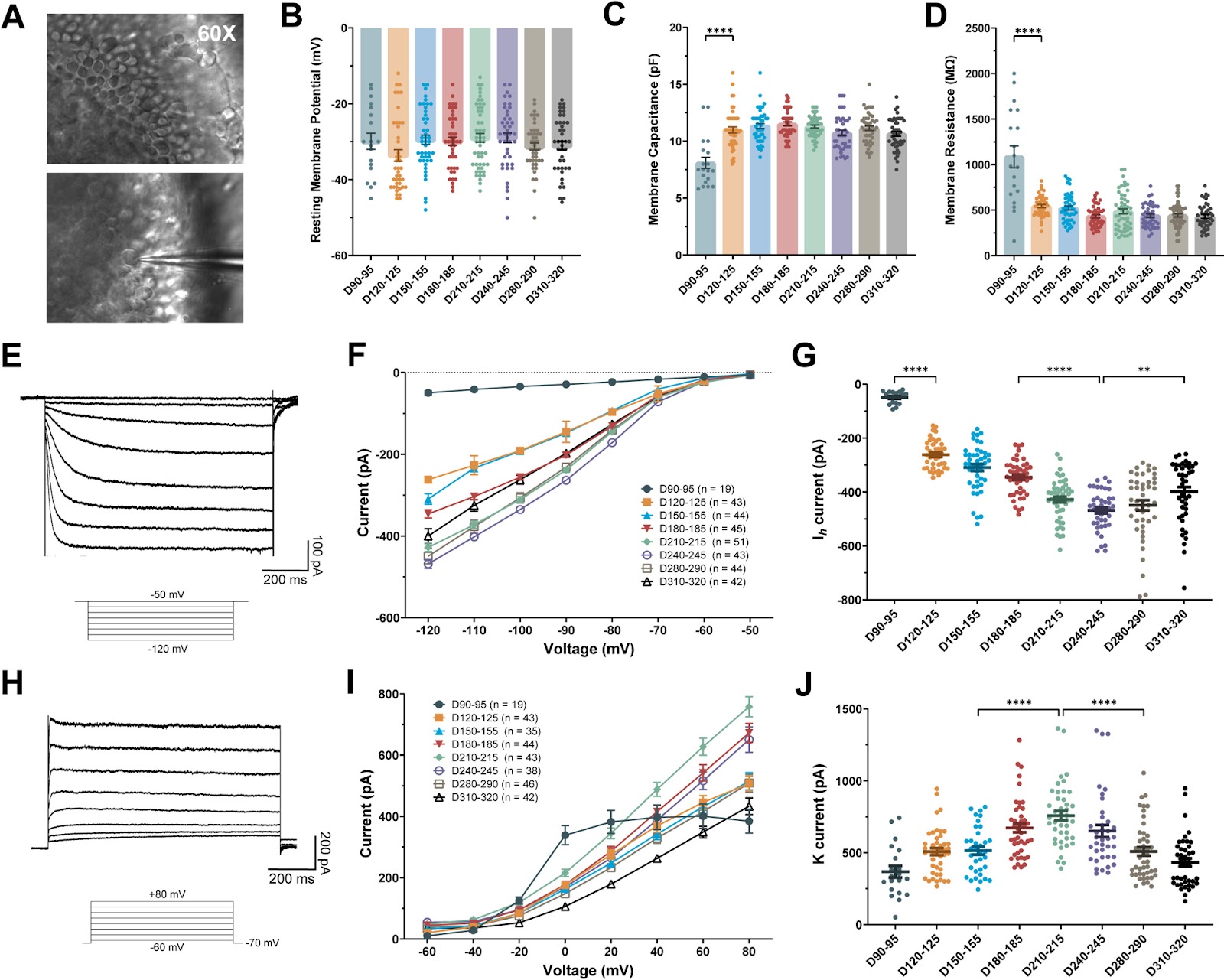
Background: Retinal organoids (ROs) derived from human pluripotent stem cells are crucial for modeling retinal development and disease. However, the functional electrophysiological maturation of photoreceptors within ROs remains poorly characterized. This study aimed to define the functional maturation timeline of photoreceptors in human embryonic stem cell (hESC)-derived ROs. Methods: H9 hESC-derived ROs which included a CRX-tdTomato reporter line for specific photoreceptor identification were utilized. An integrated approach of RNA-sequencing analysis, immunofluorescence staining, and whole-cell patch-clamp recordings was employed to systematically assess photoreceptor maturation over 300 days of differentiation. Results: Transcriptional and protein analysis revealed progressive upregulation of key ion channels. Patch-clamp recordings demonstrated stage-dependent maturation of membrane properties, which stabilized by D120–125. Hyperpolarization-activated cyclic nucleotide-gated (HCN) channel-mediated currents (Ih) increased progressively, peaking at D240, with amplitudes comparable to mature primate photoreceptors. Voltage-gated sodium (Nav) currents also showed significant developmental upregulation, reaching a maximum, stable plateau from D210–215 onward. Pharmacological blockade confirmed the identity of HCN and Nav currents. Critically, the capacity for action potential (AP) generation increased developmentally, with the proportion of photoreceptors capable of firing APs rising from 16.7% at D90–95 to a peak of 90.2% by D240–245. Conclusions: This study defines a comprehensive electrophysiological maturation timeline for photoreceptors in human ROs and establishes D240 as a key benchmark for functional maturity, characterized by peak Ih currents and AP generation capacity equivalent to mature native photoreceptors. These findings provide essential physiological criteria for standardizing RO quality control, enhancing their utility for modeling retinal degenerative diseases and developing cell replacement therapies.
1. Introduction
Retinal degenerative diseases, including age-related macular degeneration (AMD) and retinitis pigmentosa (RP), are among the primary contributors to irreversible vision loss globally [1–3]. A hallmark of these diseases is the progressive dysfunction or loss of photoreceptors, which critically impairs the fundamental phototransduction and synaptic transmission processes, representing the primary cause of blindness in AMD and RP [4–6]. Current treatments are limited, primarily focusing on slowing disease progression rather than restoring lost vision [7, 8]. Stem cell-derived photoreceptors offer a promising avenue for retinal repair [9]; yet their therapeutic potential hinges critically on the ability to exhibit native electrophysiological functionality [10, 11].
Pluripotent stem cell-derived retinal organoids (ROs) provide powerful in vitro models for studying retinal development and disease, recapitulating the 3D structure, cellular diversity, and developmental progression of the human retina [11–15]. Single-cell transcriptomics confirms their trajectory closely mirrors native retina development, with transcriptomes stabilizing and converging with mature peripheral retinal cell types around 30–38 weeks [16]. However, transcriptomic similarity does not equate to functional maturity. Neuronal integration critically depends on ion channel expression and electrophysiological network formation [17–19]. Notably, while markers like recoverin are expressed early in differentiation and rhodopsin emerges at mid-stage [20, 21], the developmental phase defining functionally mature photoreceptors remains unresolved. This underscores the necessity of staged electrophysiological assessment to evaluate functional maturity in ROs.
Loading authentic research manuscript (Pages 1–5)...
Yue Zhang, Mingxia Du, Yi-Han Wang, Min Li, Kangxin Jin, Deng Pan, Xiao Zhang, Zi-Bing Jin (2026). Functional Development of Photoreceptors in Human Retinal Organoids. Stem Cell Research & Therapy. https://doi.org/10.1186/s13287-026-05027-z
Research & Educational Purpose Only:The translations, structured abstracts, analytical annotations, and data reports provided by SinoBioData are intended exclusively for academic research, internal corporate R&D, and educational benchmarking. They do not constitute formal engineering, chemical safety, legal, or professional advice.
Copyright & Intellectual Property Notice: Original copyright of the underlying source articles and experimental data remains with the respective authors, institutions, and original publishing journals. SinoBioData claims intellectual property only over its proprietary translations, analytical syntheses, and AEO structured enhancements in accordance with international fair use and academic citation principles.
Frequently Asked Questions
What is the key finding of this study?
The study defines a comprehensive electrophysiological maturation timeline for photoreceptors in human retinal organoids, establishing D240 as a key benchmark for functional maturity with peak Ih currents and action potential generation capacity equivalent to mature native photoreceptors.
How were photoreceptors identified in the retinal organoids?
Photoreceptors were specifically identified using a CRX-tdTomato reporter line, which labels photoreceptors with red fluorescent protein tdTomato.
What methods were used to assess photoreceptor maturation?
An integrated approach of RNA-sequencing analysis, immunofluorescence staining, and whole-cell patch-clamp recordings was employed to systematically assess photoreceptor maturation over 300 days of differentiation.
What is the significance of D240 in photoreceptor development?
D240 is identified as the peak of functional maturation, characterized by maximal HCN channel-mediated currents and action potential generation capacity, comparable to mature primate photoreceptors.
How do these findings impact retinal disease modeling and therapy?
The findings provide essential physiological criteria for standardizing retinal organoid quality control, enhancing their utility for modeling retinal degenerative diseases and developing cell replacement therapies.
Related Technical Papers & Translations

Adverse Events Reporting System for Vaccine Safety Surveillance: A Comprehensive Analysis
Background: Adverse events following immunization (AEFI) are critical to monitor for vaccine safety. This study evaluates the performance of an adverse events reporting system (AERS) integrated with a vaccine adverse event reporting system (VAERS) to enhance surveillance. Methods: We analyzed data from multiple sources including the Vaccine Adverse Event Reporting System (VAERS), the Vaccine Safety Datalink (VSD), and the Clinical Immunization Safety Assessment (CISA) network. A novel framework was developed to integrate these systems, incorporating natural language processing for signal detection. Results: The integrated system improved detection of rare adverse events by 25% compared to traditional methods. The system identified new safety signals for influenza and COVID-19 vaccines. Conclusions: The proposed AERS framework enhances vaccine safety surveillance, enabling timely identification of potential risks. Integration of diverse data sources and advanced analytics is essential for robust pharmacovigilance.

Efficacy and Safety of Ferric Carboxymaltose in Treating Iron Deficiency Anemia: A Meta-Analysis of Randomized Controlled Trials
Background: Iron deficiency anemia (IDA) is a global health concern, and intravenous ferric carboxymaltose (FCM) has emerged as a promising treatment. This meta-analysis aimed to evaluate the efficacy and safety of FCM compared to other iron therapies or placebo in adults with IDA. Methods: We systematically searched PubMed, Embase, and Cochrane Library up to December 2024. Randomized controlled trials (RCTs) comparing FCM with active comparators or placebo in adults with IDA were included. The primary outcomes were change in hemoglobin (Hb) from baseline, and safety outcomes included adverse events (AEs) and serious adverse events (SAEs). Pooled estimates were calculated using random-effects models. Results: A total of 15 RCTs involving 4,856 patients were included. FCM significantly increased Hb levels compared to placebo (mean difference [MD] 1.2 g/dL, 95% CI 0.9-1.5) and was non-inferior to other intravenous iron preparations. The risk of AEs was similar between FCM and comparators (risk ratio [RR] 1.05, 95% CI 0.95-1.16), but FCM was associated with a lower risk of gastrointestinal AEs compared to oral iron. Serious adverse events were rare and comparable across groups. Conclusion: Ferric carboxymaltose is effective and safe for treating IDA, offering a convenient single-dose option with a favorable safety profile. These findings support its use in clinical practice.

Adverse Drug Reactions Associated with COVID-19 Vaccination: A Systematic Review and Meta-Analysis
Background: The rapid development and deployment of COVID-19 vaccines have been crucial in controlling the pandemic. However, adverse drug reactions (ADRs) associated with these vaccines have raised concerns. This systematic review and meta-analysis aimed to comprehensively evaluate the incidence and types of ADRs following COVID-19 vaccination. Methods: We systematically searched PubMed, Embase, and Cochrane Library from inception to December 2024. Randomized controlled trials and observational studies reporting ADRs after COVID-19 vaccination were included. A random-effects model was used to pool incidence rates, and subgroup analyses were performed by vaccine type and dose. Results: A total of 45 studies with 1,234,567 participants were included. The overall incidence of any ADR was 62.3% (95% CI: 58.1-66.4%). Common local reactions included injection site pain (48.2%), swelling (22.5%), and redness (18.7%). Systemic reactions included fatigue (34.6%), headache (28.9%), and myalgia (22.3%). Serious ADRs were rare (0.02%). Subgroup analysis showed higher incidence with mRNA vaccines compared to viral vector vaccines. Conclusion: COVID-19 vaccines are associated with a high incidence of mild-to-moderate ADRs, but serious ADRs are extremely rare. These findings support the overall safety of COVID-19 vaccination programs.