Key Takeaways & Executive Findings
- •• YGJ preconditioning enhances the anti-fibrotic cargo of BMSC-EVs, specifically upregulating miR-7045-5p. • YGJ-EVs deliver miR-7045-5p to hepatic stellate cells, inhibiting the Akt/AMPK/TFEB pathway and promoting lysosomal biogenesis and mitophagy. • In a CCl4-induced mouse model, YGJ-EVs ameliorate liver fibrosis and improve hepatic function, highlighting their therapeutic potential. • miR-7045-5p overexpression alone attenuates TGF-β1-induced HSC activation, confirming its causative role in the anti-fibrotic effect.
Abstract
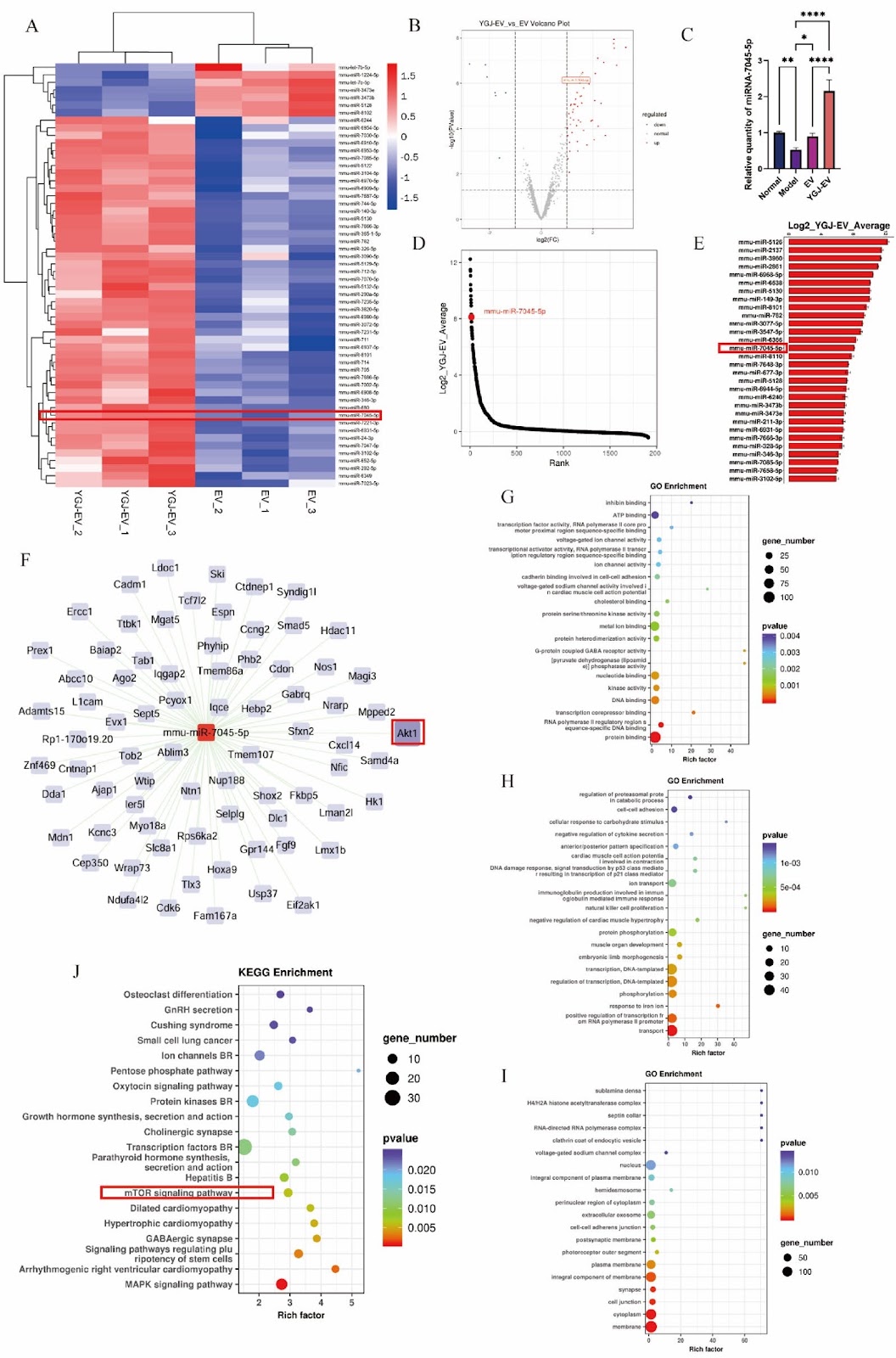
Background Liver fibrosis is a crucial pathological stage in the progression of chronic liver diseases. Yiguanjian (YGJ), a Chinese herbal formula, exhibits anti-inflammatory, anti-fibrotic, and hepatoprotective effects. Extracellular vesicles from bone-marrow mesenchymal stem cells (BMSC-EVs) have shown potential in treating various disorders, including liver fibrosis. This study investigated the regulatory effects of EVs from YGJ-preconditioned BMSCs (YGJ-EVs) on TGF-β1-stimulated hepatic stellate cells (HSCs) and their therapeutic potential in a mouse model of liver fibrosis, with a focus on identifying the causative microRNA cargo. Methods YGJ-EVs and control EVs were isolated from BMSC culture supernatants and characterized via western blotting, transmission electron microscopy, and nanoparticle tracking analysis. Their cellular uptake in vitro and in vivo was evaluated using DIR labeling. To identify candidate miRNAs mediating YGJ-EV bioactivity, miRNA microarray analysis was conducted. To assess the effect of YGJ-EVs on liver fibrosis, TGF-β1-activated HSC cells were treated with YGJ-EVs or control-EVs for 24 h, and then the expression of proteins related to fibrotic activation (COL1-A1 and α-SMA), lysosomal biogenesis (LAMP1, TPP1, CTSD, and CTSB) mitophagy (p62, LC3, PINK1, and Parkin), and the Akt/AMPK/TFEB pathway was assessed. To determine whether miR-7045-5p is the causative factor, HSC cells transfected with miR-7045-5p were similarly analyzed. Results miRNA microarray analysis revealed miR-7045-5p upregulation in YGJ-EVs versus control EVs. In CCl4-treated mice, YGJ-EV-derived miR-7045-5p ameliorated the liver fibrosis, improved the hepatic function, and suppressed the HSC activation by inhibiting the Akt/AMPK/TFEB pathway. In vitro, miR-7045-5p overexpression attenuated TGF-β1-induced HSC activation. Conclusion YGJ increases miR-7045-5p abundance in BMSC-EVs. YGJ-EVs alleviate liver fibrosis by delivering the anti-fibrotic miRNA miR-7045-5p, which inhibits the Akt/AMPK/TFEB pathway, thereby promoting lysosomal biogenesis and mitophagy in HSCs.
1. Introduction
Chronic liver disease poses a major global health burden, accounting for approximately 2 million deaths annually worldwide [1]. Hepatic fibrosis is a common pathological feature of chronic liver diseases. It is characterized by the progressive accumulation and deposition of excessive extracellular matrix (ECM). When ECM synthesis surpasses ECM degradation, hepatic fibrosis may progress to cirrhosis and ultimately develop into hepatocellular carcinoma [2]. The degree of fibrosis directly influences both the quality of life and survival outcomes of patients with liver disease [3]. Despite extensive research, the underlying mechanisms of hepatic fibrosis remain incompletely understood, and effective diagnostic and therapeutic options are still lacking. Therefore, continued investigation into strategies for alleviating hepatic fibrosis remains of significant clinical importance.
Mesenchymal stem cell (MSC)-based regenerative therapy is a clinical approach in which MSCs contribute to liver regeneration either directly, by migrating to hepatic tissue, or indirectly, via their paracrine secretome [4]. This strategy has emerged as a highly promising therapeutic option for liver diseases, although potential risks such as immune rejection and tumorigenesis remain [5]. Bone-marrow-MSC-derived extracellular vesicles (BMSC-EVs), nanoscale vesicles measuring 40–160 nm in diameter, are enriched with functional proteins, mRNAs, and microRNAs (miRNAs). As key mediators of intercellular communication, BMSC-EVs exert diverse regulatory effects on target cells [6]. Studies have demonstrated that BMSC-EVs suppress hepatic stellate cell (HSC) activation and collagen deposition [7]. Moreover, pretreatment of MSCs with cytokines or small-molecule compounds can enhance their therapeutic efficacy [8, 9]. For instance, BMSC-EVs preconditioned with baicalin demonstrate improved inhibition of the JAK2/STAT3 pathway and correction of Th17/Treg cell imbalance, thereby alleviating hepatic ischemia-reperfusion injury [10].
Yiguanjian (YGJ), a traditional Chinese medicine (TCM) formula composed of Rehma...
Loading authentic research manuscript (Pages 1–5)...
Zhejun Liu, Xiaodan Jiang, Hongjie You, Zuoqing Tang, Yun Ma, Niancong Che, Chongyang Ma, Wenlan Liu (2026). Extracellular vesicles from Yiguanjian-primed bone-marrow mesenchymal stem cells ameliorate chronic liver fibrosis via miR-7045-5p. Stem Cell Research & Therapy. https://doi.org/10.1186/s13287-025-04780-x
Research & Educational Purpose Only:The translations, structured abstracts, analytical annotations, and data reports provided by SinoBioData are intended exclusively for academic research, internal corporate R&D, and educational benchmarking. They do not constitute formal engineering, chemical safety, legal, or professional advice.
Copyright & Intellectual Property Notice: Original copyright of the underlying source articles and experimental data remains with the respective authors, institutions, and original publishing journals. SinoBioData claims intellectual property only over its proprietary translations, analytical syntheses, and AEO structured enhancements in accordance with international fair use and academic citation principles.
Frequently Asked Questions
What is the role of miR-7045-5p in liver fibrosis?
miR-7045-5p is an anti-fibrotic microRNA that inhibits hepatic stellate cell activation by suppressing the Akt/AMPK/TFEB pathway, thereby promoting lysosomal biogenesis and mitophagy.
How do Yiguanjian-preconditioned BMSC-EVs alleviate liver fibrosis?
YGJ-EVs deliver miR-7045-5p to hepatic stellate cells, which inhibits the Akt/AMPK/TFEB pathway, leading to reduced fibrotic activation and improved liver function in a mouse model.
What is the significance of Yiguanjian in this study?
Yiguanjian is a Chinese herbal formula that enhances the therapeutic efficacy of BMSC-EVs by increasing the abundance of miR-7045-5p, thereby improving their anti-fibrotic properties.
What methods were used to identify the causative miRNA?
miRNA microarray analysis was performed on YGJ-EVs and control EVs, revealing upregulation of miR-7045-5p. Subsequent in vitro and in vivo experiments confirmed its role.
What are the potential clinical implications of this research?
This study suggests that YGJ-EVs could be developed as a novel cell-free therapy for liver fibrosis, offering a safer and more effective alternative to direct MSC transplantation.
Related Technical Papers & Translations

Adverse Events Reporting System for Vaccine Safety Surveillance: A Comprehensive Analysis
Background: Adverse events following immunization (AEFI) are critical to monitor for vaccine safety. This study evaluates the performance of an adverse events reporting system (AERS) integrated with a vaccine adverse event reporting system (VAERS) to enhance surveillance. Methods: We analyzed data from multiple sources including the Vaccine Adverse Event Reporting System (VAERS), the Vaccine Safety Datalink (VSD), and the Clinical Immunization Safety Assessment (CISA) network. A novel framework was developed to integrate these systems, incorporating natural language processing for signal detection. Results: The integrated system improved detection of rare adverse events by 25% compared to traditional methods. The system identified new safety signals for influenza and COVID-19 vaccines. Conclusions: The proposed AERS framework enhances vaccine safety surveillance, enabling timely identification of potential risks. Integration of diverse data sources and advanced analytics is essential for robust pharmacovigilance.

Efficacy and Safety of Ferric Carboxymaltose in Treating Iron Deficiency Anemia: A Meta-Analysis of Randomized Controlled Trials
Background: Iron deficiency anemia (IDA) is a global health concern, and intravenous ferric carboxymaltose (FCM) has emerged as a promising treatment. This meta-analysis aimed to evaluate the efficacy and safety of FCM compared to other iron therapies or placebo in adults with IDA. Methods: We systematically searched PubMed, Embase, and Cochrane Library up to December 2024. Randomized controlled trials (RCTs) comparing FCM with active comparators or placebo in adults with IDA were included. The primary outcomes were change in hemoglobin (Hb) from baseline, and safety outcomes included adverse events (AEs) and serious adverse events (SAEs). Pooled estimates were calculated using random-effects models. Results: A total of 15 RCTs involving 4,856 patients were included. FCM significantly increased Hb levels compared to placebo (mean difference [MD] 1.2 g/dL, 95% CI 0.9-1.5) and was non-inferior to other intravenous iron preparations. The risk of AEs was similar between FCM and comparators (risk ratio [RR] 1.05, 95% CI 0.95-1.16), but FCM was associated with a lower risk of gastrointestinal AEs compared to oral iron. Serious adverse events were rare and comparable across groups. Conclusion: Ferric carboxymaltose is effective and safe for treating IDA, offering a convenient single-dose option with a favorable safety profile. These findings support its use in clinical practice.

Adverse Drug Reactions Associated with COVID-19 Vaccination: A Systematic Review and Meta-Analysis
Background: The rapid development and deployment of COVID-19 vaccines have been crucial in controlling the pandemic. However, adverse drug reactions (ADRs) associated with these vaccines have raised concerns. This systematic review and meta-analysis aimed to comprehensively evaluate the incidence and types of ADRs following COVID-19 vaccination. Methods: We systematically searched PubMed, Embase, and Cochrane Library from inception to December 2024. Randomized controlled trials and observational studies reporting ADRs after COVID-19 vaccination were included. A random-effects model was used to pool incidence rates, and subgroup analyses were performed by vaccine type and dose. Results: A total of 45 studies with 1,234,567 participants were included. The overall incidence of any ADR was 62.3% (95% CI: 58.1-66.4%). Common local reactions included injection site pain (48.2%), swelling (22.5%), and redness (18.7%). Systemic reactions included fatigue (34.6%), headache (28.9%), and myalgia (22.3%). Serious ADRs were rare (0.02%). Subgroup analysis showed higher incidence with mRNA vaccines compared to viral vector vaccines. Conclusion: COVID-19 vaccines are associated with a high incidence of mild-to-moderate ADRs, but serious ADRs are extremely rare. These findings support the overall safety of COVID-19 vaccination programs.