Key Takeaways & Executive Findings
- •• Secretomes from dermal and adipose MSCs show overlapping protein composition but differential expression of wound healing and angiogenesis-related proteins. • In a murine skin wound model, secretomes were less effective than their parental cells in accelerating wound closure and tissue remodeling. • Secretome-treated wounds exhibited intermediate outcomes between cell-treated and control groups, indicating partial therapeutic benefit. • Findings underscore the need for protocol optimization to enhance secretome efficacy for clinical translation in regenerative medicine.
Abstract
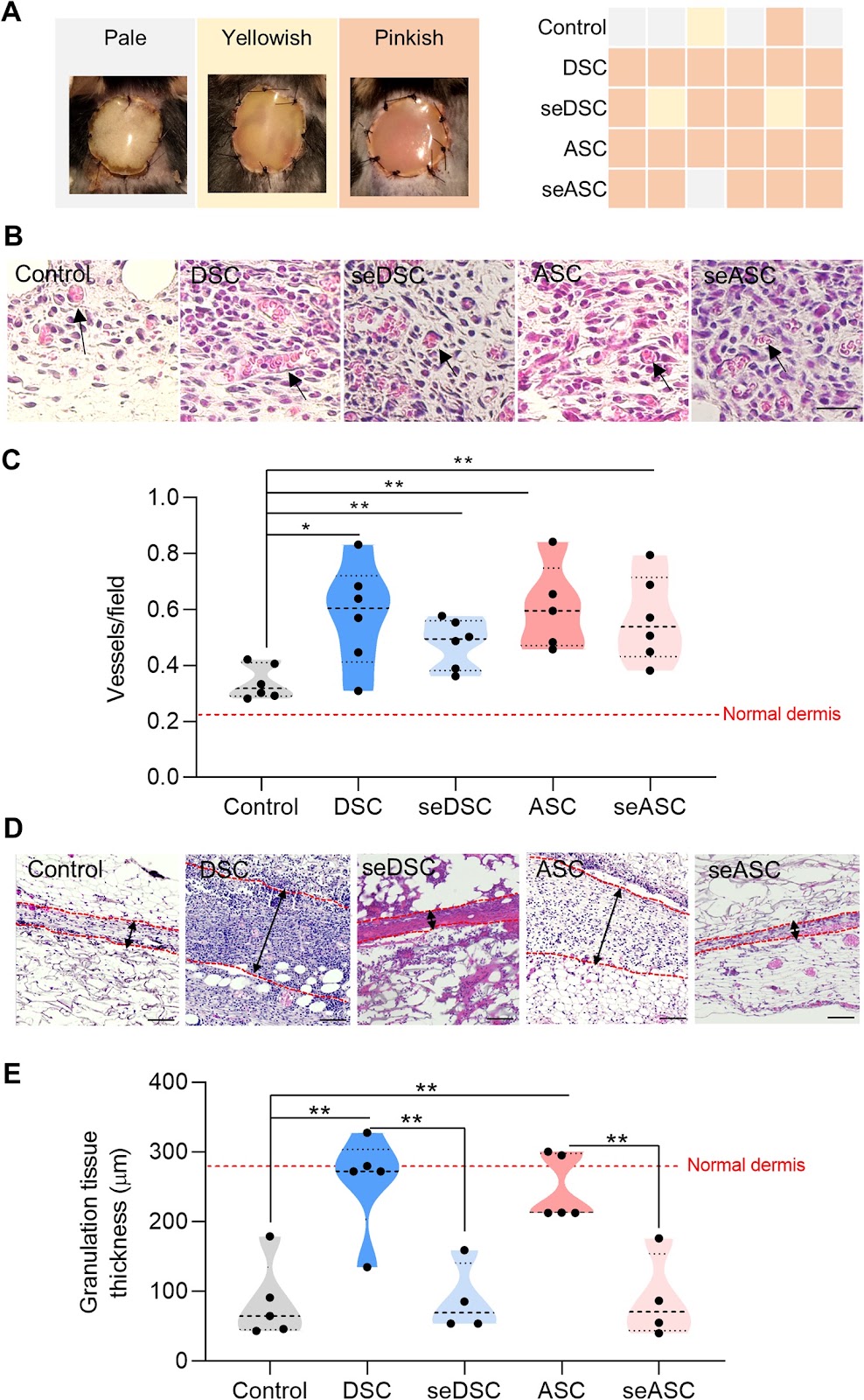
Background Although the paracrine effects of mesenchymal stem/stromal cells (MSCs) have been recognized as crucial mediators of their regenerative effects on tissue repair, the potential of MSC secretomes as effective substitutes for cellular therapies remains underexplored. Methods In this study, we compared MSCs from the human dermis (DSCs) and adipose tissue (ASCs) with their secretomes regarding their efficacy for skin wound healing using a translationally relevant murine model. Results Proteomic analysis revealed that while there was a substantial overlap in protein composition between DSC and ASC secretomes, specific proteins associated with wound healing and angiogenesis were differentially expressed. Despite a similar angiogenic potential in vivo, DSC and ASC secretomes were found to be less effective than cells in accelerating wound closure and promoting tissue remodeling. Conclusions Overall, secretome-treated groups showed intermediary results between cells- and control-treated (empty scaffold) groups. These findings highlight that although secretomes possess therapeutic potential, their efficacy might be limited compared to cellular therapies. This study contributes to the growing understanding of MSC secretomes, emphasizes the need for further protocol optimization, and offers insights into their potential applications in regenerative medicine.
1. Introduction
Mesenchymal stem/stromal cells (MSCs) are multipotent stem cells present in virtually all adult tissues that participate in homeostasis and repair by the secretion of paracrine factors and differentiation in tissue-specific cells [1–4]. MSCs can be isolated with high yield and maintain their proliferative capacity and genetic stability for several passages in vitro [5–7]. They are classified as low or non-immunogenic as they express low levels of MHC I and lack MHC II and other co-stimulatory molecules. They do not cause T-cell activation and consequent rejection when allogeneically or xenogeneically transplanted [8–10], and due to their limited plasticity, they do not form tumors in vivo [9–12]. MSCs have been tested for multiple therapeutic applications in regenerative medicine, including neurodegenerative disorders, renal failure, diabetes, and skin wound healing [4, 13–16]. Their ability to promote cell growth, angiogenesis, and immunomodulation has been widely described and supported by basic, pre-clinical, and clinical studies [16–19].
We have previously isolated and characterized MSCs derived from the human dermis and adipose tissue (DSCs and ASCs, respectively) harvested from tissues discarded after elective abdominoplasties [5, 7, 20]. We have shown that both DSCs and ASCs share the general MSC immunophenotype (CD73+, CD90+, CD105+, CD34−, and CD45−) and mesodermal differentiation potential (adipogenic, osteogenic, and chondrogenic). Both have similar self-renewal capacity and remain genetically stable over time in culture with a low frequency of nuclear alterations. However, while the isolation procedure for ASCs recovers a higher initial number of cells, the DSCs show shorter doubling time/faster proliferation and quicker closure of in vitro wounds as evaluated by cell scratch assay [7]. We also tested DSCs and ASCs’ potential to promote skin wound healing in a mouse model, using a commercially available collagen-based dermal template (Integra bilayer wound dressing, Integra LifeSciences) as a delivery system. We showed that animals treated with either DSC or ASC have accelerated wound closure in comparison to controls (empty scaffold).
Loading authentic research manuscript (Pages 1–5)...
Helena Debiazi Zomer, Victor Juan de Souza Lima, Monique Coelho Bion, Karynne Nazare Lins Brito, Michele Rode, Marco Augusto Stimamiglio, Talita da Silva Jeremias, Andrea Gonçalves Trentin (2026). Evaluation of secretomes derived from human dermal and adipose tissue mesenchymal stem/stromal cells for skin wound healing: not as effective as cells. Stem Cell Research & Therapy. https://doi.org/10.1186/s13287-023-03630-y
Research & Educational Purpose Only:The translations, structured abstracts, analytical annotations, and data reports provided by SinoBioData are intended exclusively for academic research, internal corporate R&D, and educational benchmarking. They do not constitute formal engineering, chemical safety, legal, or professional advice.
Copyright & Intellectual Property Notice: Original copyright of the underlying source articles and experimental data remains with the respective authors, institutions, and original publishing journals. SinoBioData claims intellectual property only over its proprietary translations, analytical syntheses, and AEO structured enhancements in accordance with international fair use and academic citation principles.
Frequently Asked Questions
What is the main finding of the study?
The study found that secretomes from dermal and adipose tissue MSCs are less effective than the cells themselves in accelerating skin wound healing and promoting tissue remodeling in a murine model, despite showing therapeutic potential.
How were the secretomes compared to cells?
The researchers compared the efficacy of MSCs (DSCs and ASCs) and their secretomes in a mouse skin wound model using a collagen-based dermal template. They assessed wound closure, tissue remodeling, and angiogenic potential.
What are the implications of this study for regenerative medicine?
The findings suggest that while MSC secretomes hold promise as cell-free therapies, their current efficacy is limited compared to cellular therapies. Further optimization of secretome production and application protocols is needed to enhance their therapeutic potential.
What methods were used in the study?
The study involved proteomic analysis of secretomes, in vivo wound healing experiments in mice, and comparison of angiogenic potential. The secretomes were derived from human dermal and adipose tissue MSCs.
What are the key differences between DSC and ASC secretomes?
Proteomic analysis revealed substantial overlap in protein composition, but specific proteins associated with wound healing and angiogenesis were differentially expressed between DSC and ASC secretomes.
Related Technical Papers & Translations

Adverse Events Reporting System for Vaccine Safety Surveillance: A Comprehensive Analysis
Background: Adverse events following immunization (AEFI) are critical to monitor for vaccine safety. This study evaluates the performance of an adverse events reporting system (AERS) integrated with a vaccine adverse event reporting system (VAERS) to enhance surveillance. Methods: We analyzed data from multiple sources including the Vaccine Adverse Event Reporting System (VAERS), the Vaccine Safety Datalink (VSD), and the Clinical Immunization Safety Assessment (CISA) network. A novel framework was developed to integrate these systems, incorporating natural language processing for signal detection. Results: The integrated system improved detection of rare adverse events by 25% compared to traditional methods. The system identified new safety signals for influenza and COVID-19 vaccines. Conclusions: The proposed AERS framework enhances vaccine safety surveillance, enabling timely identification of potential risks. Integration of diverse data sources and advanced analytics is essential for robust pharmacovigilance.

Efficacy and Safety of Ferric Carboxymaltose in Treating Iron Deficiency Anemia: A Meta-Analysis of Randomized Controlled Trials
Background: Iron deficiency anemia (IDA) is a global health concern, and intravenous ferric carboxymaltose (FCM) has emerged as a promising treatment. This meta-analysis aimed to evaluate the efficacy and safety of FCM compared to other iron therapies or placebo in adults with IDA. Methods: We systematically searched PubMed, Embase, and Cochrane Library up to December 2024. Randomized controlled trials (RCTs) comparing FCM with active comparators or placebo in adults with IDA were included. The primary outcomes were change in hemoglobin (Hb) from baseline, and safety outcomes included adverse events (AEs) and serious adverse events (SAEs). Pooled estimates were calculated using random-effects models. Results: A total of 15 RCTs involving 4,856 patients were included. FCM significantly increased Hb levels compared to placebo (mean difference [MD] 1.2 g/dL, 95% CI 0.9-1.5) and was non-inferior to other intravenous iron preparations. The risk of AEs was similar between FCM and comparators (risk ratio [RR] 1.05, 95% CI 0.95-1.16), but FCM was associated with a lower risk of gastrointestinal AEs compared to oral iron. Serious adverse events were rare and comparable across groups. Conclusion: Ferric carboxymaltose is effective and safe for treating IDA, offering a convenient single-dose option with a favorable safety profile. These findings support its use in clinical practice.

Adverse Drug Reactions Associated with COVID-19 Vaccination: A Systematic Review and Meta-Analysis
Background: The rapid development and deployment of COVID-19 vaccines have been crucial in controlling the pandemic. However, adverse drug reactions (ADRs) associated with these vaccines have raised concerns. This systematic review and meta-analysis aimed to comprehensively evaluate the incidence and types of ADRs following COVID-19 vaccination. Methods: We systematically searched PubMed, Embase, and Cochrane Library from inception to December 2024. Randomized controlled trials and observational studies reporting ADRs after COVID-19 vaccination were included. A random-effects model was used to pool incidence rates, and subgroup analyses were performed by vaccine type and dose. Results: A total of 45 studies with 1,234,567 participants were included. The overall incidence of any ADR was 62.3% (95% CI: 58.1-66.4%). Common local reactions included injection site pain (48.2%), swelling (22.5%), and redness (18.7%). Systemic reactions included fatigue (34.6%), headache (28.9%), and myalgia (22.3%). Serious ADRs were rare (0.02%). Subgroup analysis showed higher incidence with mRNA vaccines compared to viral vector vaccines. Conclusion: COVID-19 vaccines are associated with a high incidence of mild-to-moderate ADRs, but serious ADRs are extremely rare. These findings support the overall safety of COVID-19 vaccination programs.