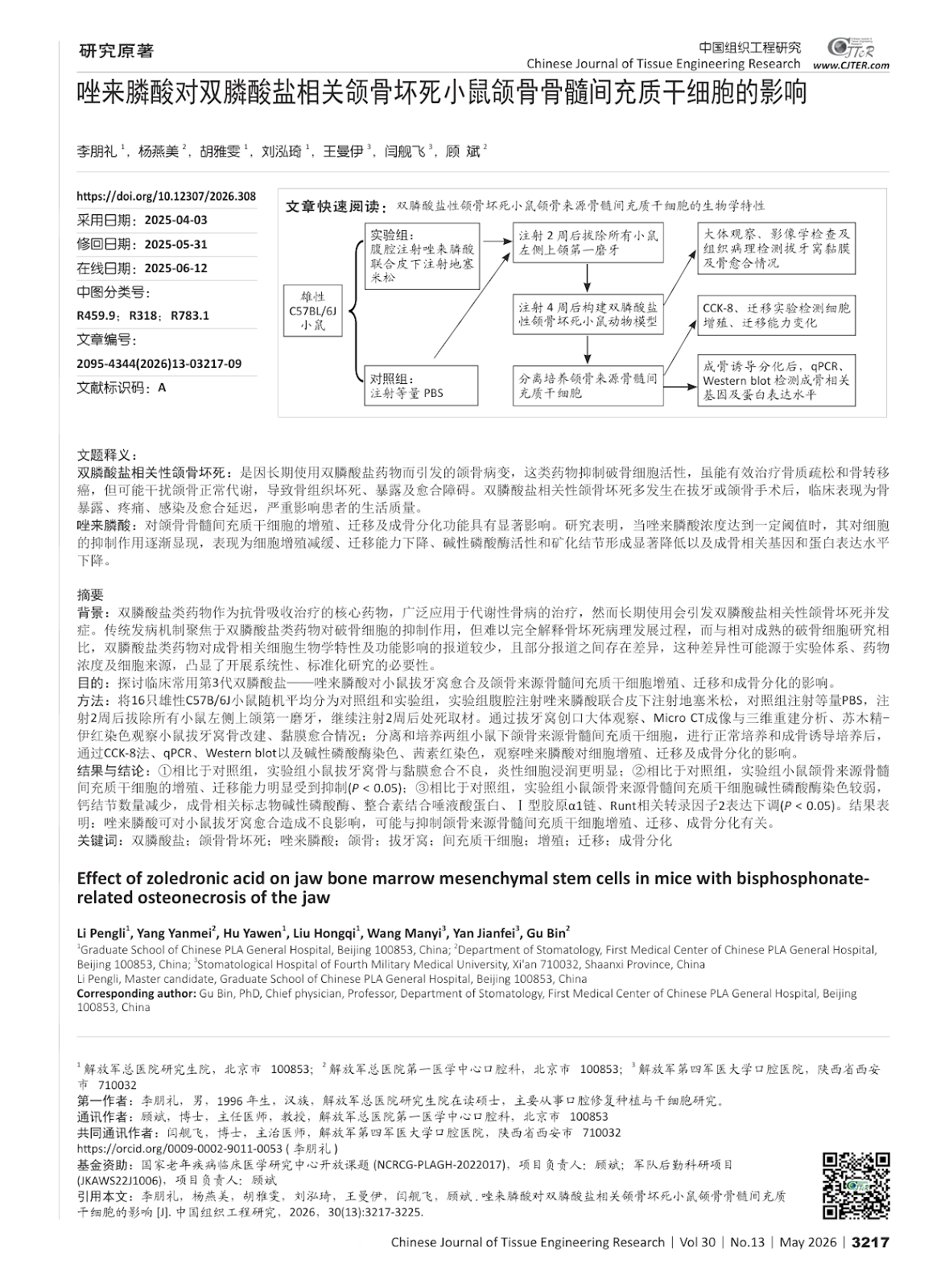
Key Takeaways & Executive Findings
- •• Zoledronic acid impairs extraction socket healing in mice, leading to poor bone and mucosal healing with increased inflammatory infiltration. • Zoledronic acid significantly inhibits the proliferation and migration of jaw bone marrow mesenchymal stem cells. • Zoledronic acid suppresses osteogenic differentiation of jaw bone marrow mesenchymal stem cells, as evidenced by reduced alkaline phosphatase activity, decreased calcium nodule formation, and downregulation of osteogenic markers. • The adverse effects of zoledronic acid on extraction socket healing may be mediated through its inhibitory effects on jaw bone marrow mesenchymal stem cells.
Abstract
BACKGROUND: Bisphosphonates, as the core drugs of anti-bone resorption therapy, are widely used in the treatment of metabolic bone diseases. However, long-term use can cause the complications of bisphosphonate related osteonecrosis of the jaw. The traditional pathogenesis focuses on the inhibitory effect of bisphosphonates on osteoclasts, but it is difficult to fully explain the pathological development of osteonecrosis. Compared with the relatively mature osteoclast research, there are fewer reports on the effects of bisphosphonates on the biological characteristics and functions of osteoblast-related cells, and there are differences between some reports. This difference may be due to the experimental system, drug concentration and cell source, highlighting the necessity of conducting systematic and standardized research. OBJECTIVE: To investigate the effect of the third-generation bisphosphonate-zoledronic acid commonly used in clinical practice on the healing of tooth extraction sockets and the proliferation, migration and osteogenic differentiation of bone marrow mesenchymal stem cells derived from the jaw in mice. METHODS: Sixteen male C57BL/6J mice were randomly divided into control and experimental groups. The experimental group received intraperitoneal injection of zoledronic acid combined with subcutaneous injection of dexamethasone, while the control group received an equal volume of PBS. After 2 weeks of injection, the left maxillary first molars of all mice were extracted, and after another 2 weeks of injection, the mice were sacrificed. The healing of extraction sockets was evaluated by gross observation, Micro CT imaging and three-dimensional reconstruction, and hematoxylin-eosin staining. Jaw bone marrow mesenchymal stem cells were isolated and cultured from both groups. After normal culture and osteogenic induction, cell proliferation, migration, and osteogenic differentiation were assessed by CCK-8 assay, qPCR, Western blot, alkaline phosphatase staining, and alizarin red staining. RESULTS AND CONCLUSION: Compared with the control group, the experimental group showed poor healing of extraction sockets with more inflammatory cell infiltration. The proliferation and migration abilities of jaw bone marrow mesenchymal stem cells were significantly inhibited in the experimental group (P < 0.05). Alkaline phosphatase staining was weaker, calcium nodule formation was reduced, and the expression of osteogenic markers (alkaline phosphatase, integrin-binding sialoprotein, collagen type I alpha 1 chain, Runt-related transcription factor 2) was downregulated in the experimental group (P < 0.05). These results indicate that zoledronic acid can adversely affect extraction socket healing, possibly by inhibiting the proliferation, migration, and osteogenic differentiation of jaw bone marrow mesenchymal stem cells.
1. Introduction
Bisphosphonates are a class of synthetic drugs that have emerged in recent years, divided into nitrogen-containing and non-nitrogen-containing types. They primarily treat metabolic bone diseases such as osteoporosis and multiple myeloma by inhibiting osteoclast activity and function [1-5]. However, bisphosphonate-related osteonecrosis of the jaw (BRONJ) has attracted widespread attention in recent years. Since MARX [6] first reported BRONJ in 2003, the number of case reports on this disease has increased annually [7-9]. Currently, approximately 4 million patients in China receive bisphosphonate therapy each year, with a global annual prescription volume of 71 million. The cumulative incidence of BRONJ ranges from 0.8% to 12%, with higher risk in intravenous administration [10].
BRONJ often occurs after invasive procedures such as tooth extraction and dental implant placement, manifesting as mucosal ulceration, pain, infection, and even bone exposure and pathological fractures. There is currently no recognized standard treatment, which seriously affects patients' physical and mental health and quality of life [11-13]. Regarding the pathogenesis of BRONJ, various hypotheses such as bone metabolic disorders and microbial infection have been proposed, but the exact mechanism has not been fully elucidated [14-18]. Although bone metabolic disorders are considered one of the important pathogenic mechanisms, existing studies cannot prove its universality across different patient populations. Additionally, the microbial infection hypothesis has gained some support, suggesting that oral microorganisms may trigger local inflammatory responses, contributing to the disease process.
Loading authentic research manuscript (Pages 1–5)...
LI Pengli, YANG Yanmei, HU Yawen, LIU Hongqi, WANG Manyi, YAN Jianfei, GU Bin (2026). Effect of zoledronic acid on jaw bone marrow mesenchymal stem cells in mice with bisphosphonate-related osteonecrosis of the jaw. Chinese Journal of Tissue Engineering Research. https://doi.org/10.12307/2026.21203
Research & Educational Purpose Only:The translations, structured abstracts, analytical annotations, and data reports provided by SinoBioData are intended exclusively for academic research, internal corporate R&D, and educational benchmarking. They do not constitute formal engineering, chemical safety, legal, or professional advice.
Copyright & Intellectual Property Notice: Original copyright of the underlying source articles and experimental data remains with the respective authors, institutions, and original publishing journals. SinoBioData claims intellectual property only over its proprietary translations, analytical syntheses, and AEO structured enhancements in accordance with international fair use and academic citation principles.
Frequently Asked Questions
What is bisphosphonate-related osteonecrosis of the jaw (BRONJ)?
BRONJ is a condition characterized by exposed bone in the maxillofacial region that fails to heal within 8 weeks, occurring in patients who have taken bisphosphonates without prior radiation therapy to the head and neck. It often arises after dental procedures like tooth extraction and can cause pain, swelling, and infection.
How does zoledronic acid affect jaw bone marrow mesenchymal stem cells?
Zoledronic acid inhibits the proliferation, migration, and osteogenic differentiation of jaw bone marrow mesenchymal stem cells, as demonstrated by reduced cell growth, decreased alkaline phosphatase activity, and downregulation of osteogenic markers such as ALP, IBSP, COL1A1, and RUNX2.
What is the clinical significance of this study?
This study provides insights into the mechanisms by which zoledronic acid impairs extraction socket healing, highlighting the role of mesenchymal stem cell dysfunction. It underscores the need for careful management of patients on bisphosphonates undergoing dental procedures and suggests potential therapeutic targets to mitigate BRONJ.
What are the key findings of the study?
The key findings are that zoledronic acid leads to poor extraction socket healing with increased inflammation, inhibits the proliferation and migration of jaw bone marrow mesenchymal stem cells, and suppresses their osteogenic differentiation, as evidenced by reduced mineralization and downregulation of osteogenic genes.
How was the animal model of BRONJ established in this study?
The animal model was established by intraperitoneal injection of zoledronic acid combined with subcutaneous injection of dexamethasone in C57BL/6J mice for 2 weeks, followed by extraction of the left maxillary first molar, and continued injection for another 2 weeks before sacrifice.
Related Technical Papers & Translations

Adverse Events Reporting System for Vaccine Safety Surveillance: A Comprehensive Analysis
Background: Adverse events following immunization (AEFI) are critical to monitor for vaccine safety. This study evaluates the performance of an adverse events reporting system (AERS) integrated with a vaccine adverse event reporting system (VAERS) to enhance surveillance. Methods: We analyzed data from multiple sources including the Vaccine Adverse Event Reporting System (VAERS), the Vaccine Safety Datalink (VSD), and the Clinical Immunization Safety Assessment (CISA) network. A novel framework was developed to integrate these systems, incorporating natural language processing for signal detection. Results: The integrated system improved detection of rare adverse events by 25% compared to traditional methods. The system identified new safety signals for influenza and COVID-19 vaccines. Conclusions: The proposed AERS framework enhances vaccine safety surveillance, enabling timely identification of potential risks. Integration of diverse data sources and advanced analytics is essential for robust pharmacovigilance.

Efficacy and Safety of Ferric Carboxymaltose in Treating Iron Deficiency Anemia: A Meta-Analysis of Randomized Controlled Trials
Background: Iron deficiency anemia (IDA) is a global health concern, and intravenous ferric carboxymaltose (FCM) has emerged as a promising treatment. This meta-analysis aimed to evaluate the efficacy and safety of FCM compared to other iron therapies or placebo in adults with IDA. Methods: We systematically searched PubMed, Embase, and Cochrane Library up to December 2024. Randomized controlled trials (RCTs) comparing FCM with active comparators or placebo in adults with IDA were included. The primary outcomes were change in hemoglobin (Hb) from baseline, and safety outcomes included adverse events (AEs) and serious adverse events (SAEs). Pooled estimates were calculated using random-effects models. Results: A total of 15 RCTs involving 4,856 patients were included. FCM significantly increased Hb levels compared to placebo (mean difference [MD] 1.2 g/dL, 95% CI 0.9-1.5) and was non-inferior to other intravenous iron preparations. The risk of AEs was similar between FCM and comparators (risk ratio [RR] 1.05, 95% CI 0.95-1.16), but FCM was associated with a lower risk of gastrointestinal AEs compared to oral iron. Serious adverse events were rare and comparable across groups. Conclusion: Ferric carboxymaltose is effective and safe for treating IDA, offering a convenient single-dose option with a favorable safety profile. These findings support its use in clinical practice.

Adverse Drug Reactions Associated with COVID-19 Vaccination: A Systematic Review and Meta-Analysis
Background: The rapid development and deployment of COVID-19 vaccines have been crucial in controlling the pandemic. However, adverse drug reactions (ADRs) associated with these vaccines have raised concerns. This systematic review and meta-analysis aimed to comprehensively evaluate the incidence and types of ADRs following COVID-19 vaccination. Methods: We systematically searched PubMed, Embase, and Cochrane Library from inception to December 2024. Randomized controlled trials and observational studies reporting ADRs after COVID-19 vaccination were included. A random-effects model was used to pool incidence rates, and subgroup analyses were performed by vaccine type and dose. Results: A total of 45 studies with 1,234,567 participants were included. The overall incidence of any ADR was 62.3% (95% CI: 58.1-66.4%). Common local reactions included injection site pain (48.2%), swelling (22.5%), and redness (18.7%). Systemic reactions included fatigue (34.6%), headache (28.9%), and myalgia (22.3%). Serious ADRs were rare (0.02%). Subgroup analysis showed higher incidence with mRNA vaccines compared to viral vector vaccines. Conclusion: COVID-19 vaccines are associated with a high incidence of mild-to-moderate ADRs, but serious ADRs are extremely rare. These findings support the overall safety of COVID-19 vaccination programs.