Key Takeaways & Executive Findings
- •• DMOG pretreatment restores osteogenic–adipogenic balance in ONFH-derived BMSCs by promoting osteogenesis and suppressing adipogenesis. • DMOG improves mitochondrial function, reduces oxidative stress, and enhances bioenergetic metabolism in a HIF-1α-dependent manner. • Homer3 is identified as a downstream negative regulator of HIF-1α, aberrantly upregulated in fhBMSCs but suppressed by DMOG. • Knockdown of Homer3 mimics DMOG effects, suggesting a potential therapeutic target for ONFH.
Abstract
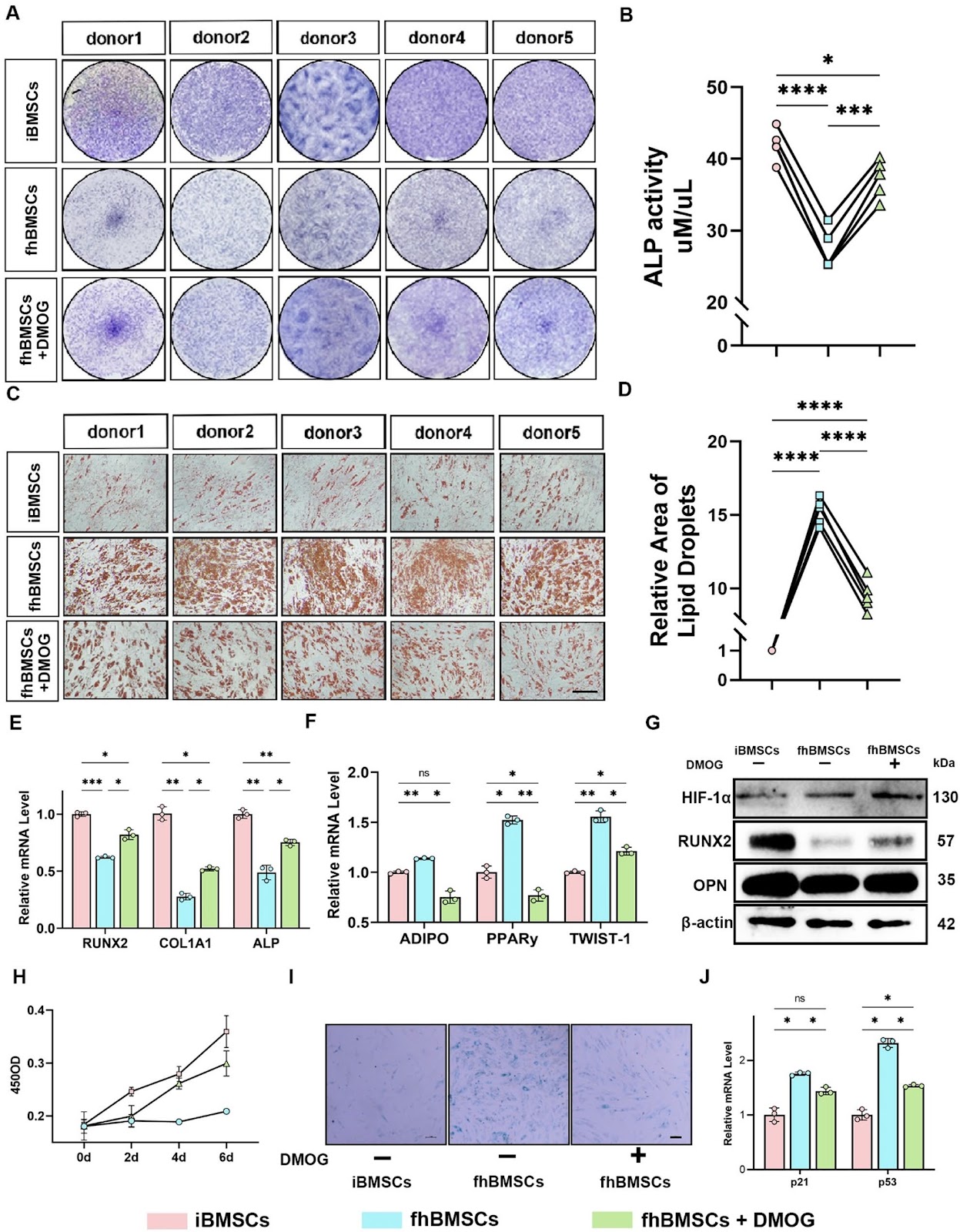
Background Osteonecrosis of the femoral head (ONFH) is a progressive orthopedic disorder that often culminates in femoral head collapse and joint failure. Dysfunction of bone marrow mesenchymal stem cells (BMSCs), including impaired osteogenesis, enhanced adipogenesis, and mitochondrial dysfunction, has been increasingly recognized as a central driver of ONFH pathogenesis. However, the molecular mechanisms linking metabolic stress to lineage imbalance remain poorly defined. Methods Paired BMSCs were isolated from necrotic femoral head regions (fhBMSCs) and the iliac crest (iBMSCs) of ONFH patients. Functional assays, RNA sequencing, and molecular analyses were performed to evaluate the effects of the hypoxia mimetic dimethyloxalylglycine (DMOG) on osteogenic–adipogenic balance, mitochondrial function, and senescence. Loss-of-function experiments targeting hypoxia-inducible factor-1α (HIF-1α) and Homer3 were conducted to elucidate mechanistic pathways. Results Compared with iBMSCs, fhBMSCs exhibited impaired osteogenesis, enhanced adipogenesis, mitochondrial dysfunction, and increased senescence. DMOG pretreatment restored osteogenic differentiation, suppressed adipogenesis, improved mitochondrial dynamics, reduced oxidative stress, and enhanced bioenergetic metabolism. These protective effects were dependent on HIF-1α stabilization. Transcriptomic profiling identified Homer3 as a downstream negative regulator of HIF-1α. Homer3 was aberrantly upregulated in fhBMSCs but suppressed by DMOG, and its knockdown mimicked the effects of DMOG by promoting osteogenesis, inhibiting adipogenesis, enhancing mitophagy, and restoring mitochondrial function. Conversely, silencing HIF-1α abolished DMOG-mediated benefits and reinstated Homer3 expression.
1. Introduction
Osteonecrosis of the femoral head (ONFH) is a progressive and debilitating orthopedic disorder that frequently progresses to femoral head collapse and total hip replacement, especially in young and middle-aged patients [1]. Despite advances in surgical techniques, effective joint-preserving treatments remain limited, largely due to the incomplete understanding of disease mechanisms [2].
Bone marrow mesenchymal stem cells (BMSCs) play a pivotal role in bone homeostasis and regeneration, and their dysfunction is increasingly recognized as a major contributor to the onset and progression of ONFH [3]. BMSCs derived from ONFH patients often exhibit impaired osteogenic differentiation accompanied by enhanced adipogenesis, resulting in reduced bone formation and increased fat accumulation [4–6]. In parallel, mitochondrial dysfunction—characterized by decreased membrane potential, reduced ATP generation, excessive reactive oxygen species (ROS), and defective autophagy—further compromises BMSC differentiation capacity and lineage stability [7, 8]. However, the molecular link between metabolic stress and impaired lineage commitment in ONFH-derived BMSCs remains poorly defined.
Accumulating evidence indicates that metabolic status is a key determinant of stem cell fate. Bioenergetic and transcriptomic studies have shown that mitochondrial oxidative phosphorylation (OxPhos) is strongly activated during osteogenic differentiation of MSCs, while glycolytic activity remains largely comparable to the undifferentiated state [9, 10]. Mitochondria not only serve as the powerhouse of energy metabolism but also regulate ROS levels, phosphorylation events, and metabolic intermediates that impact transcriptional and epigenetic programs, thereby influencing lineage commitment [8, 11]. Within the pathological microenvironment of ONFH, BMSCs may be exposed to chronic ischemia, hypoxia, and glucose dysregulation, leading to mitochondrial injury and impaired autophagic activity, which further exacerbate osteogenic–adipogenic imbalance and impair bone repair [12]. Elucidating the molecular mechanisms linking mitochondrial homeostasis to BMSC differentiation abnormalities is thus critical for understanding ONFH pathogenesis and developing new therapeutic strategies.
Loading authentic research manuscript (Pages 1–5)...
Qiheng Chen, Lingxian Yi, Penghui Nie, Jie Wang, Jing Zhu, Jiang Peng, Tujun Weng (2026). DMOG pretreatment restores osteogenic–adipogenic balance and mitochondrial function in ONFH BMSCs through the HIF-1α/Homer3 pathway. Stem Cell Research & Therapy. https://doi.org/10.1186/s13287-026-05026-0
Research & Educational Purpose Only:The translations, structured abstracts, analytical annotations, and data reports provided by SinoBioData are intended exclusively for academic research, internal corporate R&D, and educational benchmarking. They do not constitute formal engineering, chemical safety, legal, or professional advice.
Copyright & Intellectual Property Notice: Original copyright of the underlying source articles and experimental data remains with the respective authors, institutions, and original publishing journals. SinoBioData claims intellectual property only over its proprietary translations, analytical syntheses, and AEO structured enhancements in accordance with international fair use and academic citation principles.
Frequently Asked Questions
What is the role of DMOG in treating osteonecrosis of the femoral head?
DMOG pretreatment restores the osteogenic–adipogenic balance in BMSCs derived from necrotic femoral head regions, promoting osteogenesis and suppressing adipogenesis, while also improving mitochondrial function and reducing oxidative stress, thereby potentially mitigating ONFH progression.
How does HIF-1α contribute to the protective effects of DMOG?
DMOG stabilizes HIF-1α, which is essential for its protective effects. HIF-1α suppresses the expression of Homer3, a negative regulator, leading to enhanced osteogenesis, inhibited adipogenesis, and improved mitochondrial dynamics.
What is the significance of Homer3 in ONFH pathogenesis?
Homer3 is aberrantly upregulated in BMSCs from necrotic femoral head regions, contributing to impaired osteogenesis and enhanced adipogenesis. Its knockdown mimics the beneficial effects of DMOG, suggesting Homer3 as a potential therapeutic target.
What are the key mitochondrial changes in ONFH-derived BMSCs?
ONFH-derived BMSCs exhibit mitochondrial dysfunction characterized by decreased membrane potential, reduced ATP generation, excessive reactive oxygen species, and defective autophagy, which compromise differentiation capacity and lineage stability.
Could DMOG be used as a therapeutic agent for ONFH?
The findings suggest that DMOG, by modulating the HIF-1α/Homer3 pathway, could be a promising therapeutic agent for ONFH, as it restores osteogenic–adipogenic balance and mitochondrial function in patient-derived BMSCs.
Related Technical Papers & Translations

Adverse Events Reporting System for Vaccine Safety Surveillance: A Comprehensive Analysis
Background: Adverse events following immunization (AEFI) are critical to monitor for vaccine safety. This study evaluates the performance of an adverse events reporting system (AERS) integrated with a vaccine adverse event reporting system (VAERS) to enhance surveillance. Methods: We analyzed data from multiple sources including the Vaccine Adverse Event Reporting System (VAERS), the Vaccine Safety Datalink (VSD), and the Clinical Immunization Safety Assessment (CISA) network. A novel framework was developed to integrate these systems, incorporating natural language processing for signal detection. Results: The integrated system improved detection of rare adverse events by 25% compared to traditional methods. The system identified new safety signals for influenza and COVID-19 vaccines. Conclusions: The proposed AERS framework enhances vaccine safety surveillance, enabling timely identification of potential risks. Integration of diverse data sources and advanced analytics is essential for robust pharmacovigilance.

Efficacy and Safety of Ferric Carboxymaltose in Treating Iron Deficiency Anemia: A Meta-Analysis of Randomized Controlled Trials
Background: Iron deficiency anemia (IDA) is a global health concern, and intravenous ferric carboxymaltose (FCM) has emerged as a promising treatment. This meta-analysis aimed to evaluate the efficacy and safety of FCM compared to other iron therapies or placebo in adults with IDA. Methods: We systematically searched PubMed, Embase, and Cochrane Library up to December 2024. Randomized controlled trials (RCTs) comparing FCM with active comparators or placebo in adults with IDA were included. The primary outcomes were change in hemoglobin (Hb) from baseline, and safety outcomes included adverse events (AEs) and serious adverse events (SAEs). Pooled estimates were calculated using random-effects models. Results: A total of 15 RCTs involving 4,856 patients were included. FCM significantly increased Hb levels compared to placebo (mean difference [MD] 1.2 g/dL, 95% CI 0.9-1.5) and was non-inferior to other intravenous iron preparations. The risk of AEs was similar between FCM and comparators (risk ratio [RR] 1.05, 95% CI 0.95-1.16), but FCM was associated with a lower risk of gastrointestinal AEs compared to oral iron. Serious adverse events were rare and comparable across groups. Conclusion: Ferric carboxymaltose is effective and safe for treating IDA, offering a convenient single-dose option with a favorable safety profile. These findings support its use in clinical practice.

Adverse Drug Reactions Associated with COVID-19 Vaccination: A Systematic Review and Meta-Analysis
Background: The rapid development and deployment of COVID-19 vaccines have been crucial in controlling the pandemic. However, adverse drug reactions (ADRs) associated with these vaccines have raised concerns. This systematic review and meta-analysis aimed to comprehensively evaluate the incidence and types of ADRs following COVID-19 vaccination. Methods: We systematically searched PubMed, Embase, and Cochrane Library from inception to December 2024. Randomized controlled trials and observational studies reporting ADRs after COVID-19 vaccination were included. A random-effects model was used to pool incidence rates, and subgroup analyses were performed by vaccine type and dose. Results: A total of 45 studies with 1,234,567 participants were included. The overall incidence of any ADR was 62.3% (95% CI: 58.1-66.4%). Common local reactions included injection site pain (48.2%), swelling (22.5%), and redness (18.7%). Systemic reactions included fatigue (34.6%), headache (28.9%), and myalgia (22.3%). Serious ADRs were rare (0.02%). Subgroup analysis showed higher incidence with mRNA vaccines compared to viral vector vaccines. Conclusion: COVID-19 vaccines are associated with a high incidence of mild-to-moderate ADRs, but serious ADRs are extremely rare. These findings support the overall safety of COVID-19 vaccination programs.