Key Takeaways & Executive Findings
- •• Both BMMNC and MSC transplantation significantly improve left ventricular ejection fraction (LVEF) in chronic heart failure patients, with no significant difference between cell types. • Stem cell therapy does not significantly reduce the risk of major adverse cardiovascular events (MACE) compared to controls. • There is a marginally decreased risk of all-cause death and rehospitalization with stem cell therapy, but no difference between BMMNCs and MSCs. • Future randomized controlled trials should focus on clinical outcomes to confirm the comparative effectiveness of these stem cell therapies.
Abstract
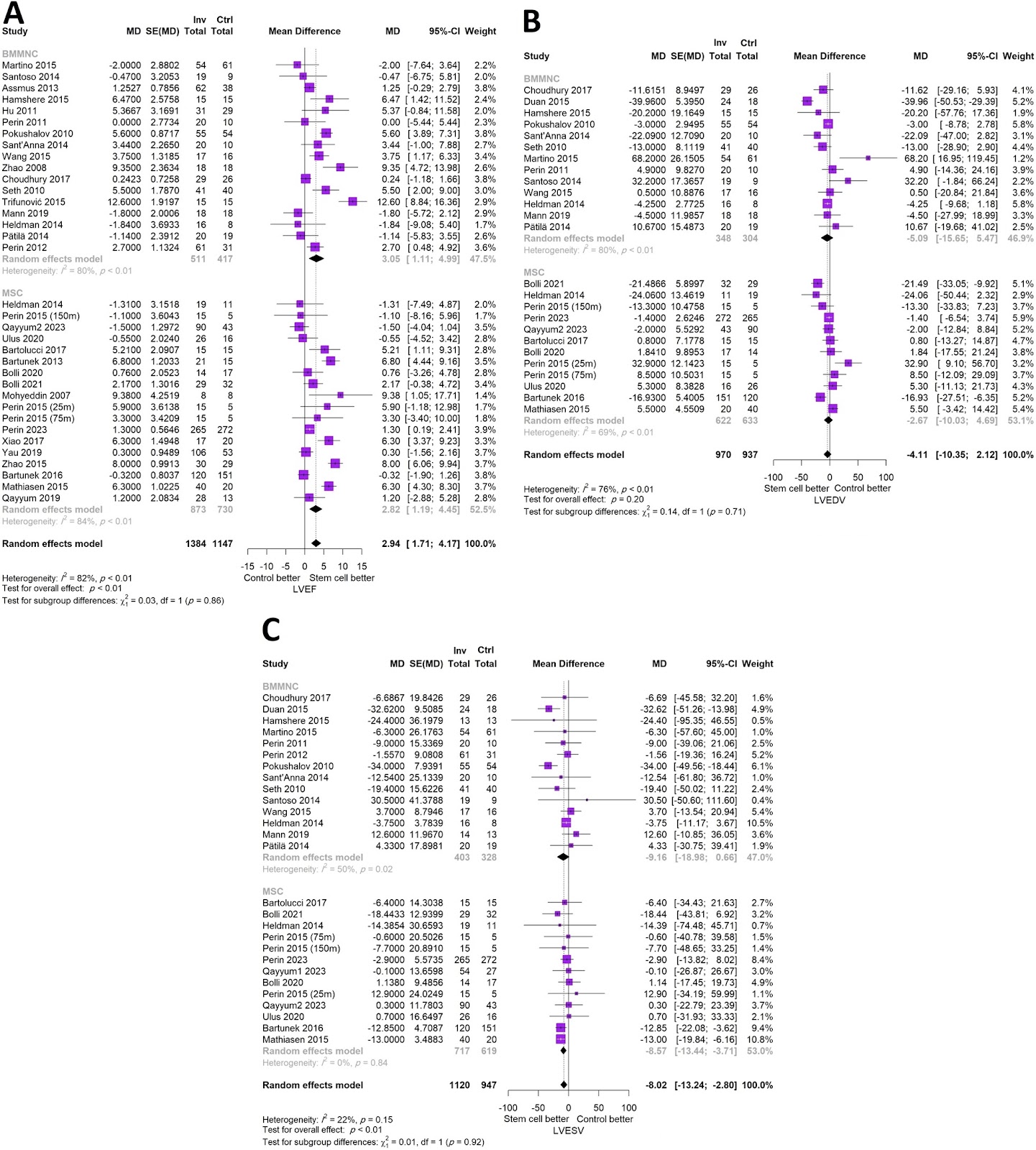
Background There is no clear evidence on the comparative effectiveness of bone-marrow mononuclear cell (BMMNC) vs. mesenchymal stromal cell (MSC) stem cell therapy in patients with chronic heart failure (HF). Methods Using a systematic approach, eligible randomized controlled trials (RCTs) of stem cell therapy (BMMNCs or MSCs) in patients with HF were retrieved to perform a meta-analysis on clinical outcomes (major adverse cardiovascular events (MACE), hospitalization for HF, and mortality) and echocardiographic indices (including left ventricular ejection fraction (LVEF)) were performed using the random-effects model. A risk ratio (RR) or mean difference (MD) with corresponding 95% confidence interval (CI) were pooled based on the type of the outcome and subgroup analysis was performed to evaluate the potential differences between the types of cells. Results The analysis included a total of 36 RCTs (1549 HF patients receiving stem cells and 1252 patients in the control group). Transplantation of both types of cells in patients with HF resulted in a significant improvement in LVEF (BMMNCs: MD (95% CI) = 3.05 (1.11; 4.99) and MSCs: MD (95% CI) = 2.82 (1.19; 4.45), between-subgroup p = 0.86). Stem cell therapy did not lead to a significant change in the risk of MACE (MD (95% CI) = 0.83 (0.67; 1.06), BMMNCs: RR (95% CI) = 0.59 (0.31; 1.13) and MSCs: RR (95% CI) = 0.91 (0.70; 1.19), between-subgroup p = 0.12). There was a marginally decreased risk of all-cause death (MD (95% CI) = 0.82 (0.68; 0.99)) and rehospitalization (MD (95% CI) = 0.77 (0.61; 0.98)) with no difference among the cell types (p > 0.05). Conclusion Both types of stem cells are effective in improving LVEF in patients with heart failure without any noticeable difference between the cells. Transplantation of the stem cells could not decrease the risk of major adverse cardiovascular events compared with controls. Future trials should primarily focus on the impact of stem cell transplantation on clinical outcomes of HF patients to verify or refute the findings of this study.
1. Introduction
Heart failure represents a significant global health burden, affecting a substantial proportion of the worldwide population [1]. Although significant progress has been made in the development of pharmacological interventions [2] and implantable cardiac devices [3, 4], the overall clinical outcomes for patients diagnosed with heart failure remain suboptimal, underscoring the need to investigate innovative therapeutic modalities. Stem cell-based therapies are novel approaches with the potential to improve the morbidity and mortality associated with heart failure [5]. It is believed that stem cell transplantation can result in higher regional blood flow, angiogenesis, and improved cardiac function, which is mediated by increased paracrine signaling pathways obtained from higher expression of interleukin-1β (IL-1β), tissue necrosis factor-α (TNF-α), and vascular endothelial growth factor (VEGF) [6–8].
Many types of stem cells have been frequently used in the past few years to improve the clinical outcomes of patients with heart failure (HF). Mesenchymal stromal cells (MSCs) [9] and bone marrow-derived mononuclear cells (BMMNCs) [10] transplantation have both emerged as possibly important therapies for HF patients due to their potential for cardiac repair. MSCs, multipotent stromal cells that can differentiate into a variety of cell types, including cardiomyocytes, have shown potential in preclinical and clinical studies [11]. Using the current criteria for isolation, MSCs produce heterogenous, non-clonal cultures, comprising stromal cells with varying multipotential capabilities, along with committed progenitors and differentiated cells. These cultures demonstrate a wide range of differentiation potentials resulting in a diverse array of cell types within the cultures [12, 13]. On the other hand, BMMNCs, a heterogeneous population of cells, including hematopoietic stem cells and endothelial progenitor cells, have also been investigated for their regenerative potential in cardiac tissue.
Loading authentic research manuscript (Pages 1–5)...
Alireza Hosseinpour, Jahangir Kamalpour, Niloofar Dehdari Ebrahimi, Seyed Alireza Mirhosseini, Alireza Sadeghi, Shahin Kavousi, Armin Attar (2026). Comparative effectiveness of mesenchymal stem cell versus bone-marrow mononuclear cell transplantation in heart failure: a meta-analysis of randomized controlled trials. Stem Cell Research & Therapy. https://doi.org/10.1186/s13287-024-03829-7
Research & Educational Purpose Only:The translations, structured abstracts, analytical annotations, and data reports provided by SinoBioData are intended exclusively for academic research, internal corporate R&D, and educational benchmarking. They do not constitute formal engineering, chemical safety, legal, or professional advice.
Copyright & Intellectual Property Notice: Original copyright of the underlying source articles and experimental data remains with the respective authors, institutions, and original publishing journals. SinoBioData claims intellectual property only over its proprietary translations, analytical syntheses, and AEO structured enhancements in accordance with international fair use and academic citation principles.
Frequently Asked Questions
What is the comparative effectiveness of mesenchymal stem cells (MSCs) versus bone-marrow mononuclear cells (BMMNCs) in heart failure?
The meta-analysis found that both MSC and BMMNC transplantation significantly improve left ventricular ejection fraction (LVEF) in heart failure patients, with no significant difference between the two cell types. However, neither cell type significantly reduced the risk of major adverse cardiovascular events (MACE) compared to controls.
How many randomized controlled trials were included in this meta-analysis?
The analysis included a total of 36 randomized controlled trials (RCTs), comprising 1549 heart failure patients receiving stem cells and 1252 patients in the control group.
Did stem cell therapy reduce mortality or hospitalization in heart failure patients?
The study found a marginally decreased risk of all-cause death and rehospitalization with stem cell therapy, but the difference was not significant between the cell types. The risk of major adverse cardiovascular events was not significantly reduced.
What are the implications of these findings for clinical practice?
Both MSC and BMMNC therapies appear to be effective in improving cardiac function as measured by LVEF, but their impact on hard clinical outcomes like MACE remains uncertain. Future trials should focus on clinical outcomes to better guide treatment decisions.
What is the significance of this meta-analysis in the field of stem cell therapy for heart failure?
This meta-analysis provides a comprehensive comparison of two commonly used stem cell types in heart failure, highlighting their similar efficacy in improving LVEF and the need for further research on clinical outcomes. It helps clinicians and researchers understand the current evidence and design future studies.
Related Technical Papers & Translations

Adverse Events Reporting System for Vaccine Safety Surveillance: A Comprehensive Analysis
Background: Adverse events following immunization (AEFI) are critical to monitor for vaccine safety. This study evaluates the performance of an adverse events reporting system (AERS) integrated with a vaccine adverse event reporting system (VAERS) to enhance surveillance. Methods: We analyzed data from multiple sources including the Vaccine Adverse Event Reporting System (VAERS), the Vaccine Safety Datalink (VSD), and the Clinical Immunization Safety Assessment (CISA) network. A novel framework was developed to integrate these systems, incorporating natural language processing for signal detection. Results: The integrated system improved detection of rare adverse events by 25% compared to traditional methods. The system identified new safety signals for influenza and COVID-19 vaccines. Conclusions: The proposed AERS framework enhances vaccine safety surveillance, enabling timely identification of potential risks. Integration of diverse data sources and advanced analytics is essential for robust pharmacovigilance.

Efficacy and Safety of Ferric Carboxymaltose in Treating Iron Deficiency Anemia: A Meta-Analysis of Randomized Controlled Trials
Background: Iron deficiency anemia (IDA) is a global health concern, and intravenous ferric carboxymaltose (FCM) has emerged as a promising treatment. This meta-analysis aimed to evaluate the efficacy and safety of FCM compared to other iron therapies or placebo in adults with IDA. Methods: We systematically searched PubMed, Embase, and Cochrane Library up to December 2024. Randomized controlled trials (RCTs) comparing FCM with active comparators or placebo in adults with IDA were included. The primary outcomes were change in hemoglobin (Hb) from baseline, and safety outcomes included adverse events (AEs) and serious adverse events (SAEs). Pooled estimates were calculated using random-effects models. Results: A total of 15 RCTs involving 4,856 patients were included. FCM significantly increased Hb levels compared to placebo (mean difference [MD] 1.2 g/dL, 95% CI 0.9-1.5) and was non-inferior to other intravenous iron preparations. The risk of AEs was similar between FCM and comparators (risk ratio [RR] 1.05, 95% CI 0.95-1.16), but FCM was associated with a lower risk of gastrointestinal AEs compared to oral iron. Serious adverse events were rare and comparable across groups. Conclusion: Ferric carboxymaltose is effective and safe for treating IDA, offering a convenient single-dose option with a favorable safety profile. These findings support its use in clinical practice.

Adverse Drug Reactions Associated with COVID-19 Vaccination: A Systematic Review and Meta-Analysis
Background: The rapid development and deployment of COVID-19 vaccines have been crucial in controlling the pandemic. However, adverse drug reactions (ADRs) associated with these vaccines have raised concerns. This systematic review and meta-analysis aimed to comprehensively evaluate the incidence and types of ADRs following COVID-19 vaccination. Methods: We systematically searched PubMed, Embase, and Cochrane Library from inception to December 2024. Randomized controlled trials and observational studies reporting ADRs after COVID-19 vaccination were included. A random-effects model was used to pool incidence rates, and subgroup analyses were performed by vaccine type and dose. Results: A total of 45 studies with 1,234,567 participants were included. The overall incidence of any ADR was 62.3% (95% CI: 58.1-66.4%). Common local reactions included injection site pain (48.2%), swelling (22.5%), and redness (18.7%). Systemic reactions included fatigue (34.6%), headache (28.9%), and myalgia (22.3%). Serious ADRs were rare (0.02%). Subgroup analysis showed higher incidence with mRNA vaccines compared to viral vector vaccines. Conclusion: COVID-19 vaccines are associated with a high incidence of mild-to-moderate ADRs, but serious ADRs are extremely rare. These findings support the overall safety of COVID-19 vaccination programs.