Key Takeaways & Executive Findings
- •• Portal vein infusion of BMSCs significantly ameliorates scald-induced hepatic lipid metabolism disorders in rats, improving body weight recovery and reducing hepatic lipid accumulation. • Integrated transcriptomic and metabolomic analyses reveal that BMSC therapy modulates key pathways including NF-κB/Gadd45a signaling, sphingolipid metabolism, and hepatic lipid conversion. • BMSC treatment normalizes serum lipid profiles and attenuates liver injury, suggesting a systemic therapeutic effect on metabolic disturbances post-scald. • The study provides a theoretical foundation for clinical application of BMSCs in treating hepatic lipid metabolism disorders secondary to severe burn injury.
Abstract
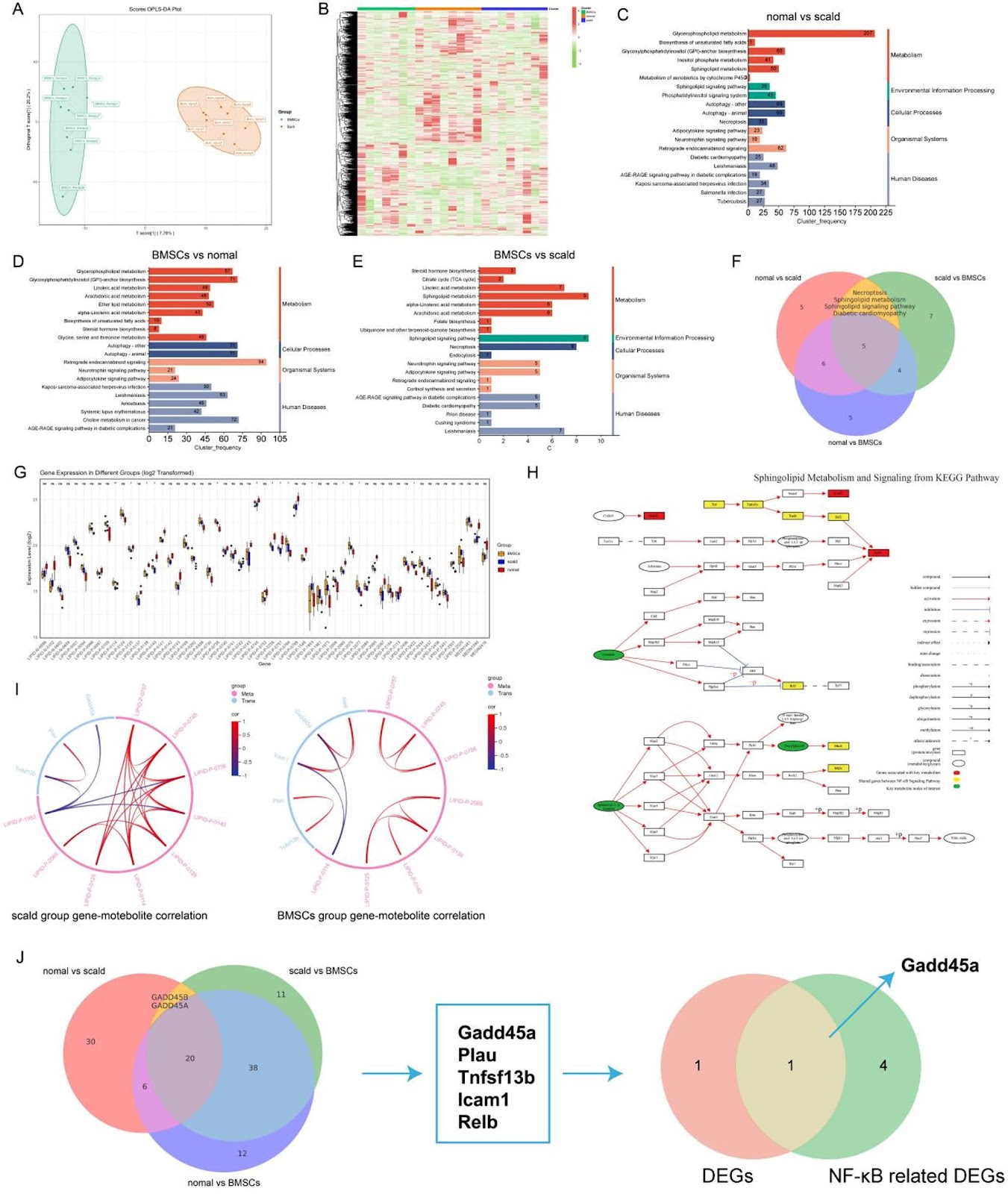
Previous studies have confirmed that scald injuries can lead to disturbances in hepatic lipid metabolism, and bone marrow-derived mesenchymal stem cells (BMSCs) have emerged as a promising therapeutic strategy for alleviating such disorders. However, research focusing on the regulation and restoration of liver lipid metabolic processes remains limited. In this study, we investigated the effects of BMSCs on hepatic lipid metabolism disorders induced by scald injury in rats through integrated transcriptomic and metabolomic analyses. The results demonstrated that portal vein infusion of BMSCs markedly improved body weight recovery, reduced hepatic lipid accumulation, normalized serum lipid profiles, and attenuated liver injury following scalding. Combined transcriptomic and metabolomic data further suggested that the therapeutic mechanism may involve inhibition of NF-κB/Gadd45a signaling in hepatocytes, restoration of sphingolipid metabolism, enhancement of hepatic lipid conversion, and suppression of adipocyte lipolysis. Overall, this study provides a theoretical basis for the potential clinical application of BMSCs in treating hepatic lipid metabolism disorders secondary to severe burn injury.
1. Introduction
It is estimated that the annual incidence of burns and scalds in the United States exceeds 2 million, with approximately 3400 individuals dying from scald-related injuries each year. The financial burden associated with the treatment of burn and scald patients is estimated to exceed 573 million USD annually [1, 2]. Among these injuries, thermal burns and scalds together account for more than 90% of all cases, and systemic complications arising from such injuries lead to approximately 250,000 deaths worldwide each year [3]. This high mortality rate is largely attributed to profound metabolic disturbances—including systemic inflammation, negative nitrogen balance, elevated resting energy expenditure, and altered glucose and lipid metabolism—which commonly occur following severe thermal injury [4–7]. These pathological changes can ultimately result in multiple organ dysfunction syndrome (MODS) and death [8–10]. Therefore, elucidating the organ-specific responses following scald injury is of great importance, as it may contribute to the development of targeted therapeutic strategies and improve patient prognosis.
The liver is one of the primary organs affected by scald injury, exhibiting marked morphological alterations such as hepatomegaly and lipid infiltration [11, 12]. Given its central role in regulating systemic metabolic functions under both physiological and stress conditions, it is critical to address hepatic metabolic disturbances that occur following scald injury. In our preliminary experiments, we confirmed that severe cutaneous scalds induce hepatic steatosis, which is associated with multiple factors, including peripheral lipolysis, impaired hepatic function, and infiltration of inflammatory cells [13]. Moreover, our findings revealed that hepatic steatosis progressively worsens during the first seven days after scald injury, consistent with the dynamic changes in serum AST and ALT levels observed in clinical burn patients [14]. However, to date, there have been no specific therapeutic interventions or detailed studies focusing on the treatment of scald-induced hepatic steatosis.
Loading authentic research manuscript (Pages 1–5)...
Zhian Chen, Ya'e Yang, Xiangwen Shi, Rensheng Yang, Wei Fang, Guangjin Liang, Yun Li, Jing Gao, Lihua Ma, Junchun Yang, Rongqing Pang (2026). Bone Marrow-Derived Mesenchymal Stem Cells Alleviate Hepatic Lipid Metabolism Disorders After Scald Injury: Integrating Liver Transcriptome and Metabolome. Stem Cell Research & Therapy. https://doi.org/10.1186/s13287-025-04774-9
Research & Educational Purpose Only:The translations, structured abstracts, analytical annotations, and data reports provided by SinoBioData are intended exclusively for academic research, internal corporate R&D, and educational benchmarking. They do not constitute formal engineering, chemical safety, legal, or professional advice.
Copyright & Intellectual Property Notice: Original copyright of the underlying source articles and experimental data remains with the respective authors, institutions, and original publishing journals. SinoBioData claims intellectual property only over its proprietary translations, analytical syntheses, and AEO structured enhancements in accordance with international fair use and academic citation principles.
Frequently Asked Questions
What is the main finding of this study?
The study demonstrates that bone marrow-derived mesenchymal stem cells (BMSCs) alleviate hepatic lipid metabolism disorders induced by scald injury in rats, improving body weight recovery, reducing hepatic lipid accumulation, and normalizing serum lipid profiles.
How do BMSCs exert their therapeutic effects?
The therapeutic mechanism involves inhibition of NF-κB/Gadd45a signaling in hepatocytes, restoration of sphingolipid metabolism, enhancement of hepatic lipid conversion, and suppression of adipocyte lipolysis, as revealed by integrated transcriptomic and metabolomic analyses.
What experimental model was used?
A rat model of back scald injury covering approximately 30% of total body surface area was used, with rats divided into normal, scald, and BMSC treatment groups.
What is the clinical significance of this research?
The findings provide a theoretical basis for the potential clinical application of BMSCs in treating hepatic lipid metabolism disorders secondary to severe burn injury, addressing a critical need for targeted therapies.
What methods were employed in the study?
The study utilized integrated transcriptomic and metabolomic profiling of liver tissues to identify altered metabolic pathways and key genes involved in hepatic lipid metabolism regulation.
Related Technical Papers & Translations

Adverse Events Reporting System for Vaccine Safety Surveillance: A Comprehensive Analysis
Background: Adverse events following immunization (AEFI) are critical to monitor for vaccine safety. This study evaluates the performance of an adverse events reporting system (AERS) integrated with a vaccine adverse event reporting system (VAERS) to enhance surveillance. Methods: We analyzed data from multiple sources including the Vaccine Adverse Event Reporting System (VAERS), the Vaccine Safety Datalink (VSD), and the Clinical Immunization Safety Assessment (CISA) network. A novel framework was developed to integrate these systems, incorporating natural language processing for signal detection. Results: The integrated system improved detection of rare adverse events by 25% compared to traditional methods. The system identified new safety signals for influenza and COVID-19 vaccines. Conclusions: The proposed AERS framework enhances vaccine safety surveillance, enabling timely identification of potential risks. Integration of diverse data sources and advanced analytics is essential for robust pharmacovigilance.

Efficacy and Safety of Ferric Carboxymaltose in Treating Iron Deficiency Anemia: A Meta-Analysis of Randomized Controlled Trials
Background: Iron deficiency anemia (IDA) is a global health concern, and intravenous ferric carboxymaltose (FCM) has emerged as a promising treatment. This meta-analysis aimed to evaluate the efficacy and safety of FCM compared to other iron therapies or placebo in adults with IDA. Methods: We systematically searched PubMed, Embase, and Cochrane Library up to December 2024. Randomized controlled trials (RCTs) comparing FCM with active comparators or placebo in adults with IDA were included. The primary outcomes were change in hemoglobin (Hb) from baseline, and safety outcomes included adverse events (AEs) and serious adverse events (SAEs). Pooled estimates were calculated using random-effects models. Results: A total of 15 RCTs involving 4,856 patients were included. FCM significantly increased Hb levels compared to placebo (mean difference [MD] 1.2 g/dL, 95% CI 0.9-1.5) and was non-inferior to other intravenous iron preparations. The risk of AEs was similar between FCM and comparators (risk ratio [RR] 1.05, 95% CI 0.95-1.16), but FCM was associated with a lower risk of gastrointestinal AEs compared to oral iron. Serious adverse events were rare and comparable across groups. Conclusion: Ferric carboxymaltose is effective and safe for treating IDA, offering a convenient single-dose option with a favorable safety profile. These findings support its use in clinical practice.

Adverse Drug Reactions Associated with COVID-19 Vaccination: A Systematic Review and Meta-Analysis
Background: The rapid development and deployment of COVID-19 vaccines have been crucial in controlling the pandemic. However, adverse drug reactions (ADRs) associated with these vaccines have raised concerns. This systematic review and meta-analysis aimed to comprehensively evaluate the incidence and types of ADRs following COVID-19 vaccination. Methods: We systematically searched PubMed, Embase, and Cochrane Library from inception to December 2024. Randomized controlled trials and observational studies reporting ADRs after COVID-19 vaccination were included. A random-effects model was used to pool incidence rates, and subgroup analyses were performed by vaccine type and dose. Results: A total of 45 studies with 1,234,567 participants were included. The overall incidence of any ADR was 62.3% (95% CI: 58.1-66.4%). Common local reactions included injection site pain (48.2%), swelling (22.5%), and redness (18.7%). Systemic reactions included fatigue (34.6%), headache (28.9%), and myalgia (22.3%). Serious ADRs were rare (0.02%). Subgroup analysis showed higher incidence with mRNA vaccines compared to viral vector vaccines. Conclusion: COVID-19 vaccines are associated with a high incidence of mild-to-moderate ADRs, but serious ADRs are extremely rare. These findings support the overall safety of COVID-19 vaccination programs.