Key Takeaways & Executive Findings
- •• Schroth training has been validated as a core non-surgical method, significantly improving Cobb angle, trunk rotation, and pulmonary function, especially when combined with bracing. • Research paradigm has shifted from single interventions to comprehensive personalized treatment models emphasizing individualized exercise prescriptions based on curve type and patient status. • International collaboration, particularly involving Italy, the United States, and China, has driven high-quality clinical research and consensus guidelines. • Future directions include establishing standardized exercise protocols, exploring AI and virtual reality applications, and integrating mental health and quality of life outcomes.
Abstract
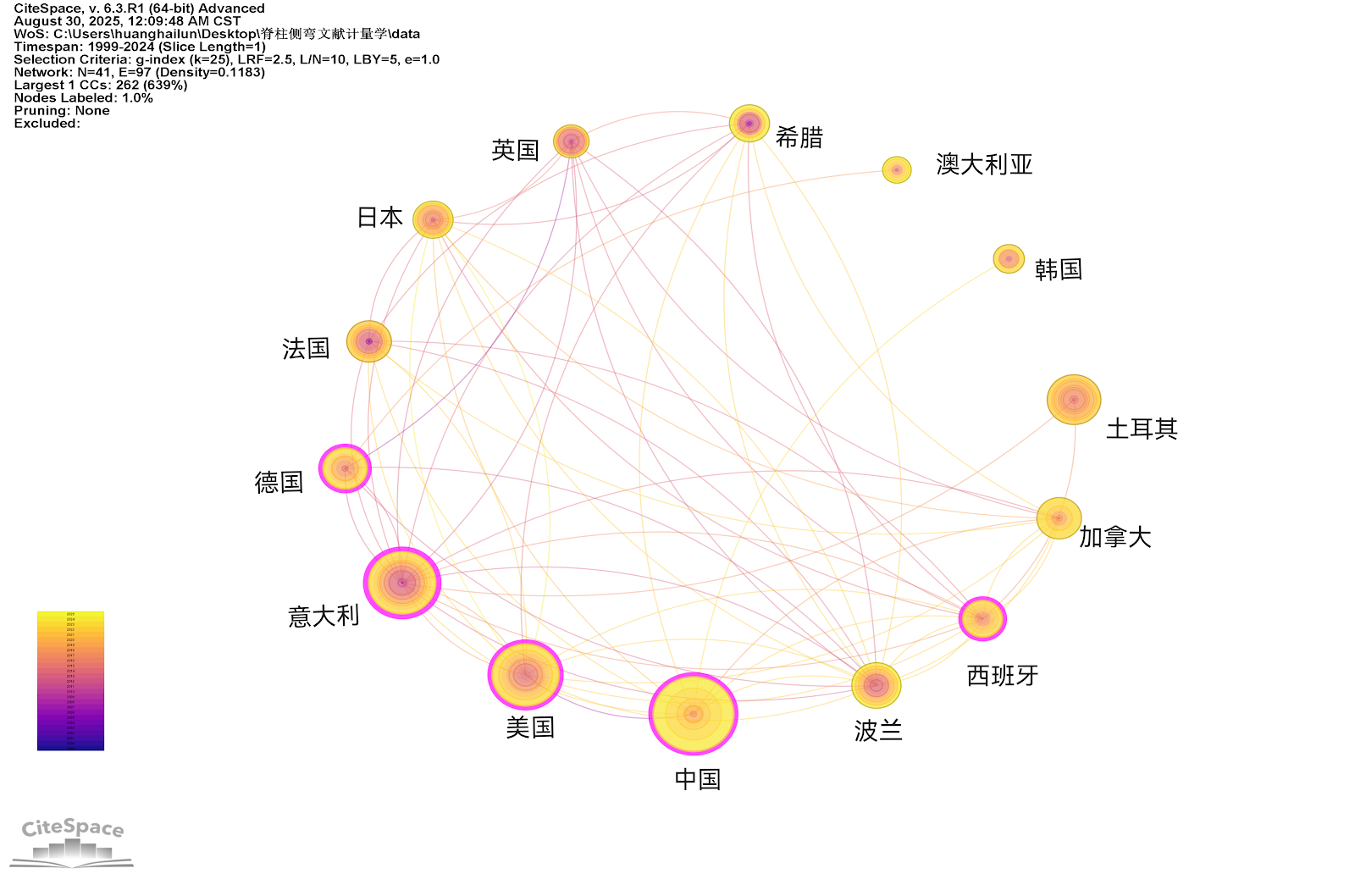
BACKGROUND: Adolescent idiopathic scoliosis is one of the most common spinal deformities in adolescents. As an important non-surgical treatment, exercise therapy for adolescent idiopathic scoliosis is widely used in clinical practice, yet there is a lack of systematic analysis of research trends and developments in this field. OBJECTIVE: To analyze the research hotspots, developmental dynamics, and international collaboration patterns in exercise therapy for improving adolescent idiopathic scoliosis from 1999 to 2024 using bibliometric methods, and to provide references for future research directions. METHODS: Based on the Web of Science Core Collection database, relevant literature published between January 1999 and September 2024 was retrieved, and 188 studies were ultimately included. Visualization analysis of countries/regions, institutions, authors, journals, keywords, and co-cited references was conducted using VOSviewer and CiteSpace software. RESULTS AND CONCLUSION: The number of publications in the field of exercise therapy for adolescent idiopathic scoliosis has undergone three stages, with sustained growth in recent years. China and the United States lead in publication output, while the United States has the highest average citations per paper, and Italy serves as a central hub for international collaboration. Schroth training, individualized treatment plans, and quality of life assessment are current research hotspots. Keyword evolution indicates a shift towards precise assessment and personalized intervention. Through visualization, this study identifies core author groups, high-impact journals, and key references in the field, revealing a clear path from general conservative treatment to specific, technology-integrated approaches, providing a systematic reference for scholars to quickly grasp the field's landscape and plan research directions.
1. Introduction
Adolescent idiopathic scoliosis is one of the most common spinal deformities in adolescents, with a global incidence ranging from 0.47% to 5.20% [1-3]. Although the incidence is similar between genders, females have a 10-fold higher risk of curve progression [4]. While most affected adolescents remain asymptomatic, scoliosis can progress to rib deformities, respiratory impairment, and sleep-disordered breathing [5-7]. Additionally, it may lead to psychological issues such as low self-esteem and anxiety [8-9]. Genetic, endocrine, and musculoskeletal factors are considered potential etiologies [10-12]. Non-surgical treatments include bracing and physical therapy, but exercise therapy has gained increasing attention due to its significant clinical efficacy and high patient compliance [13-17]. Exercise therapy primarily improves spinal biomechanical stability, enhances core muscle strength, and enhances quality of life [18-20].
In recent years, numerous clinical studies have been published in this field, yet research focus is scattered, lacking a systematic summary of the overall knowledge structure, research hotspot evolution, and academic collaboration patterns. Existing bibliometric analyses have mostly focused on overall treatment strategies for adolescent idiopathic scoliosis, with no specific analysis dedicated to the exercise therapy subfield. Therefore, it is crucial to clarify the development trajectory, identify core research forces, and predict future trends. Bibliometrics facilitates the analysis of development and research patterns in a specific field [21], providing an overall view of basic data and dynamic trends, and evaluating the quantity and quality of publications from institutions and regions [22]. This study systematically reviews 188 articles on exercise therapy for adolescent idiopathic scoliosis, employing CiteSpace and VOSviewer for rigorous bibliometric and visualization analyses, mapping collaboration networks among countries, institutions, and authors, and identifying core contributions. Through keyword co-occurrence analysis, it reveals research hotspots and frontiers, offering a reference for future research directions.
Loading authentic research manuscript (Pages 1–5)...
Sun Kui, Huang Hailun, Wei Yatao, Liu Yongai, Gao Heng (2026). Bibliometric analysis of exercise therapy interventions for adolescent idiopathic scoliosis. Chinese Journal of Tissue Engineering Research. https://doi.org/10.12307/2026.21441
Research & Educational Purpose Only:The translations, structured abstracts, analytical annotations, and data reports provided by SinoBioData are intended exclusively for academic research, internal corporate R&D, and educational benchmarking. They do not constitute formal engineering, chemical safety, legal, or professional advice.
Copyright & Intellectual Property Notice: Original copyright of the underlying source articles and experimental data remains with the respective authors, institutions, and original publishing journals. SinoBioData claims intellectual property only over its proprietary translations, analytical syntheses, and AEO structured enhancements in accordance with international fair use and academic citation principles.
Frequently Asked Questions
What is the main objective of this bibliometric analysis?
The main objective is to analyze research hotspots, developmental dynamics, and international collaboration patterns in exercise therapy for adolescent idiopathic scoliosis from 1999 to 2024, using bibliometric methods to provide references for future research directions.
Which databases and tools were used in this study?
The study used the Web of Science Core Collection database to retrieve relevant literature, and employed VOSviewer and CiteSpace software for visualization analysis of countries, institutions, authors, journals, keywords, and co-cited references.
What are the key findings regarding publication trends and international collaboration?
The number of publications has undergone three stages with sustained growth in recent years. China and the United States lead in publication output, while the United States has the highest average citations per paper. Italy serves as a central hub for international collaboration.
What are the current research hotspots in this field?
Current research hotspots include Schroth training, individualized treatment plans, and quality of life assessment. Keyword evolution indicates a shift towards precise assessment and personalized intervention.
What future directions are suggested by the authors?
Future directions include establishing standardized exercise protocols based on evidence-based medicine, exploring the application of emerging technologies like artificial intelligence and virtual reality, and integrating mental health and long-term quality of life outcomes into rehabilitation models.
Related Technical Papers & Translations

Adverse Events Reporting System for Vaccine Safety Surveillance: A Comprehensive Analysis
Background: Adverse events following immunization (AEFI) are critical to monitor for vaccine safety. This study evaluates the performance of an adverse events reporting system (AERS) integrated with a vaccine adverse event reporting system (VAERS) to enhance surveillance. Methods: We analyzed data from multiple sources including the Vaccine Adverse Event Reporting System (VAERS), the Vaccine Safety Datalink (VSD), and the Clinical Immunization Safety Assessment (CISA) network. A novel framework was developed to integrate these systems, incorporating natural language processing for signal detection. Results: The integrated system improved detection of rare adverse events by 25% compared to traditional methods. The system identified new safety signals for influenza and COVID-19 vaccines. Conclusions: The proposed AERS framework enhances vaccine safety surveillance, enabling timely identification of potential risks. Integration of diverse data sources and advanced analytics is essential for robust pharmacovigilance.

Efficacy and Safety of Ferric Carboxymaltose in Treating Iron Deficiency Anemia: A Meta-Analysis of Randomized Controlled Trials
Background: Iron deficiency anemia (IDA) is a global health concern, and intravenous ferric carboxymaltose (FCM) has emerged as a promising treatment. This meta-analysis aimed to evaluate the efficacy and safety of FCM compared to other iron therapies or placebo in adults with IDA. Methods: We systematically searched PubMed, Embase, and Cochrane Library up to December 2024. Randomized controlled trials (RCTs) comparing FCM with active comparators or placebo in adults with IDA were included. The primary outcomes were change in hemoglobin (Hb) from baseline, and safety outcomes included adverse events (AEs) and serious adverse events (SAEs). Pooled estimates were calculated using random-effects models. Results: A total of 15 RCTs involving 4,856 patients were included. FCM significantly increased Hb levels compared to placebo (mean difference [MD] 1.2 g/dL, 95% CI 0.9-1.5) and was non-inferior to other intravenous iron preparations. The risk of AEs was similar between FCM and comparators (risk ratio [RR] 1.05, 95% CI 0.95-1.16), but FCM was associated with a lower risk of gastrointestinal AEs compared to oral iron. Serious adverse events were rare and comparable across groups. Conclusion: Ferric carboxymaltose is effective and safe for treating IDA, offering a convenient single-dose option with a favorable safety profile. These findings support its use in clinical practice.

Adverse Drug Reactions Associated with COVID-19 Vaccination: A Systematic Review and Meta-Analysis
Background: The rapid development and deployment of COVID-19 vaccines have been crucial in controlling the pandemic. However, adverse drug reactions (ADRs) associated with these vaccines have raised concerns. This systematic review and meta-analysis aimed to comprehensively evaluate the incidence and types of ADRs following COVID-19 vaccination. Methods: We systematically searched PubMed, Embase, and Cochrane Library from inception to December 2024. Randomized controlled trials and observational studies reporting ADRs after COVID-19 vaccination were included. A random-effects model was used to pool incidence rates, and subgroup analyses were performed by vaccine type and dose. Results: A total of 45 studies with 1,234,567 participants were included. The overall incidence of any ADR was 62.3% (95% CI: 58.1-66.4%). Common local reactions included injection site pain (48.2%), swelling (22.5%), and redness (18.7%). Systemic reactions included fatigue (34.6%), headache (28.9%), and myalgia (22.3%). Serious ADRs were rare (0.02%). Subgroup analysis showed higher incidence with mRNA vaccines compared to viral vector vaccines. Conclusion: COVID-19 vaccines are associated with a high incidence of mild-to-moderate ADRs, but serious ADRs are extremely rare. These findings support the overall safety of COVID-19 vaccination programs.