Key Takeaways & Executive Findings
- •• Local injection of autologous bone marrow-derived MSCs combined with voice training was safe with no treatment-related side effects over 36 months. • Patient-reported outcomes improved significantly, with Voice Handicap Index scores decreasing by a mean of 25.9 points at 12 months. • Clinically relevant improvements were observed in 63–88% of patients across various voice function parameters. • All participants reported reduced vocal strain after voice training, suggesting potential added benefit of a structured post-operative protocol.
Abstract
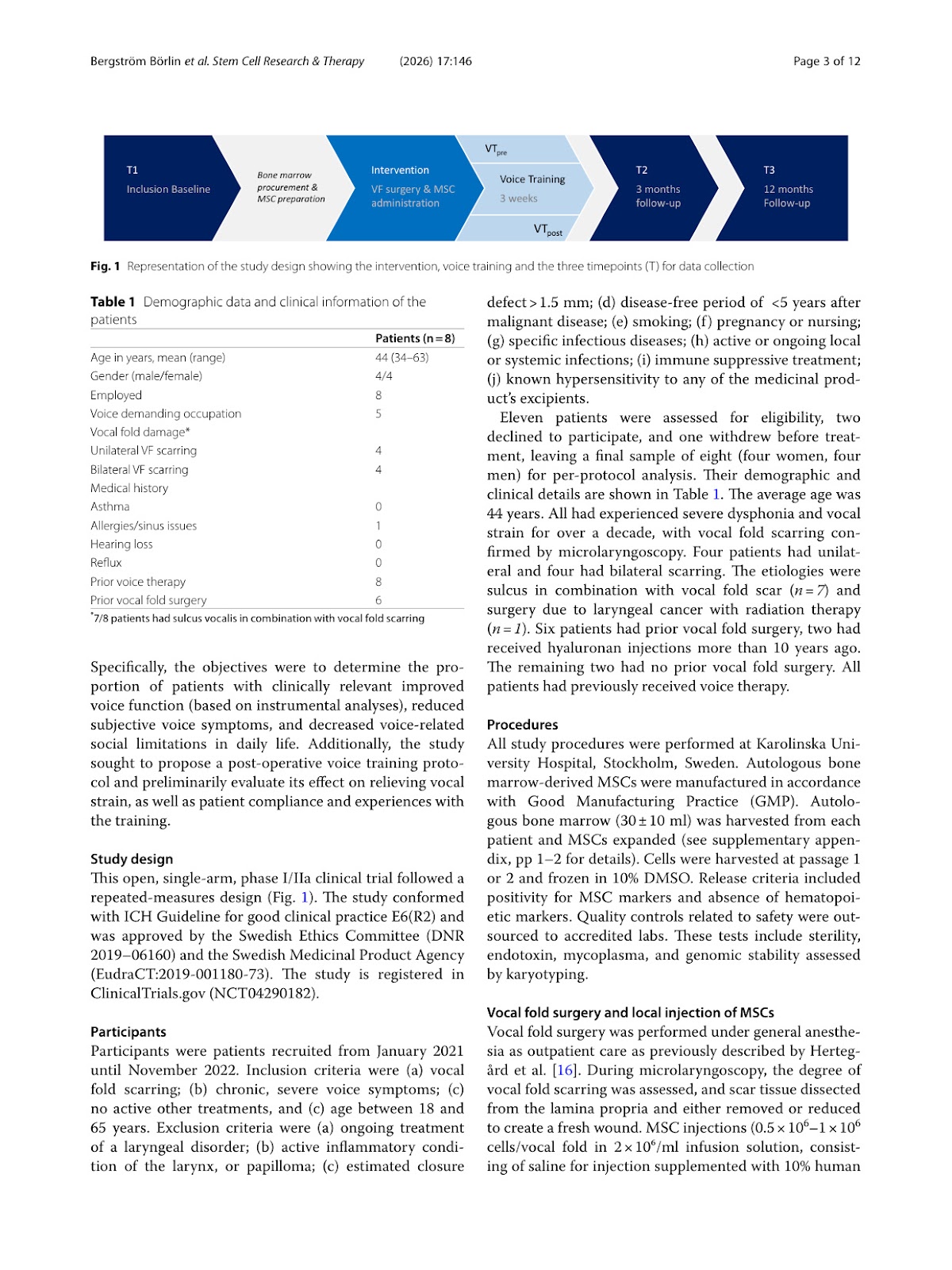
Background: Damage to the vocal folds can result in scarring, leading to chronic, severe voice impairments for which lasting and effective treatments are currently lacking. The aim of this clinical trial was to evaluate the safety and effectiveness of autologous bone marrow-derived Mesenchymal Stromal Cell (MSC) therapy for patients with vocal fold scarring and severe dysphonia. Additionally, the study sought to propose a post-operative voice training protocol and explore its potential role in facilitating voice improvement. Methods: Eight patients with vocal fold scarring and chronic dysphonia underwent surgical scar resection and autologous MSC injection, followed by voice training. Safety was continuously monitored for up to 36 months postoperatively. Data to evaluate therapeutic efficacy was collected pre-treatment, 3 and 12 months post-treatment. Assessments included analysis of vocal fold vibrations, Phonation Threshold Pressure, and Maximum Phonation Time. Patient-reported measures were collected using the Voice Handicap Index, the Vocal Fatigue Index, and ratings of major symptoms and their impact on daily life. Treatment effectiveness was analyzed at both group and individual levels, with clinically relevant changes predefined. Results: No treatment-related side effects were reported within the 36 months of follow-up. Group-level analysis of the self-reported outcomes indicated positive treatment effects, with Voice Handicap Index scores reduced by −25.9 points (95% CI [−48, −3.6]) between pre-treatment and 12 months post-treatment. Group-level aerodynamic changes were small with Phonation Threshold Pressure showing a marginal positive change on average (−0.94 cmH₂O), as did Maximum Phonation Time (+0.2 s). At the individual level, clinically relevant improvements were observed in 63–88% of patients depending on the parameter analyzed. Three patients (38%) achieved relevant improvement on ≥5/6 selected parameters in combination. All participants in voice training reported reduced vocal strain following training. Conclusions: This preliminary, uncontrolled study indicates that local administration of autologous bone marrow-derived MSCs appears safe and is associated with clinically relevant patient-reported outcome improvements in a majority of patients. Larger, controlled trials are needed in the future to establish efficacy and possibly disentangle contributions of MSCs versus voice training. Trial registration: This clinical trial is registered in ClinicalTrials.gov (NCT04290182).
1. Introduction
The vocal folds comprise three main layers: the vocalis muscle, the lamina propria, and the epithelium. The epithelium and superficial lamina propria vibrate independently of the deeper layers and the vocalis muscle. Mechanical stress, environmental factors, and pathological conditions can impair vocal fold pliability, leading to a range of voice disorders [1, 2].
Injury or damage to the vocal folds can result in scarring, causing stiff tissue that restricts lamina propria vibration and pliability, impairs vocal fold closure, and disrupts the vertical glottal mucosal wave essential for voice production [3]. Known causes include surgery, radiation therapy, phonotrauma, congenital or acquired conditions, severe inflammation, and infections. Vocal fold scarring often leads to severe dysphonia, vocal strain, and vocal fatigue [4, 5].
Loading authentic research manuscript (Pages 1–5)...
Erika Bergström Börlin, Ulrika Nygren, Maria Södersten, Svante Granqvist, Nadir Kadri, Ida Rasmusson Duprez, Katarina Le Blanc, Stellan Hertegård (2026). An Open Phase I/IIa Study Evaluating Safety, Patient-Reported Outcomes, and Voice Function After Surgery, Local Administration of Mesenchymal Stromal Cells, and Voice Training in Patients with Vocal Fold Scarring and Dysphonia. Stem Cell Research & Therapy. https://doi.org/10.1186/s13287-026-05022-4
Research & Educational Purpose Only:The translations, structured abstracts, analytical annotations, and data reports provided by SinoBioData are intended exclusively for academic research, internal corporate R&D, and educational benchmarking. They do not constitute formal engineering, chemical safety, legal, or professional advice.
Copyright & Intellectual Property Notice: Original copyright of the underlying source articles and experimental data remains with the respective authors, institutions, and original publishing journals. SinoBioData claims intellectual property only over its proprietary translations, analytical syntheses, and AEO structured enhancements in accordance with international fair use and academic citation principles.
Frequently Asked Questions
What is the main purpose of this clinical trial?
The trial aimed to evaluate the safety and effectiveness of autologous bone marrow-derived mesenchymal stromal cell (MSC) therapy combined with voice training for patients with vocal fold scarring and severe dysphonia.
How many patients were included and what was the follow-up duration?
Eight patients with vocal fold scarring and chronic dysphonia participated. Safety was monitored for up to 36 months postoperatively, while efficacy data were collected at 3 and 12 months.
What were the key findings regarding safety and patient-reported outcomes?
No treatment-related side effects were reported. Voice Handicap Index scores improved by an average of 25.9 points at 12 months, indicating significant patient-reported benefit.
Did the study include a voice training protocol?
Yes, all patients underwent a structured post-operative voice training protocol, and all participants reported reduced vocal strain following training.
What are the limitations of this study?
The study was preliminary and uncontrolled, with a small sample size. Larger, controlled trials are needed to confirm efficacy and to separate the contributions of MSCs versus voice training.
Related Technical Papers & Translations

Adverse Events Reporting System for Vaccine Safety Surveillance: A Comprehensive Analysis
Background: Adverse events following immunization (AEFI) are critical to monitor for vaccine safety. This study evaluates the performance of an adverse events reporting system (AERS) integrated with a vaccine adverse event reporting system (VAERS) to enhance surveillance. Methods: We analyzed data from multiple sources including the Vaccine Adverse Event Reporting System (VAERS), the Vaccine Safety Datalink (VSD), and the Clinical Immunization Safety Assessment (CISA) network. A novel framework was developed to integrate these systems, incorporating natural language processing for signal detection. Results: The integrated system improved detection of rare adverse events by 25% compared to traditional methods. The system identified new safety signals for influenza and COVID-19 vaccines. Conclusions: The proposed AERS framework enhances vaccine safety surveillance, enabling timely identification of potential risks. Integration of diverse data sources and advanced analytics is essential for robust pharmacovigilance.

Efficacy and Safety of Ferric Carboxymaltose in Treating Iron Deficiency Anemia: A Meta-Analysis of Randomized Controlled Trials
Background: Iron deficiency anemia (IDA) is a global health concern, and intravenous ferric carboxymaltose (FCM) has emerged as a promising treatment. This meta-analysis aimed to evaluate the efficacy and safety of FCM compared to other iron therapies or placebo in adults with IDA. Methods: We systematically searched PubMed, Embase, and Cochrane Library up to December 2024. Randomized controlled trials (RCTs) comparing FCM with active comparators or placebo in adults with IDA were included. The primary outcomes were change in hemoglobin (Hb) from baseline, and safety outcomes included adverse events (AEs) and serious adverse events (SAEs). Pooled estimates were calculated using random-effects models. Results: A total of 15 RCTs involving 4,856 patients were included. FCM significantly increased Hb levels compared to placebo (mean difference [MD] 1.2 g/dL, 95% CI 0.9-1.5) and was non-inferior to other intravenous iron preparations. The risk of AEs was similar between FCM and comparators (risk ratio [RR] 1.05, 95% CI 0.95-1.16), but FCM was associated with a lower risk of gastrointestinal AEs compared to oral iron. Serious adverse events were rare and comparable across groups. Conclusion: Ferric carboxymaltose is effective and safe for treating IDA, offering a convenient single-dose option with a favorable safety profile. These findings support its use in clinical practice.

Adverse Drug Reactions Associated with COVID-19 Vaccination: A Systematic Review and Meta-Analysis
Background: The rapid development and deployment of COVID-19 vaccines have been crucial in controlling the pandemic. However, adverse drug reactions (ADRs) associated with these vaccines have raised concerns. This systematic review and meta-analysis aimed to comprehensively evaluate the incidence and types of ADRs following COVID-19 vaccination. Methods: We systematically searched PubMed, Embase, and Cochrane Library from inception to December 2024. Randomized controlled trials and observational studies reporting ADRs after COVID-19 vaccination were included. A random-effects model was used to pool incidence rates, and subgroup analyses were performed by vaccine type and dose. Results: A total of 45 studies with 1,234,567 participants were included. The overall incidence of any ADR was 62.3% (95% CI: 58.1-66.4%). Common local reactions included injection site pain (48.2%), swelling (22.5%), and redness (18.7%). Systemic reactions included fatigue (34.6%), headache (28.9%), and myalgia (22.3%). Serious ADRs were rare (0.02%). Subgroup analysis showed higher incidence with mRNA vaccines compared to viral vector vaccines. Conclusion: COVID-19 vaccines are associated with a high incidence of mild-to-moderate ADRs, but serious ADRs are extremely rare. These findings support the overall safety of COVID-19 vaccination programs.