Key Takeaways & Executive Findings
- •• aFGF-overexpressing ADSCs significantly accelerate diabetic wound healing in a dose-dependent manner, with 3×10⁶ cells showing optimal efficacy. • The treatment enhances angiogenesis (CD31), promotes M2 macrophage polarization (CD163), and reduces pro-inflammatory markers (CD86). • Mechanistically, aFGF-ADSCs modulate inflammatory responses, accelerate epithelialization, and optimize collagen deposition. • This gene-modified stem cell approach offers a promising new therapeutic strategy for chronic diabetic wounds.
Abstract
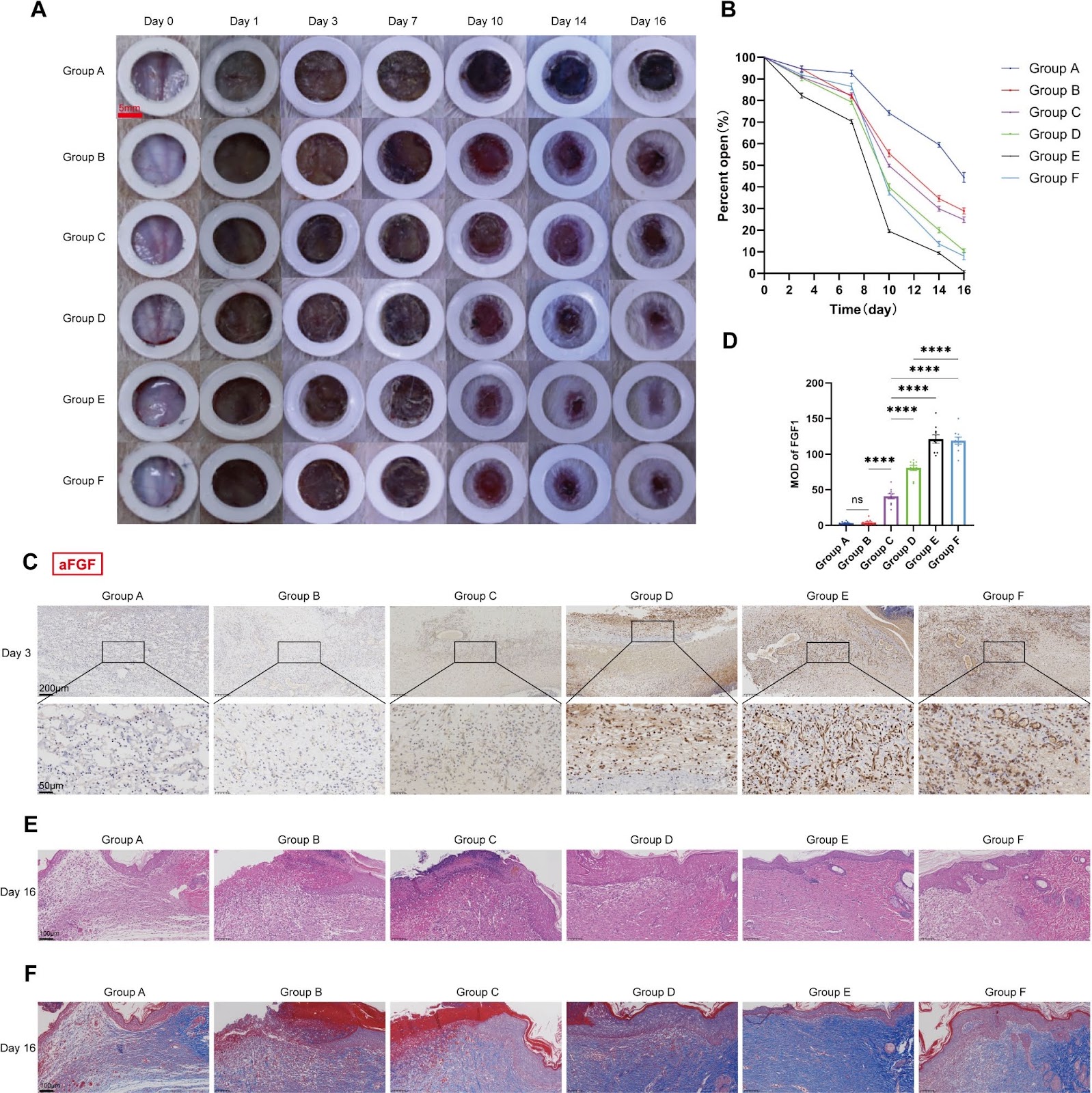
Background Chronic diabetic wounds pose a significant clinical challenge due to the limited efficacy of current treatments. This study aimed to investigate the role and potential mechanisms of adipose-derived mesenchymal stem cells (ADSCs) overexpressing acidic fibroblast growth factor (aFGF) in diabetic wound healing in a rat model. Methods ADSCs were genetically modified to achieve stable overexpression of aFGF. Varying doses of aFGF-ADSCs (1×10⁶, 2×10⁶, 3×10⁶, 4×10⁶) were injected into the muscular tissue surrounding diabetic rat wounds. We assessed aFGF expression and its impact on various stages of wound healing, including angiogenesis, inflammatory response, epithelialization, and collagen deposition. Transcriptomic sequencing was performed to explore the underlying mechanisms driving enhanced wound healing. Results Lentiviral transduction successfully induced stable aFGF overexpression in ADSCs. In vivo experiments revealed that varying doses of aFGF-ADSCs markedly enhanced wound healing in diabetic rats in a dose-dependent manner. The dose of 3×10⁶ aFGF-ADSCs demonstrated the most significant effect. In the 3×10⁶ aFGF-ADSCs group, expression levels of aFGF, CD31, and CD163 were significantly higher than in other groups (p < 0.05), while CD86 expression was significantly lower (p < 0.05). Conclusion Single doses of aFGF-ADSCs comprehensively improved various aspects of wound repair in diabetic rats, offering a potential new approach for treating chronic diabetic wounds. The mechanism of action involves promoting angiogenesis, modulating inflammatory responses, accelerating epithelialization, and optimizing collagen deposition.
1. Introduction
The skin, as the largest organ in the human body, serves as a natural physical barrier against external stimuli [1]. Normal wound healing commences with blood coagulation and activation of inflammatory cells, followed by proliferation and migration of fibroblasts and keratinocytes, along with matrix deposition and angiogenesis [2]. Chronic wounds are defined as long-term injuries that fail to achieve complete anatomical and functional repair through normal healing processes after one month of clinical treatment [3, 4]. Various diseases or specific injuries can impede wound healing, notably diabetes, which disrupts the typically ordered and overlapping healing process. Common characteristics of chronic wounds include persistent bacterial biofilms, defective epithelial regeneration, reduced angiogenesis, and delayed extracellular matrix (ECM) remodeling [5, 6]. In the United States, annual medical expenditures related to wound care are estimated to range between $31.7 billion and $96.8 billion [7]. Traditional treatments for chronic, non-healing wounds include wound cleaning and dressing changes, local or systemic antibiotic application, various physical therapies, and skin grafting or flap transplantation when feasible. However, these treatments often yield unsatisfactory results due to the persistent and complex pathophysiological features of chronic wounds.
In recent years, many scholars domestically and internationally have proposed and applied new treatment concepts and methods for chronic, non-healing wounds. Particularly, numerous novel bioengineered artificial skin products have gained attention in wound repair. Research on bioengineered artificial skin primarily involves three aspects: seed cells, scaffold materials, and growth factors, which work synergistically to promote wound repair [8]. Seed cells provide a vital source for scaffold materials and can form cells with functional tissue properties [9]. Common stem cells in wound repair include epidermal stem cells, dermal stem cells.
Loading authentic research manuscript (Pages 1–5)...
Yiren Zhu, Pinhua Chen, Zhengchao Zhang, XueYi He, Ruoli Wang, Qi Fang, Zhixian Xu, Wubing He (2026). aFGF gene-modified adipose-derived mesenchymal stem cells promote healing of full-thickness skin defects in diabetic rats. Stem Cell Research & Therapy. https://doi.org/10.1186/s13287-025-04241-5
Research & Educational Purpose Only:The translations, structured abstracts, analytical annotations, and data reports provided by SinoBioData are intended exclusively for academic research, internal corporate R&D, and educational benchmarking. They do not constitute formal engineering, chemical safety, legal, or professional advice.
Copyright & Intellectual Property Notice: Original copyright of the underlying source articles and experimental data remains with the respective authors, institutions, and original publishing journals. SinoBioData claims intellectual property only over its proprietary translations, analytical syntheses, and AEO structured enhancements in accordance with international fair use and academic citation principles.
Frequently Asked Questions
What is the role of aFGF in diabetic wound healing?
aFGF (acidic fibroblast growth factor) promotes angiogenesis, modulates inflammation, accelerates epithelialization, and optimizes collagen deposition, thereby enhancing wound repair in diabetic conditions.
How were ADSCs modified to overexpress aFGF?
ADSCs were genetically modified using lentiviral transduction to achieve stable overexpression of aFGF.
What was the optimal dose of aFGF-ADSCs for wound healing?
The dose of 3×10⁶ aFGF-ADSCs demonstrated the most significant effect on wound healing in diabetic rats.
What are the key mechanisms of aFGF-ADSCs in wound healing?
The mechanisms include promoting angiogenesis, modulating inflammatory responses (shifting from M1 to M2 macrophages), accelerating epithelialization, and optimizing collagen deposition.
What is the clinical significance of this study?
This study provides a potential new therapeutic approach for treating chronic diabetic wounds, which are challenging to manage with current treatments.
Related Technical Papers & Translations

Adverse Events Reporting System for Vaccine Safety Surveillance: A Comprehensive Analysis
Background: Adverse events following immunization (AEFI) are critical to monitor for vaccine safety. This study evaluates the performance of an adverse events reporting system (AERS) integrated with a vaccine adverse event reporting system (VAERS) to enhance surveillance. Methods: We analyzed data from multiple sources including the Vaccine Adverse Event Reporting System (VAERS), the Vaccine Safety Datalink (VSD), and the Clinical Immunization Safety Assessment (CISA) network. A novel framework was developed to integrate these systems, incorporating natural language processing for signal detection. Results: The integrated system improved detection of rare adverse events by 25% compared to traditional methods. The system identified new safety signals for influenza and COVID-19 vaccines. Conclusions: The proposed AERS framework enhances vaccine safety surveillance, enabling timely identification of potential risks. Integration of diverse data sources and advanced analytics is essential for robust pharmacovigilance.

Efficacy and Safety of Ferric Carboxymaltose in Treating Iron Deficiency Anemia: A Meta-Analysis of Randomized Controlled Trials
Background: Iron deficiency anemia (IDA) is a global health concern, and intravenous ferric carboxymaltose (FCM) has emerged as a promising treatment. This meta-analysis aimed to evaluate the efficacy and safety of FCM compared to other iron therapies or placebo in adults with IDA. Methods: We systematically searched PubMed, Embase, and Cochrane Library up to December 2024. Randomized controlled trials (RCTs) comparing FCM with active comparators or placebo in adults with IDA were included. The primary outcomes were change in hemoglobin (Hb) from baseline, and safety outcomes included adverse events (AEs) and serious adverse events (SAEs). Pooled estimates were calculated using random-effects models. Results: A total of 15 RCTs involving 4,856 patients were included. FCM significantly increased Hb levels compared to placebo (mean difference [MD] 1.2 g/dL, 95% CI 0.9-1.5) and was non-inferior to other intravenous iron preparations. The risk of AEs was similar between FCM and comparators (risk ratio [RR] 1.05, 95% CI 0.95-1.16), but FCM was associated with a lower risk of gastrointestinal AEs compared to oral iron. Serious adverse events were rare and comparable across groups. Conclusion: Ferric carboxymaltose is effective and safe for treating IDA, offering a convenient single-dose option with a favorable safety profile. These findings support its use in clinical practice.

Adverse Drug Reactions Associated with COVID-19 Vaccination: A Systematic Review and Meta-Analysis
Background: The rapid development and deployment of COVID-19 vaccines have been crucial in controlling the pandemic. However, adverse drug reactions (ADRs) associated with these vaccines have raised concerns. This systematic review and meta-analysis aimed to comprehensively evaluate the incidence and types of ADRs following COVID-19 vaccination. Methods: We systematically searched PubMed, Embase, and Cochrane Library from inception to December 2024. Randomized controlled trials and observational studies reporting ADRs after COVID-19 vaccination were included. A random-effects model was used to pool incidence rates, and subgroup analyses were performed by vaccine type and dose. Results: A total of 45 studies with 1,234,567 participants were included. The overall incidence of any ADR was 62.3% (95% CI: 58.1-66.4%). Common local reactions included injection site pain (48.2%), swelling (22.5%), and redness (18.7%). Systemic reactions included fatigue (34.6%), headache (28.9%), and myalgia (22.3%). Serious ADRs were rare (0.02%). Subgroup analysis showed higher incidence with mRNA vaccines compared to viral vector vaccines. Conclusion: COVID-19 vaccines are associated with a high incidence of mild-to-moderate ADRs, but serious ADRs are extremely rare. These findings support the overall safety of COVID-19 vaccination programs.