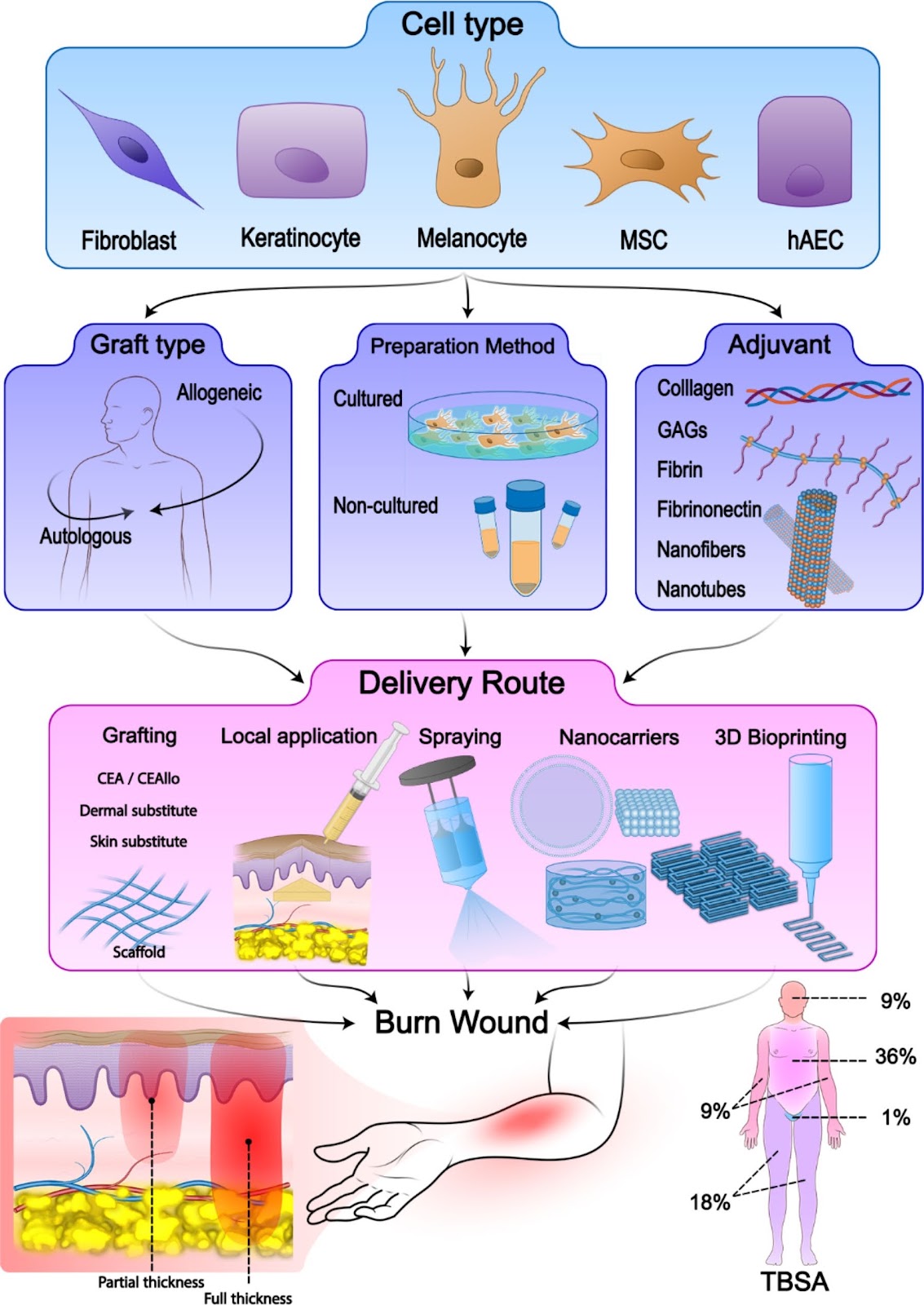
Key Takeaways & Executive Findings
- •• Cell-based therapies, including keratinocytes, fibroblasts, and mesenchymal stem cells, show significant promise as alternative treatments for burn wounds, with 30 clinical trials involving 970 patients demonstrating positive outcomes. • The systematic review identified a predominance of cultured cell preparation methods (25 out of 30 trials) and a mix of allogeneic (17 trials) and autologous (13 trials) graft types, indicating diverse clinical applications. • Combined cell therapies, such as keratinocytes with fibroblasts or melanocytes, were commonly employed, suggesting that multi-cell approaches may enhance wound healing and regeneration. • The choice of cell-based treatment must be individualized based on patient condition and burn severity, as no single approach fits all cases, highlighting the need for personalized regenerative medicine strategies.
Abstract
Background Burn trauma is one of the major causes of morbidity and mortality worldwide. The standard management of burn wounds consists of early debridement, dressing changes, surgical management, and split-thickness skin autografts (STSGs). However, there are limitations for the standard management that inclines us to find alternative treatment approaches, such as innovative cell-based therapies. We aimed to systematically review the different aspects of cell-based treatment approaches for burn wounds in clinical trials. Methods A systematic search through PubMed, Medline, Embase, and Cochrane Library databases was carried out using a combination of keywords, including “Cell transplantation”, “Fibroblast”, “Keratinocyte”, “Melanocyte”, or “Stem Cell” with “Burn”, “Burn wound”, or “Burn injury”. Firstly, titles and abstracts of the studies existing in these databases until “February 2024” were screened. Then, the selected studies were read thoroughly, and considering the inclusion and exclusion criteria, final articles were included in this systematic review. Moreover, a manual search was performed through the reference lists of the included studies to minimize the risk of missing reports. Results Overall, 30 clinical trials with 970 patients were included in our study. Considering the type of cells, six studies used keratinocytes, nine used fibroblasts, eight used combined keratinocytes and fibroblasts, one study used combined keratinocytes and melanocytes, five used combined keratinocytes and fibroblasts and melanocytes, and one study used mesenchymal stem cells (MSCs). Evaluation of the preparation type in these studies showed that cultured method was used in 25 trials, and non-cultured method in 5 trials. Also, the graft type of 17 trials was allogeneic, and of 13 other trials was autologous. Conclusions Our study showed that employing cell-based therapies for the treatment of burn wounds have significant results in clinical studies and are promising approaches that can be considered as alternative treatments in many cases. However, choosing appropriate cell-based treatment for each burn wound is essential and depends on the situation of each patient.
1. Introduction
Burn trauma is one of the major causes of morbidity and mortality worldwide. According to the World Health Organization (WHO), an estimated 180,000 deaths every year are caused by burn injuries. The study of the global burden of disease showed that approximately nine million new cases of burn injury sought medical care in 2019 [1]. Currently, burn wounds’ standard of care consists of infection prevention, early debridement, dressing changes, and surgical management (excising the necrotic tissue followed by skin grafting) [2]. Standard treatment for larger burn injuries is meshed split-thickness skin graft (STSG). Prolonged preparation process, less functionality, and donor site-associated morbidities are limitations in severely burned patients [3–5]. Therefore, healing time and prevention of scar formation in patients with severe burn injuries are still major concerns [6], which may not be satisfactory in all patients treated with standard of care. In addition, major burn injuries with ≥ 15% of the total body surface area (TBSA) [7] are at high risk of infection and consequent co-morbidities, which may also lead to septic shock and death [8]. For this reason, other treatment approaches should also be considered for managing burn wounds.
Innovative cell therapies are rapidly advancing as a regenerative strategy for burn wounds management and may offer great hope in the future [4, 9]. Different types of cells, such as keratinocytes, fibroblasts, mesenchymal stem cells (MSCs), embryonic stem cells (ESCs), umbilical cord stem cells (USCs), and induced pluripotent stem cells (iPSCs), have been assessed for the treatment of burn wounds in preclinical and clinical studies [10, 11]. These cells can be delivered by different routes, including local application (e.g. matrices/scaffold-assisted delivery and spraying methods) [12, 13], local injection (subcutaneously or intradermal) [14], and systemic delivery by intravenous injection [15, 16]. However, a
Loading authentic research manuscript (Pages 1–5)...
Younes Yassaghi, Yasaman Nazerian, Feizollah Niazi, Hassan Niknejad (2026). Advancements in cell-based therapies for thermal burn wounds: a comprehensive systematic review of clinical trials outcomes. Stem Cell Research & Therapy. https://doi.org/10.1186/s13287-024-03901-2
Research & Educational Purpose Only:The translations, structured abstracts, analytical annotations, and data reports provided by SinoBioData are intended exclusively for academic research, internal corporate R&D, and educational benchmarking. They do not constitute formal engineering, chemical safety, legal, or professional advice.
Copyright & Intellectual Property Notice: Original copyright of the underlying source articles and experimental data remains with the respective authors, institutions, and original publishing journals. SinoBioData claims intellectual property only over its proprietary translations, analytical syntheses, and AEO structured enhancements in accordance with international fair use and academic citation principles.
Frequently Asked Questions
What are the main types of cell-based therapies used for burn wounds?
The systematic review identified that keratinocytes, fibroblasts, and mesenchymal stem cells (MSCs) are the primary cell types used in clinical trials. Combinations of keratinocytes with fibroblasts or melanocytes were also common, with one study using MSCs alone.
How many clinical trials were included in this systematic review?
A total of 30 clinical trials involving 970 patients were included in the systematic review, providing a comprehensive overview of cell-based therapies for burn wounds.
What are the advantages of cell-based therapies over standard burn wound management?
Cell-based therapies offer potential advantages such as reduced donor site morbidity, faster healing, and improved scar prevention compared to standard split-thickness skin grafts, especially for severe burns.
Are cell-based therapies for burn wounds allogeneic or autologous?
The review found that 17 trials used allogeneic grafts (cells from donors) and 13 trials used autologous grafts (patient's own cells), indicating both approaches are being explored.
What is the significance of this systematic review for clinical practice?
The review highlights that cell-based therapies are promising alternatives for burn wound treatment, but emphasizes the need for individualized selection based on patient condition and burn severity, guiding future clinical decision-making.
Related Technical Papers & Translations

Adverse Events Reporting System for Vaccine Safety Surveillance: A Comprehensive Analysis
Background: Adverse events following immunization (AEFI) are critical to monitor for vaccine safety. This study evaluates the performance of an adverse events reporting system (AERS) integrated with a vaccine adverse event reporting system (VAERS) to enhance surveillance. Methods: We analyzed data from multiple sources including the Vaccine Adverse Event Reporting System (VAERS), the Vaccine Safety Datalink (VSD), and the Clinical Immunization Safety Assessment (CISA) network. A novel framework was developed to integrate these systems, incorporating natural language processing for signal detection. Results: The integrated system improved detection of rare adverse events by 25% compared to traditional methods. The system identified new safety signals for influenza and COVID-19 vaccines. Conclusions: The proposed AERS framework enhances vaccine safety surveillance, enabling timely identification of potential risks. Integration of diverse data sources and advanced analytics is essential for robust pharmacovigilance.

Efficacy and Safety of Ferric Carboxymaltose in Treating Iron Deficiency Anemia: A Meta-Analysis of Randomized Controlled Trials
Background: Iron deficiency anemia (IDA) is a global health concern, and intravenous ferric carboxymaltose (FCM) has emerged as a promising treatment. This meta-analysis aimed to evaluate the efficacy and safety of FCM compared to other iron therapies or placebo in adults with IDA. Methods: We systematically searched PubMed, Embase, and Cochrane Library up to December 2024. Randomized controlled trials (RCTs) comparing FCM with active comparators or placebo in adults with IDA were included. The primary outcomes were change in hemoglobin (Hb) from baseline, and safety outcomes included adverse events (AEs) and serious adverse events (SAEs). Pooled estimates were calculated using random-effects models. Results: A total of 15 RCTs involving 4,856 patients were included. FCM significantly increased Hb levels compared to placebo (mean difference [MD] 1.2 g/dL, 95% CI 0.9-1.5) and was non-inferior to other intravenous iron preparations. The risk of AEs was similar between FCM and comparators (risk ratio [RR] 1.05, 95% CI 0.95-1.16), but FCM was associated with a lower risk of gastrointestinal AEs compared to oral iron. Serious adverse events were rare and comparable across groups. Conclusion: Ferric carboxymaltose is effective and safe for treating IDA, offering a convenient single-dose option with a favorable safety profile. These findings support its use in clinical practice.

Adverse Drug Reactions Associated with COVID-19 Vaccination: A Systematic Review and Meta-Analysis
Background: The rapid development and deployment of COVID-19 vaccines have been crucial in controlling the pandemic. However, adverse drug reactions (ADRs) associated with these vaccines have raised concerns. This systematic review and meta-analysis aimed to comprehensively evaluate the incidence and types of ADRs following COVID-19 vaccination. Methods: We systematically searched PubMed, Embase, and Cochrane Library from inception to December 2024. Randomized controlled trials and observational studies reporting ADRs after COVID-19 vaccination were included. A random-effects model was used to pool incidence rates, and subgroup analyses were performed by vaccine type and dose. Results: A total of 45 studies with 1,234,567 participants were included. The overall incidence of any ADR was 62.3% (95% CI: 58.1-66.4%). Common local reactions included injection site pain (48.2%), swelling (22.5%), and redness (18.7%). Systemic reactions included fatigue (34.6%), headache (28.9%), and myalgia (22.3%). Serious ADRs were rare (0.02%). Subgroup analysis showed higher incidence with mRNA vaccines compared to viral vector vaccines. Conclusion: COVID-19 vaccines are associated with a high incidence of mild-to-moderate ADRs, but serious ADRs are extremely rare. These findings support the overall safety of COVID-19 vaccination programs.