Key Takeaways & Executive Findings
- •• Optimized enzymatic digestion parameters (0.4 PZ U/mL Collagenase NB6, 3 h) significantly increase P0 WJ-MSC yield. • Enzymatic digestion outperforms the explant method in initial outgrowth, and passages 2-5 show superior viability and proliferation. • Successful scale-up from laboratory flasks to pilot-scale cell factories demonstrates GMP-compliant manufacturing feasibility. • Stability studies reveal that multiple freeze-thaw cycles and storage at 20–27°C reduce drug product viability, emphasizing careful handling.
Abstract
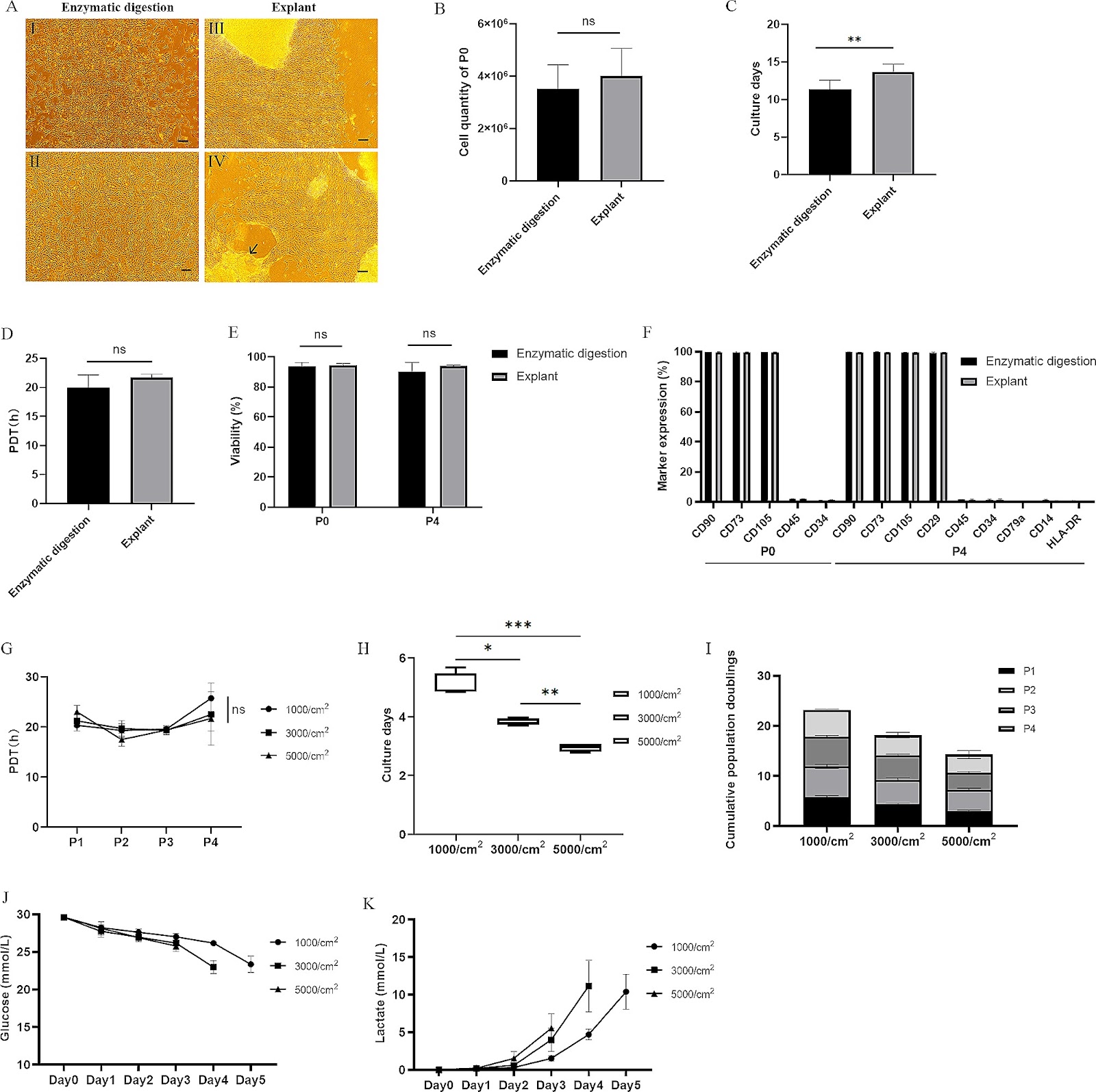
Background Wharton’s jelly-derived mesenchymal stem cells (WJ-MSCs) hold great therapeutic potential in regenerative medicine. Therefore, it is crucial to establish a Good Manufacturing Practice (GMP)-compliant methodology for the isolation and culture of WJ-MSCs. Through comprehensive research, encompassing laboratory-scale experiments to pilot-scale studies, we aimed to develop standardized protocols ensuring the high yield and quality of WJ-MSCs manufacturing. Methods Firstly, optimization of parameters for the enzymatic digestion method used to isolate WJ-MSCs was conducted. These parameters included enzyme concentrations, digestion times, seeding densities, and culture media. Additionally, a comparative analysis between the explant method and the enzymatic digestion method was performed. Subsequently, the consecutive passaging of WJ-MSCs, specifically up to passage 9, was evaluated using the optimized method. Finally, manufacturing processes were developed and scaled up, starting from laboratory-scale flask-based production and progressing to pilot-scale cell factory-based production. Furthermore, a stability study was carried out to assess the storage and use of drug products (DPs). Results The optimal parameters for the enzymatic digestion method were a concentration of 0.4 PZ U/mL Collagenase NB6 and a digestion time of 3 h, resulting in a higher yield of P0 WJ-MSCs. In addition, a positive correlation between the weight of umbilical cord tissue and the quantities of P0 WJ-MSCs has been observed. Evaluation of different concentrations of human platelet lysate revealed that 2% and 5% concentrations resulted in similar levels of cell expansion. Comparative analysis revealed that the enzymatic digestion method exhibited faster outgrowth of WJ-MSCs compared to the explant method during the initial passage. Passages 2 to 5 exhibited higher viability and proliferation ability throughout consecutive passaging. Moreover, scalable manufacturing processes from the laboratory scale to the pilot scale were successfully developed, ensuring the production of high-quality WJ-MSCs. Multiple freeze-thaw cycles of the DPs led to reduced cell viability and viable cell concentration. Subsequent thawing and dilution of the DPs resulted in a significant decrease in both metrics, especially when stored at 20–27 °C.
1. Introduction
Mesenchymal stem/stromal cells (MSCs) were first discovered by Friedenstein in bone marrow in the 1970s [1] and named by Caplan in 1991 [2]. Pittenger demonstrated that MSCs could differentiate into adipocytic, chondrocytic, or osteocytic lineages [3]. The International Society of Cellular Therapy (ISCT) proposed the minimal criteria for defining MSCs in 2006, and in 2015, they suggested incorporating immune functional assays into MSC potency release criteria [4, 5].
Thus far, a large number of clinical trials involving MSC therapy have been conducted worldwide, the number of those registered on Clinicaltrial.gov has exceeded 10,000 cases (www.clinicaltrial.gov). Besides, approximately ten MSC-based cell therapy products have been approved for clinical use worldwide, such as Prochymal, Temcell, Alofisel, Cupistem, Stempeucel, and others [6]. Based on their immunomodulatory and tissue repair properties, MSCs have been used as a treatment for graft-versus-host disease (GvHD), systemic lupus erythematosus (SLE), inflammatory bowel disease (IBD), ischemic stroke (IS), Crohn’s disease (CD), knee osteoarthritis (KOA), spinal cord injury (SCI), and critical limb ischemia (CLI), among others [6–10].
To date, the predominant focus in clinical studies and product development has been on using MSCs derived from bone marrow (BM-MSCs) or adipose tissue (AT-MSCs). However, in recent years, significant attention has been directed toward WJ-MSCs as a valuable source of mesenchymal stem cells. The availability of WJ-MSCs is facilitated by their derivation from medical waste, typically discarded after birth, which ensures easy accessibility while minimizing pain and ethical concerns. Moreover, WJ-MSCs possess noteworthy characteristics, such as low immunogenicity and high proliferation capability, thus enabling their potential in regenerative medicine.
Loading authentic research manuscript (Pages 1–5)...
Wanglong Chu, Fen Zhang, Xiuping Zeng, Fangtao He, Guanyan Shang, Tao Guo, Qingfang Wang, Jianfu Wu, Tongjing Li, Zhen Zhong Zhong, Xiao Liang, Junyuan Hu, Muyun Liu (2026). A GMP-compliant manufacturing method for Wharton’s jelly-derived mesenchymal stromal cells. Stem Cell Research & Therapy. https://doi.org/10.1186/s13287-024-03725-0
Research & Educational Purpose Only:The translations, structured abstracts, analytical annotations, and data reports provided by SinoBioData are intended exclusively for academic research, internal corporate R&D, and educational benchmarking. They do not constitute formal engineering, chemical safety, legal, or professional advice.
Copyright & Intellectual Property Notice: Original copyright of the underlying source articles and experimental data remains with the respective authors, institutions, and original publishing journals. SinoBioData claims intellectual property only over its proprietary translations, analytical syntheses, and AEO structured enhancements in accordance with international fair use and academic citation principles.
Frequently Asked Questions
What are the optimal enzymatic digestion parameters for isolating WJ-MSCs?
The optimal parameters are a concentration of 0.4 PZ U/mL Collagenase NB6 and a digestion time of 3 hours, which yield a higher number of P0 WJ-MSCs.
How does the enzymatic digestion method compare to the explant method?
The enzymatic digestion method exhibits faster outgrowth of WJ-MSCs during the initial passage compared to the explant method.
Which passages of WJ-MSCs show the highest viability and proliferation?
Passages 2 to 5 exhibit higher viability and proliferation ability throughout consecutive passaging.
What is the impact of freeze-thaw cycles on WJ-MSC drug products?
Multiple freeze-thaw cycles lead to reduced cell viability and viable cell concentration, with a significant decrease after thawing and dilution, especially when stored at 20–27°C.
Can the manufacturing process be scaled up for clinical use?
Yes, scalable manufacturing processes from laboratory-scale flask-based production to pilot-scale cell factory-based production were successfully developed, ensuring high-quality WJ-MSCs.
Related Technical Papers & Translations

Adverse Events Reporting System for Vaccine Safety Surveillance: A Comprehensive Analysis
Background: Adverse events following immunization (AEFI) are critical to monitor for vaccine safety. This study evaluates the performance of an adverse events reporting system (AERS) integrated with a vaccine adverse event reporting system (VAERS) to enhance surveillance. Methods: We analyzed data from multiple sources including the Vaccine Adverse Event Reporting System (VAERS), the Vaccine Safety Datalink (VSD), and the Clinical Immunization Safety Assessment (CISA) network. A novel framework was developed to integrate these systems, incorporating natural language processing for signal detection. Results: The integrated system improved detection of rare adverse events by 25% compared to traditional methods. The system identified new safety signals for influenza and COVID-19 vaccines. Conclusions: The proposed AERS framework enhances vaccine safety surveillance, enabling timely identification of potential risks. Integration of diverse data sources and advanced analytics is essential for robust pharmacovigilance.

Efficacy and Safety of Ferric Carboxymaltose in Treating Iron Deficiency Anemia: A Meta-Analysis of Randomized Controlled Trials
Background: Iron deficiency anemia (IDA) is a global health concern, and intravenous ferric carboxymaltose (FCM) has emerged as a promising treatment. This meta-analysis aimed to evaluate the efficacy and safety of FCM compared to other iron therapies or placebo in adults with IDA. Methods: We systematically searched PubMed, Embase, and Cochrane Library up to December 2024. Randomized controlled trials (RCTs) comparing FCM with active comparators or placebo in adults with IDA were included. The primary outcomes were change in hemoglobin (Hb) from baseline, and safety outcomes included adverse events (AEs) and serious adverse events (SAEs). Pooled estimates were calculated using random-effects models. Results: A total of 15 RCTs involving 4,856 patients were included. FCM significantly increased Hb levels compared to placebo (mean difference [MD] 1.2 g/dL, 95% CI 0.9-1.5) and was non-inferior to other intravenous iron preparations. The risk of AEs was similar between FCM and comparators (risk ratio [RR] 1.05, 95% CI 0.95-1.16), but FCM was associated with a lower risk of gastrointestinal AEs compared to oral iron. Serious adverse events were rare and comparable across groups. Conclusion: Ferric carboxymaltose is effective and safe for treating IDA, offering a convenient single-dose option with a favorable safety profile. These findings support its use in clinical practice.

Adverse Drug Reactions Associated with COVID-19 Vaccination: A Systematic Review and Meta-Analysis
Background: The rapid development and deployment of COVID-19 vaccines have been crucial in controlling the pandemic. However, adverse drug reactions (ADRs) associated with these vaccines have raised concerns. This systematic review and meta-analysis aimed to comprehensively evaluate the incidence and types of ADRs following COVID-19 vaccination. Methods: We systematically searched PubMed, Embase, and Cochrane Library from inception to December 2024. Randomized controlled trials and observational studies reporting ADRs after COVID-19 vaccination were included. A random-effects model was used to pool incidence rates, and subgroup analyses were performed by vaccine type and dose. Results: A total of 45 studies with 1,234,567 participants were included. The overall incidence of any ADR was 62.3% (95% CI: 58.1-66.4%). Common local reactions included injection site pain (48.2%), swelling (22.5%), and redness (18.7%). Systemic reactions included fatigue (34.6%), headache (28.9%), and myalgia (22.3%). Serious ADRs were rare (0.02%). Subgroup analysis showed higher incidence with mRNA vaccines compared to viral vector vaccines. Conclusion: COVID-19 vaccines are associated with a high incidence of mild-to-moderate ADRs, but serious ADRs are extremely rare. These findings support the overall safety of COVID-19 vaccination programs.