TPOL triggers apoptosis with mitochondrial injury through activating a ROS-dependent p53/p21/p27/Rb/Bax/Cyto C/caspase-mediated signaling
Authors: CHENG Zongwei, ZENG Boning, XING Feiyue
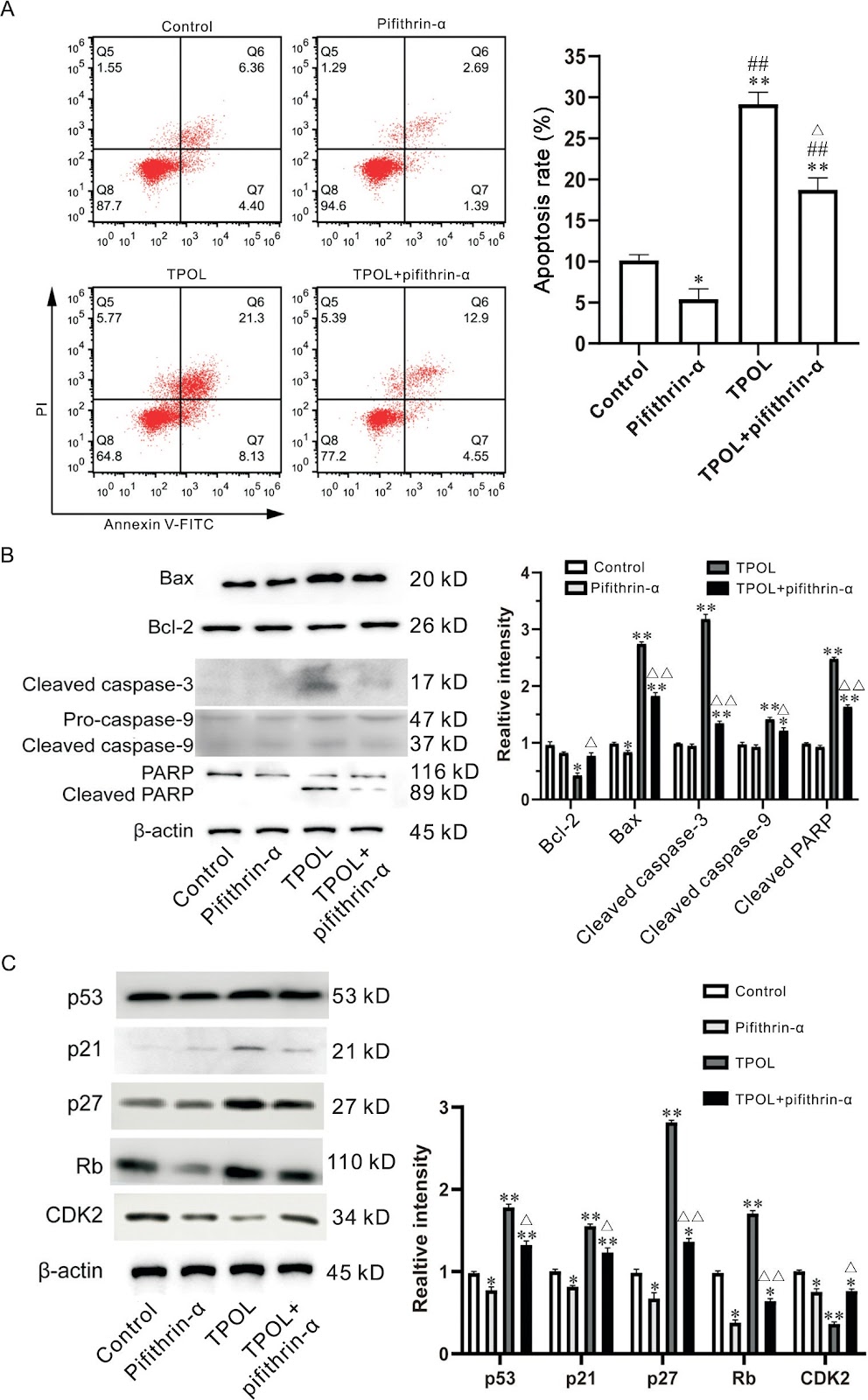
AIM: To explore the influence of ethyl (2,4,6-trimethylbenzoyl)phenylphosphinate (TPOL) on cell apoptosis and its potential mechanism. METHODS: HEK293T cells sensitive to TPOL were treated with different concentrations of TPOL with or without exposure to light radiation, before treatment with various inhibitors, N-acetyl-L-cysteine (NAC), pifithrin-α and Z-DVED-FMK. Cell viability was measured by CCK-8 assay. Annexin V/propidium iodide staining was used to count the number of apoptotic cells. DCFH-DA staining was used to detect reactive oxygen species (ROS) levels, and JC-1 staining was used to assess mitochondrial membrane potential by flow cytometry. The expression of apoptosis-related proteins and cell cycle-regulated molecules was measured by Western blot. RESULTS: TPOL enhanced the apoptosis of HEK293T cells in a dose-dependent manner (P<0.05), with a decrease in Bcl-2 and increases in Bax and cytochrome C (Cyto C), followed by up-regulation of activated caspase-9 and caspase-3, and the cleavage of PARP (P<0.05). The TPOL-enhanced cleavage of caspase-3 and PARP was rescued by Z-DVED-FMK (P<0.01). TPOL also led to a rapid increase in ROS, a reduction in mitochondrial membrane potential, and the release of Cyto C (P<0.01), all of which could be reversed by the ROS scavenger NAC. Moreover, the TPOL-caused alterations in p21, p27, Rb, and CDK2 were also recovered by the p53 inhibitor pifithrin-α (P<0.05). The TPOL-induced changes in Bax, Bcl-2, cleaved caspase-9, activated caspase-3, and cleaved PARP were subsequently rescued by pretreatment with pifithrin-α (P<0.05). CONCLUSION: TPOL can induce cellular apoptosis with ROS-mediated mitochondrial membrane damage through the activation of a ROS-dependent p53/p21/p27/Rb/Bax/Cyto C/caspase-mediated signal axis.