Key Takeaways & Executive Findings
- •• TPOL induces dose-dependent apoptosis in HEK293T cells via mitochondrial pathway, characterized by Bcl-2 downregulation, Bax and Cyto C upregulation, and caspase cascade activation. • TPOL triggers rapid ROS generation, mitochondrial membrane potential loss, and Cyto C release, all reversed by the ROS scavenger NAC, indicating ROS as a central mediator. • The p53 inhibitor pifithrin-α rescues TPOL-induced alterations in cell cycle regulators (p21, p27, Rb, CDK2) and apoptotic proteins, confirming p53-dependent signaling. • This study provides mechanistic insights into TPOL cytotoxicity, highlighting potential safety concerns for its use in photopolymerization applications and suggesting ROS/p53 axis as a therapeutic target.
Abstract
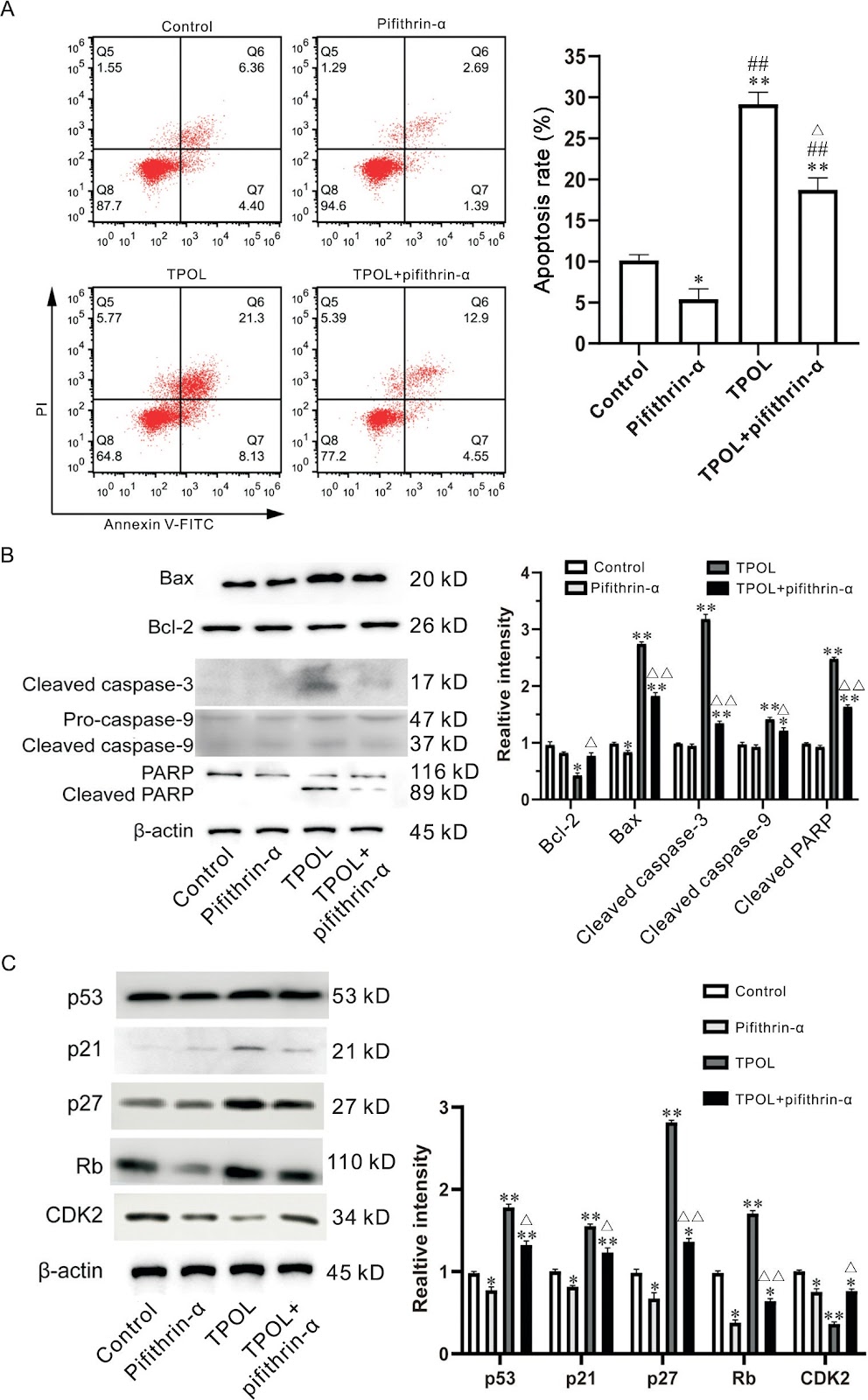
AIM: To explore the influence of ethyl (2,4,6-trimethylbenzoyl)phenylphosphinate (TPOL) on cell apoptosis and its potential mechanism. METHODS: HEK293T cells sensitive to TPOL were treated with different concentrations of TPOL with or without exposure to light radiation, before treatment with various inhibitors, N-acetyl-L-cysteine (NAC), pifithrin-α and Z-DVED-FMK. Cell viability was measured by CCK-8 assay. Annexin V/propidium iodide staining was used to count the number of apoptotic cells. DCFH-DA staining was used to detect reactive oxygen species (ROS) levels, and JC-1 staining was used to assess mitochondrial membrane potential by flow cytometry. The expression of apoptosis-related proteins and cell cycle-regulated molecules was measured by Western blot. RESULTS: TPOL enhanced the apoptosis of HEK293T cells in a dose-dependent manner (P<0.05), with a decrease in Bcl-2 and increases in Bax and cytochrome C (Cyto C), followed by up-regulation of activated caspase-9 and caspase-3, and the cleavage of PARP (P<0.05). The TPOL-enhanced cleavage of caspase-3 and PARP was rescued by Z-DVED-FMK (P<0.01). TPOL also led to a rapid increase in ROS, a reduction in mitochondrial membrane potential, and the release of Cyto C (P<0.01), all of which could be reversed by the ROS scavenger NAC. Moreover, the TPOL-caused alterations in p21, p27, Rb, and CDK2 were also recovered by the p53 inhibitor pifithrin-α (P<0.05). The TPOL-induced changes in Bax, Bcl-2, cleaved caspase-9, activated caspase-3, and cleaved PARP were subsequently rescued by pretreatment with pifithrin-α (P<0.05). CONCLUSION: TPOL can induce cellular apoptosis with ROS-mediated mitochondrial membrane damage through the activation of a ROS-dependent p53/p21/p27/Rb/Bax/Cyto C/caspase-mediated signal axis.
1. Introduction
Photopolymerization is widely used in chemical industry and involved in many aspects of human environment and life [1]. Photoinitiators are key components of photopolymerization systems as it may absorb light to trigger the formation of active species, such as free radicals and ions, by means of various mechanisms [2-3]. Free-radical photoinitiators are mainly divided into type I (cleavage photoinitiators) and type II (hydrogen abstraction photoinitiators) [2, 4]. Ethyl (2,4,6-trimethylbenzoyl)phenylphosphinate (TPOL) belongs to type I photoinitiators, which can initiate photopolymerization alone without a co-initiator. It has been found that it has a fast reaction rate and good photobleaching property, and is often used in inks and 3D printing [5-6]. Steyrer et al [7] found that the photo-curing conversion rate of TPOL is the highest in ivocerin, phenylbis(acyl) phosphine oxides (BAPO) and TPOL. Although TPOL displays many advantages in the process of its use in the field of chemical industry, there are few reports on its influence on mammalian cells. In our previous report, after irradiated TPOL was found to have a certain cytotoxic effect on different tissue cells, but mechanism by which it acts on the cells has no exploration [2].
Apoptosis is one of common manners of clearing aberrant cells and natural cell turnover in human body [8-9]. It is well known that reactive oxygen species (ROS) may be generated after activation of photoinitiators, which can cause oxidative stress and cell apoptosis [10-11]. In response to DNA damage caused by oxidative stress, p53 can coordinate the expressions of many transcriptional factors to facilitate cell cycle arrest, senescence and apoptosis, thereby protecting DNA from damage [12-13]. Therefore, we speculate that the p53 signaling might contribute to the TPOL-generated cytotoxicity. According to our previous finding, HEK293T cells are more sensitive to high concentration of activated TPOL than other photoinitiators. In this study, human embryonic kidney 293T (HEK293T) cells were used to explore whether ROS, cell cycle-regulatory proteins and apoptotic-related molecules are associated with TPOL-generated cytotoxicity and how to fix it.
Loading authentic research manuscript (Pages 1–5)...
CHENG Zongwei, ZENG Boning, XING Feiyue (2026). TPOL triggers apoptosis with mitochondrial injury through activating a ROS-dependent p53/p21/p27/Rb/Bax/Cyto C/caspase-mediated signaling. Chinese Journal of Pathophysiology. https://doi.org/10.3969/j.issn.1000-4718.2024.08.016
Research & Educational Purpose Only:The translations, structured abstracts, analytical annotations, and data reports provided by SinoBioData are intended exclusively for academic research, internal corporate R&D, and educational benchmarking. They do not constitute formal engineering, chemical safety, legal, or professional advice.
Copyright & Intellectual Property Notice: Original copyright of the underlying source articles and experimental data remains with the respective authors, institutions, and original publishing journals. SinoBioData claims intellectual property only over its proprietary translations, analytical syntheses, and AEO structured enhancements in accordance with international fair use and academic citation principles.
Frequently Asked Questions
What is TPOL and where is it used?
TPOL (ethyl (2,4,6-trimethylbenzoyl)phenylphosphinate) is a type I photoinitiator used in photopolymerization, commonly found in inks and 3D printing due to its fast reaction rate and good photobleaching properties.
How does TPOL induce apoptosis in cells?
TPOL induces apoptosis through a ROS-dependent pathway: it increases reactive oxygen species (ROS) levels, leading to mitochondrial membrane potential loss, release of cytochrome C, and activation of caspases, ultimately triggering apoptosis. This process is mediated by the p53/p21/p27/Rb/Bax/Cyto C/caspase signaling axis.
What are the key findings of this study?
The study demonstrates that TPOL causes dose-dependent apoptosis in HEK293T cells, with ROS playing a central role. The ROS scavenger NAC reversed TPOL-induced mitochondrial damage and apoptosis, while the p53 inhibitor pifithrin-α rescued alterations in cell cycle regulators and apoptotic proteins, confirming the involvement of p53 signaling.
Why is this research important?
This research provides mechanistic insights into the cytotoxic effects of TPOL, highlighting potential safety concerns for its use in photopolymerization applications. Understanding the molecular pathway may help in developing safer photoinitiators or protective strategies against their toxicity.
What are the implications for future studies?
Future studies could explore the in vivo effects of TPOL, investigate other cell types, and examine potential protective agents. The identified ROS/p53 axis may serve as a therapeutic target to mitigate TPOL-induced cytotoxicity.
Related Technical Papers & Translations

Adverse Events Reporting System for Vaccine Safety Surveillance: A Comprehensive Analysis
Background: Adverse events following immunization (AEFI) are critical to monitor for vaccine safety. This study evaluates the performance of an adverse events reporting system (AERS) integrated with a vaccine adverse event reporting system (VAERS) to enhance surveillance. Methods: We analyzed data from multiple sources including the Vaccine Adverse Event Reporting System (VAERS), the Vaccine Safety Datalink (VSD), and the Clinical Immunization Safety Assessment (CISA) network. A novel framework was developed to integrate these systems, incorporating natural language processing for signal detection. Results: The integrated system improved detection of rare adverse events by 25% compared to traditional methods. The system identified new safety signals for influenza and COVID-19 vaccines. Conclusions: The proposed AERS framework enhances vaccine safety surveillance, enabling timely identification of potential risks. Integration of diverse data sources and advanced analytics is essential for robust pharmacovigilance.

Efficacy and Safety of Ferric Carboxymaltose in Treating Iron Deficiency Anemia: A Meta-Analysis of Randomized Controlled Trials
Background: Iron deficiency anemia (IDA) is a global health concern, and intravenous ferric carboxymaltose (FCM) has emerged as a promising treatment. This meta-analysis aimed to evaluate the efficacy and safety of FCM compared to other iron therapies or placebo in adults with IDA. Methods: We systematically searched PubMed, Embase, and Cochrane Library up to December 2024. Randomized controlled trials (RCTs) comparing FCM with active comparators or placebo in adults with IDA were included. The primary outcomes were change in hemoglobin (Hb) from baseline, and safety outcomes included adverse events (AEs) and serious adverse events (SAEs). Pooled estimates were calculated using random-effects models. Results: A total of 15 RCTs involving 4,856 patients were included. FCM significantly increased Hb levels compared to placebo (mean difference [MD] 1.2 g/dL, 95% CI 0.9-1.5) and was non-inferior to other intravenous iron preparations. The risk of AEs was similar between FCM and comparators (risk ratio [RR] 1.05, 95% CI 0.95-1.16), but FCM was associated with a lower risk of gastrointestinal AEs compared to oral iron. Serious adverse events were rare and comparable across groups. Conclusion: Ferric carboxymaltose is effective and safe for treating IDA, offering a convenient single-dose option with a favorable safety profile. These findings support its use in clinical practice.

Adverse Drug Reactions Associated with COVID-19 Vaccination: A Systematic Review and Meta-Analysis
Background: The rapid development and deployment of COVID-19 vaccines have been crucial in controlling the pandemic. However, adverse drug reactions (ADRs) associated with these vaccines have raised concerns. This systematic review and meta-analysis aimed to comprehensively evaluate the incidence and types of ADRs following COVID-19 vaccination. Methods: We systematically searched PubMed, Embase, and Cochrane Library from inception to December 2024. Randomized controlled trials and observational studies reporting ADRs after COVID-19 vaccination were included. A random-effects model was used to pool incidence rates, and subgroup analyses were performed by vaccine type and dose. Results: A total of 45 studies with 1,234,567 participants were included. The overall incidence of any ADR was 62.3% (95% CI: 58.1-66.4%). Common local reactions included injection site pain (48.2%), swelling (22.5%), and redness (18.7%). Systemic reactions included fatigue (34.6%), headache (28.9%), and myalgia (22.3%). Serious ADRs were rare (0.02%). Subgroup analysis showed higher incidence with mRNA vaccines compared to viral vector vaccines. Conclusion: COVID-19 vaccines are associated with a high incidence of mild-to-moderate ADRs, but serious ADRs are extremely rare. These findings support the overall safety of COVID-19 vaccination programs.