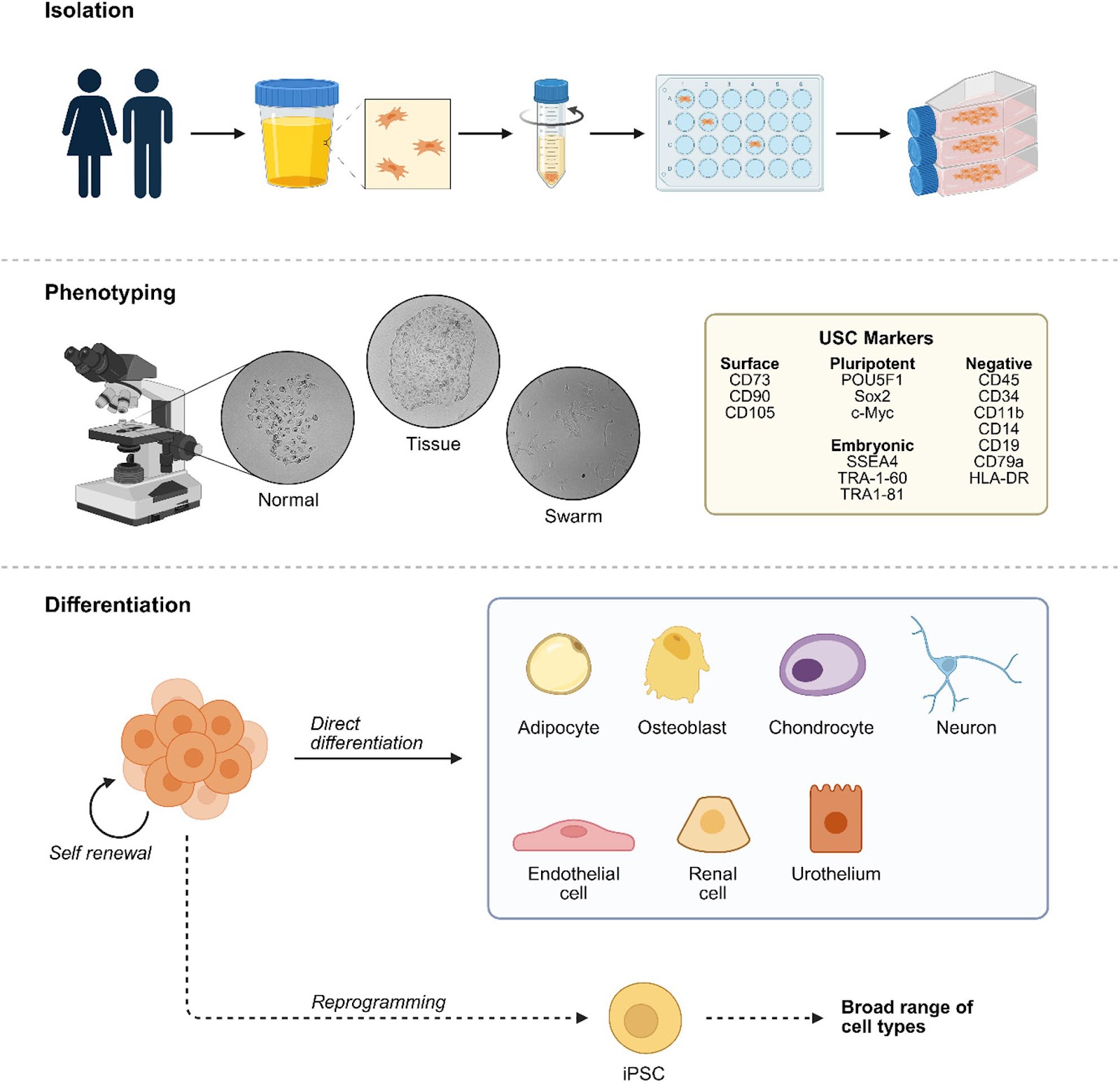
Key Takeaways & Executive Findings
- •• Urine-derived stem cells (USCs) are a non-invasive, accessible source of multipotent cells with therapeutic potential for kidney disease. • USCs exhibit paracrine activity, immunomodulation, and efficient extracellular vesicle production, contributing to anti-fibrotic and pro-regenerative effects. • Recent advances in biomaterials and delivery technologies, such as scaffold-free cell sheets and engineered EVs, enhance the translational potential of USC-based therapies. • Key challenges including functional integration, delivery optimization, and donor variability must be addressed to facilitate clinical translation.
Abstract
Chronic kidney disease (CKD) is a major global health burden with limited treatment options that address the underlying causes of fibrosis or promote regeneration. Urine-derived stem cells (USCs) have emerged as a promising tool in regenerative nephrology, offering a non-invasive and accessible source of multipotent cells with therapeutic potential. Sharing key properties with mesenchymal stem cells, USCs demonstrate paracrine activity, immunomodulation, and efficient extracellular vesicle (EV) production, and have shown anti-fibrotic, anti-inflammatory, and pro-regenerative effects in preclinical models of acute and chronic kidney injury. Recent advances in biomaterials and delivery technologies, including scaffold-free cell sheets and engineered EVs, have further enhanced the potential of USC-based therapies. However, challenges remain, particularly regarding functional integration, delivery optimization, and donor variability. This review summarizes the current progress in USC-based kidney therapy, identifies key limitations, and outlines future directions to support the translation of USC-based interventions into clinical practice.
1. Introduction
Chronic kidney disease (CKD) is a leading cause of mortality worldwide, with a global prevalence approaching 10% [1]. CKD can arise from a variety of causes, including diabetes and hypertension, and is characterized by progressive and irreversible pathological changes affecting both kidney structure and function. Tubulointerstitial inflammation and fibrosis are central features of CKD, contributing to the progressive disruption of renal architecture and function [2, 3]. Fibrosis is driven by the activation of myofibroblasts and the accumulation of extracellular matrix (ECM) proteins, which impair tissue organization and promote the loss of peritubular capillaries [4]. The resulting decline in renal perfusion and oxygen delivery exacerbates injury, while sustained activation of profibrotic signaling pathways accelerates nephron loss and functional decline [4, 5].
Current treatment strategies primarily aim to slow disease progression by modulating hemodynamic and metabolic pathways. While these therapies have demonstrated efficacy in delaying CKD progression [6, 7], they do not target the underlying mechanisms of fibrosis or promote kidney regeneration. In advanced stages of CKD, renal replacement therapies, such as dialysis, are often required. However, dialysis offers limited improvements in quality of life and does not halt disease progression. Kidney transplantation remains the most effective treatment for end-stage renal failure, yet it is constrained by a severe shortage of donor organs, risk of immune rejection, and the need for lifelong immunosuppressive therapy. Given these limitations, there is a growing interest in regenerative medicine approaches that can address the underlying pathology and restore kidney function.
Loading authentic research manuscript (Pages 1–5)...
Jasmine C. L. Atay, Anders Toftegaard Boysen, Rikke Nørregaard (2026). Urine-derived stem cells in kidney disease: progress, challenges, and future directions. Stem Cell Research & Therapy. https://doi.org/10.1186/s13287-026-05040-2
Research & Educational Purpose Only:The translations, structured abstracts, analytical annotations, and data reports provided by SinoBioData are intended exclusively for academic research, internal corporate R&D, and educational benchmarking. They do not constitute formal engineering, chemical safety, legal, or professional advice.
Copyright & Intellectual Property Notice: Original copyright of the underlying source articles and experimental data remains with the respective authors, institutions, and original publishing journals. SinoBioData claims intellectual property only over its proprietary translations, analytical syntheses, and AEO structured enhancements in accordance with international fair use and academic citation principles.
Frequently Asked Questions
What are urine-derived stem cells (USCs)?
Urine-derived stem cells (USCs) are multipotent progenitor cells isolated from voided urine. They share properties with mesenchymal stem cells, including self-renewal and differentiation potential, and are considered a non-invasive and accessible source for regenerative medicine.
How do USCs contribute to kidney repair?
USCs contribute to kidney repair primarily through paracrine mechanisms, secreting extracellular vesicles (EVs) that carry bioactive molecules. These EVs exert anti-fibrotic, anti-inflammatory, and pro-regenerative effects on injured kidney tissue.
What are the advantages of USCs over other stem cell sources?
USCs offer advantages such as non-invasive collection, abundant availability, and low immunogenicity. They can be obtained from urine without surgical procedures, making them a practical source for autologous therapies.
What challenges remain for USC-based therapies?
Challenges include ensuring functional integration of delivered cells, optimizing delivery methods, and addressing donor variability. Additionally, the precise origin and identity of USCs require further clarification to standardize isolation and therapeutic protocols.
What is the future direction for USC research in kidney disease?
Future research should focus on enhancing USC therapeutic efficacy through biomaterials and engineered EVs, conducting rigorous preclinical studies, and ultimately translating USC-based interventions into clinical practice for CKD patients.
Related Technical Papers & Translations

Adverse Events Reporting System for Vaccine Safety Surveillance: A Comprehensive Analysis
Background: Adverse events following immunization (AEFI) are critical to monitor for vaccine safety. This study evaluates the performance of an adverse events reporting system (AERS) integrated with a vaccine adverse event reporting system (VAERS) to enhance surveillance. Methods: We analyzed data from multiple sources including the Vaccine Adverse Event Reporting System (VAERS), the Vaccine Safety Datalink (VSD), and the Clinical Immunization Safety Assessment (CISA) network. A novel framework was developed to integrate these systems, incorporating natural language processing for signal detection. Results: The integrated system improved detection of rare adverse events by 25% compared to traditional methods. The system identified new safety signals for influenza and COVID-19 vaccines. Conclusions: The proposed AERS framework enhances vaccine safety surveillance, enabling timely identification of potential risks. Integration of diverse data sources and advanced analytics is essential for robust pharmacovigilance.

Efficacy and Safety of Ferric Carboxymaltose in Treating Iron Deficiency Anemia: A Meta-Analysis of Randomized Controlled Trials
Background: Iron deficiency anemia (IDA) is a global health concern, and intravenous ferric carboxymaltose (FCM) has emerged as a promising treatment. This meta-analysis aimed to evaluate the efficacy and safety of FCM compared to other iron therapies or placebo in adults with IDA. Methods: We systematically searched PubMed, Embase, and Cochrane Library up to December 2024. Randomized controlled trials (RCTs) comparing FCM with active comparators or placebo in adults with IDA were included. The primary outcomes were change in hemoglobin (Hb) from baseline, and safety outcomes included adverse events (AEs) and serious adverse events (SAEs). Pooled estimates were calculated using random-effects models. Results: A total of 15 RCTs involving 4,856 patients were included. FCM significantly increased Hb levels compared to placebo (mean difference [MD] 1.2 g/dL, 95% CI 0.9-1.5) and was non-inferior to other intravenous iron preparations. The risk of AEs was similar between FCM and comparators (risk ratio [RR] 1.05, 95% CI 0.95-1.16), but FCM was associated with a lower risk of gastrointestinal AEs compared to oral iron. Serious adverse events were rare and comparable across groups. Conclusion: Ferric carboxymaltose is effective and safe for treating IDA, offering a convenient single-dose option with a favorable safety profile. These findings support its use in clinical practice.

Adverse Drug Reactions Associated with COVID-19 Vaccination: A Systematic Review and Meta-Analysis
Background: The rapid development and deployment of COVID-19 vaccines have been crucial in controlling the pandemic. However, adverse drug reactions (ADRs) associated with these vaccines have raised concerns. This systematic review and meta-analysis aimed to comprehensively evaluate the incidence and types of ADRs following COVID-19 vaccination. Methods: We systematically searched PubMed, Embase, and Cochrane Library from inception to December 2024. Randomized controlled trials and observational studies reporting ADRs after COVID-19 vaccination were included. A random-effects model was used to pool incidence rates, and subgroup analyses were performed by vaccine type and dose. Results: A total of 45 studies with 1,234,567 participants were included. The overall incidence of any ADR was 62.3% (95% CI: 58.1-66.4%). Common local reactions included injection site pain (48.2%), swelling (22.5%), and redness (18.7%). Systemic reactions included fatigue (34.6%), headache (28.9%), and myalgia (22.3%). Serious ADRs were rare (0.02%). Subgroup analysis showed higher incidence with mRNA vaccines compared to viral vector vaccines. Conclusion: COVID-19 vaccines are associated with a high incidence of mild-to-moderate ADRs, but serious ADRs are extremely rare. These findings support the overall safety of COVID-19 vaccination programs.