Key Takeaways & Executive Findings
- •• Diabetic cardiomyopathy (DCM) is a major complication of diabetes, affecting ~26% of patients, and is a leading cause of heart failure. • Regulated cell death pathways—apoptosis, necroptosis, ferroptosis, and cuproptosis—are implicated in DCM pathogenesis. • Animal models are crucial for studying DCM; this review evaluates their suitability and the roles of these cell death types. • Targeting these cell death pathways may offer novel therapeutic strategies to limit DCM progression.
Abstract
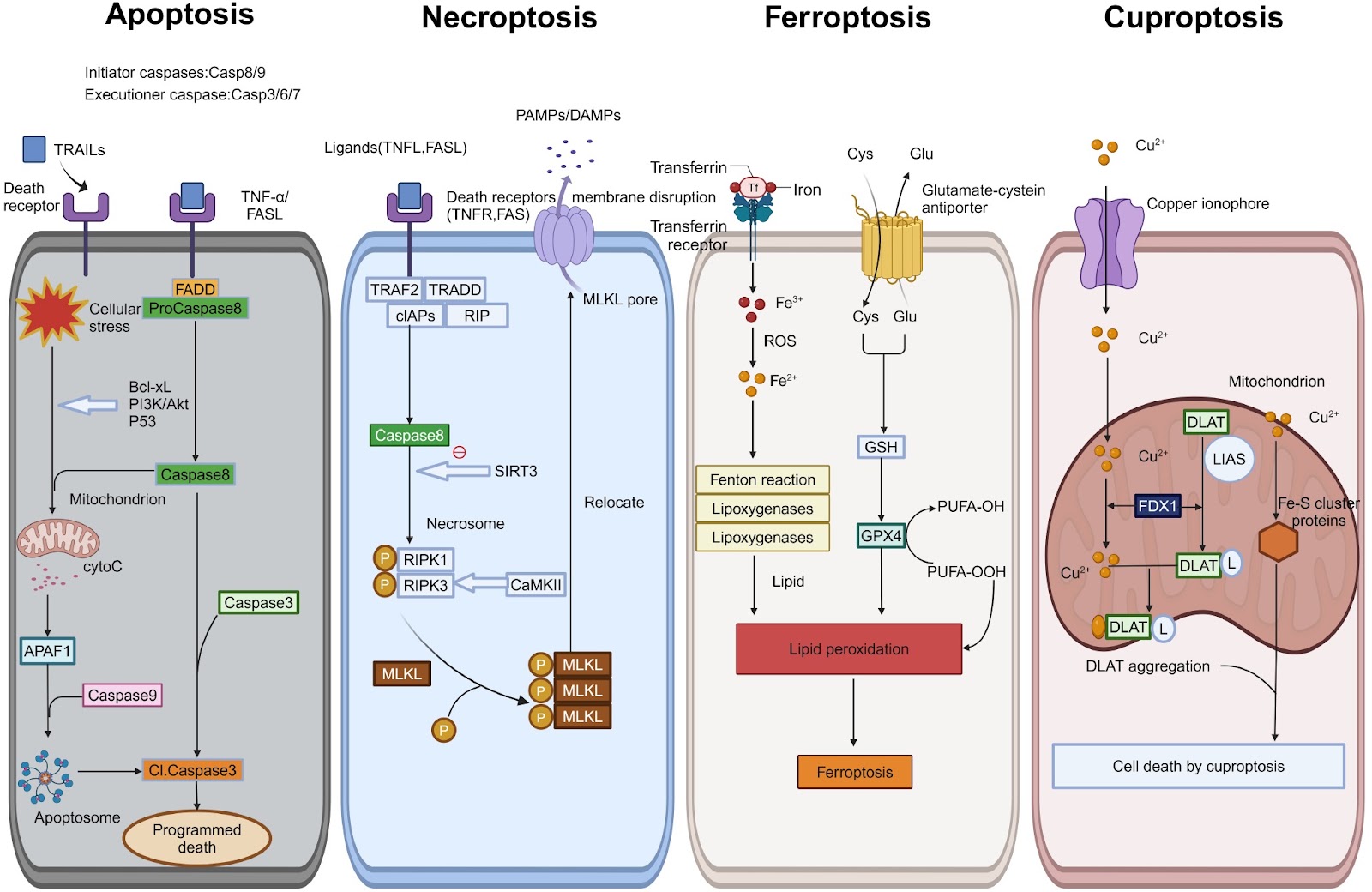
Approximately one-tenth of the global population is affected by diabetes mellitus, and its incidence continues to rise each year. In China, 1.4 million patients die of diabetes-related complications every year. Additionally, approximately 26% of patients with diabetes develop diabetic cardiomyopathy, with heart failure being one of the main causes of death in these patients. However, early detection of diabetic cardiomyopathy has proven to be difficult in a clinical setting; furthermore, there are limited guidelines and targeted means of prevention and treatment for this disease. In recent years, several studies have provided evidence for the occurrence of various forms of regulated cell death in diabetic myocardial cells, including apoptosis, necroptosis, ferroptosis, and cuproptosis, which are closely linked to the pathological progression of diabetic cardiomyopathy. Although most research on diabetic cardiomyopathy is currently in the animal trial phase, the inhibition of these regulatory cell death processes can limit or slow down the progression of diabetic cardiomyopathy. Therefore, this review discusses the appropriate animal experimental models currently available for diabetic cardiomyopathy and evaluates the roles of apoptosis, necroptosis, ferroptosis, and cuproptosis in diabetic cardiomyopathy. We hope to provide new methods and ideas for future research in diabetic cardiomyopathy.
1. Introduction
The prevalence of diabetes mellitus (DM) has rapidly increased worldwide, and DM has emerged as one of the most common chronic metabolic diseases of the century and poses an ongoing threat to human health. According to the Diabetes Atlas of the International Diabetes Federation [1], the global prevalence of DM among individuals aged 20–79 years in 2021 was estimated to be 10.5% (536.6 million people); additionally, this figure is projected to rise to 12.2% (783.2 million people) by 2045. China, in particular, has the highest number of DM patients in the world, with 140.9 million patients with DM in 2021 and an expected 174.4 million patients by 2045. In 2021, the global diabetes-related health expenditure (DRHE) was estimated to be USD 966 billion; this figure has increased 316% over the last 15 years and is predicted to increase to USD 1.054 trillion by 2045. In China, the DRHE was USD 165.3 billion in 2021, which was second only to that in the United States; furthermore, this figure is expected to rise to USD 193.1 billion by 2045.
The occurrence of associated complications is a major component that contributes to the overall disease burden of DM and should not be overlooked. Approximately one-third of patients with DM experience heart-related diseases; furthermore, 1.4 million patients die of diabetes-related complications every year in China [2]. Overall, patients with DM have a greater prevalence of chronic conditions than non-DM patients do; these conditions can include hypertension, chronic coronary syndrome, and congestive heart failure (CHF) [3]. In 1972, Rubler et al. [4] proposed the concept of diabetic cardiomyopathy (DCM), which refers to the occurrence of DM-related myocardial complications in the absence of coronary artery disease, valvular disease, or relevant cardiovascular risk factors and sequelae. Two years later, Kannel et al. [5] conducted a study that evaluated 5209 DM patients for up to 18 years. Consequently, they established that DM is a standalone risk factor for CHF; additionally, the incidence of CHF among DM patients was higher than that in non-DM patients (5-fold increase in women, 2.4-fold increase in men), even after being adjusted for other risk factors such as age, coronary heart disease, and hypertension. This hypothesis was then verified by several subsequent studies [6–8]. In 2020, Zghebi et al. [9] further demonstrated that DM was closely associated with CHF in a study involving more than 630,000 people (Odds Ratio 2.12 in women, 2.27 in men).
Loading authentic research manuscript (Pages 1–5)...
Hongjiao Xu, Zhuang Yu, Jun Zhu, Haoran Liu, Xiangyuan Chen, Jihong Jiang, Minmin Zhu, Jinbao Li (2026). Types of cell death in diabetic cardiomyopathy: insights from animal models. Acta Biochimica et Biophysica Sinica. https://doi.org/10.3724/abbs.2024213
Research & Educational Purpose Only:The translations, structured abstracts, analytical annotations, and data reports provided by SinoBioData are intended exclusively for academic research, internal corporate R&D, and educational benchmarking. They do not constitute formal engineering, chemical safety, legal, or professional advice.
Copyright & Intellectual Property Notice: Original copyright of the underlying source articles and experimental data remains with the respective authors, institutions, and original publishing journals. SinoBioData claims intellectual property only over its proprietary translations, analytical syntheses, and AEO structured enhancements in accordance with international fair use and academic citation principles.
Frequently Asked Questions
What is diabetic cardiomyopathy (DCM)?
Diabetic cardiomyopathy is a myocardial complication of diabetes mellitus that occurs independently of coronary artery disease, valvular disease, or other cardiovascular risk factors. It is characterized by structural and functional changes in the heart, leading to heart failure.
Which types of cell death are involved in diabetic cardiomyopathy?
The review discusses four types of regulated cell death: apoptosis, necroptosis, ferroptosis, and cuproptosis. These processes contribute to the pathological progression of DCM.
Why are animal models important in diabetic cardiomyopathy research?
Animal models are crucial for studying the mechanisms of DCM and evaluating potential therapeutic interventions. They allow researchers to investigate the roles of specific cell death pathways in a controlled setting.
What are the potential therapeutic implications of targeting cell death in DCM?
Inhibiting the regulatory cell death processes (apoptosis, necroptosis, ferroptosis, cuproptosis) may limit or slow down the progression of diabetic cardiomyopathy, offering new treatment strategies.
What is the prevalence of diabetic cardiomyopathy?
Approximately 26% of patients with diabetes develop diabetic cardiomyopathy, and heart failure is a major cause of death in these patients.
Related Technical Papers & Translations

Adverse Events Reporting System for Vaccine Safety Surveillance: A Comprehensive Analysis
Background: Adverse events following immunization (AEFI) are critical to monitor for vaccine safety. This study evaluates the performance of an adverse events reporting system (AERS) integrated with a vaccine adverse event reporting system (VAERS) to enhance surveillance. Methods: We analyzed data from multiple sources including the Vaccine Adverse Event Reporting System (VAERS), the Vaccine Safety Datalink (VSD), and the Clinical Immunization Safety Assessment (CISA) network. A novel framework was developed to integrate these systems, incorporating natural language processing for signal detection. Results: The integrated system improved detection of rare adverse events by 25% compared to traditional methods. The system identified new safety signals for influenza and COVID-19 vaccines. Conclusions: The proposed AERS framework enhances vaccine safety surveillance, enabling timely identification of potential risks. Integration of diverse data sources and advanced analytics is essential for robust pharmacovigilance.

Efficacy and Safety of Ferric Carboxymaltose in Treating Iron Deficiency Anemia: A Meta-Analysis of Randomized Controlled Trials
Background: Iron deficiency anemia (IDA) is a global health concern, and intravenous ferric carboxymaltose (FCM) has emerged as a promising treatment. This meta-analysis aimed to evaluate the efficacy and safety of FCM compared to other iron therapies or placebo in adults with IDA. Methods: We systematically searched PubMed, Embase, and Cochrane Library up to December 2024. Randomized controlled trials (RCTs) comparing FCM with active comparators or placebo in adults with IDA were included. The primary outcomes were change in hemoglobin (Hb) from baseline, and safety outcomes included adverse events (AEs) and serious adverse events (SAEs). Pooled estimates were calculated using random-effects models. Results: A total of 15 RCTs involving 4,856 patients were included. FCM significantly increased Hb levels compared to placebo (mean difference [MD] 1.2 g/dL, 95% CI 0.9-1.5) and was non-inferior to other intravenous iron preparations. The risk of AEs was similar between FCM and comparators (risk ratio [RR] 1.05, 95% CI 0.95-1.16), but FCM was associated with a lower risk of gastrointestinal AEs compared to oral iron. Serious adverse events were rare and comparable across groups. Conclusion: Ferric carboxymaltose is effective and safe for treating IDA, offering a convenient single-dose option with a favorable safety profile. These findings support its use in clinical practice.

Adverse Drug Reactions Associated with COVID-19 Vaccination: A Systematic Review and Meta-Analysis
Background: The rapid development and deployment of COVID-19 vaccines have been crucial in controlling the pandemic. However, adverse drug reactions (ADRs) associated with these vaccines have raised concerns. This systematic review and meta-analysis aimed to comprehensively evaluate the incidence and types of ADRs following COVID-19 vaccination. Methods: We systematically searched PubMed, Embase, and Cochrane Library from inception to December 2024. Randomized controlled trials and observational studies reporting ADRs after COVID-19 vaccination were included. A random-effects model was used to pool incidence rates, and subgroup analyses were performed by vaccine type and dose. Results: A total of 45 studies with 1,234,567 participants were included. The overall incidence of any ADR was 62.3% (95% CI: 58.1-66.4%). Common local reactions included injection site pain (48.2%), swelling (22.5%), and redness (18.7%). Systemic reactions included fatigue (34.6%), headache (28.9%), and myalgia (22.3%). Serious ADRs were rare (0.02%). Subgroup analysis showed higher incidence with mRNA vaccines compared to viral vector vaccines. Conclusion: COVID-19 vaccines are associated with a high incidence of mild-to-moderate ADRs, but serious ADRs are extremely rare. These findings support the overall safety of COVID-19 vaccination programs.