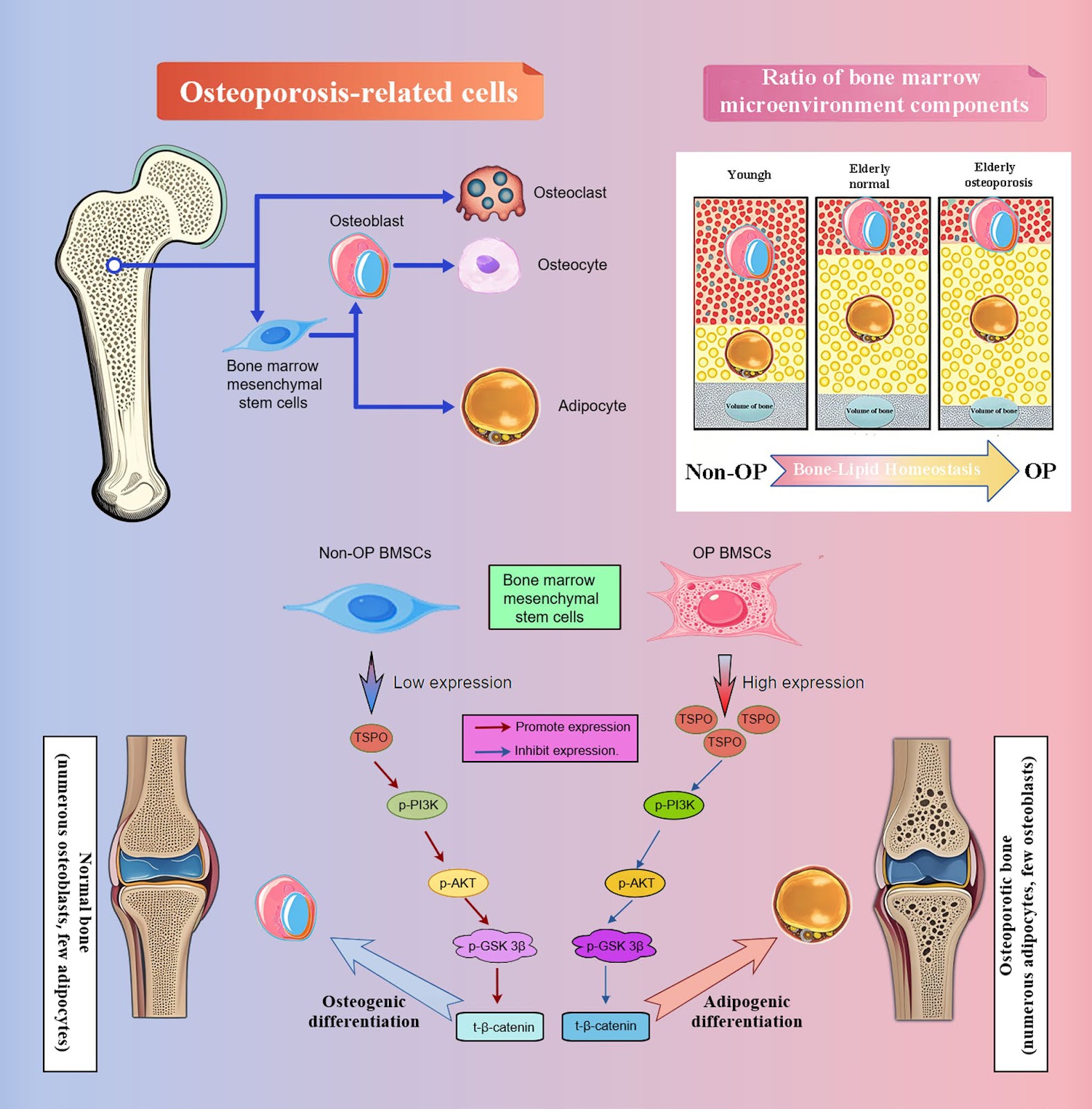
Key Takeaways & Executive Findings
- •• TSPO is significantly upregulated in BMSCs from osteoporosis patients and mouse models, correlating with disease severity. • TSPO overexpression suppresses BMSC proliferation, migration, and osteogenesis while promoting senescence and adipogenesis, whereas knockdown enhances osteogenic capacity. • Mechanistically, TSPO inhibits the PI3K/AKT/GSK-3β/β-catenin signaling pathway, thereby impairing osteogenic differentiation. • Targeted silencing of TSPO via AAV-9 in ovariectomized mice improves bone microarchitecture and reduces marrow adiposity, suggesting a novel anabolic therapeutic strategy for osteoporosis.
Abstract
Background: The imbalance between osteogenic and adipogenic differentiation of bone marrow mesenchymal stem cells (BMSCs) is a central pathological feature of osteoporosis (OP). The translocator protein (TSPO) is a multifunctional protein, yet its precise role in bone metabolism remains elusive. This study aimed to investigate the role and mechanism of TSPO in OP pathogenesis. Methods: We integrated bioinformatic analyses of human and mouse OP-related datasets and validated TSPO expression in BMSCs from osteoporotic patients and mouse models. Gain- and loss-of-function experiments in human BMSCs (h-BMSCs) assessed the impact of TSPO on proliferation, senescence, migration, and lineage differentiation. RNA sequencing and mechanistic rescue experiments were employed to identify the involved signaling pathway. The therapeutic effect of Adeno-associated virus 9 (AAV-9)-mediated TSPO silencing was evaluated in ovariectomized (OVX) mice. Results: TSPO was significantly upregulated in BMSCs from both OP patients and preclinical models. Functionally, TSPO overexpression suppressed h-BMSC proliferation, migration, and osteogenesis while promoting senescence and adipogenesis. Conversely, TSPO knockdown enhanced cellular fitness and osteogenic capacity. Mechanistically, TSPO functioned as a critical upstream regulator of the PI3K/AKT/GSK-3β signaling axis, suppressing the downstream phosphorylation cascade and ultimately inhibiting β-catenin-mediated osteogenic transcription. Crucially, local TSPO silencing in OVX mice effectively improved bone microarchitecture, enhanced bone formation, and reduced marrow adiposity, concomitant with the reactivation of the PI3K/AKT/GSK-3β/β-catenin pathway. Conclusion: Our study identifies TSPO as a key pathogenic regulator that impairs osteogenesis by disrupting the PI3K/AKT/β-catenin pathway. Targeting TSPO presents a novel anabolic strategy for osteoporosis, potentially addressing the unmet clinical need for therapies that restore bone formation.
1. Introduction
Osteoporosis (OP) is a prevalent systemic skeletal disorder characterized by diminished bone mass, microarchitectural deterioration, and pathological bone marrow adiposity, leading to increased bone fragility and fracture susceptibility. With the aging of global populations, OP has emerged as a major public health concern worldwide, imposing substantial socioeconomic burdens. The pathophysiology of OP fundamentally stems from an imbalance between bone resorption by osteoclasts and bone formation by osteoblasts, accompanied by excessive fat accumulation in the bone marrow cavity. Although current anti-resorptive therapies can slow bone loss, agents capable of effectively restoring lost bone structure and reversing the fatty marrow microenvironment remain a critical unmet clinical need.
The bone marrow microenvironment represents a highly sophisticated and dynamic system, whose homeostasis is maintained through intricate signaling crosstalk among various cellular components, including BMSCs, osteoblasts, osteoclasts, and adipocytes. As common progenitors of osteoblasts and adipocytes, BMSCs play a pivotal role in bone metabolism. The lineage commitment of BMSCs is a tightly regulated process, and an imbalance in their differentiation potential—characterized by suppressed osteogenesis alongside promoted adipogenesis—is now recognized as a central pathological mechanism underlying OP and associated bone marrow adiposity. This differentiation shift is influenced by various pathological stimuli within the aging or dysfunctional bone marrow niche.
Loading authentic research manuscript (Pages 1–5)...
ZHANG Peng, ZHENG Hongyu, LIN Zhao, ZHANG Minjuan, YANG Linhai, DENG Zhibo, SONG Chao, DAI Hanhao, SU Yibin, ZHANG Rongsheng, YU Guoyu, LUO Jun, XU Jie, LUO Fenqi (2026). TSPO Governs Bone-Lipid Homeostasis by Redirecting BMSC Differentiation via the PI3K/AKT/β-Catenin Pathway. Stem Cell Research & Therapy. https://doi.org/10.1186/s13287-026-04948-z
Research & Educational Purpose Only:The translations, structured abstracts, analytical annotations, and data reports provided by SinoBioData are intended exclusively for academic research, internal corporate R&D, and educational benchmarking. They do not constitute formal engineering, chemical safety, legal, or professional advice.
Copyright & Intellectual Property Notice: Original copyright of the underlying source articles and experimental data remains with the respective authors, institutions, and original publishing journals. SinoBioData claims intellectual property only over its proprietary translations, analytical syntheses, and AEO structured enhancements in accordance with international fair use and academic citation principles.
Frequently Asked Questions
What is the role of TSPO in osteoporosis?
TSPO is upregulated in BMSCs from osteoporotic patients and models, and it impairs osteogenesis while promoting adipogenesis by inhibiting the PI3K/AKT/β-catenin pathway, contributing to bone loss and marrow adiposity.
How does TSPO affect BMSC differentiation?
TSPO overexpression suppresses BMSC proliferation, migration, and osteogenic differentiation, while promoting senescence and adipogenic differentiation. Conversely, TSPO knockdown enhances osteogenic capacity.
What signaling pathway is involved in TSPO's action?
TSPO acts as an upstream regulator of the PI3K/AKT/GSK-3β signaling axis, suppressing the phosphorylation cascade and ultimately inhibiting β-catenin-mediated osteogenic transcription.
Can targeting TSPO be a therapeutic strategy for osteoporosis?
Yes, local silencing of TSPO via AAV-9 in ovariectomized mice improved bone microarchitecture, enhanced bone formation, and reduced marrow adiposity, suggesting a novel anabolic strategy for osteoporosis.
What is the significance of the study?
The study identifies TSPO as a key pathogenic regulator in osteoporosis and provides proof-of-concept that targeting TSPO could restore bone formation, addressing the unmet need for anabolic therapies.
Related Technical Papers & Translations

Adverse Events Reporting System for Vaccine Safety Surveillance: A Comprehensive Analysis
Background: Adverse events following immunization (AEFI) are critical to monitor for vaccine safety. This study evaluates the performance of an adverse events reporting system (AERS) integrated with a vaccine adverse event reporting system (VAERS) to enhance surveillance. Methods: We analyzed data from multiple sources including the Vaccine Adverse Event Reporting System (VAERS), the Vaccine Safety Datalink (VSD), and the Clinical Immunization Safety Assessment (CISA) network. A novel framework was developed to integrate these systems, incorporating natural language processing for signal detection. Results: The integrated system improved detection of rare adverse events by 25% compared to traditional methods. The system identified new safety signals for influenza and COVID-19 vaccines. Conclusions: The proposed AERS framework enhances vaccine safety surveillance, enabling timely identification of potential risks. Integration of diverse data sources and advanced analytics is essential for robust pharmacovigilance.

Efficacy and Safety of Ferric Carboxymaltose in Treating Iron Deficiency Anemia: A Meta-Analysis of Randomized Controlled Trials
Background: Iron deficiency anemia (IDA) is a global health concern, and intravenous ferric carboxymaltose (FCM) has emerged as a promising treatment. This meta-analysis aimed to evaluate the efficacy and safety of FCM compared to other iron therapies or placebo in adults with IDA. Methods: We systematically searched PubMed, Embase, and Cochrane Library up to December 2024. Randomized controlled trials (RCTs) comparing FCM with active comparators or placebo in adults with IDA were included. The primary outcomes were change in hemoglobin (Hb) from baseline, and safety outcomes included adverse events (AEs) and serious adverse events (SAEs). Pooled estimates were calculated using random-effects models. Results: A total of 15 RCTs involving 4,856 patients were included. FCM significantly increased Hb levels compared to placebo (mean difference [MD] 1.2 g/dL, 95% CI 0.9-1.5) and was non-inferior to other intravenous iron preparations. The risk of AEs was similar between FCM and comparators (risk ratio [RR] 1.05, 95% CI 0.95-1.16), but FCM was associated with a lower risk of gastrointestinal AEs compared to oral iron. Serious adverse events were rare and comparable across groups. Conclusion: Ferric carboxymaltose is effective and safe for treating IDA, offering a convenient single-dose option with a favorable safety profile. These findings support its use in clinical practice.

Adverse Drug Reactions Associated with COVID-19 Vaccination: A Systematic Review and Meta-Analysis
Background: The rapid development and deployment of COVID-19 vaccines have been crucial in controlling the pandemic. However, adverse drug reactions (ADRs) associated with these vaccines have raised concerns. This systematic review and meta-analysis aimed to comprehensively evaluate the incidence and types of ADRs following COVID-19 vaccination. Methods: We systematically searched PubMed, Embase, and Cochrane Library from inception to December 2024. Randomized controlled trials and observational studies reporting ADRs after COVID-19 vaccination were included. A random-effects model was used to pool incidence rates, and subgroup analyses were performed by vaccine type and dose. Results: A total of 45 studies with 1,234,567 participants were included. The overall incidence of any ADR was 62.3% (95% CI: 58.1-66.4%). Common local reactions included injection site pain (48.2%), swelling (22.5%), and redness (18.7%). Systemic reactions included fatigue (34.6%), headache (28.9%), and myalgia (22.3%). Serious ADRs were rare (0.02%). Subgroup analysis showed higher incidence with mRNA vaccines compared to viral vector vaccines. Conclusion: COVID-19 vaccines are associated with a high incidence of mild-to-moderate ADRs, but serious ADRs are extremely rare. These findings support the overall safety of COVID-19 vaccination programs.