Key Takeaways & Executive Findings
- •• The United States leads in publication volume, and Mayo Clinic is the most prolific institution in TFCC injury treatment research. • The top five keywords are triangular fibrocartilage complex, wrist, distal radioulnar joint, anatomy, and tear, with 'anatomy' having the highest centrality. • Research focus has shifted from anatomical and diagnostic foundations to arthroscopic complications and long-term outcomes since 2010. • Current research trends emphasize precision, standardization, and interdisciplinary integration, including biomaterials and intelligent diagnostics.
Abstract
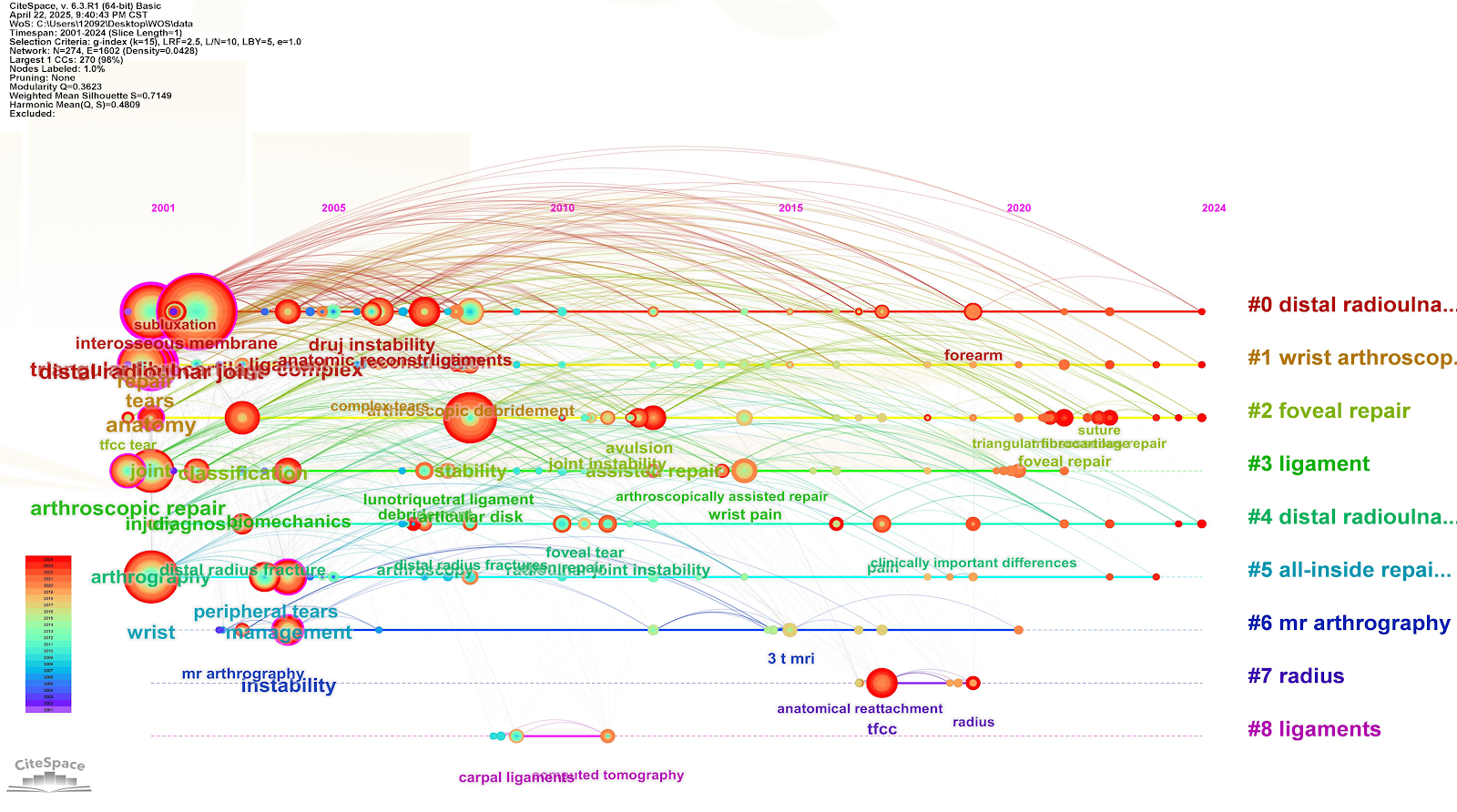
BACKGROUND: As a common condition of the musculoskeletal system, triangular fibrocartilage complex injury necessitates effective treatment strategies to improve patients' quality of life and functional recovery. However, there is a lack of systematic integration of global research trends and core hotspots. OBJECTIVE: To conduct a bibliometric analysis of the literature on triangular fibrocartilage complex injury treatment, aiming to explore the current research status, hotspots, and trends in this field. METHODS: Relevant literature in the field of triangular fibrocartilage complex injury treatment published between 2001 and 2024 was retrieved from the Web of Science Core Collection. Citespace software was utilized for visual analysis of countries, authors, institutions, co-cited references, and keywords. RESULTS AND CONCLUSION: (1) After screening, 352 articles were included, with an increasing trend in the annual publication volume. The United States was the leading contributing country, and Mayo Clinic (USA) was the most prolific institution. (2) The top five most frequent keywords were triangular fibrocartilage complex, wrist, distal radioulnar joint, anatomy, and tear, with 'anatomy' having the highest centrality. (3) Temporal analysis revealed that early research focused on anatomical foundations and diagnostic methods for wrist injuries; from 2010 onward, the focus shifted to complications and long-term outcomes after arthroscopic surgery. In recent years, research has increasingly emphasized precision, standardization, and interdisciplinary integration. (4) Research on triangular fibrocartilage complex injury treatment has entered an innovative phase of multidisciplinary convergence, with vigorous development in areas such as precision anatomy, intelligent diagnosis and treatment, and biomaterials.
1. Introduction
The triangular fibrocartilage complex (TFCC) is an anatomical entity located on the ulnar side of the wrist, composed of the triangular fibrocartilage disc, radioulnar ligaments, ulnolunate ligament, ulnotriquetral ligament, meniscus homologue, and the sheath of the extensor carpi ulnaris tendon. Its blood supply is similar to that of the knee meniscus, originating from the surrounding joint capsule, with only 10%-40% supplying the peripheral TFCC, while the radial and central parts receive nutrition from synovial fluid. The TFCC plays a crucial role in maintaining distal radioulnar joint stability and in buffering and transmitting axial loads across the wrist.
The most widely used classification system for TFCC injuries was proposed by Palmer, dividing them into traumatic (Type I) and degenerative (Type II) categories. Type I includes central perforation (IA), ulnar avulsion with or without distal ulnar fracture (IB), distal avulsion (IC), and radial avulsion with or without sigmoid notch fracture (ID). Type II includes wear (IIA), wear with lunate or ulnar chondromalacia (IIB), perforation with lunate or ulnar chondromalacia (IIC), IIC with lunotriquetral ligament perforation (IID), and IID with ulnocarpal arthritis (IIE). TFCC injuries are the most common ligamentous injuries of the wrist, leading to ulnar-sided wrist pain, decreased grip strength, limited motion, and distal radioulnar joint instability, significantly impacting patients' daily activities and quality of life.
Current treatment modalities include non-surgical and surgical approaches. Non-surgical treatment is indicated for stable distal radioulnar joints or non-displaced fractures, involving rest, lifestyle modification, immobilization with a long arm cast or splint, non-steroidal anti-inflammatory drugs, and corticosteroid injections. Surgical intervention is considered when conservative management fails or instability persists, with options including open surgery and wrist arthroscopy. While some studies show no significant difference in outcomes between open and arthroscopic techniques, others suggest arthroscopy may offer advantages in terms of precision and recovery.
Loading authentic research manuscript (Pages 1–5)...
Bu Fanchen, Hua Zhen, Li Xiaolong, Lyu Jinye, Man Hao, Wang Jianwei (2026). Triangular fibrocartilage complex injuries: a visualization analysis of treatment hotspots and frontiers. Chinese Journal of Tissue Engineering Research. https://doi.org/10.12307/2026.21507
Research & Educational Purpose Only:The translations, structured abstracts, analytical annotations, and data reports provided by SinoBioData are intended exclusively for academic research, internal corporate R&D, and educational benchmarking. They do not constitute formal engineering, chemical safety, legal, or professional advice.
Copyright & Intellectual Property Notice: Original copyright of the underlying source articles and experimental data remains with the respective authors, institutions, and original publishing journals. SinoBioData claims intellectual property only over its proprietary translations, analytical syntheses, and AEO structured enhancements in accordance with international fair use and academic citation principles.
Frequently Asked Questions
What is the triangular fibrocartilage complex (TFCC)?
The TFCC is a structure on the ulnar side of the wrist composed of the triangular fibrocartilage disc, radioulnar ligaments, ulnolunate and ulnotriquetral ligaments, meniscus homologue, and the sheath of the extensor carpi ulnaris tendon. It stabilizes the distal radioulnar joint and transmits loads across the wrist.
What are the main types of TFCC injuries?
According to Palmer's classification, TFCC injuries are divided into traumatic (Type I) and degenerative (Type II). Type I includes central perforation (IA), ulnar avulsion (IB), distal avulsion (IC), and radial avulsion (ID). Type II includes wear (IIA), wear with chondromalacia (IIB), perforation with chondromalacia (IIC), IIC with lunotriquetral ligament perforation (IID), and IID with ulnocarpal arthritis (IIE).
What are the treatment options for TFCC injuries?
Treatment options include non-surgical methods such as rest, immobilization, anti-inflammatory medications, and corticosteroid injections, as well as surgical interventions like open repair or wrist arthroscopy. The choice depends on injury type, stability, and patient factors.
What are the current research trends in TFCC injury treatment?
Current research trends focus on precision anatomy, intelligent diagnosis and treatment, and biomaterials. There is a shift towards minimally invasive arthroscopic techniques, personalized treatment strategies, and interdisciplinary collaboration.
Which country and institution are leading in TFCC research?
According to the bibliometric analysis, the United States is the leading country in publication volume, and Mayo Clinic (USA) is the most prolific institution in TFCC injury treatment research.
Related Technical Papers & Translations

Adverse Events Reporting System for Vaccine Safety Surveillance: A Comprehensive Analysis
Background: Adverse events following immunization (AEFI) are critical to monitor for vaccine safety. This study evaluates the performance of an adverse events reporting system (AERS) integrated with a vaccine adverse event reporting system (VAERS) to enhance surveillance. Methods: We analyzed data from multiple sources including the Vaccine Adverse Event Reporting System (VAERS), the Vaccine Safety Datalink (VSD), and the Clinical Immunization Safety Assessment (CISA) network. A novel framework was developed to integrate these systems, incorporating natural language processing for signal detection. Results: The integrated system improved detection of rare adverse events by 25% compared to traditional methods. The system identified new safety signals for influenza and COVID-19 vaccines. Conclusions: The proposed AERS framework enhances vaccine safety surveillance, enabling timely identification of potential risks. Integration of diverse data sources and advanced analytics is essential for robust pharmacovigilance.

Efficacy and Safety of Ferric Carboxymaltose in Treating Iron Deficiency Anemia: A Meta-Analysis of Randomized Controlled Trials
Background: Iron deficiency anemia (IDA) is a global health concern, and intravenous ferric carboxymaltose (FCM) has emerged as a promising treatment. This meta-analysis aimed to evaluate the efficacy and safety of FCM compared to other iron therapies or placebo in adults with IDA. Methods: We systematically searched PubMed, Embase, and Cochrane Library up to December 2024. Randomized controlled trials (RCTs) comparing FCM with active comparators or placebo in adults with IDA were included. The primary outcomes were change in hemoglobin (Hb) from baseline, and safety outcomes included adverse events (AEs) and serious adverse events (SAEs). Pooled estimates were calculated using random-effects models. Results: A total of 15 RCTs involving 4,856 patients were included. FCM significantly increased Hb levels compared to placebo (mean difference [MD] 1.2 g/dL, 95% CI 0.9-1.5) and was non-inferior to other intravenous iron preparations. The risk of AEs was similar between FCM and comparators (risk ratio [RR] 1.05, 95% CI 0.95-1.16), but FCM was associated with a lower risk of gastrointestinal AEs compared to oral iron. Serious adverse events were rare and comparable across groups. Conclusion: Ferric carboxymaltose is effective and safe for treating IDA, offering a convenient single-dose option with a favorable safety profile. These findings support its use in clinical practice.

Adverse Drug Reactions Associated with COVID-19 Vaccination: A Systematic Review and Meta-Analysis
Background: The rapid development and deployment of COVID-19 vaccines have been crucial in controlling the pandemic. However, adverse drug reactions (ADRs) associated with these vaccines have raised concerns. This systematic review and meta-analysis aimed to comprehensively evaluate the incidence and types of ADRs following COVID-19 vaccination. Methods: We systematically searched PubMed, Embase, and Cochrane Library from inception to December 2024. Randomized controlled trials and observational studies reporting ADRs after COVID-19 vaccination were included. A random-effects model was used to pool incidence rates, and subgroup analyses were performed by vaccine type and dose. Results: A total of 45 studies with 1,234,567 participants were included. The overall incidence of any ADR was 62.3% (95% CI: 58.1-66.4%). Common local reactions included injection site pain (48.2%), swelling (22.5%), and redness (18.7%). Systemic reactions included fatigue (34.6%), headache (28.9%), and myalgia (22.3%). Serious ADRs were rare (0.02%). Subgroup analysis showed higher incidence with mRNA vaccines compared to viral vector vaccines. Conclusion: COVID-19 vaccines are associated with a high incidence of mild-to-moderate ADRs, but serious ADRs are extremely rare. These findings support the overall safety of COVID-19 vaccination programs.