Key Takeaways & Executive Findings
- •• Human umbilical cord-derived MSCs transplantation partially restores age-related ovarian functional decline in mice by modulating the local renin-angiotensin system (RAS), specifically upregulating AT1R expression. • The ovarian local RAS is independent of systemic RAS, correlates with age and ovarian function, and is linked to inflammation and oxidative stress markers in human follicular fluid. • Co-culture with MSCs alleviates aging-induced dysfunction in KGN cells, reducing ROS and senescence while improving mitochondrial membrane potential and secretion; Ang(1–7) enhances these effects more than Ang II. • This study proposes a novel mechanism for MSC therapy in reproductive aging, highlighting the RAS pathway as a potential therapeutic target.
Abstract
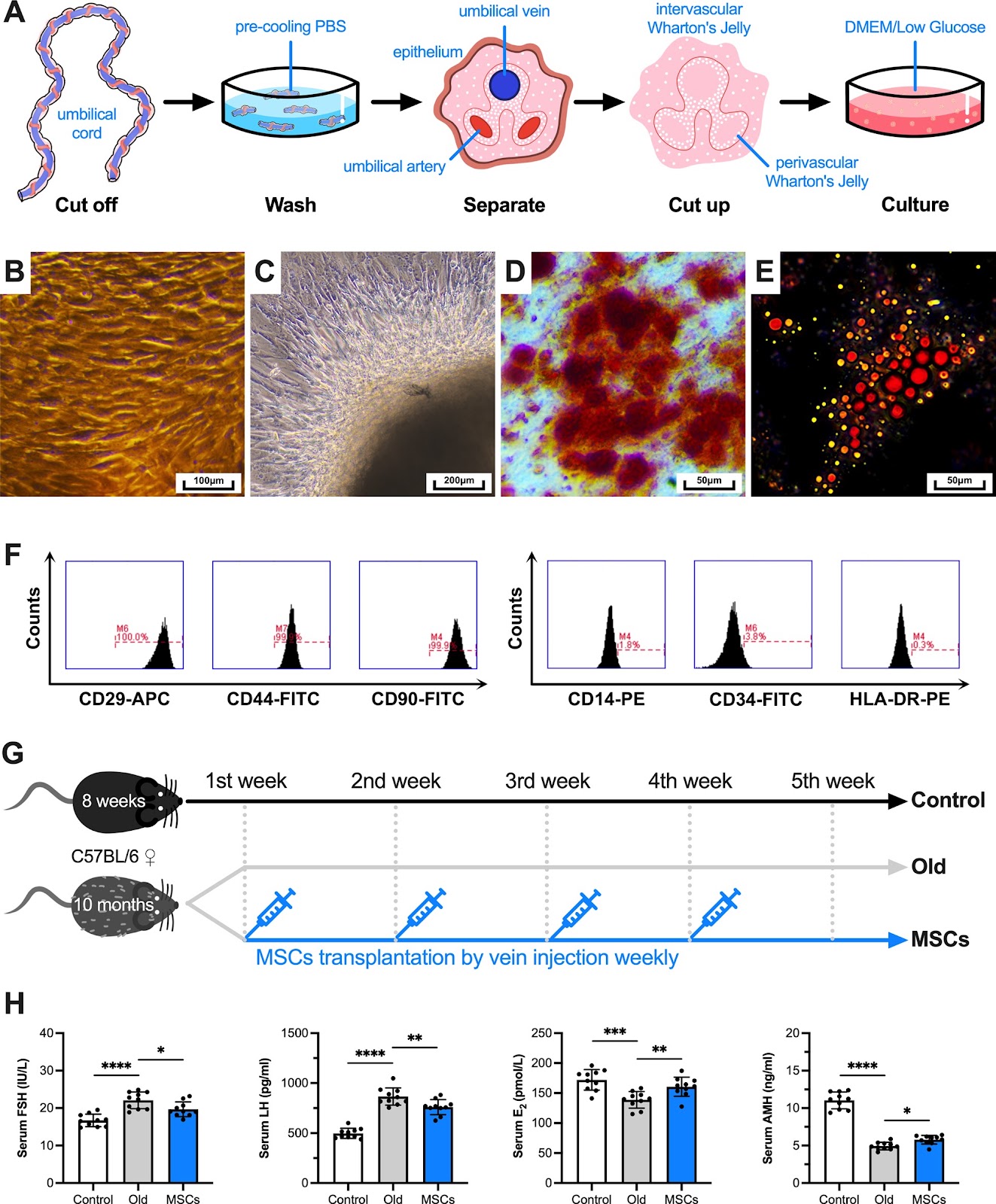
Background Age-related reproductive aging is a natural and irreversible physiological process, and delaying childbearing is increasingly common all over the world. Transplantation of mesenchymal stem cells (MSCs) is considered a new and effective therapy to restore ovarian function, but the relevant mechanisms remain unclear. Recently, it has been found that there is a local Renin–angiotensin system (RAS) in human ovary and it plays a key role. Methods After collecting follicular fluid from women who received oocyte retrieval for pure male factor infertility, the level of RAS components in it were detected, and the correlation analysis by linear regression. Then, the in vivo experiments on female C57BL/6 mice were designed to measure ovarian function, and the transcription and translation levels of RAS pathway were detected by molecular biology methods. Moreover, the role of RAS in regulating inflammation and oxidative stress in the co-culture system were explored in in vitro experiments on KGN cells. Results First, a total of 139 samples of analyzable follicular fluid were obtained. The local RAS of ovary, which is independent of systemic RAS (P > 0.05), is affected by age (Pearson r < 0, P < 0.05) and related to ovarian function, inflammation, oxidative stress indexes and assisted reproduction laboratory outcomes (P < 0.05). Next, the ovary/body weight of aging mice decreased significantly and serum sex hormones levels changed significantly (P < 0.01). The number of functional follicles decreased, while the atresia follicles increased (P < 0.05). After MSCs transplantation, all the above measures have been partially recovered (P < 0.05). Although several RAS components in aging ovary changed, MSCs only improved the expression level of AT1R (P < 0.05). Furthermore, the secretion ability and mitochondrial membrane potential of aging KGN cells decreased, while the intracellular ROS level and the aging cells ratio increased (P < 0.01). All the above measures have been partially recovered when co-cultured with MSCs (P < 0.05). After Ang(1–7) were added into the co-culture system, the above have been more significantly restored compared with Ang II (P < 0.05). Nevertheless, there was no statistical difference in estradiol level no matter which one was added (P > 0.05). Conclusions Together, our findings indicate that a novel possible mechanism to explain how stem cells restore age-related ovarian functional decline.
1. Introduction
According to the World Population Outlook 2022 issued by the United Nations, women’s mean age of childbearing around the world has generally increased [1]. The age-related reproductive aging is a natural and irreversible physiological process, especially for oocytes [2]. Apart from strong advocation of age-appropriate reproduction, few redeemable therapies are effective in the age-related ovarian functional decline. Fortunately, the rapid development of regenerative medicine brings promising hope in recent years, and the transplantation of mesenchymal stem cells (MSCs) is considered a new and effective therapy [3]. Searching on ClinicalTrials.gov, as of 30 August 2023, 25 clinical trials on SCs therapy for the treatment of premature ovarian failure/insufficiency (POF/POI) have been registered. Among them, the umbilical cord-derived MSCs are considered as an ideal source, furthermore, they have been proved effective by a large number of scientific and clinical research [4]. However, the relevant mechanisms remain unclear.
Ovary as the second largest source of renin in human, the ovarian RAS has been confirmed by a large number of studies. The local RAS emphasizes a complex network of precursors, peptides, enzymes and receptors [5], which is involved in regulating ovarian function, oogenesis and ovarian diseases or abnormalities via paracrine and autocrine [6, 7]. Local RAS has been proved to be the key to regulating repair and regeneration in epidermal and vasculogenesis r
Loading authentic research manuscript (Pages 1–5)...
Lun Wei, Le Bo, Chao Luo, Na Yin, Wangtao Jiang, Fei Qian, Anwen Zhou, Xuanping Lu, Huiping Guo, Caiping Mao (2026). Transplantation of human umbilical cord-derived mesenchymal stem cells improves age-related ovarian functional decline via regulating the local renin–angiotensin system on inflammation and oxidative stress. Stem Cell Research & Therapy. https://doi.org/10.1186/s13287-024-03997-6
Research & Educational Purpose Only:The translations, structured abstracts, analytical annotations, and data reports provided by SinoBioData are intended exclusively for academic research, internal corporate R&D, and educational benchmarking. They do not constitute formal engineering, chemical safety, legal, or professional advice.
Copyright & Intellectual Property Notice: Original copyright of the underlying source articles and experimental data remains with the respective authors, institutions, and original publishing journals. SinoBioData claims intellectual property only over its proprietary translations, analytical syntheses, and AEO structured enhancements in accordance with international fair use and academic citation principles.
Frequently Asked Questions
What is the role of the local renin-angiotensin system (RAS) in ovarian aging?
The local RAS in the ovary is independent of systemic RAS and is affected by age. It correlates with ovarian function, inflammation, and oxidative stress markers, suggesting it plays a key role in age-related ovarian functional decline.
How do human umbilical cord-derived mesenchymal stem cells (MSCs) improve ovarian function in aging?
MSCs transplantation partially restores ovarian function in aging mice by modulating the local RAS, specifically upregulating AT1R expression, and by reducing inflammation and oxidative stress in ovarian cells.
What are the effects of Ang(1–7) and Ang II on aging ovarian cells co-cultured with MSCs?
In co-culture with MSCs, Ang(1–7) significantly enhances the restoration of cellular function compared to Ang II, including improved secretion, mitochondrial membrane potential, and reduced ROS and senescence, though estradiol levels remain unaffected.
What is the clinical significance of this study?
This study provides a novel mechanism for MSC therapy in age-related ovarian decline, highlighting the RAS pathway as a potential therapeutic target to improve reproductive outcomes in older women.
What methods were used to assess ovarian function and RAS involvement?
The study used human follicular fluid analysis, in vivo mouse models, and in vitro KGN cell co-cultures, employing molecular biology techniques to measure RAS components, inflammation, oxidative stress, and ovarian function parameters.
Related Technical Papers & Translations

Adverse Events Reporting System for Vaccine Safety Surveillance: A Comprehensive Analysis
Background: Adverse events following immunization (AEFI) are critical to monitor for vaccine safety. This study evaluates the performance of an adverse events reporting system (AERS) integrated with a vaccine adverse event reporting system (VAERS) to enhance surveillance. Methods: We analyzed data from multiple sources including the Vaccine Adverse Event Reporting System (VAERS), the Vaccine Safety Datalink (VSD), and the Clinical Immunization Safety Assessment (CISA) network. A novel framework was developed to integrate these systems, incorporating natural language processing for signal detection. Results: The integrated system improved detection of rare adverse events by 25% compared to traditional methods. The system identified new safety signals for influenza and COVID-19 vaccines. Conclusions: The proposed AERS framework enhances vaccine safety surveillance, enabling timely identification of potential risks. Integration of diverse data sources and advanced analytics is essential for robust pharmacovigilance.

Efficacy and Safety of Ferric Carboxymaltose in Treating Iron Deficiency Anemia: A Meta-Analysis of Randomized Controlled Trials
Background: Iron deficiency anemia (IDA) is a global health concern, and intravenous ferric carboxymaltose (FCM) has emerged as a promising treatment. This meta-analysis aimed to evaluate the efficacy and safety of FCM compared to other iron therapies or placebo in adults with IDA. Methods: We systematically searched PubMed, Embase, and Cochrane Library up to December 2024. Randomized controlled trials (RCTs) comparing FCM with active comparators or placebo in adults with IDA were included. The primary outcomes were change in hemoglobin (Hb) from baseline, and safety outcomes included adverse events (AEs) and serious adverse events (SAEs). Pooled estimates were calculated using random-effects models. Results: A total of 15 RCTs involving 4,856 patients were included. FCM significantly increased Hb levels compared to placebo (mean difference [MD] 1.2 g/dL, 95% CI 0.9-1.5) and was non-inferior to other intravenous iron preparations. The risk of AEs was similar between FCM and comparators (risk ratio [RR] 1.05, 95% CI 0.95-1.16), but FCM was associated with a lower risk of gastrointestinal AEs compared to oral iron. Serious adverse events were rare and comparable across groups. Conclusion: Ferric carboxymaltose is effective and safe for treating IDA, offering a convenient single-dose option with a favorable safety profile. These findings support its use in clinical practice.

Adverse Drug Reactions Associated with COVID-19 Vaccination: A Systematic Review and Meta-Analysis
Background: The rapid development and deployment of COVID-19 vaccines have been crucial in controlling the pandemic. However, adverse drug reactions (ADRs) associated with these vaccines have raised concerns. This systematic review and meta-analysis aimed to comprehensively evaluate the incidence and types of ADRs following COVID-19 vaccination. Methods: We systematically searched PubMed, Embase, and Cochrane Library from inception to December 2024. Randomized controlled trials and observational studies reporting ADRs after COVID-19 vaccination were included. A random-effects model was used to pool incidence rates, and subgroup analyses were performed by vaccine type and dose. Results: A total of 45 studies with 1,234,567 participants were included. The overall incidence of any ADR was 62.3% (95% CI: 58.1-66.4%). Common local reactions included injection site pain (48.2%), swelling (22.5%), and redness (18.7%). Systemic reactions included fatigue (34.6%), headache (28.9%), and myalgia (22.3%). Serious ADRs were rare (0.02%). Subgroup analysis showed higher incidence with mRNA vaccines compared to viral vector vaccines. Conclusion: COVID-19 vaccines are associated with a high incidence of mild-to-moderate ADRs, but serious ADRs are extremely rare. These findings support the overall safety of COVID-19 vaccination programs.