Key Takeaways & Executive Findings
- •• Successfully derived porcine expanded potential stem cells from cloned embryos (pEPSCsNT) with ~14% efficiency using an optimized culture system. • Transcriptomic analysis revealed that pEPSCsNT closely resemble 8-cell to morula-stage embryos and exhibit a formative pluripotent state with enrichment of EPSC signature genes. • pEPSCsNT demonstrate broad differentiation capacity, including formation of blastocyst-like structures and potential to differentiate into trophoblast lineages, indicating Hippo signaling pathway involvement. • Established a feeder-free culture system using modified medium and 2× Matrigel coating, preserving pluripotency and differentiation potential, which facilitates scalable applications.
Abstract
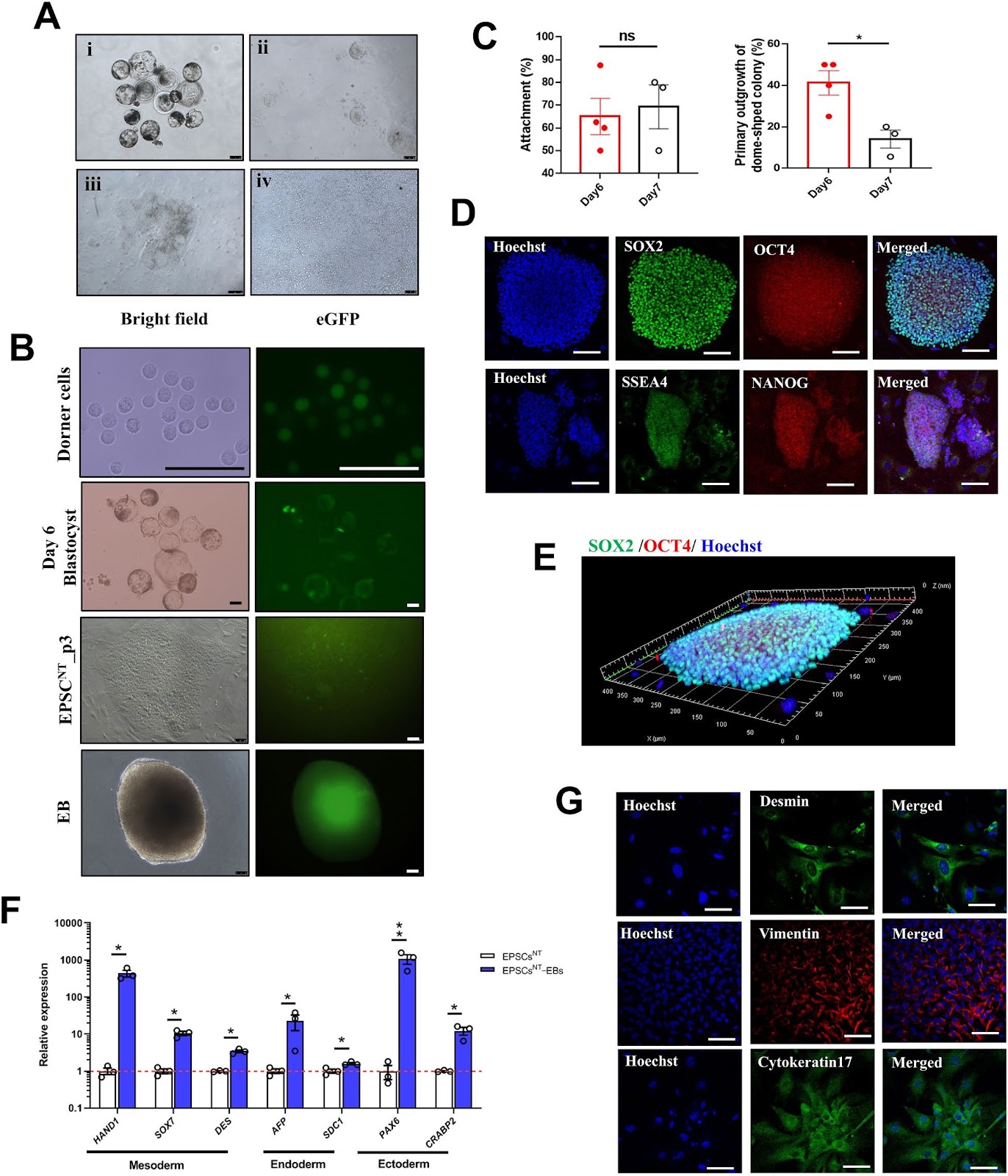
Background Generating expanded potential stem cells from cloned porcine embryos (pEPSCsNT) represents a notable advancement in regenerative medicine and agricultural biotechnology. However, challenges, including low derivation efficiency, limited understanding of transcriptomic features, and unknown feasibility of culturing under feeder-free conditions, remain. This study aimed to generate pEPSCs using blastocysts derived from parthenogenetic activation, in vitro fertilization, and somatic cell nuclear transfer (SCNT) using a modified culture system. Methods We derived pEPSCNT lines using an optimized culture system. We characterized the pEPSC lines from all three origins by analyzing pluripotent marker expression, performing karyotyping, and assessing their differentiation potential into the three germ layers. Furthermore, we performed a comparative transcriptomic analysis using in vivo and cloned embryo data, with a major focus on cell lines derived from SCNT (pEPSCsNT). We optimized feeder-free culture conditions for the pEPSCNT line and derived the pEPSCNT lines using an optimized culture system with an efficiency of ~14%. Results The cells were closely correlated with 8-cell to morula-stage embryos and exhibited significant enrichment of EPSC signature genes, suggesting a unique pluripotent state relatively close to the naïve state, specifically within a formative state. The pEPSCsNT possessed broad differentiation capacity, indicative of Hippo signaling pathway enrichment, blastocyst-like structure formation ability, and potential differentiation into trophoblast lineage cells. Conclusions Our modified culture medium combined with the 2× Matrigel coating system facilitated the transition to feeder-independent culture conditions. These findings facilitate the establishment of a feeder-free culture system while preserving pluripotency and differentiation potential.
1. Introduction
Pluripotent stem cells (PSCs) are versatile and invaluable tools for various research applications because of their intrinsic ability to self-renew and differentiate into multiple cell types [1, 2, 3]. Among the various PSC types, those derived from domestic pigs (pPSCs) are the most promising. The physiological, genetic, and immunological similarities between pigs and humans render pigs an ideal large-animal model for comparative biology, disease modeling, and regenerative medicine [4, 5, 6, 7]. Despite this considerable potential, establishing bona fide pPSCs has been challenging over the past few decades, often resulting in the generation of cells referred to as embryonic stem (ES)-like cells instead [8, 9, 10, 11, 12].
Since 2019, important breakthroughs have shown promise in generating stable pPSCs [13, 14, 15, 16, 17]. Similar to those from other species, the characteristics and status of pPSCs in terms of transcriptomic expression vary depending on the established strategies employed [13, 14, 15, 16, 17]. For instance, Choi et al. [14] demonstrated that the activation of the fibroblast growth factor 2 (FGF2), ACTIVIN/NODAL, and WNT signaling pathways enabled the derivation of authentic pPSCs. These cells exhibited a transcriptome developmentally similar to that of late epiblasts rather than that of an inner cell mass (ICM), suggesting a primed pluripotent state achieved by seeding hatched blastocysts under feeder cells [14]. These primed pPSCs formed morphologically flat colonies, maintained stability for over 50 passages, exhibited teratoma formation, and retained two active X chromosomes [14]. In the same year, Gao et al. [18] demonstrated the establishment of more advanced cell lines, known as porcine-expanded potential stem cells (pEPSCs).
These cells exhibited a remarkable ability to differentiate into embryonic and extra-embryonic lineages. This was achieved by inhibiting GSK3, SRC, and Tankyrase, activating the Activin A and TGFβ pathways, and adding vitamin C [18]. These pEPSCs formed compact colonies with smooth edges, remained genetically stable over multiple passages, showed extensive DNA demethylation, and exhibited transcriptomic features similar to those of the early embryo.
Loading authentic research manuscript (Pages 1–5)...
Lian Cai, Mirae Kim, Hyerin Choi, Haneul Kim, Sang-Hwan Hyun, Eunhye Kim (2026). Transcriptomic insights and feeder-free culturing of porcine expanded potential stem cells from cloned embryos. Stem Cell Research & Therapy. https://doi.org/10.1186/s13287-025-04627-5
Research & Educational Purpose Only:The translations, structured abstracts, analytical annotations, and data reports provided by SinoBioData are intended exclusively for academic research, internal corporate R&D, and educational benchmarking. They do not constitute formal engineering, chemical safety, legal, or professional advice.
Copyright & Intellectual Property Notice: Original copyright of the underlying source articles and experimental data remains with the respective authors, institutions, and original publishing journals. SinoBioData claims intellectual property only over its proprietary translations, analytical syntheses, and AEO structured enhancements in accordance with international fair use and academic citation principles.
Frequently Asked Questions
What are porcine expanded potential stem cells (pEPSCs)?
Porcine expanded potential stem cells (pEPSCs) are a type of pluripotent stem cell derived from pig embryos that have the ability to differentiate into both embryonic and extra-embryonic lineages, making them valuable for regenerative medicine and agricultural biotechnology.
How were pEPSCs derived from cloned porcine embryos in this study?
The researchers derived pEPSCs from blastocysts obtained through parthenogenetic activation, in vitro fertilization, and somatic cell nuclear transfer (SCNT) using an optimized culture system. They achieved a derivation efficiency of approximately 14% for the SCNT-derived lines.
What is the significance of feeder-free culture conditions for pEPSCs?
Feeder-free culture conditions are important for scalability and clinical application, as they eliminate the need for animal feeder cells, reducing variability and contamination risks. This study established a feeder-free system using a modified medium and 2× Matrigel coating, which preserved pluripotency and differentiation potential.
What are the transcriptomic features of the pEPSCs derived in this study?
Transcriptomic analysis revealed that the pEPSCs closely resemble 8-cell to morula-stage embryos and show enrichment of EPSC signature genes. They exhibit a formative pluripotent state, which is relatively close to the naïve state, and show activation of the Hippo signaling pathway, contributing to their broad differentiation capacity.
What are the potential applications of pEPSCs derived from cloned embryos?
These pEPSCs have potential applications in regenerative medicine, disease modeling, and agricultural biotechnology. Their ability to differentiate into trophoblast lineages and form blastocyst-like structures makes them useful for studying early development and placental biology, as well as for generating genetically modified pigs for xenotransplantation.
Related Technical Papers & Translations

Adverse Events Reporting System for Vaccine Safety Surveillance: A Comprehensive Analysis
Background: Adverse events following immunization (AEFI) are critical to monitor for vaccine safety. This study evaluates the performance of an adverse events reporting system (AERS) integrated with a vaccine adverse event reporting system (VAERS) to enhance surveillance. Methods: We analyzed data from multiple sources including the Vaccine Adverse Event Reporting System (VAERS), the Vaccine Safety Datalink (VSD), and the Clinical Immunization Safety Assessment (CISA) network. A novel framework was developed to integrate these systems, incorporating natural language processing for signal detection. Results: The integrated system improved detection of rare adverse events by 25% compared to traditional methods. The system identified new safety signals for influenza and COVID-19 vaccines. Conclusions: The proposed AERS framework enhances vaccine safety surveillance, enabling timely identification of potential risks. Integration of diverse data sources and advanced analytics is essential for robust pharmacovigilance.

Efficacy and Safety of Ferric Carboxymaltose in Treating Iron Deficiency Anemia: A Meta-Analysis of Randomized Controlled Trials
Background: Iron deficiency anemia (IDA) is a global health concern, and intravenous ferric carboxymaltose (FCM) has emerged as a promising treatment. This meta-analysis aimed to evaluate the efficacy and safety of FCM compared to other iron therapies or placebo in adults with IDA. Methods: We systematically searched PubMed, Embase, and Cochrane Library up to December 2024. Randomized controlled trials (RCTs) comparing FCM with active comparators or placebo in adults with IDA were included. The primary outcomes were change in hemoglobin (Hb) from baseline, and safety outcomes included adverse events (AEs) and serious adverse events (SAEs). Pooled estimates were calculated using random-effects models. Results: A total of 15 RCTs involving 4,856 patients were included. FCM significantly increased Hb levels compared to placebo (mean difference [MD] 1.2 g/dL, 95% CI 0.9-1.5) and was non-inferior to other intravenous iron preparations. The risk of AEs was similar between FCM and comparators (risk ratio [RR] 1.05, 95% CI 0.95-1.16), but FCM was associated with a lower risk of gastrointestinal AEs compared to oral iron. Serious adverse events were rare and comparable across groups. Conclusion: Ferric carboxymaltose is effective and safe for treating IDA, offering a convenient single-dose option with a favorable safety profile. These findings support its use in clinical practice.

Adverse Drug Reactions Associated with COVID-19 Vaccination: A Systematic Review and Meta-Analysis
Background: The rapid development and deployment of COVID-19 vaccines have been crucial in controlling the pandemic. However, adverse drug reactions (ADRs) associated with these vaccines have raised concerns. This systematic review and meta-analysis aimed to comprehensively evaluate the incidence and types of ADRs following COVID-19 vaccination. Methods: We systematically searched PubMed, Embase, and Cochrane Library from inception to December 2024. Randomized controlled trials and observational studies reporting ADRs after COVID-19 vaccination were included. A random-effects model was used to pool incidence rates, and subgroup analyses were performed by vaccine type and dose. Results: A total of 45 studies with 1,234,567 participants were included. The overall incidence of any ADR was 62.3% (95% CI: 58.1-66.4%). Common local reactions included injection site pain (48.2%), swelling (22.5%), and redness (18.7%). Systemic reactions included fatigue (34.6%), headache (28.9%), and myalgia (22.3%). Serious ADRs were rare (0.02%). Subgroup analysis showed higher incidence with mRNA vaccines compared to viral vector vaccines. Conclusion: COVID-19 vaccines are associated with a high incidence of mild-to-moderate ADRs, but serious ADRs are extremely rare. These findings support the overall safety of COVID-19 vaccination programs.