Key Takeaways & Executive Findings
- •• TCM compounds and active ingredients exert anti-inflammatory effects by inhibiting inflammatory cytokine release and pathway activation, though specific immune cell-mediated mechanisms remain unclear. • TCM demonstrates multi-target antioxidative stress capabilities, enhancing antioxidant enzyme activity, stabilizing mitochondrial function, and reducing reactive oxygen species accumulation. • TCM regulates extracellular matrix homeostasis by modulating synthesis and degradative enzyme activity, thereby alleviating disc structural disruption. • TCM's holistic regulation can simultaneously target multiple programmed cell death pathways (apoptosis, pyroptosis, ferroptosis, autophagy) to protect disc cells and delay degeneration.
Abstract
BACKGROUND: Traditional Chinese Medicine (TCM) has significant potential and benefits in the treatment of intervertebral disc degeneration. However, reviews on the mechanisms by which TCM ameliorates disc degeneration are relatively limited. OBJECTIVE: To review how TCM compounds and their active ingredients improve intervertebral disc degeneration through mechanisms such as anti-inflammation, antioxidative stress, maintenance of extracellular matrix balance and regulation of programmed cell death. METHODS: CNKI, WanFang, PubMed, and Web of Science were retrieved for relevant literature published from January 2001 to June 2025. The Chinese search terms were “Chinese herb, compound, traditional Chinese medicine, herbal medicine, soup, formula, degenerative disc disease, disc degeneration, disc injury, annulus fibrosus, cartilage endplates, nucleus pulposus, research, progress, review, experiment, inflammation, oxidative stress, extracellular matrix, programmed cell death, apoptosis, pyroptosis, ferroptosis, autophagy, immune cells, mechanism”, and English search terms were “Traditional Chinese medicine, herbal medicine, herbal formula, Intervertebral Disc Degeneration, Intervertebral Disc, disc degeneration, nucleus pulposus, annulus fibrosus, cartilage endplate, Oxidative Stress, Extracellular Matrix, Inflammation, Programmed Cell Death, Apoptosis, Pyroptosis, Ferroptosis, Autophagy, review, progress, experiment”. According to inclusion and exclusion criteria, 104 articles were finally included for review. RESULTS AND CONCLUSION: TCM can effectively inhibit the release of inflammatory factors and activation of inflammatory pathways through multiple mechanisms, improving the local inflammatory state of the intervertebral disc, but the specific mechanisms in immune cell-mediated inflammatory responses remain unclear. TCM shows strong multi-target regulatory ability in alleviating oxidative stress in the intervertebral disc, especially in enhancing antioxidant enzyme activity, stabilizing mitochondrial function, and inhibiting reactive oxygen species accumulation. However, systematic comparisons of antioxidant effects of different active ingredients in different disc cell types are lacking, and the crosstalk between related signaling pathways needs further exploration. TCM can effectively alleviate disc structural disruption by regulating extracellular matrix synthesis and degradative enzyme activity. Apoptosis, pyroptosis, ferroptosis, and autophagy collectively participate in the development of intervertebral disc degeneration; they are not isolated but interact through complex signaling networks. Therefore, the multi-target and holistic regulatory advantages of TCM are expected to simultaneously regulate multiple programmed cell death processes, protecting disc cells from multiple levels and delaying degeneration.
1. Introduction
Intervertebral disc degeneration is a degenerative process characterized by structural disruption and dysfunction of the intervertebral disc under the influence of various internal and external factors such as mechanical stress, aging, and inflammation. It involves multiple tissue structures including the nucleus pulposus, annulus fibrosus, and cartilage endplates, and is progressive and multifactorial in nature [1-2]. Disc degeneration can affect cervical, thoracic, and lumbar segments, serving as the primary anatomical basis for common spinal disorders such as neck pain, thoracic back pain, and low back pain. Epidemiological data indicate that low back pain is a major cause of productivity loss worldwide and the leading cause of disability in 126 countries, with disc degeneration considered the main pathological basis. Therefore, low back pain caused by disc degeneration is a global public health issue, severely impacting patients' quality of life and imposing a substantial economic burden on individuals and society [3].
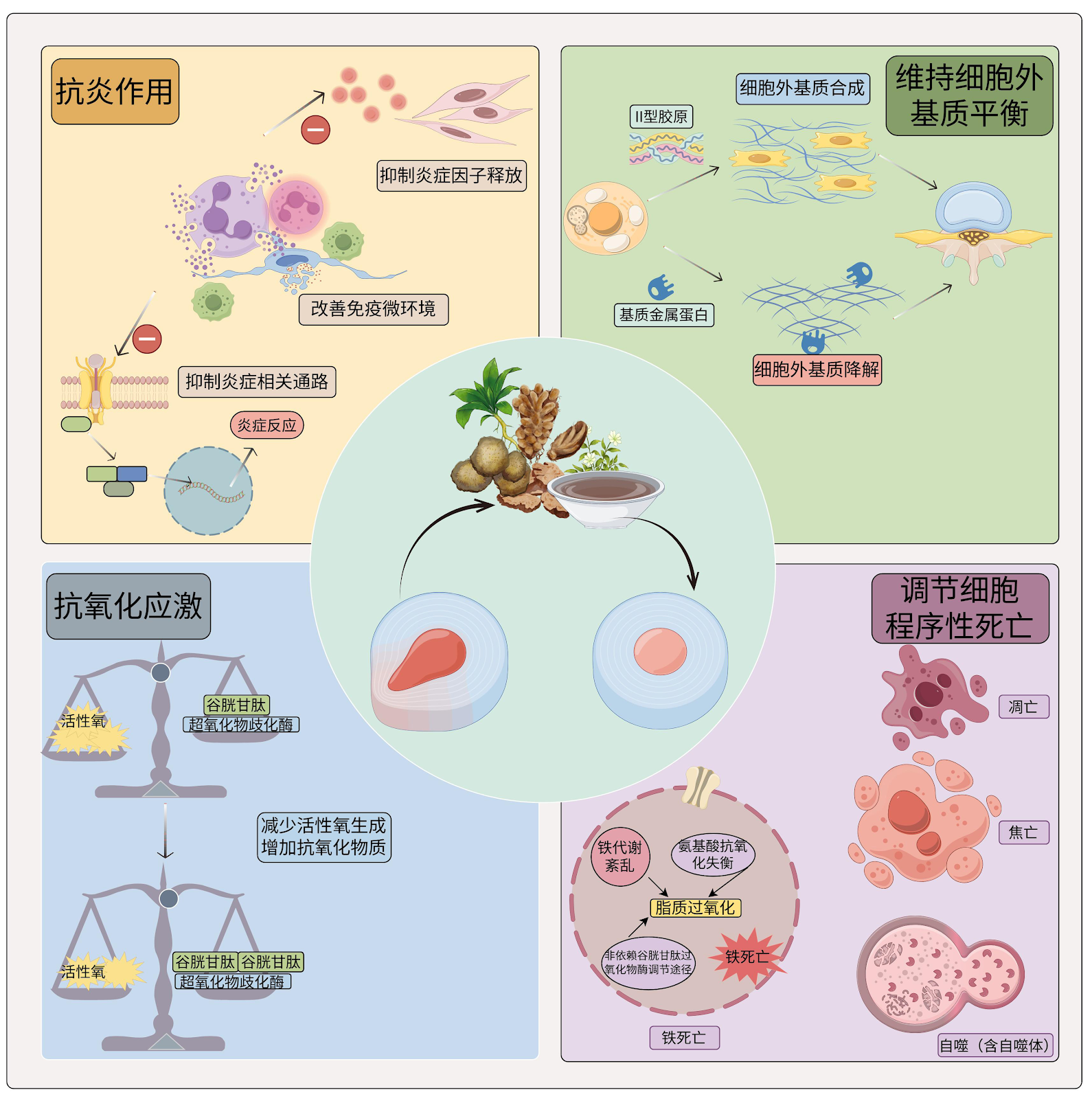
Currently, although surgical treatment can relatively effectively alleviate patient suffering, it does not target the underlying pathogenesis and carries perioperative risks. For patients with early-stage disc degeneration or contraindications to surgery, effective non-surgical treatments are lacking. Hence, exploring new anti-degenerative drugs holds great economic and social significance. In recent years, novel approaches such as gene and molecular therapies have been applied to improve disc degeneration, but they still face numerous challenges. Traditional Chinese Medicine (TCM) offers unique advantages in the prevention and treatment of degenerative diseases, including abundant targets, fewer adverse effects, and definite efficacy [4], showing great potential in treating disc degeneration. Despite the diverse mechanisms reported for TCM in improving disc degeneration [5], systematic reviews of these therapeutic mechanisms remain insufficient. This review systematically summarizes research progress on TCM compounds and their active ingredients in intervening in disc degeneration, categorizing them into four core mechanisms: anti-inflammation, antioxidative stress, maintenance of extracellular matrix balance, and regulation of programmed cell death (Figure 1), providing new insights and directions for TCM treatment of disc degeneration.
Loading authentic research manuscript (Pages 1–5)...
ZHONG Haotian, LI Jianwen, HAN Weichao, LI Songbo (2026). Traditional Chinese Medicine compound formula and effective ingredients for treating intervertebral disc degeneration: a multi-targeted and holistic regulation concept. Chinese Journal of Tissue Engineering Research. https://doi.org/10.12307/2026.21300
Research & Educational Purpose Only:The translations, structured abstracts, analytical annotations, and data reports provided by SinoBioData are intended exclusively for academic research, internal corporate R&D, and educational benchmarking. They do not constitute formal engineering, chemical safety, legal, or professional advice.
Copyright & Intellectual Property Notice: Original copyright of the underlying source articles and experimental data remains with the respective authors, institutions, and original publishing journals. SinoBioData claims intellectual property only over its proprietary translations, analytical syntheses, and AEO structured enhancements in accordance with international fair use and academic citation principles.
Frequently Asked Questions
What are the main mechanisms by which Traditional Chinese Medicine treats intervertebral disc degeneration?
TCM treats intervertebral disc degeneration through four core mechanisms: anti-inflammation, antioxidative stress, maintenance of extracellular matrix balance, and regulation of programmed cell death (including apoptosis, pyroptosis, ferroptosis, and autophagy).
How does Traditional Chinese Medicine exert anti-inflammatory effects on intervertebral disc degeneration?
TCM compounds and active ingredients inhibit the release of inflammatory cytokines and activation of inflammatory pathways, thereby improving the local inflammatory state of the disc. However, the specific mechanisms in immune cell-mediated inflammatory responses remain unclear.
What is the role of oxidative stress in intervertebral disc degeneration and how does TCM address it?
Oxidative stress contributes to disc degeneration by causing cellular damage. TCM demonstrates strong multi-target antioxidative capabilities, enhancing antioxidant enzyme activity, stabilizing mitochondrial function, and inhibiting reactive oxygen species accumulation.
How does TCM regulate programmed cell death in intervertebral disc degeneration?
TCM can simultaneously regulate multiple programmed cell death pathways, including apoptosis, pyroptosis, ferroptosis, and autophagy, through its multi-target and holistic regulatory advantages, thereby protecting disc cells and delaying degeneration.
What are the advantages of TCM over conventional treatments for intervertebral disc degeneration?
TCM offers advantages such as multiple targets, fewer adverse effects, and definite efficacy. It can address the multifactorial nature of disc degeneration through holistic regulation, potentially providing a non-surgical option for early-stage patients or those with contraindications to surgery.
Related Technical Papers & Translations

Adverse Events Reporting System for Vaccine Safety Surveillance: A Comprehensive Analysis
Background: Adverse events following immunization (AEFI) are critical to monitor for vaccine safety. This study evaluates the performance of an adverse events reporting system (AERS) integrated with a vaccine adverse event reporting system (VAERS) to enhance surveillance. Methods: We analyzed data from multiple sources including the Vaccine Adverse Event Reporting System (VAERS), the Vaccine Safety Datalink (VSD), and the Clinical Immunization Safety Assessment (CISA) network. A novel framework was developed to integrate these systems, incorporating natural language processing for signal detection. Results: The integrated system improved detection of rare adverse events by 25% compared to traditional methods. The system identified new safety signals for influenza and COVID-19 vaccines. Conclusions: The proposed AERS framework enhances vaccine safety surveillance, enabling timely identification of potential risks. Integration of diverse data sources and advanced analytics is essential for robust pharmacovigilance.

Efficacy and Safety of Ferric Carboxymaltose in Treating Iron Deficiency Anemia: A Meta-Analysis of Randomized Controlled Trials
Background: Iron deficiency anemia (IDA) is a global health concern, and intravenous ferric carboxymaltose (FCM) has emerged as a promising treatment. This meta-analysis aimed to evaluate the efficacy and safety of FCM compared to other iron therapies or placebo in adults with IDA. Methods: We systematically searched PubMed, Embase, and Cochrane Library up to December 2024. Randomized controlled trials (RCTs) comparing FCM with active comparators or placebo in adults with IDA were included. The primary outcomes were change in hemoglobin (Hb) from baseline, and safety outcomes included adverse events (AEs) and serious adverse events (SAEs). Pooled estimates were calculated using random-effects models. Results: A total of 15 RCTs involving 4,856 patients were included. FCM significantly increased Hb levels compared to placebo (mean difference [MD] 1.2 g/dL, 95% CI 0.9-1.5) and was non-inferior to other intravenous iron preparations. The risk of AEs was similar between FCM and comparators (risk ratio [RR] 1.05, 95% CI 0.95-1.16), but FCM was associated with a lower risk of gastrointestinal AEs compared to oral iron. Serious adverse events were rare and comparable across groups. Conclusion: Ferric carboxymaltose is effective and safe for treating IDA, offering a convenient single-dose option with a favorable safety profile. These findings support its use in clinical practice.

Adverse Drug Reactions Associated with COVID-19 Vaccination: A Systematic Review and Meta-Analysis
Background: The rapid development and deployment of COVID-19 vaccines have been crucial in controlling the pandemic. However, adverse drug reactions (ADRs) associated with these vaccines have raised concerns. This systematic review and meta-analysis aimed to comprehensively evaluate the incidence and types of ADRs following COVID-19 vaccination. Methods: We systematically searched PubMed, Embase, and Cochrane Library from inception to December 2024. Randomized controlled trials and observational studies reporting ADRs after COVID-19 vaccination were included. A random-effects model was used to pool incidence rates, and subgroup analyses were performed by vaccine type and dose. Results: A total of 45 studies with 1,234,567 participants were included. The overall incidence of any ADR was 62.3% (95% CI: 58.1-66.4%). Common local reactions included injection site pain (48.2%), swelling (22.5%), and redness (18.7%). Systemic reactions included fatigue (34.6%), headache (28.9%), and myalgia (22.3%). Serious ADRs were rare (0.02%). Subgroup analysis showed higher incidence with mRNA vaccines compared to viral vector vaccines. Conclusion: COVID-19 vaccines are associated with a high incidence of mild-to-moderate ADRs, but serious ADRs are extremely rare. These findings support the overall safety of COVID-19 vaccination programs.