Key Takeaways & Executive Findings
- •• NEDD4L overexpression in HUVECs suppresses proliferation and migration, while enhancing autophagy. • NEDD4L promotes K48-linked ubiquitination and degradation of eEF1A1, a key mechanism in regulating endothelial cell function. • Loss of endothelial NEDD4L enhances tumor growth and angiogenesis in vivo, underscoring its tumor-suppressive role. • The NEDD4L-eEF1A1 axis represents a novel therapeutic target for cancer therapy by inhibiting angiogenesis.
Abstract
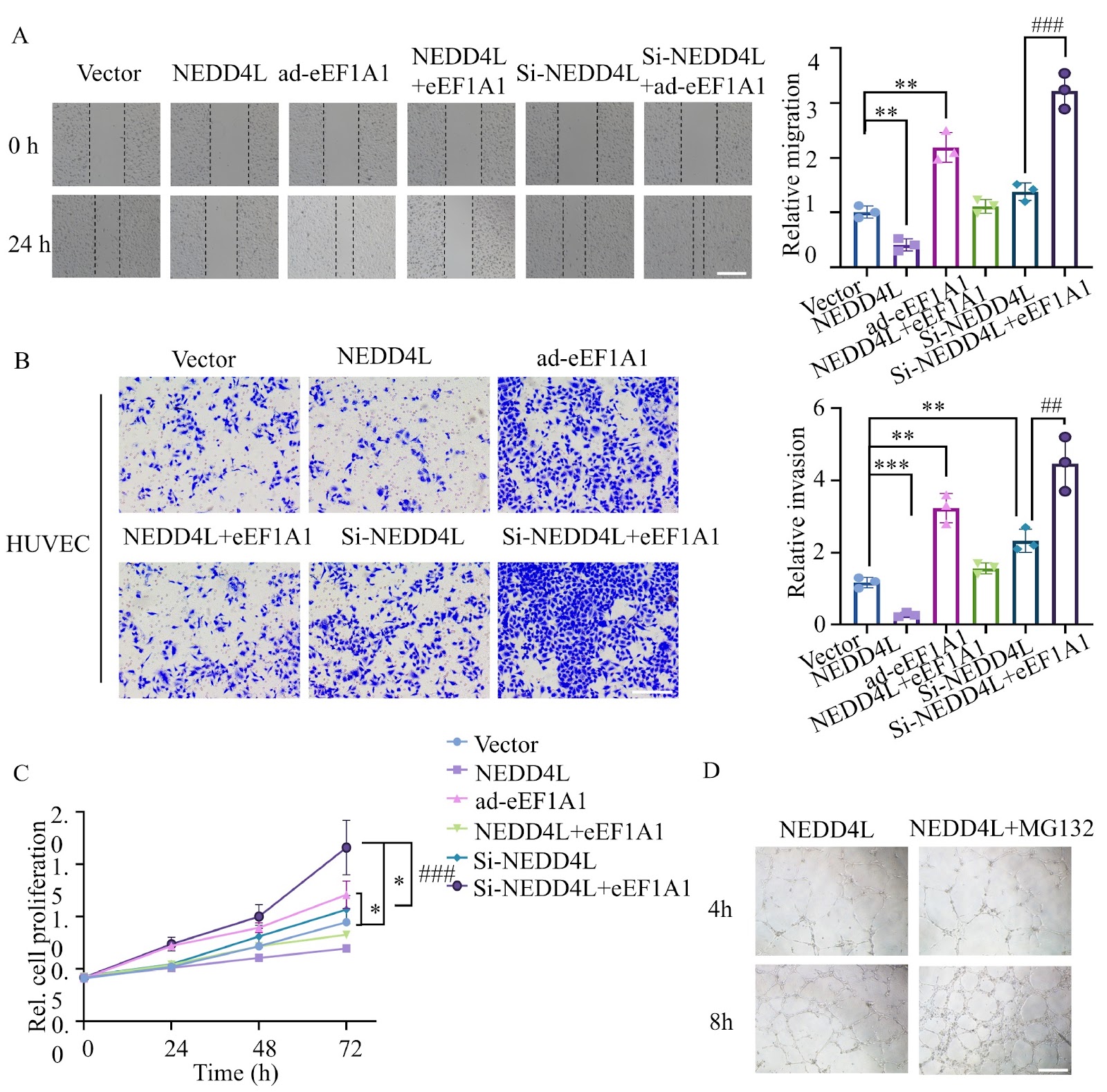
Abnormal proliferation and migration of endothelial cells are key contributors to tumor angiogenesis. Recent studies have shown that the crucial role of E3 ubiquitin ligase neuronal precursor cell expression developmentally downregulated 4-like (NEDD4L) in tumorigenesis. However, the precise mechanisms by which NEDD4L functions in endothelial cells remain unclear. In this study, we investigate the mechanisms by which NEDD4L influences the function of human umbilical vein endothelial cells (HUVECs) and its effect on tumor angiogenesis. Our results show that NEDD4L overexpression in HUVECs suppresses both cell proliferation and migration. Additionally, we find that the autophagic activity in NEDD4L-overexpressing cells is increased. Proteomic profiling and ubiquitination assays reveal that NEDD4L interacts with eEF1A1, promoting K48-linked ubiquitination-mediated degradation of eEF1A1. This post-translational modification is a key step in the NEDD4L-mediated regulation of autophagy and cellular function. Moreover, we find that loss of endothelial NEDD4L significantly enhances tumor growth and promotes angiogenesis in vivo. Overall, NEDD4L plays a crucial role in inhibiting tumor angiogenesis by regulating eEF1A1 ubiquitination and degradation, providing new insights into the NEDD4L-eEF1A1 axis and its potential as a therapeutic target.
1. Introduction
Angiogenesis, which involves the formation of new blood vessels from the existing vasculature, is essential for various physiological processes, including tissue regeneration [1]. However, dysregulation of angiogenesis can result in neovascularization, which may worsen or contribute to the progression of several pathological conditions, particularly cancer [2,3]. Emerging evidence indicates that neovascularization is a complex and vital process in oncogenesis, providing essential nutrients and oxygen, facilitating waste removal, and enabling cancer cell metastasis [4]. The proliferation and migration of endothelial cells are crucial for the development of neovascular structures. Moreover, endothelial cells interact bidirectionally with cancer cells, influencing angiogenesis and promoting tumor progression [5]. Consequently, substantial research efforts in recent decades have focused on developing therapeutic strategies to inhibit endothelial cell proliferation and migration in the context of cancer.
E3 ubiquitin ligases are a diverse group of enzymes that play pivotal roles in the ubiquitin-proteasome system (UPS), which tags proteins with ubiquitin molecules, targeting them for degradation or modulating their functions via post-translational modifications [6,7]. These ligases are particularly relevant in cancer and tumor angiogenesis, as they regulate the stability and activity of proteins involved in these pathways [8–10]. Additionally, they participate in the regulation of nonprotein targets, such as microRNAs (miRNAs), which influence angiogenic signaling at the post-transcriptional level [11,12]. Therefore, modulating E3 ligase activity—either by altering their function or targeting specific protein degradation—is a promising therapeutic strategy for cancer treatment.
The neural precursor cell-expressed developmentally downregulated 4 (NEDD4) family comprises a group of E3 ubiquitin ligases that are crucial for cellular regulation. This family includes key members such as RPF1 (neuronal precursor cell expression developmentally downregulated 4-1), NEDD4L (also known as NEDD4-2, neuronal precursor cell-expressed, developmentally downregulated 4-like), and AIP4 (ITCH/atrophin-1 interacting protein 4) [7,13]. NEDD4L, a member of the NEDD4 family, is an E3 ubiquitin ligase distinguished by a homology to the E6AP C-terminus (HECT) domain, which plays a central role in this highly conserved family. This enzyme regulates several proteins essential for autophagy, cell cycle progression, DNA repair, and antiviral responses [14–16]. Multiple clinical and basic studies have demonstrated an association between
Loading authentic research manuscript (Pages 1–5)...
Yan Qin, Xinyue Wang, Minghui Zhao, Yuehui Liu, Huiyi Hou, Tingting Wang, Yuhe Pei, Jingxin Zhang, Zhou Shen, Feixiang Wu, Lishuang Zheng, Jinghua Li, Zhiyu Ni, Jianhong Shi (2026). Therapeutic potential of targeting the NEDD4L-eEF1A1 axis in cancer therapy. Acta Biochimica et Biophysica Sinica. https://doi.org/10.3724/abbs.2025101
Research & Educational Purpose Only:The translations, structured abstracts, analytical annotations, and data reports provided by SinoBioData are intended exclusively for academic research, internal corporate R&D, and educational benchmarking. They do not constitute formal engineering, chemical safety, legal, or professional advice.
Copyright & Intellectual Property Notice: Original copyright of the underlying source articles and experimental data remains with the respective authors, institutions, and original publishing journals. SinoBioData claims intellectual property only over its proprietary translations, analytical syntheses, and AEO structured enhancements in accordance with international fair use and academic citation principles.
Frequently Asked Questions
What is the role of NEDD4L in cancer therapy?
NEDD4L acts as a tumor suppressor by inhibiting angiogenesis through the ubiquitination and degradation of eEF1A1, thereby suppressing endothelial cell proliferation and migration. This makes the NEDD4L-eEF1A1 axis a potential therapeutic target.
How does NEDD4L regulate autophagy in endothelial cells?
NEDD4L overexpression increases autophagic activity in HUVECs. It promotes K48-linked ubiquitination and degradation of eEF1A1, which is a key step in NEDD4L-mediated regulation of autophagy and cellular function.
What is the significance of the NEDD4L-eEF1A1 axis in tumor angiogenesis?
The axis is crucial for controlling tumor angiogenesis. Loss of endothelial NEDD4L enhances tumor growth and promotes angiogenesis in vivo, while its overexpression suppresses these processes, highlighting its therapeutic potential.
What methods were used to study NEDD4L function?
The study used HUVECs with NEDD4L overexpression, proteomic profiling, ubiquitination assays, and in vivo tumor models to assess effects on proliferation, migration, autophagy, and angiogenesis.
What are the clinical implications of targeting NEDD4L?
Targeting the NEDD4L-eEF1A1 axis could provide a novel strategy for cancer therapy by inhibiting angiogenesis, potentially improving treatment outcomes for patients with solid tumors.
Related Technical Papers & Translations

Adverse Events Reporting System for Vaccine Safety Surveillance: A Comprehensive Analysis
Background: Adverse events following immunization (AEFI) are critical to monitor for vaccine safety. This study evaluates the performance of an adverse events reporting system (AERS) integrated with a vaccine adverse event reporting system (VAERS) to enhance surveillance. Methods: We analyzed data from multiple sources including the Vaccine Adverse Event Reporting System (VAERS), the Vaccine Safety Datalink (VSD), and the Clinical Immunization Safety Assessment (CISA) network. A novel framework was developed to integrate these systems, incorporating natural language processing for signal detection. Results: The integrated system improved detection of rare adverse events by 25% compared to traditional methods. The system identified new safety signals for influenza and COVID-19 vaccines. Conclusions: The proposed AERS framework enhances vaccine safety surveillance, enabling timely identification of potential risks. Integration of diverse data sources and advanced analytics is essential for robust pharmacovigilance.

Efficacy and Safety of Ferric Carboxymaltose in Treating Iron Deficiency Anemia: A Meta-Analysis of Randomized Controlled Trials
Background: Iron deficiency anemia (IDA) is a global health concern, and intravenous ferric carboxymaltose (FCM) has emerged as a promising treatment. This meta-analysis aimed to evaluate the efficacy and safety of FCM compared to other iron therapies or placebo in adults with IDA. Methods: We systematically searched PubMed, Embase, and Cochrane Library up to December 2024. Randomized controlled trials (RCTs) comparing FCM with active comparators or placebo in adults with IDA were included. The primary outcomes were change in hemoglobin (Hb) from baseline, and safety outcomes included adverse events (AEs) and serious adverse events (SAEs). Pooled estimates were calculated using random-effects models. Results: A total of 15 RCTs involving 4,856 patients were included. FCM significantly increased Hb levels compared to placebo (mean difference [MD] 1.2 g/dL, 95% CI 0.9-1.5) and was non-inferior to other intravenous iron preparations. The risk of AEs was similar between FCM and comparators (risk ratio [RR] 1.05, 95% CI 0.95-1.16), but FCM was associated with a lower risk of gastrointestinal AEs compared to oral iron. Serious adverse events were rare and comparable across groups. Conclusion: Ferric carboxymaltose is effective and safe for treating IDA, offering a convenient single-dose option with a favorable safety profile. These findings support its use in clinical practice.

Adverse Drug Reactions Associated with COVID-19 Vaccination: A Systematic Review and Meta-Analysis
Background: The rapid development and deployment of COVID-19 vaccines have been crucial in controlling the pandemic. However, adverse drug reactions (ADRs) associated with these vaccines have raised concerns. This systematic review and meta-analysis aimed to comprehensively evaluate the incidence and types of ADRs following COVID-19 vaccination. Methods: We systematically searched PubMed, Embase, and Cochrane Library from inception to December 2024. Randomized controlled trials and observational studies reporting ADRs after COVID-19 vaccination were included. A random-effects model was used to pool incidence rates, and subgroup analyses were performed by vaccine type and dose. Results: A total of 45 studies with 1,234,567 participants were included. The overall incidence of any ADR was 62.3% (95% CI: 58.1-66.4%). Common local reactions included injection site pain (48.2%), swelling (22.5%), and redness (18.7%). Systemic reactions included fatigue (34.6%), headache (28.9%), and myalgia (22.3%). Serious ADRs were rare (0.02%). Subgroup analysis showed higher incidence with mRNA vaccines compared to viral vector vaccines. Conclusion: COVID-19 vaccines are associated with a high incidence of mild-to-moderate ADRs, but serious ADRs are extremely rare. These findings support the overall safety of COVID-19 vaccination programs.