Key Takeaways & Executive Findings
- •• MSC therapy significantly reduced all-cause mortality in severe/critical COVID-19 patients (OR=0.74, 95% CI 0.55–0.99) with low heterogeneity and no publication bias. • Subgroup analysis showed a survival benefit specifically in severe/critical cases, but not in studies including moderate cases, suggesting severity-dependent efficacy. • MSC therapy was well tolerated with no significant differences in adverse events or serious adverse events compared to control. • Secondary outcomes indicated improvements in clinical recovery, pulmonary function, and cytokine balance, with potential long-term benefits for Long-COVID symptoms.
Abstract
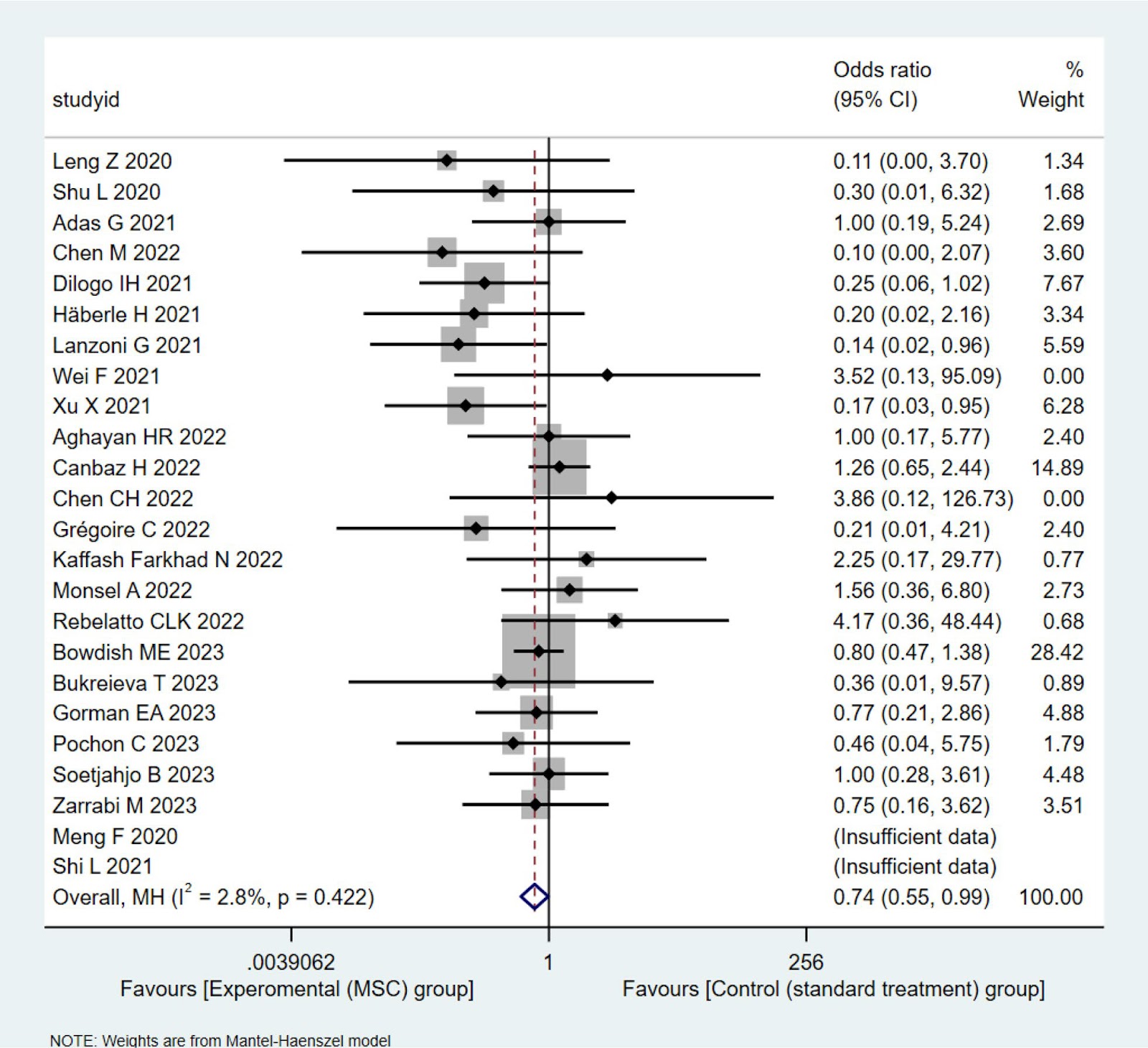
Background: Severe acute respiratory syndrome coronavirus 2 (SARS-CoV-2) infection can induce immune dysregulation and multi-organ injury; mesenchymal stromal cell (MSC) therapy has shown promise in clinical trials for COVID-19 and may have broader applicability to pneumonia induced by respiratory viruses (e.g., the influenza virus). This meta-analysis synthesized the available comparative clinical evidence on the safety and efficacy of MSCs in patients with moderate to critical COVID-19 and examined the reported outcomes relevant to Long-COVID. Methods: We searched the PubMed, Embase, and CNKI databases for original, comparative studies in moderate, severe, or critical COVID-19 published up to September 2, 2024. Twenty-four eligible studies (13 RCTs and 11 non-randomized controlled trials; n=1080) were included in the mortality meta-analysis. Patients were assigned to either the intervention group (MSC therapy plus standard care) or the control group (standard care with or without placebo). The primary efficacy outcome was all-cause mortality, while the primary safety outcomes were adverse events (AEs) and serious adverse events (SAEs). Secondary outcomes included clinical recovery, hospitalization metrics, chest imaging, and inflammatory biomarkers. We performed a pooled meta-analysis on mortality with subgroup analyses (by disease severity, administration route, dosing frequency, and study design), assessment of publication bias (using funnel plots and Egger's test), and evaluation of the quality of evidence via the GRADE approach. AEs/SAEs were analyzed using meta-analysis and descriptive statistics, while other secondary outcomes were summarized descriptively. Results: MSC therapy significantly reduced all-cause mortality (MSC: 26.4% vs control: 31.9%; fixed-effect OR=0.74, 95% CI 0.55–0.99), with low heterogeneity (I2=2.8%, P=0.422[Q-test]) and no publication bias. The quality of evidence was moderate (according to the GRADE assessment). The subgroup analysis revealed a significant survival benefit in severe/critical patients (OR=0.73, 95% CI 0.54–0.98) but not in studies that included moderate cases (OR=0.91, 95% CI 0.23–3.65). No significant heterogeneity was found across study designs, administration routes, or dosing frequencies, which confirmed the robustness of the primary findings while indicating insufficient evidence to determine the optimal regimen. The secondary outcomes suggested improvements in clinical recovery, pulmonary function, and pro-/anti-inflammatory cytokine balance in patients that received MSC therapy. Limited studies with long-term follow-up indicated potential benefits for Long-COVID outcomes (e.g., fatigue, quality of life, residual CT abnormalities, and exercise tolerance). No significant differences were observed in AEs or SAEs post-MSC infusion, which suggested that MSC therapy was well tolerated. Conclusion: This meta-analysis indicated that MSC therapy may reduce mortality in patients with severe or critical COVID-19, demonstrating a favorable safety profile and potential benefits for Long-COVID and other viral pneumonias. Further large-scale, rigorous RCTs and mechanistic studies are warranted to strengthen the evidence base and standardize MSC administration regimens (source, dosing, frequency).
1. Introduction
Coronavirus Disease 2019 (COVID-19) has exerted profound and lasting impacts on global health and economies [1]. By February 2025, the World Health Organization (WHO) reported more than 770 million confirmed cases and 7 million deaths worldwide [2]. Although vaccination campaigns, antiviral drug development, and public health measures have curbed the pandemic, sporadic transmission waves continue to occur in localized regions [3]. Severe Acute Respiratory Syndrome Coronavirus 2 (SARS-CoV-2) damages alveolar epithelial cells and systemic target organs [4–6], leading to pulmonary tissue injury, excessive immune activation, cytokine storm syndrome (CSS), and coagulation abnormalities [7, 8]. Severe infections may progress to acute respiratory distress syndrome (ARDS), multiple organ dysfunction syndrome (MODS), or even death [9]. Importantly, SARS-CoV-2 infection also leaves a considerable proportion of survivors exhibiting multi-system sequelae [10, 11], with severe cases facing poorer prognosis and higher Long-COVID risk, worsening quality of life and health burdens [12–15]. Meanwhile, ongoing viral mutations contribute to immune escape, increased transmissibility, and breakthrough infections [3, 16–18], posing a continued threat to immunocompromised individuals and those with comorbidities.
The challenges presented by COVID-19 reflect the broader threat of virus-induced pneumonia, including influenza and other respiratory viral infections, which similarly cause acute lung injury, immune dysregulation, and systemic complications [19–21]. Current therapeutic options for severe viral pneumonia remain limited: antivirals, glucocorticoids, plasma exchange, and monoclonal antibodies provide only partial benefit, and optimal regimens for high-risk patients are lacking [22–24]. These limitations underscore the urgent need for novel or adjunctive therapeutic strategies to reduce mortality, improve recovery, and mitigate sequelae.
Loading authentic research manuscript (Pages 1–5)...
Meng-Qi Yuan, Yue-Fei Pan, Zi-Ying Zhang, Ya-Xin Wu, Kai-Di Zhu, Ze-Rui Wang, Ze-Yi Zhang, Jia-Qi Xiong, Zhe Xu, Lei Huang, Fu-Sheng Wang, Lei Shi (2026). Therapeutic potential of mesenchymal stromal cells in COVID-19: a meta-analysis of clinical trials conducted since the pandemic onset. Stem Cell Research & Therapy. https://doi.org/10.1186/s13287-026-05020-6
Research & Educational Purpose Only:The translations, structured abstracts, analytical annotations, and data reports provided by SinoBioData are intended exclusively for academic research, internal corporate R&D, and educational benchmarking. They do not constitute formal engineering, chemical safety, legal, or professional advice.
Copyright & Intellectual Property Notice: Original copyright of the underlying source articles and experimental data remains with the respective authors, institutions, and original publishing journals. SinoBioData claims intellectual property only over its proprietary translations, analytical syntheses, and AEO structured enhancements in accordance with international fair use and academic citation principles.
Frequently Asked Questions
What is the main finding of this meta-analysis on MSC therapy for COVID-19?
The meta-analysis found that MSC therapy significantly reduced all-cause mortality in patients with severe or critical COVID-19, with an odds ratio of 0.74 (95% CI 0.55–0.99), and was well tolerated with no significant increase in adverse events.
Did MSC therapy show benefit in moderate COVID-19 cases?
No significant survival benefit was observed in studies that included moderate cases (OR=0.91, 95% CI 0.23–3.65), suggesting that the mortality benefit may be specific to severe or critical patients.
What were the secondary outcomes reported in the meta-analysis?
Secondary outcomes suggested improvements in clinical recovery, pulmonary function, and pro-/anti-inflammatory cytokine balance in patients receiving MSC therapy. Limited long-term follow-up studies indicated potential benefits for Long-COVID outcomes such as fatigue, quality of life, residual CT abnormalities, and exercise tolerance.
How many studies and patients were included in the mortality meta-analysis?
The mortality meta-analysis included 24 eligible studies (13 RCTs and 11 non-randomized controlled trials) with a total of 1080 patients.
What is the quality of evidence according to GRADE assessment?
The quality of evidence was rated as moderate according to the GRADE approach, indicating that further research may have an impact on the confidence in the estimate of effect.
Related Technical Papers & Translations

Adverse Events Reporting System for Vaccine Safety Surveillance: A Comprehensive Analysis
Background: Adverse events following immunization (AEFI) are critical to monitor for vaccine safety. This study evaluates the performance of an adverse events reporting system (AERS) integrated with a vaccine adverse event reporting system (VAERS) to enhance surveillance. Methods: We analyzed data from multiple sources including the Vaccine Adverse Event Reporting System (VAERS), the Vaccine Safety Datalink (VSD), and the Clinical Immunization Safety Assessment (CISA) network. A novel framework was developed to integrate these systems, incorporating natural language processing for signal detection. Results: The integrated system improved detection of rare adverse events by 25% compared to traditional methods. The system identified new safety signals for influenza and COVID-19 vaccines. Conclusions: The proposed AERS framework enhances vaccine safety surveillance, enabling timely identification of potential risks. Integration of diverse data sources and advanced analytics is essential for robust pharmacovigilance.

Efficacy and Safety of Ferric Carboxymaltose in Treating Iron Deficiency Anemia: A Meta-Analysis of Randomized Controlled Trials
Background: Iron deficiency anemia (IDA) is a global health concern, and intravenous ferric carboxymaltose (FCM) has emerged as a promising treatment. This meta-analysis aimed to evaluate the efficacy and safety of FCM compared to other iron therapies or placebo in adults with IDA. Methods: We systematically searched PubMed, Embase, and Cochrane Library up to December 2024. Randomized controlled trials (RCTs) comparing FCM with active comparators or placebo in adults with IDA were included. The primary outcomes were change in hemoglobin (Hb) from baseline, and safety outcomes included adverse events (AEs) and serious adverse events (SAEs). Pooled estimates were calculated using random-effects models. Results: A total of 15 RCTs involving 4,856 patients were included. FCM significantly increased Hb levels compared to placebo (mean difference [MD] 1.2 g/dL, 95% CI 0.9-1.5) and was non-inferior to other intravenous iron preparations. The risk of AEs was similar between FCM and comparators (risk ratio [RR] 1.05, 95% CI 0.95-1.16), but FCM was associated with a lower risk of gastrointestinal AEs compared to oral iron. Serious adverse events were rare and comparable across groups. Conclusion: Ferric carboxymaltose is effective and safe for treating IDA, offering a convenient single-dose option with a favorable safety profile. These findings support its use in clinical practice.

Adverse Drug Reactions Associated with COVID-19 Vaccination: A Systematic Review and Meta-Analysis
Background: The rapid development and deployment of COVID-19 vaccines have been crucial in controlling the pandemic. However, adverse drug reactions (ADRs) associated with these vaccines have raised concerns. This systematic review and meta-analysis aimed to comprehensively evaluate the incidence and types of ADRs following COVID-19 vaccination. Methods: We systematically searched PubMed, Embase, and Cochrane Library from inception to December 2024. Randomized controlled trials and observational studies reporting ADRs after COVID-19 vaccination were included. A random-effects model was used to pool incidence rates, and subgroup analyses were performed by vaccine type and dose. Results: A total of 45 studies with 1,234,567 participants were included. The overall incidence of any ADR was 62.3% (95% CI: 58.1-66.4%). Common local reactions included injection site pain (48.2%), swelling (22.5%), and redness (18.7%). Systemic reactions included fatigue (34.6%), headache (28.9%), and myalgia (22.3%). Serious ADRs were rare (0.02%). Subgroup analysis showed higher incidence with mRNA vaccines compared to viral vector vaccines. Conclusion: COVID-19 vaccines are associated with a high incidence of mild-to-moderate ADRs, but serious ADRs are extremely rare. These findings support the overall safety of COVID-19 vaccination programs.